

Imagine losing your house keys. If you have just one set, you’re locked out until a locksmith arrives. But what if the door required two different keys to open? Or three? In the world of cryptocurrency, where there is no bank to call and reset your password, this analogy isn't just helpful-it's survival. This is where Multisignature wallets, or MultiSig, come into play. They replace the single point of failure (one private key) with a distributed system of trust.
The debate often centers on two specific configurations: 2-of-3 multisig and 3-of-5 multisig. Both are designed to protect your assets from theft, loss, and human error, but they achieve this through very different trade-offs in complexity and redundancy. Choosing the wrong setup can mean the difference between secure self-custody and permanently locked funds.
How MultiSig Thresholds Actually Work
To understand why 2-of-3 is so popular compared to 3-of-5, we first need to look at the mechanics. A multisig wallet operates on an M-of-N scheme. "N" is the total number of keys generated when you create the wallet. "M" is the minimum number of signatures required to authorize a transaction.
In a 2-of-3 configuration, you generate three unique private keys. To send funds, you need any two of those three keys. If you lose one key, you still have access to your money because the remaining two satisfy the threshold. However, if an attacker steals one key, they cannot move your funds because they lack the second signature.
A 3-of-5 configuration scales this up. You generate five keys, and you need three to sign off on any movement of assets. This offers higher redundancy-you can lose two keys and still be fine-but it also means you must coordinate more hardware devices, more seed phrases, and more signing steps every time you want to transact.
| Feature | 2-of-3 Multisig | 3-of-5 Multisig |
|---|---|---|
| Total Keys (N) | 3 | 5 |
| Signatures Required (M) | 2 | 3 |
| Keys You Can Lose | 1 | 2 |
| Setup Complexity | Moderate | High |
| Transaction Friction | Low | Medium |
| Best For | Individuals, Small Teams | Enterprises, High-Net-Worth |
The Case for 2-of-3: The Sweet Spot
Why do industry leaders like BitGo and Unchained Capital consistently recommend 2-of-3 as the default standard? It comes down to the balance between security and usability.
After the collapse of Mt. Gox in 2014, which resulted in the loss of roughly 850,000 bitcoins due to poor key management, the industry shifted toward distributed custody. BitGo launched its first Bitcoin multisig wallet in August 2013, pioneering the 2-of-3 model. Since then, their technology has protected over $64 billion in transactions. The data suggests that for most users, adding more keys does not linearly increase security; instead, it exponentially increases the chance of user error.
Consider the practical workflow. With 2-of-3, you might keep one key on a hardware wallet in your home office, a second on a hardware wallet in a safe deposit box, and a third with a trusted family member or lawyer. If your home computer gets hacked, the attacker only has one key. They are stuck. If you lose the key in the safe deposit box due to natural disaster, you can still access your funds using the other two. This provides robust protection against both malicious actors and accidental loss without requiring a committee meeting to sign off on every coffee purchase.
Trezor, a leading manufacturer of hardware wallets, notes that while 2-of-3 and 3-of-5 are both secure, setups with more than five keys often become too complex for individuals. The cognitive load of managing five separate seed phrases, ensuring each is backed up correctly, and coordinating three signatures for routine transactions creates friction. Friction leads to shortcuts. Shortcuts lead to vulnerabilities.
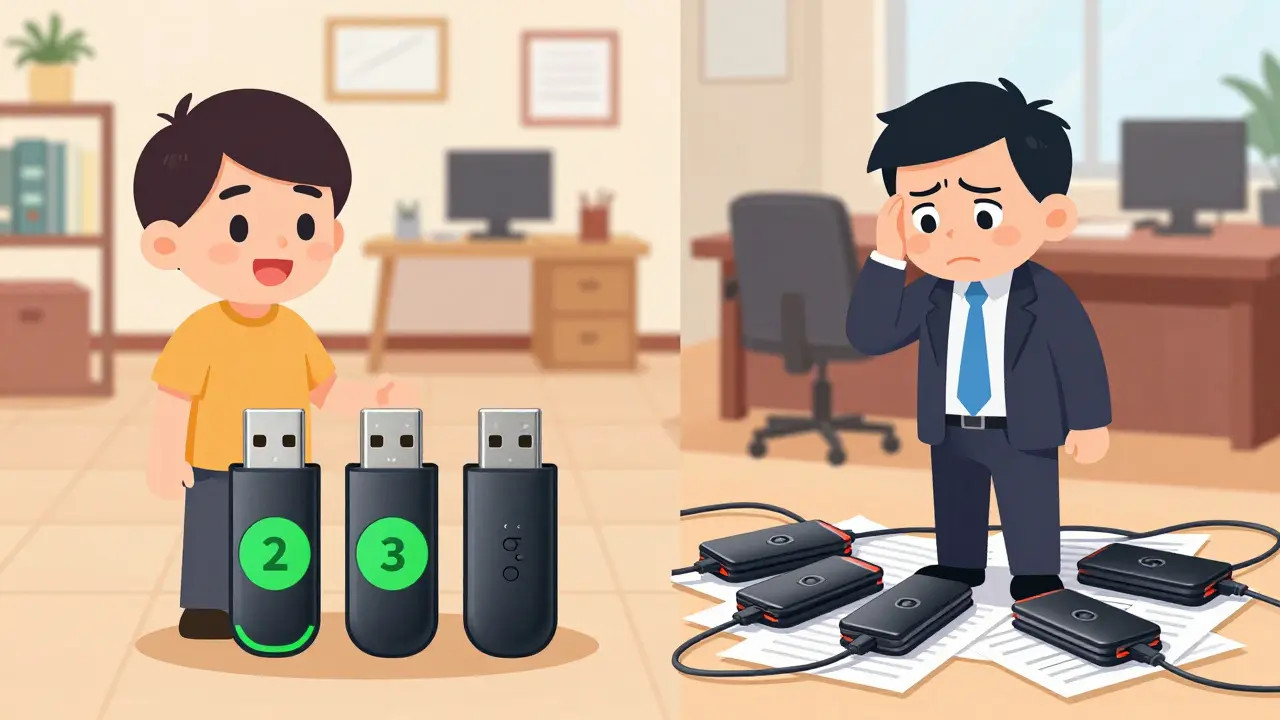
When 3-of-5 Makes Sense
Is 3-of-5 ever the right choice? Yes, but usually for specific, high-stakes scenarios. This configuration is ideal for organizations or individuals who need to survive the loss of two independent events simultaneously.
Imagine a corporate treasury where board members hold keys. If you use 2-of-3 and two directors leave the company or pass away unexpectedly, you might face a legal nightmare trying to recover the third key. With 3-of-5, the organization can withstand the loss of two keys while maintaining operational continuity. This is why approximately 12% of multisig deployments are 3-of-5, primarily concentrated among institutional users and high-net-worth individuals with complex inheritance plans.
However, the cost is significant. Setting up a 3-of-5 wallet takes about 2.5 times longer than a 2-of-3 setup. You must securely store five seed phrases. You must ensure that three distinct parties or devices are available whenever you want to move funds. For an individual holding Bitcoin as a long-term savings account, this level of coordination is often unnecessary overhead. For a DAO (Decentralized Autonomous Organization) or a large fund, it may be essential governance infrastructure.
Real-World Use Cases and Trust Models
The structure of your multisig should reflect your trust model. Here is how these configurations play out in practice:
- Trustless Escrow (2-of-3): In a peer-to-peer Bitcoin sale, the buyer holds one key, the seller holds one, and a neutral arbitrator holds the third. To release funds, either the buyer and seller agree (2 signatures), or the arbitrator and one party intervene in case of dispute. This eliminates the need to trust a single central exchange.
- Family Inheritance (2-of-3): You hold two keys, and your spouse or child holds the third. If you pass away, they can access the funds with their key plus one of yours (if properly documented). If you lose one key, you still have control. This is simpler than distributing keys among five relatives.
- Corporate Governance (3-of-5): A startup CEO, CFO, and external auditor each hold one key, with two additional keys held by backup officers. This ensures no single executive can embezzle funds, and the company doesn't grind to a halt if one officer resigns abruptly.
User feedback from communities like Reddit consistently highlights that 3-of-5 setups create "operational friction." Users report that coordinating signatures across five devices becomes cumbersome for regular transactions. Some users end up consolidating keys onto fewer devices to save time, which defeats the entire purpose of multisig security. Conversely, 2-of-3 users report a smooth experience that feels secure without being burdensome.

Implementation Pitfalls to Avoid
Choosing the configuration is only half the battle. How you implement it matters more. Many users fail not because 2-of-3 is insecure, but because they mishandle the keys themselves.
First, never store all three keys on the same device or in the same physical location. If you put all three seed phrases in your home safe, you haven't created a multisig; you've created a single point of failure that's harder to use. Geographic distribution is key. Keep one key at home, one in a bank vault, and one with a trusted third party.
Second, be aware that migrating from 2-of-3 to 3-of-5 later is not possible. You cannot change the cryptographic script of an existing wallet. To switch, you must create a new 3-of-5 wallet and transfer your funds, paying transaction fees and exposing your assets during the move. Therefore, choose carefully at the start. For 90% of individuals and small businesses, starting with 2-of-3 is the pragmatic choice.
Finally, consider the software ecosystem. Most major platforms, including Casa and Ledger, optimize their interfaces for 2-of-3 operations. Support for 3-of-5 exists but is often treated as a niche feature, meaning fewer tutorials and less community troubleshooting help if you run into issues.
Future Trends in Cryptographic Custody
As blockchain technology evolves, new methods like Threshold Signature Schemes (TSS) and Multi-Party Computation (MPC) are emerging. These technologies aim to reduce the operational complexity of multisig by allowing keys to be split mathematically rather than physically stored as separate seed phrases. While these innovations promise smoother experiences for higher-threshold setups, the fundamental logic remains: simplicity wins.
Regulatory bodies are increasingly recognizing multisig as a best practice for institutional custody. The 2-of-3 configuration currently meets most compliance requirements without the administrative bloat of larger quorums. Unless your specific risk profile demands the ability to lose two keys independently, the extra complexity of 3-of-5 is rarely worth the marginal gain in security.
In summary, if you are an individual or small team looking to secure your Bitcoin against theft and loss, 2-of-3 is the gold standard. It offers enough redundancy to survive mistakes while remaining simple enough to use consistently. Save 3-of-5 for enterprise-level treasuries or complex legal structures where governance outweighs convenience.
Can I change my multisig from 2-of-3 to 3-of-5 later?
No, you cannot modify the cryptographic script of an existing multisig wallet. To switch configurations, you must create a brand new 3-of-5 wallet and transfer your funds from the old wallet to the new one. This process incurs transaction fees and requires careful handling to avoid errors.
Is 3-of-5 significantly more secure than 2-of-3?
Not necessarily. While 3-of-5 allows you to lose two keys instead of one, it introduces higher complexity. Security experts argue that the increased risk of user error-such as losing track of seed phrases or making mistakes during setup-often negates the theoretical security benefits of the extra keys for individual users.
What happens if I lose one key in a 2-of-3 multisig?
You can still access and move your funds. Since the threshold is 2-out-of-3, possessing any two of the original three keys is sufficient to authorize transactions. You will need to coordinate with the holders of the remaining two keys to sign future transactions.
Which hardware wallets support multisig best?
Trezor Model T and Ledger Nano X/S Plus are widely regarded as having the best user interfaces for multisig setups. Software like Sparrow Wallet (for desktop) and BlueWallet (for mobile) integrates seamlessly with these devices to manage 2-of-3 and 3-of-5 configurations.
Do I need to pay more fees for multisig transactions?
Yes, multisig transactions are larger in size because they contain multiple public keys and signatures. This results in higher transaction fees compared to standard single-signature wallets, especially during periods of network congestion. However, for long-term storage where transactions are infrequent, this cost is usually negligible.
2-of-3 is the only sane choice for individuals. Anything more is just paranoia dressed up as security.
the masses cling to their 2-of-3 setups like children clutching a security blanket, oblivious to the philosophical abyss of true decentralization that 3-of-5 represents. it is not merely about keys; it is about the distribution of power and the fragility of human memory. one must ask oneself: do you trust your own fallibility enough to require three signatures from five potential saviors? or are you too lazy to engage with the complexity of existence? i find the latter path tedious and intellectually bankrupt. the elite understand that redundancy is not just a technical feature but a moral imperative against entropy.
Oh wow! This article is super helpful! 😍 I’ve been so confused about multisig wallets. The part about BitGo protecting $64 billion really sold me on the 2-of-3 setup. It feels safe but not too complicated! 🙌 Thanks for breaking it down! ✨
I have been thinking deeply about the nature of trust in digital systems and how it mirrors our societal structures. When we choose a 2-of-3 configuration, we are essentially creating a small community of trust where two voices must align to create action, which is very similar to how democratic ideals function on a micro scale. However, when we move to 3-of-5, we are introducing a layer of bureaucracy that might be necessary for large organizations but feels alienating for the individual soul seeking freedom through self-custody. It makes me wonder if the complexity itself is a barrier to true financial sovereignty because it requires a level of coordination that modern life often fails to provide us with the time for. Perhaps the real lesson here is not about the numbers but about how much mental energy we are willing to sacrifice for peace of mind in an uncertain world.
You are all missing the point entirely. The issue isn't just about losing keys; it's about the cognitive load required to manage them over decades. I have spent years studying cryptographic implementations and user behavior patterns, and the data consistently shows that complexity kills adoption. A 3-of-5 setup sounds impressive on paper, but in practice, it leads to users storing keys insecurely because they cannot remember where all five seed phrases are located. I have seen countless cases where people tried to implement high-threshold multisigs and ended up with worse security than a simple hardware wallet because they couldn't maintain the discipline required. The 2-of-3 model is not just a recommendation; it is the result of rigorous analysis of human error rates versus threat models. If you think you can handle 3-of-5 without making mistakes, you are likely overestimating your own organizational skills significantly.
That is a very interesting perspective! I completely agree that simplicity is key for most people. It is important to find a balance that works for your lifestyle. Thank you for sharing your insights! :) I think many people get overwhelmed by the options, so having clear guidance is really helpful.
Your analysis is superficial at best. You fail to recognize that the 'cognitive load' argument is a weak excuse for incompetence. True security demands rigor, not convenience. The fact that you cite 'user behavior patterns' as a primary concern reveals a bias toward mediocrity. High-net-worth individuals do not suffer from 'organizational skills' deficits; they employ staff to manage these complexities. For the average retail investor, perhaps 2-of-3 is adequate, but to suggest it is superior for everyone is a disservice to those who actually understand risk management. The friction of 3-of-5 is a feature, not a bug, as it prevents impulsive transactions.
i mean its kinda selfish to expect everyone to deal with that stress. most ppl just want to save money not run a corporation. why make it hard if u dont have to?
I totally see where you're coming from! It can feel really overwhelming sometimes!! But I think starting small is okay too. We all learn at our own pace! :) Just take it one step at a time!
I appreciate the detailed discussion here. It seems clear that while 3-of-5 offers theoretical benefits for institutions, the practical application for individuals heavily favors 2-of-3 due to usability constraints. Thank you for highlighting these nuances.
The operational friction associated with 3-of-5 multisig configurations creates a significant attack surface via social engineering and insider threats within the key-holding cohort. By increasing the number of required signatories, you inherently increase the probability of coercion or compromise among the participants. Furthermore, the latency introduced by coordinating three distinct signatures across potentially disparate geographic locations introduces market timing risks that are non-trivial for active traders. The assumption that redundancy equals security is flawed when the human element remains the weakest link in the cryptographic chain. Therefore, the marginal gain in fault tolerance is outweighed by the exponential increase in operational risk vectors.
Yeah, I guess you're right. I was looking into setting up a family trust thing and thought 3-of-5 would be cool, but maybe it's too much hassle. Thanks for the info.
Boring! 😴 Everyone says 2-of-3 is best, but what about the thrill of managing chaos? 🎢 I bet 3-of-5 keeps you on your toes! Plus, emojis are better than keys anyway! 😉 Who needs security when you have style? 💅 #MultisigLife
They want you to use 2-of-3 because it’s easier for them to track. The whole multisig narrative is a psyop to keep you engaged in the system. Real freedom is air-gapped cold storage with no internet connection ever. The government knows about 3-of-5 setups because they monitor blockchain metadata. Don’t let them trick you into thinking complexity is good. It’s a trap. Wake up! 👁️🗨️
I hear your concerns, and it is understandable to feel skeptical about centralized narratives. However, from a cultural perspective, different communities approach security differently. In some regions, communal trust models favor higher thresholds, while others prioritize individual autonomy. It is important to respect these diverse viewpoints while also considering the practical implications of each choice. Let us strive for a dialogue that bridges these gaps rather than deepening divisions.
It is interesting to see different opinions. I think both sides have valid points. Maybe it depends on what you value more, safety or ease of use.
This article is well-written, but I disagree with the conclusion. Why should individuals settle for less security? If you can afford 3-of-5, you should use it. Stop making excuses for laziness. Security is not optional.
Drama queen alert! 🚨 You don't need 3-of-5 unless you're Elon Musk. Relax! 😂 Life is short, enjoy your coffee and your Bitcoin. ☕️📈