

The world of cryptocurrency enforcement changed drastically between 2024 and 2025. It is no longer just about vague warnings or slow-moving legislation. Governments and regulators are now actively tracking, freezing, and fining bad actors with a precision that would have seemed impossible just a few years ago. If you are wondering whether the "wild west" era of crypto is truly over, the numbers say yes-but with some important caveats.
While the total volume of illicit crypto activity has actually dropped in specific categories like fraud, the sophistication of attacks remains high. Regulators are shifting their focus from punishing individual scams to enforcing systemic compliance through frameworks like the Travel Rule. This article breaks down the real numbers behind global crypto enforcement in 2024 and 2025, looking at where the money went, which blockchains were targeted, and how the penalties compare to traditional finance.
How Much Illicit Crypto Activity Happened?
When we talk about "crypto crime," the definition matters immensely. Two major firms, TRM Labs and Chainalysis, released conflicting but complementary reports for 2024. These discrepancies aren't errors; they reflect different methods of counting.
TRM Labs focuses specifically on funds sent to fraud addresses. According to their 2025 Crypto Crime Report, published in January 2025, illicit crypto activity related to fraud amounted to $10.7 billion in 2024. This represents a significant 40% decrease from 2023. The trend shows a clear downward trajectory from the peak year of 2022, suggesting that enforcement efforts against direct consumer fraud are working.
In contrast, Chainalysis uses a broader metric. Their 2025 Crypto Crime Report, released in February 2025, stated that $40.9 billion was received by illicit cryptocurrency addresses in 2024. This figure includes darknet markets, ransomware payments, and sanctions evasion, not just fraud. Chainalysis also notes that these figures typically grow by about 25% between annual reports as investigators identify more hidden illicit addresses. For example, the 2023 figure initially reported as $24.2 billion later grew to $46.1 billion within a year.
| Source | Methodology Focus | Reported Volume (2024) | Trend vs Previous Year |
|---|---|---|---|
| TRM Labs | Fraud-specific funds sent | $10.7 Billion | -40% (Decrease) |
| Chainalysis | All illicit addresses (broad) | $40.9 Billion | Stable/Slight Increase* |
*Note: Chainalysis figures often adjust upward retrospectively. The raw 2024 data suggests stability compared to the adjusted 2023 numbers.
Despite the drop in fraud, theft remains a persistent threat. The Kroll Cyber Threat Intelligence team reported that nearly $1.93 billion was stolen in crypto-related crimes during the first half of 2025 alone. This highlights a crucial distinction: while scammers are sending less money to fraudulent schemes, hackers and sophisticated thieves are still making off with billions.
Which Blockchains Host the Most Crime?
Criminals are not randomly choosing networks. They prefer platforms with low transaction fees, fast settlement times, and popular stablecoins. In 2024, the distribution of illicit volume across blockchains revealed clear preferences:
- TRON: Hosted 58% of global illicit crypto volume.
- Ethereum: Accounted for 24%.
- Bitcoin: Made up 12%.
- Binance Smart Chain & Polygon: Each held about 3%.
TRON’s dominance is largely due to its widespread use of USDT (Tether), a stablecoin favored for moving large sums without price volatility. However, 2024 marked a turning point for TRON. The network saw a dramatic decline in illicit volume, dropping by $6 billion. This wasn't accidental. In August 2024, the T3 Financial Crime Unit (T3 FCU) was formed. This public-private partnership between TRON, Tether, and TRM Labs enabled the freezing of over $130 million in illicit proceeds.
The impact was immediate. Approximately 20% of blocklisted USDT on TRON was reissued directly to victims and government accounts. This model proves that when blockchain protocols cooperate with law enforcement, they can effectively disrupt criminal flows. About 49% of TRON's remaining illicit volume was linked to sanctioned entities, showing that despite the crackdowns, the network remains a target for those trying to bypass international sanctions.

Global Regulatory Compliance: Paper vs. Practice
Having laws on paper is one thing; enforcing them is another. The gap between regulatory intent and actual implementation remains wide. The Financial Action Task Force (FATF) is the global standard-setter for anti-money laundering (AML) rules. In March 2024, FATF assessed 58 jurisdictions with materially important virtual asset sectors.
On the surface, the numbers look good: 91% of these jurisdictions had enacted or were implementing an AML/CFT registration regime, and 84% claimed to have implemented the Travel Rule. The Travel Rule requires exchanges to share sender and receiver information for transactions above a certain threshold, similar to wire transfers in traditional banking.
However, the reality is less optimistic. PwC’s Global Crypto Regulation Report 2025 found that 75% of surveyed jurisdictions remain only partially compliant or non-compliant with FATF requirements. Nearly 30% still fail to implement the Travel Rule effectively. This creates "jurisdictional arbitrage," where criminals move funds to countries with weak enforcement to launder money before it re-enters stricter markets.
TRM Labs’ Global Crypto Policy Review noted that while over 60% of the 24 key jurisdictions analyzed introduced new policies in 2024, the subsequent FATF Targeted Report highlighted significant gaps in implementation. The contradiction is clear: most countries have the rules, but few have the technical infrastructure or political will to enforce them consistently.
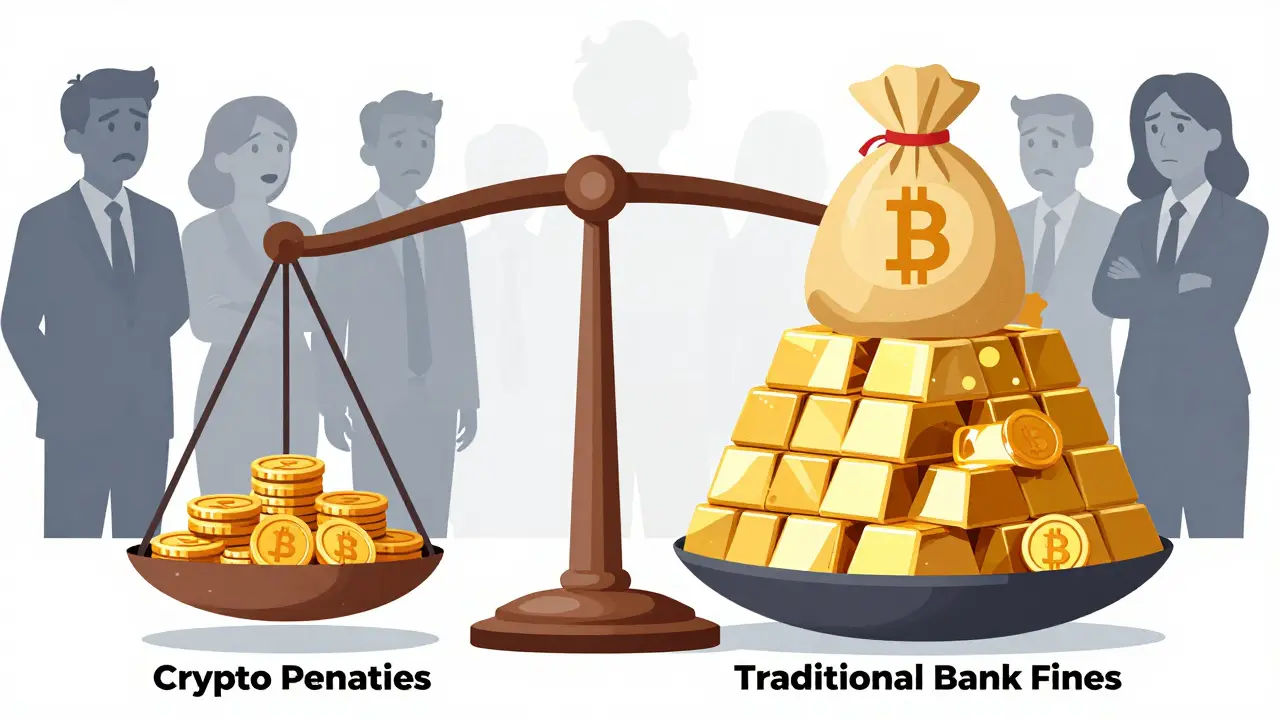
Penalties: Crypto vs. Traditional Finance
If you think crypto is being unfairly targeted by regulators, the data might surprise you. The Coincub Crypto Asset Risk Report 2025 provides a stark comparison between the two industries.
Between 2020 and early 2025, the crypto industry faced aggregate penalties totaling $13.5 billion. This includes formal sanctions, fines, and costs associated with significant security incidents. While this sounds like a lot, it pales in comparison to traditional finance. Institutions like Bank of America and JPMorgan Chase have collectively faced penalties exceeding $97 billion. The broader financial services sector has incurred over $300 billion in fines, primarily for mortgage abuses, sanctions breaches, and systemic scandals.
The nature of enforcement also differs. In crypto, 72% of enforcement records involve regulatory compliance actions rather than massive monetary fines for systemic fraud. Regulators are currently focused on building the framework and ensuring companies follow KYC (Know Your Customer) and AML rules. In traditional finance, penalties are often retrospective punishments for decades of misconduct. This suggests that crypto enforcement is still in its "rule-setting" phase, whereas traditional finance is in its "punishment" phase.
Key Enforcement Trends for 2025
As we move deeper into 2025, several trends are shaping the enforcement landscape:
- Focus on Stablecoins and DeFi: With 68% of regulatory bodies planning specific guidance for stablecoins and decentralized finance (DeFi) by Q3 2025, expect tighter scrutiny on protocols that facilitate anonymous swaps or lending.
- Cross-Border Cooperation: Norton Rose Fulbright predicts that international enforcement cooperation will be pivotal in 2025. Agencies are developing better mechanisms for cross-border asset recovery, reducing the ability of criminals to hide assets in offshore havens.
- Market Manipulation Crackdowns: The U.S. Department of Justice has intensified its focus on market manipulation. In October 2024, the District of Massachusetts charged 17 individuals with using bots for wash trading alt and meme coins. This signals that regulators are watching not just who owns the coins, but how they trade them.
- Growing User Base Risks: The global crypto user base is estimated at 560-659 million as of 2024, projected to surpass 950 million by the end of 2025. More users mean more targets for social engineering attacks and phishing, even if direct blockchain fraud decreases.
The effectiveness of initiatives like the T3 FCU shows that public-private partnerships can reduce platform-specific illicit activity by up to 50% within 6-12 months. This model is likely to be replicated across other major chains in 2025 and beyond.
Did crypto crime increase or decrease in 2024?
It depends on how you measure it. Fraud-specific activity decreased by 40% according to TRM Labs, dropping to $10.7 billion. However, broad illicit activity including ransomware and darknet markets remained high at $40.9 billion according to Chainalysis. Theft volumes also remained significant, with $1.93 billion stolen in the first half of 2025 alone.
Which blockchain has the most illicit activity?
In 2024, TRON hosted 58% of global illicit crypto volume, followed by Ethereum at 24% and Bitcoin at 12%. TRON's high volume is largely due to the use of USDT stablecoins for moving funds cheaply and quickly. However, enforcement efforts like the T3 FCU significantly reduced illicit flows on TRON in late 2024.
Are crypto fines higher than traditional bank fines?
No. Between 2020 and early 2025, crypto industry penalties totaled $13.5 billion. In contrast, major banks like JPMorgan and Bank of America have faced over $97 billion in collective penalties, with the broader financial sector facing over $300 billion. Crypto enforcement is currently focused more on compliance frameworks than massive punitive fines.
What is the Travel Rule in crypto?
The Travel Rule is a FATF requirement that mandates Virtual Asset Service Providers (VASPs) to share originator and beneficiary information for transactions above a certain threshold. Despite 84% of jurisdictions claiming implementation, PwC reports that nearly 30% still fail to enforce it effectively, creating loopholes for money laundering.
How effective are public-private partnerships in stopping crypto crime?
They are highly effective. The T3 Financial Crime Unit, a partnership between TRON, Tether, and TRM Labs, froze over $130 million in illicit proceeds in 2024. Such initiatives can reduce platform-specific illicit activity by up to 50% within 6-12 months by enabling real-time identification and freezing of suspicious wallets.
the whole notion that regulation equals safety is a quaint delusion held by those who have never actually lost money to a rugpull. the data shows fraud dropped, sure, but only because the scammers got smarter and moved to chains with less oversight. it's not that they stopped, it's that they evolved into something more insidious. we are watching the birth of a digital panopticon where every transaction is tracked, yet somehow, the 'bad actors' still manage to siphon billions. it is ironic really, how much effort goes into policing the little guy while the systemic rot in traditional finance remains untouched. the $13.5 billion in crypto fines is a drop in the ocean compared to the trillions laundered through shell companies in the old world. this isn't progress, it's just a change in scenery for the same old power dynamics.
Oh my gosh, can we talk about TRON for a second? 🤯 Like, seriously, 58% of illicit volume? That is wild. I always thought Bitcoin was the go-to for criminals because of the movies, but nope, it’s all about USDT on TRON now. It makes so much sense when you think about it though, low fees and fast settlement. But also, the fact that T3 FCU froze $130 million is kinda amazing? 😱 It feels like we are finally seeing some real action instead of just talk. Does this mean my stablecoins are safer now? Asking for a friend who is definitely not me. 💸📉
When one considers the broader philosophical implications of these statistics, it becomes apparent that the definition of crime itself is shifting in ways that challenge our understanding of justice in the digital age. The discrepancy between TRM Labs and Chainalysis reports is not merely a statistical anomaly but rather a reflection of the subjective nature of what constitutes 'illicit' activity within a decentralized framework. One might argue that the decrease in fraud-specific funds sent indicates a maturation of the ecosystem, yet the persistent high volumes of theft suggest that the underlying vulnerabilities remain unaddressed. It is a complex tapestry of human behavior woven into the blockchain, where the threads of greed and innovation are indistinguishable to the naked eye. We must ask ourselves if the tools we are using to measure this activity are truly capturing the essence of the phenomenon or if we are merely counting shadows on the wall of the cave.
I find it deeply concerning that despite the vast improvements in tracking technology, there is still such a significant gap between regulatory intent and actual implementation across different jurisdictions. It seems that while some nations are diligently working towards compliance with FATF requirements, others continue to serve as havens for those seeking to evade international sanctions. This disparity creates an uneven playing field that ultimately harms the integrity of the global financial system and undermines the efforts of law enforcement agencies worldwide. Perhaps we need a more unified approach that encourages cooperation rather than competition among countries, ensuring that no single jurisdiction can be exploited for malicious purposes without facing immediate consequences from the international community at large.
Surely you jest. 😂 The idea that 'public-private partnerships' are the silver bullet for crypto crime is laughable. T3 FCU froze $130 million? Cute. Meanwhile, the big banks are laughing all the way to the bank with their $97 billion in penalties which they treat as a cost of doing business. It’s adorable how regulators pretend they’re cracking down on crypto while letting Wall Street walk free. The Travel Rule is a joke too, with 30% of jurisdictions failing to implement it. Enjoy your 'safe' transactions while the elites play chess with your savings. 🙄💼
they say the wild west is over but i see only the beginning of the end for privacy. the government wants to know where every penny goes and they will use any excuse to get that power. the travel rule is just another chain around our ankles. do not trust these numbers because they are designed to make you feel safe so you keep giving them your money. the real criminals are the ones writing the rules. stay woke and keep your coins off chain if you value your freedom at all :)
typo alert: its 'ilicit' not 'illicit'. anyway, the point is clear. bad people steal money. good people pay taxes. why are we surprised? the system works exactly as intended. stop complaining and buy gold.
Listen up folks. You think you're smart using DeFi? Nah. The bots are already ahead of you. Wash trading is rampant and the DOJ knows it. If you're holding meme coins, you're basically donating to someone else's yacht fund. Wake up. The game is rigged. 🎰🚫
hey everyone! just wanted to say that even though the news sounds scary, its actually pretty cool that we are learning more about how to protect ourselves. the drop in fraud is a win right? lets keep pushing for better security and education. we got this! ✨💪
It is truly heartbreaking to see how fear is being used to justify increased surveillance. While I understand the desire for safety, we must not lose sight of the fundamental rights that come with financial autonomy. The dramatic rise in enforcement actions feels less like protection and more like control. Let us remember that behind every statistic is a person trying to navigate a complex world. We need empathy, not just algorithms. Please, let's discuss this with kindness and open hearts. ❤️🕊️
i guess thats it then. not much to add. just watch your wallets.
The sheer audacity of TRON hosting nearly 60% of illicit volume is staggering! It’s like watching a house of cards built on quicksand. And yet, here we are, discussing it as if it’s normal. The fact that Ethereum and Bitcoin trail behind doesn’t absolve them; it just means the criminals found a loophole elsewhere. We are witnessing the death of anonymity in real-time, and it’s glorious. Long live the ledger! 📜🔥
i think its important to note that not all crime is equal. some people are just trying to survive in a broken system. we shouldnt judge them too harshly. maybe if we were kinder to each other, there would be less stealing. just a thought. hope you have a nice day.
One cannot help but observe the profound lack of intellectual rigor in the prevailing discourse surrounding cryptocurrency enforcement. The conflation of 'fraud' with 'theft' reveals a fundamental misunderstanding of the mechanisms at play. Furthermore, the reliance on retrospective adjustments by firms like Chainalysis undermines the credibility of their metrics. It is imperative that we demand higher standards of transparency and accountability from these self-appointed arbiters of truth. Until then, any discussion based on these figures is nothing short of speculative fiction masquerading as analysis.
This article is a masterclass in obfuscation. They want you to believe that a 40% drop in fraud is a victory, but they conveniently ignore the context. Who defines 'fraud'? Is it the scammer or the victim? The narrative is controlled by the very entities profiting from the chaos. Stop buying the hype. Look at the raw data. The system is rigged against you.
wait, so if TRON is freezing funds, does that mean they are acting as a bank? that seems like a huge conflict of interest. i’m curious how they decide which wallets to freeze. is it automated or manual? feels like a slippery slope. anyone else worried about false positives?
It is quite evident that the average reader lacks the sophistication to comprehend the nuanced interplay between regulatory frameworks and market dynamics. The assertion that crypto enforcement is 'fair' is absurd when juxtaposed with the leniency shown to traditional financial institutions. However, one must acknowledge that the current trajectory suggests a inevitable convergence of crypto and fiat systems, rendering the distinction moot. Those who cling to the ideology of decentralization are merely delaying the inevitable. Acceptance of regulated structures is not capitulation; it is maturity.
look, i’ve been in crypto since 2013. i’ve seen it all. the bans, the hacks, the rugs. this is nothing new. the only thing that changes is the tech. the people stay the same. greedy idiots getting greedy. don’t expect anything to change. just HODL and pray.
Can we just take a moment to appreciate the sheer scale of this? Billions of dollars moving around in seconds, tracked by satellites and AI. It’s like living in a sci-fi movie. The drama of it all is just... breathtaking. Are we heroes or villains? Who knows. But the show must go on. 🌟🎭
You guys are missing the point entirely. It’s not about the money. It’s about control. The fact that 17 people were charged for wash trading shows they are watching EVERYTHING. Your private keys aren’t private anymore. They are building a profile on you. Every swap, every trade. It’s creepy. And you’re cheering for it? 🤡👀
In light of the aforementioned developments, it is pertinent to consider the long-term implications for cross-border transactions. The harmonization of regulatory standards, albeit slow, represents a significant step towards global financial stability. One must recognize that the initial resistance to such measures often stems from a misunderstanding of their purpose. By fostering an environment of transparency, we can mitigate risks and promote sustainable growth. Therefore, collaboration between stakeholders is essential for the continued evolution of the digital asset landscape.
Let’s cut the crap. The fines are peanuts to the banks. For crypto, it’s a slap on the wrist. But hey, at least they’re trying. Or are they? Maybe it’s all a distraction. Who cares. Just buy low sell high. Easy peasy. 🍋
As a seasoned analyst, I find the juxtaposition of TRM Labs’ narrow focus versus Chainalysis’ broad scope to be intellectually stimulating yet practically confusing. The term 'illicit' is fraught with ambiguity. Is ransomware payment 'crime' or 'business expense' for the attacker? The regulatory bodies are flailing. They need a unified taxonomy before they can claim victory. Until then, we are shouting into the void. :)
OMG!!! Did you see the part about the bots?! 😱😱😱 Seventeen people arrested! That is insane! My neighbor probably did that! He’s always staring at his screens! I’m so scared now! What if my wallet gets frozen next?! 🛑🚨 This is the end times! I’m moving my money to gold bars buried in the backyard! Stay safe everyone!! 💀💀💀