
Ethereum Transaction Fee Estimator
Ethereum transaction fees vary based on network congestion. This tool estimates your gas fees based on current conditions.
Estimated Transaction Details
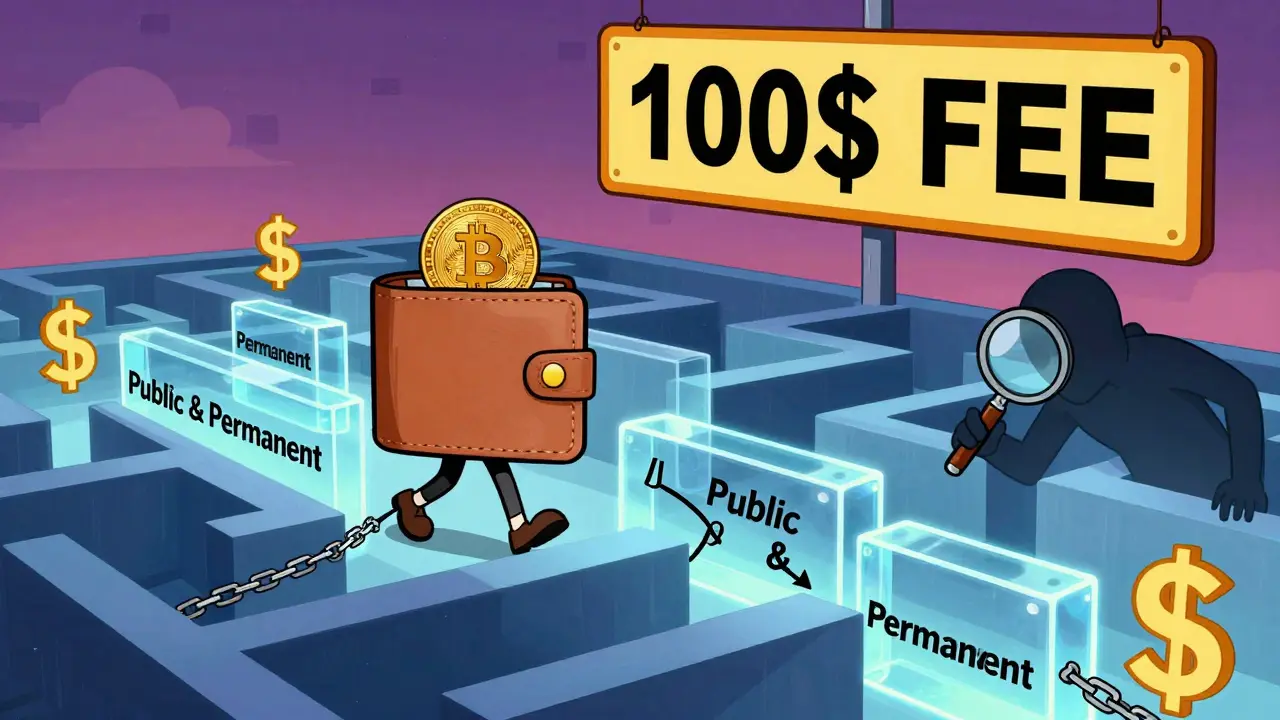
Transaction fees depend on network demand. During high congestion (like NFT drops), fees can jump from $1 to $100. Layer 2 solutions like Arbitrum or Polygon can reduce costs significantly.
Learn about Layer 2 solutionsLayer 2 solutions handle transactions off-chain and only settle results on Ethereum. This reduces fees by 90-95% and speeds up transactions. Popular options include Polygon, Optimism, and Arbitrum.
Public blockchains are the backbone of Bitcoin and Ethereum - the systems that let people send money, sign contracts, and trade assets without banks or middlemen. But they’re not perfect. If you’ve ever waited 20 minutes for a Bitcoin transaction to confirm or paid $50 in fees to swap tokens on Ethereum, you’ve felt the downside. On the flip side, if you’ve sent crypto to someone in another country without a bank account, or seen a government try to shut down a decentralized app and fail, you’ve seen the power. Public blockchains give you freedom - but at a cost.
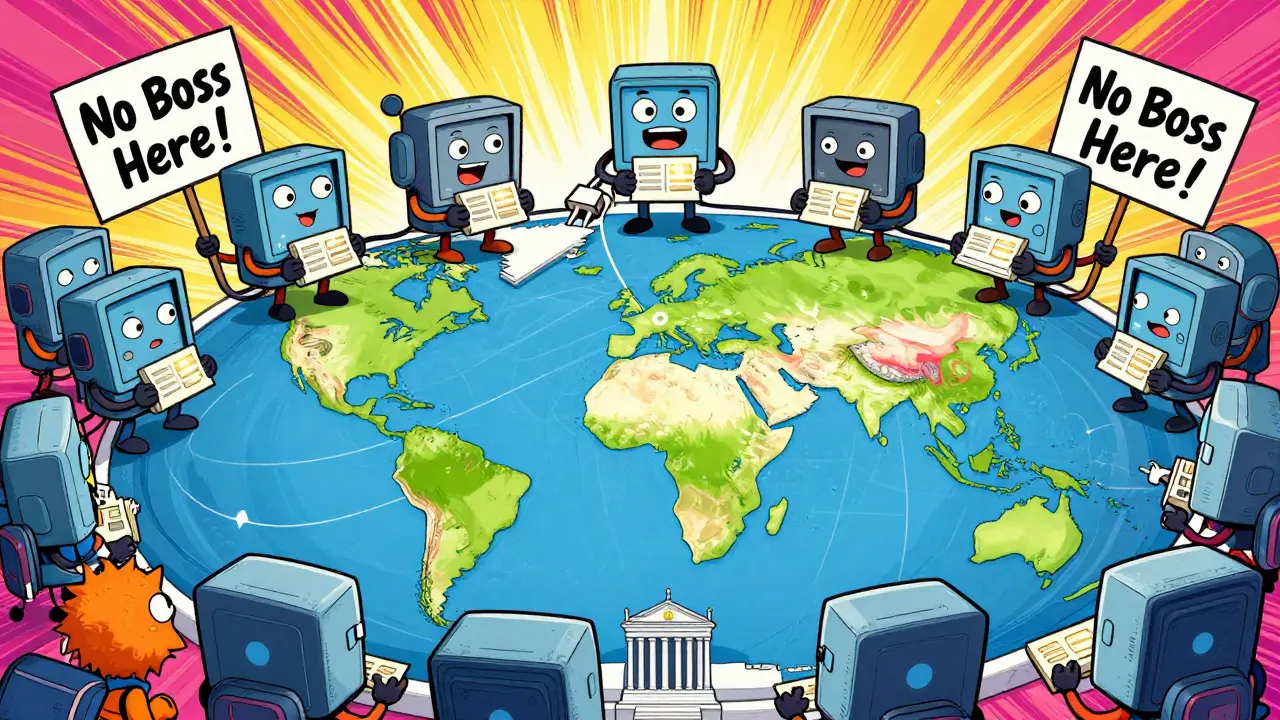
Decentralization: No Boss, No Single Point of Failure
What makes public blockchains different from your bank’s system? No one owns them. There’s no CEO, no headquarters, no central server you can shut down. Thousands of computers around the world - run by strangers - all keep a copy of the same ledger. If one goes offline, the network keeps going. If someone tries to cheat, the others spot it and ignore the fake transaction.
This is why Bitcoin still works after 15 years, even though governments have tried to ban it and hackers have targeted exchanges. The network itself can’t be taken down. That’s the core advantage: decentralization. It means censorship resistance. If you’re in a country with capital controls, or if you’re a journalist being silenced, public blockchains let you move value without asking permission.
Transparency: Everything Is Public - Even Your Wallet
Every transaction on a public blockchain is visible to anyone. You can go to a block explorer right now and see every Bitcoin ever sent - who sent it, who received it, how much, and when. No hidden ledgers. No secret accounts.
This openness builds trust. You don’t need to believe a company’s claim that they’re solvent - you can check the blockchain yourself. That’s why charities use public blockchains to prove donations reached their destination. It’s also why auditors love it: every step is recorded and can’t be erased.
But here’s the catch: your identity isn’t hidden. Even if you use a pseudonym, patterns in your transactions can be traced. If you ever buy Bitcoin from an exchange that requires ID, your real name is linked to that wallet. Governments and forensic firms use this to track criminals - but they can also track activists, journalists, or anyone they want to monitor.
Immutability: Once It’s On the Chain, It’s There Forever
Once a transaction is confirmed on a public blockchain, it’s nearly impossible to change. That’s a huge win for record-keeping. Imagine a land registry where no one can alter ownership records. Or a medical record system where no hospital can delete your history. Public blockchains make that possible.
This feature stopped fraud in early crypto exchanges. When someone tried to double-spend Bitcoin, the network rejected it because the original transaction was already recorded. No chargebacks. No disputes. No lawyers.
But immutability isn’t always good. If you send crypto to the wrong address - and you didn’t make a typo - there’s no way to undo it. No customer service line. No refund. You lose it forever. That’s why people say: “Not your keys, not your crypto.” But even if you hold your own keys, you’re still stuck with your mistakes.
Security: Built on Math, Not Trust
Public blockchains don’t rely on trust. They rely on cryptography and economics. To hack Bitcoin, you’d need to control more than half the computing power on the entire network - a feat that would cost billions and still might fail. That’s why Bitcoin has never been hacked - only wallets and exchanges have been broken into.
The security comes from the number of participants. More miners or validators = harder to attack. Ethereum, after switching to Proof of Stake, now has over 1 million validators. That’s more than any bank’s internal security team. It’s not perfect - smart contract bugs still get exploited - but the core network is extremely resilient.
Still, this security isn’t free. It requires massive energy or locked-up capital. And if the price of crypto drops too low, miners or stakers may leave, weakening the network. That’s a hidden risk.
Scalability: Slow When Everyone Uses It
Here’s where public blockchains struggle. Bitcoin can handle about 7 transactions per second. Ethereum, before its upgrade, managed around 15. Visa processes 24,000 per second. That’s not a bug - it’s by design. Every node must verify every transaction. The more people use it, the slower it gets.
During the 2021 DeFi boom, Ethereum fees spiked to over $100 per transaction. People couldn’t afford to swap tokens. NFTs couldn’t mint. Users left. This isn’t theoretical - it’s happened repeatedly. Public blockchains are like highways: great when empty, a parking lot when crowded.
Layer 2 solutions like the Lightning Network for Bitcoin and Optimism for Ethereum help. They handle transactions off-chain and only settle the final result on the main chain. But they add complexity. Not every app can use them. And they don’t solve everything - just make it bearable.
Energy Use: The Environmental Cost of Freedom
Before 2022, Bitcoin used more electricity than Argentina. Mining rigs ran 24/7, burning fossil fuels to solve math puzzles. Critics called it wasteful. Supporters said it was the price of security.
Ethereum changed that. In September 2022, it switched from Proof of Work to Proof of Stake. Energy use dropped by 99.95%. No more mining rigs. Validators just need to lock up ETH and stay online. The environmental impact is now tiny - less than a single data center.
But Bitcoin still uses Proof of Work. And while some miners now use renewable energy, the system still consumes massive amounts of power. If you care about climate change, you need to ask: is the trade-off worth it? For some, yes. For others, no.
Governance: Who Decides What’s Next?
Who gets to upgrade the software? No one. That’s the problem. In a public blockchain, changes require consensus - and consensus is messy.
In 2017, Bitcoin developers wanted to increase the block size to handle more transactions. A large group of users and miners disagreed. The result? A split. Bitcoin Cash was born. Same blockchain, different rules. Two coins. Two communities. Two philosophies.
Ethereum had its own fork in 2016 after the DAO hack. The community decided to roll back the blockchain and steal back stolen funds. Critics called it a betrayal of immutability. Supporters called it justice. The result? Ethereum Classic, a version of Ethereum that never changed.
These splits show a deeper truth: public blockchains can’t easily adapt. They’re governed by social pressure, not votes or boards. That’s powerful - but also unpredictable. If you’re building a business on a public chain, you’re betting on a community’s mood.

Privacy: You’re an Open Book
Public blockchains are transparent - which is great for accountability, terrible for privacy. Your transaction history is public. Your wallet balance is public. Your spending habits are visible to anyone with a block explorer.
That’s why banks don’t use them. Why hospitals don’t store patient records on them. Why governments worry about surveillance. Even if you use a new wallet for every transaction, analytics firms can link them together using patterns - like when you send small amounts to mixers or use the same exchange.
Some chains like Zcash or Monero offer privacy by default. But they’re not as widely adopted. And even those have weaknesses. For most public blockchains, privacy is an afterthought - not a feature.
Who Should Use Public Blockchains?
Public blockchains aren’t for everyone. Here’s who they work for:
- Cryptocurrency users who want to own their money without banks.
- Developers building DeFi apps, NFTs, or DAOs that need open access.
- Activists and journalists in censored regions who need censorship-resistant payments.
- Nonprofits that want to prove donations were delivered.
They’re not for:
- Enterprises needing fast, low-cost internal systems - they use private blockchains.
- Healthcare providers storing patient data - too public, too slow.
- High-frequency traders - fees and speed make it impractical.
The Future: Layer 2s, Hybrid Models, and Real-World Use
Public blockchains aren’t going away. But they’re evolving. Layer 2 networks are already handling millions of transactions daily at a fraction of the cost. Ethereum’s main chain is now more like a settlement layer - secure, slow, and final. The real action is happening on top.
Hybrid models are emerging too. Companies like Walmart and Maersk use private blockchains for internal tracking - but anchor key events (like a shipment’s arrival) to Ethereum for public verification. That gives them speed and trust in one system.
Public blockchains will likely become the foundation for digital identity, supply chain proof, and voting systems - not because they’re fast, but because they’re unstoppable. And that’s worth something.
Are public blockchains safe from hacking?
The core networks like Bitcoin and Ethereum have never been hacked. Their security comes from thousands of nodes verifying every transaction. But wallets, exchanges, and smart contracts get hacked all the time. The blockchain itself is secure - your access to it isn’t.
Can I use a public blockchain for my business?
Only if you need transparency and censorship resistance. For internal records, payroll, or inventory, private blockchains are faster and cheaper. Public blockchains work best when you need to prove something to strangers - like a charity showing donors where money went.
Why are transaction fees so high sometimes?
When too many people want to send transactions at once, the network gets congested. Miners or validators prioritize transactions with higher fees. During NFT drops or DeFi surges, fees can jump from $1 to $100. Layer 2 solutions like Arbitrum or Polygon fix this by handling most transactions off-chain.
Is Ethereum still energy-intensive after its upgrade?
No. Ethereum switched from Proof of Work to Proof of Stake in September 2022. It now uses about 0.005% of the energy it used before. That’s less than a household appliance. Bitcoin, however, still uses massive amounts of electricity.
What’s the difference between public and private blockchains?
Public blockchains are open to anyone - no permission needed. Private blockchains restrict access to trusted parties, like a company’s employees. Public chains are slower and more transparent. Private chains are faster and more private, but they’re centralized by design.
Can I get my money back if I send crypto to the wrong address?
No. Public blockchains don’t have undo buttons. If you send ETH to a wallet that doesn’t exist, or to the wrong address, the funds are gone forever. Always double-check addresses before sending.
Public blockchains are amazing for sovereignty, but the UX still feels like driving a tank to the grocery store. I love the idea, but I don't want to pay $40 to send $10 to my cousin.
Layer 2s help, but they’re still too fragmented. We need better abstraction, not more complexity.
USA invented the internet and now we’re letting Indians and Chinese dictate blockchain future? Ethereum’s energy drop? Please. It’s just centralized mining pools with fancy names. Real decentralization means American miners running rigs 24/7 - not some guy in Bangalore staking ETH on his laptop.
Stop pretending this is tech. It’s socialist redistribution dressed up in crypto jargon.
Wait so if I send crypto to the wrong address its gone forever???
like… no undo? no customer service? no ‘oops my bad’?
bro i just lost my rent money because i copied the wrong hex and now im crying in a 7/11 parking lot
also who designed this system?? it’s like a toaster with no ‘cancel’ button and a 3 hour warranty
India has 1.4 billion people and zero public blockchain adoption? Pathetic. While Americans whine about gas fees, we’re building decentralized voting systems in rural villages using cheap phones and zero internet.
You call it slow? We call it revolutionary. Your ‘decentralization’ is just a luxury for Silicon Valley elites. Ours is survival.
The real tragedy isn’t the energy use or the fees - it’s how we’ve turned a tool for liberation into a status symbol. People aren’t using blockchains to escape censorship or build trust. They’re using them to flex NFTs and brag about their wallet balance.
We lost the soul of this tech the moment ‘degen’ became a badge of honor.
imagine being so naive to think a blockchain cant be hacked
the network maybe but your wallet? your seed phrase? your trust in some dev you met on discord? thats where you die
no one cares about your math its your dumb ass clicking links
Public blockchains are not scalable by design - that’s not a bug, it’s a feature. Scalability is a centralized compromise. If you want speed, use a database. If you want trustlessness, accept latency.
Layer 2s are a betrayal of the original ethos. They reintroduce intermediaries under the guise of innovation. The core chain must remain slow - that’s the price of immutability.
The notion that public blockchains offer ‘censorship resistance’ is a romantic delusion. Governments regulate access points - exchanges, wallets, KYC providers. The chain may be immutable, but the entry points are sovereign-controlled.
True decentralization requires non-KYC infrastructure - which remains statistically negligible.
Let’s be brutally honest: public blockchains are a speculative architecture masquerading as infrastructure. The energy consumption debate is a distraction - the real issue is the total absence of economic sustainability. Miners and validators are not altruists; they are rent-seekers dependent on token appreciation.
When the price collapses, the network degrades. The entire model is a Ponzi dynamic disguised as a protocol. The only ‘immutable’ thing here is the cycle of hype, FOMO, and collapse.
USA thinks it owns innovation. Meanwhile, India’s rural farmers use blockchain to verify crop prices without middlemen. No apps. No wallets. Just SMS and QR codes.
You call it slow? We call it democracy in action.
Stop watching YouTube tutorials and go see real use cases.
It’s fascinating how the same people who decry ‘centralized control’ in banks enthusiastically trust Coinbase, MetaMask, and Ledger - all of which are corporate entities with servers, legal teams, and customer support.
We’ve created a paradox: we demand decentralization, but we outsource our security to centralized gatekeepers. The blockchain is decentralized - but the user experience is profoundly, dangerously centralized.
Everyone’s focused on the problems, but let’s not forget what this tech enables: a kid in Nigeria selling digital art to someone in Berlin without a bank account. A whistleblower in Iran sending evidence to a journalist in Canada. That’s not just tech - that’s freedom.
Yeah, it’s slow. Yeah, fees suck. But it’s working. And that’s more than most systems can say.
Just wanted to say thank you for writing this. I’ve been trying to explain blockchain to my grandma for months - she gets it now. She said, ‘So it’s like a public ledger that no one can erase? Like a library book, but for money?’
Yes, grandma. Exactly like that. 💙
You think Ethereum’s energy use dropped? Please. They just moved the emissions to the cloud - now it’s all hosted in AWS data centers in Nevada.
And don’t get me started on ‘Layer 2s.’ They’re just private ledgers with a blockchain-shaped sticker on them. You’re not decentralized - you’re just renting someone else’s trust.
One of the most overlooked advantages of public blockchains is their ability to serve as a neutral settlement layer for global commerce - especially in regions without reliable banking infrastructure.
Imagine a Tanzanian farmer receiving payment from a German buyer in real-time, without currency conversion fees or intermediaries. That’s not theoretical - it’s happening now, quietly, in the shadows of mainstream crypto discourse.
Layer 2s are the new ICOs - vaporware wrapped in whitepapers. You think Arbitrum is ‘decentralized’? It’s run by a VC-backed startup with a multisig wallet controlled by 5 people in San Francisco.
The blockchain is just a branding exercise. The real power lies in the centralized relayers, sequencers, and fee structures.
Don’t be fooled. This isn’t liberation - it’s rebranding.
To the person who said ‘no one cares about the math’ - I get it. It’s intimidating. But here’s the thing: you don’t need to understand elliptic curves to benefit from them.
Like electricity, you don’t need to know how a generator works to turn on a light. The tech is there. The question is whether we build it for people - or just for engineers.
Public blockchains are a Western fantasy. In India, we’ve had decentralized ledgers for centuries - in village records, handwritten ledgers passed hand to hand. No crypto. No nodes. Just trust.
You’re not innovating. You’re digitizing colonial finance and calling it revolution.
My dad sent $500 to a friend in Pakistan last week. No bank. No app. Just a QR code and a phone. Took 4 minutes. Cost $0.12.
He didn’t know what a blockchain was. He just knew it worked.
That’s the real win.
❤️