
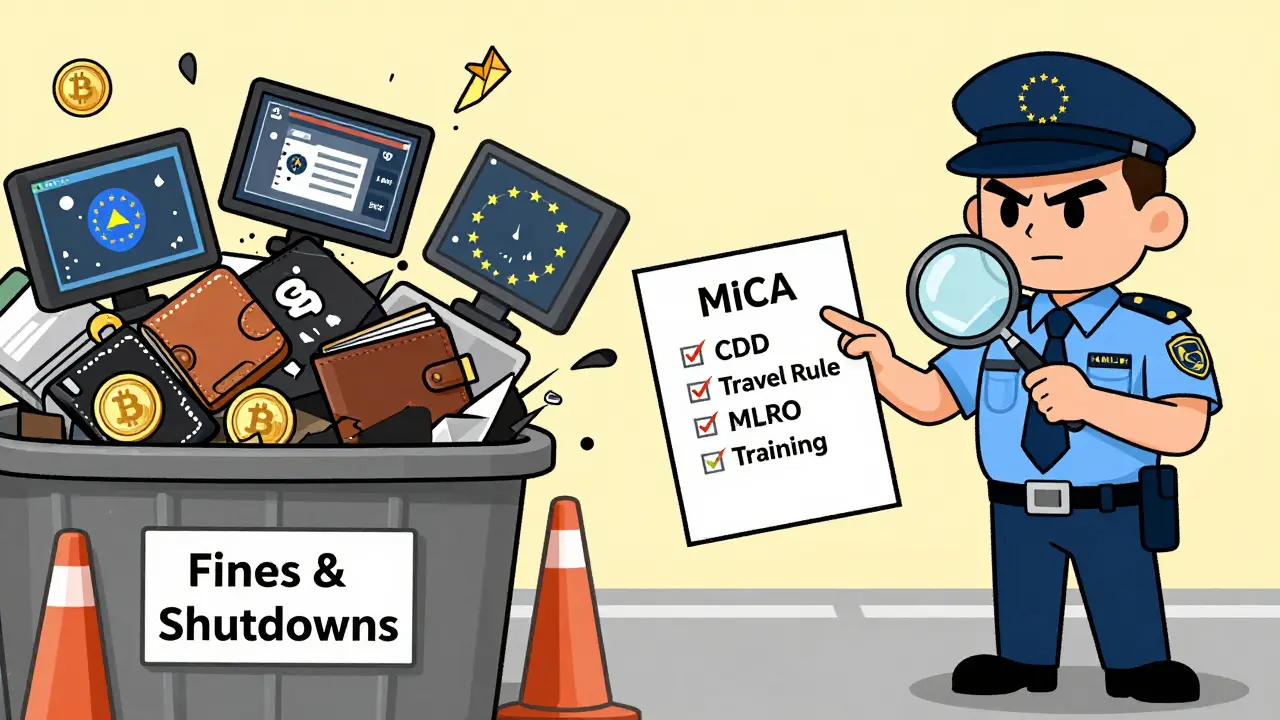
If you're running a crypto business in the European Union, you're not just dealing with technology-you're navigating one of the strictest financial regulatory systems in the world. Since 2020, the EU has been building a unified, no-exceptions framework to stop money laundering and terrorist financing through digital assets. By 2026, this isn't optional. It's mandatory. And the cost of getting it wrong? Fines, license revocation, or worse-being shut out of the entire EU market.
How the EU’s Crypto AML Rules Evolved
The EU didn’t wake up one day and decide to regulate crypto. It built the rules step by step. The first real step came with AMLD5 the Fifth Anti-Money Laundering Directive, enacted in January 2020, which first required crypto exchanges and custodial wallet providers to register with national authorities and apply customer due diligence. Before that, crypto firms operated in legal gray zones. Now, if you’re handling fiat-to-crypto trades or holding customers’ keys, you’re a regulated entity.
Then came AMLD6 the Sixth Anti-Money Laundering Directive, which turned vague rules into enforceable law by defining money laundering as a crime across all 27 EU countries, making company executives personally liable, and boosting cross-border investigations. But the real game-changer was MiCA the Markets in Crypto-Assets Regulation, which became fully effective in 2024 and created a single EU-wide license for Crypto-Asset Service Providers (CASPs). No more applying to 27 different regulators. One license, one rulebook.
And in 2025, the Anti-Money Laundering Authority (AMLA) a new centralized EU agency launched to coordinate national supervisors and enforce AML rules directly across member states began operations. Its chair, Bruna Szego, made it clear: "We welcome innovation-but not at the cost of financial security."
What You Must Do Today to Stay Legal
If you’re a crypto business operating in the EU, here’s what you absolutely must have in place:
- Full MiCA license - You can’t legally offer services like trading, custody, or staking without one. As of September 2025, only 217 firms had received it.
- Customer Due Diligence (CDD) - You must verify every user’s identity. For transactions under €1,000, basic info (name, address) is enough. Between €1,000 and €10,000, you need government-issued ID. Over €10,000? You need proof of where the money came from and approval from senior management.
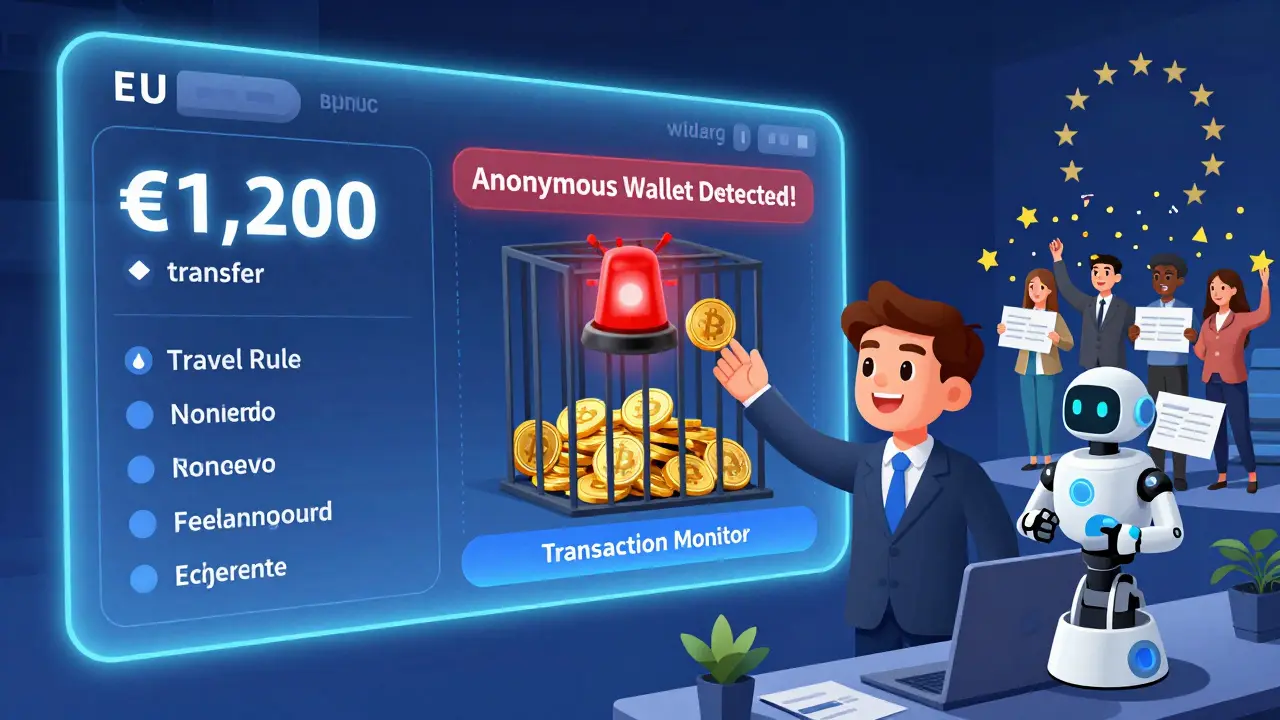
- Travel Rule compliance - Every crypto transfer over €1,000, whether to another exchange or a self-hosted wallet, must carry six data points: sender name, sender account, sender address or DOB, recipient name, recipient account, recipient address. This applies to all transactions-no minimum threshold like in the U.S.
- Money Laundering Reporting Officer (MLRO) - Someone on your team must be legally responsible for spotting and reporting suspicious activity.
- Annual staff training - Compliance staff need 40 hours of AML training per year. Operational staff need 16. Quarterly tests are mandatory.
- Transaction monitoring systems - Your platform must flag unusual patterns: sudden large deposits, rapid movement between wallets, or repeated small transfers designed to avoid thresholds.
And don’t forget DORA the Digital Operational Resilience Act, which requires crypto firms to prove their IT systems can survive cyberattacks, outages, and third-party failures. If your platform goes down during a market crash because you didn’t test backups? That’s a regulatory violation too.
How the EU’s Rules Compare to the Rest of the World
Most countries handle crypto regulation like a patchwork quilt. The U.S. has the SEC, FinCEN, state regulators, and federal courts all claiming authority. The UK has the FCA. Singapore has MAS. Each has different rules.
The EU is different. It’s one system. One license. One set of rules. That’s why firms like Kraken and Coinbase now operate under a single EU-wide license instead of 27 separate ones. It’s also why compliance costs are higher-but so is predictability.
Here’s how the EU stacks up:
| Requirement | EU | United States | Singapore |
|---|---|---|---|
| Travel Rule Threshold | €1,000 (all transfers) | $3,000 (only for certain entities) | Same as EU, but less enforcement |
| Anonymous Transactions | Banned | Allowed if unregulated | Permitted with limits |
| Licensing Authority | Single EU license (MiCA) | Multiple agencies | MAS (monolithic) |
| DeFi Regulation | Unclear, high risk | Unclear, high risk | More flexible, case-by-case |
| Enforcement Speed | Fast, coordinated | Slow, fragmented | Fast, but less transparent |
The EU’s ban on anonymous transactions is especially strict. In Switzerland, you can still use privacy coins like Monero without full ID verification. Not in the EU. If your platform allows it, you’re breaking the law.
Real Costs and Real Challenges
Getting licensed isn’t cheap. According to Kraken’s 2025 public disclosure, integrating the Travel Rule across 28 national Financial Intelligence Units (FIUs) cost them €2.1 million. Startups with under 10 employees? The European Commission found 68% said compliance costs were too high. Nearly half of them either scaled back or left the EU entirely.
One Estonian firm processed €187 million in transactions through a Gibraltar entity to dodge stricter local rules. When caught, both authorities acted. The firm lost its license. The founders were fined.
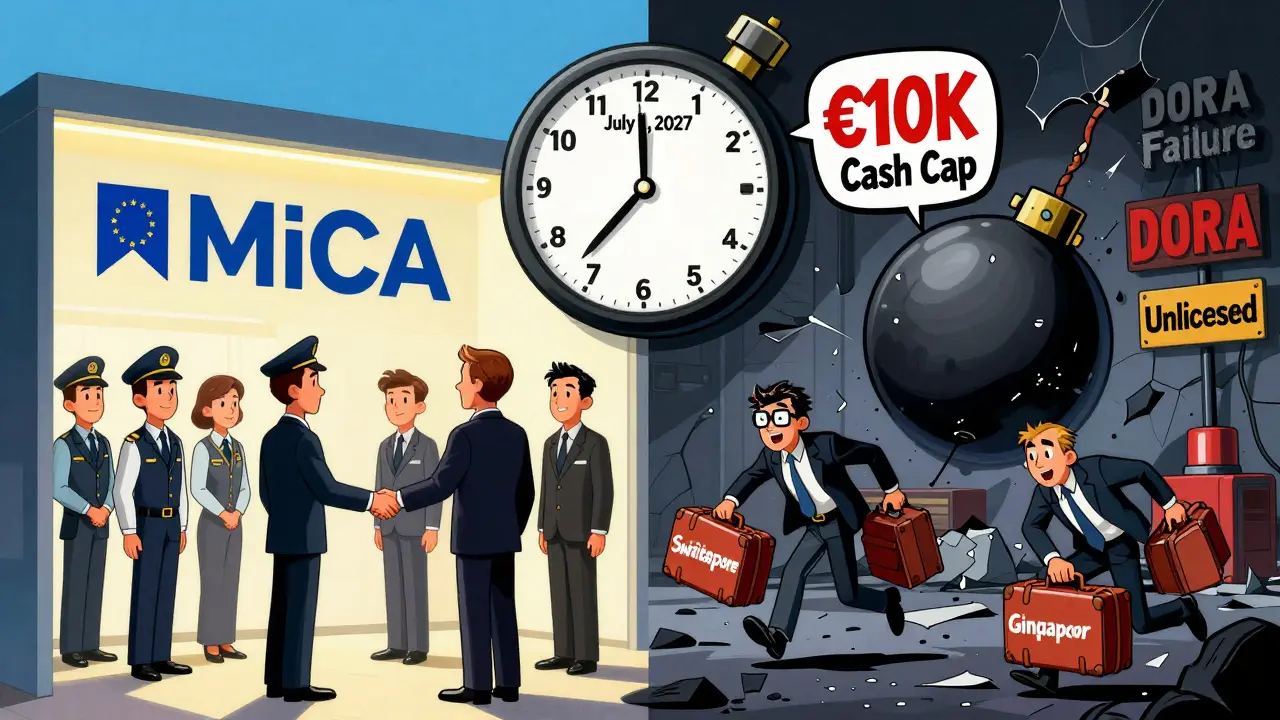
And the clock is ticking. The EU-wide AML Regulation set to take effect on July 1, 2027, will replace all previous directives and introduce new rules: a €10,000 cash payment cap for businesses, a five-working-day deadline to respond to FIU requests, and mandatory verification for cash payments over €3,000. Even football clubs and high-value art dealers will be covered.
What’s Next? DeFi and Privacy Coins
The biggest gap in the EU’s system? Decentralized Finance (DeFi). If there’s no company, no CEO, no registered office-how do you enforce AML rules? The EBA’s October 2025 report flagged this as the "most critical vulnerability." Criminals have exploited it. In early 2025, BaFin found €42 million in laundered funds flowing through a DeFi protocol that had no operator to hold accountable.
AMLA has signaled it will release guidance in Q1 2026 on how to regulate DeFi. But right now, if you’re building a DeFi app and want to serve EU users, you’re walking a legal tightrope. The same goes for privacy coins. Even if you don’t actively support Monero or Zcash, if your platform allows users to deposit them, you’re at risk.
Why This Matters for Your Business
The EU isn’t just regulating crypto. It’s reshaping it. Since MiCA launched, 78% of crypto trading volume in the EU now flows through licensed platforms-up from 41% in 2023. Institutional investors won’t touch unregulated firms. The PwC 2025 Crypto Institutional Survey found that 89% of institutional clients only work with MiCA-licensed CASPs.
That means compliance isn’t just a cost-it’s a competitive advantage. Firms that got licensed early now have better access to banking partners, institutional capital, and EU-wide customer trust. Those who waited? They’re being pushed out.
But here’s the truth: if you’re a small startup with limited resources, the EU system is brutal. The €350,000-€500,000 cost to set up compliance isn’t just a number-it’s the difference between surviving and shutting down. That’s why 31% of crypto startups surveyed in 2025 said they were considering relocating to Switzerland or Singapore.
The EU’s rules are clear, powerful, and growing tighter. There’s no way around them. The only question is: are you ready to meet them-or are you ready to leave?
Do all crypto businesses need a MiCA license in the EU?
No-not every crypto business. Only Crypto-Asset Service Providers (CASPs) that offer specific services: trading, custody, staking, issuance, or brokerage. If you’re just a developer building a wallet app for personal use, or running a small peer-to-peer marketplace with no fiat on-ramps, you might not need one. But if you’re handling customer funds or facilitating trades between crypto and euros, you absolutely do. The EBA defines CASPs clearly, and non-compliance can lead to criminal penalties.
What happens if I ignore EU AML rules?
You risk being shut down. National regulators can freeze your assets, revoke your license, and ban you from operating in any EU country. Executives can be personally fined or jailed. In 2024, a German-based exchange was fined €12 million for failing to report suspicious transactions. The same firm’s CEO was barred from the industry for five years. The EU doesn’t issue warnings. It enforces.
Can I use a third-party provider to handle AML compliance?
Yes, but you can’t outsource responsibility. You can use tools like the Traveler platform or compliance SaaS providers to automate KYC and transaction monitoring. But you still need an MLRO on staff, internal policies, training records, and audit trails. Regulators will hold you accountable-even if you hired a vendor to make the mistakes.
Are privacy coins like Monero banned in the EU?
They’re not explicitly banned-but no licensed CASP can offer them without full identity verification for every transaction. In practice, most regulated exchanges have removed Monero, Zcash, and similar coins because they can’t meet the EU’s transparency requirements. Even if you don’t list them, if your platform allows users to deposit them, you’re violating AML rules.
How long does it take to get a MiCA license?
On average, 9 to 12 months. The application requires detailed documentation on your business model, risk assessments, internal controls, staff qualifications, and IT infrastructure. ESMA recommends having at least three full-time compliance staff during the process. Some firms have taken longer if their structure is complex or if they’ve previously been flagged for compliance issues.
Will the EU’s rules affect my non-EU customers?
If your business is licensed in the EU, you must apply EU AML rules to all users-regardless of where they live. That means if you have a user in Brazil or Japan who deposits crypto into your EU-licensed platform, you still need to verify their identity and monitor their transactions. This is why many firms set up separate non-EU entities to serve international customers under different rules.
Final Thoughts
The EU’s crypto AML framework isn’t perfect. It’s expensive. It’s complex. It leaves DeFi in a gray zone. But it’s also the most complete system in the world. If you’re serious about operating in Europe, you don’t have a choice. You build to the rules-or you build somewhere else.
I've been helping crypto startups navigate this mess for years and let me tell you it's brutal but doable. The key is not to fight the system but to build into it. Start with your MLRO before you even think about the license. Train your team like they're prepping for a nuclear launch. And don't even think about skipping the Travel Rule just because you're small. I saw a guy try that last year and now he's in a Zoom call with three regulators asking why he thought €999 was a magic number. It's not a bug it's a feature. The EU wants you to be transparent. So be gloriously transparent.
Honestly i just want to build something cool without having to hire a law firm just to log in. But i get it. The old wild west was fun but it was also a free for all. Now there's structure. It's not perfect but at least i know what the rules are. No more guessing if my wallet app is legal. That's worth something.
I know it feels overwhelming but think of it this way. You're not just complying you're building trust. People are scared of crypto because of what happened before. Now you get to show them it can be safe. It's not about fear it's about care. Take a breath. One step at a time. You got this.
If you're complaining about costs you never should've started a crypto business in the first place. This isn't a hobby it's a financial institution. You think banks get to skip compliance? Get real. The EU is giving you a golden ticket to legitimacy. Stop whining and earn it.
I love how people say 'the EU is too strict' but then they go to Switzerland and say 'wow this is so chill'. The truth is the EU is saying 'we want you here but you have to play fair'. That's not oppression that's inclusion. And if you're scared of privacy coins? Good. That's the point. You don't need Monero to make a good product. You need transparency. And yes i used a smiley because this is hard and we need to be kind to each other 🌈
The EU didn't just write rules they wrote a manifesto. And it says 'no more shadows no more ghosts no more silent wallets'. They want to see the faces behind the addresses. And honestly? I'm kind of into it. It's like they're saying crypto can be clean. That it can be noble. That's not regulation that's redemption.
Let's get technical. MiCA's Article 58 defines CASPs with surgical precision but here's the kicker: the definition hinges on 'acting as an intermediary in the exchange of crypto-assets for fiat currency or other crypto-assets'. So if you're running a peer-to-peer marketplace where users self-custody and you don't touch funds? You're not a CASP. But if your platform auto-converts USDC to EUR on settlement? Congratulations you're regulated. The gray zone is shrinking fast. And yes the AMLA is already auditing metadata flows from DeFi bridges. You're not safe just because you're decentralized.
People think they're being oppressed but they're being protected. The same people who scream about freedom are the ones who lost everything to rug pulls and exit scams. The EU is saying enough. Enough with the anonymity. Enough with the evasion. Enough with pretending crypto is a lawless frontier. It's not. It's finance. And finance has rules because people get hurt. Stop romanticizing chaos.
I must respectfully underscore the significance of the AMLA's operational mandate. The centralized enforcement framework represents a paradigm shift in regulatory architecture. Not merely a consolidation but a harmonization of supervisory intent. It is imperative that all CASPs recognize that the regulatory perimeter is now unequivocally defined under Article 17 of the EU-wide AML Regulation. Noncompliance shall not be construed as oversight but as systemic disregard for the integrity of the financial ecosystem.
I've watched this evolution from the sidelines and it's been fascinating. The EU didn't just react to crime they designed a future. They're not trying to kill crypto they're trying to give it a spine. Think about it. For decades we had this dream of decentralized money. But if no one trusts it no one uses it. The EU is building trust through structure. Not by taking power away but by giving it clarity. It's not about control it's about coherence. And that's actually kind of beautiful.
So let me get this straight. You're telling me I can't use Monero anymore but I can still send €10k in Bitcoin with zero KYC? That's not regulation that's performance art. The EU's rules are so strict they're almost theatrical. Like they're auditioning for 'World's Most Compliant Financial Zone'. Meanwhile real people are just trying to send money to their cousins. Maybe the real problem isn't crypto it's that we still think money needs permission.
Too much paperwork
You think this is harsh? Try being the person who lost their life savings to a fake exchange because no one was watching. The EU didn't create this problem. They're just the first ones brave enough to fix it. If you can't handle the heat then go make your 'decentralized dream' in a cave somewhere. The real world doesn't need your chaos.
The irony is that while the EU imposes these rigid frameworks it simultaneously creates the most attractive market for institutional capital. The very compliance burdens that scare startups are the same ones that make pension funds and sovereign wealth entities feel safe. The EU isn't punishing innovation. It's filtering it. And the survivors? They become the next Coinbase. Or Kraken. Or whoever comes next. The rules aren't a wall. They're a sieve.