
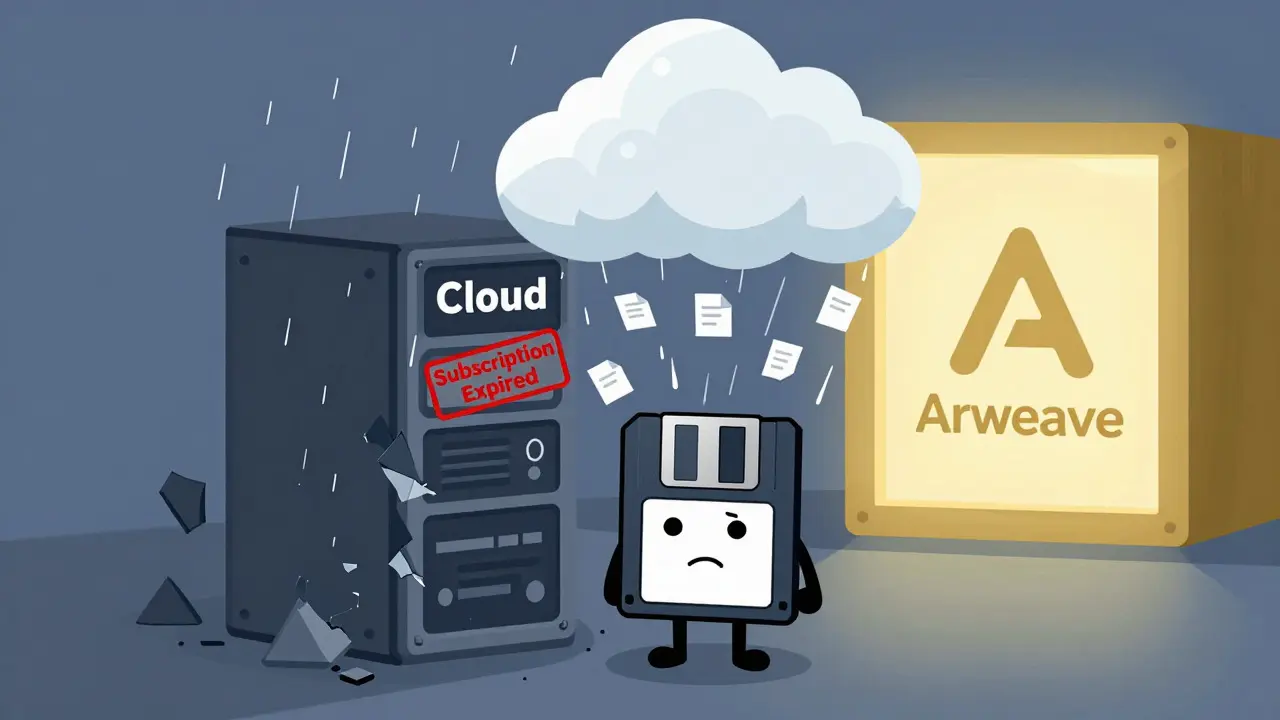
Have you ever uploaded a file to the cloud, only to find it gone years later? Or perhaps you paid for a website host, and when your credit card expired, your entire digital presence vanished into thin air. This is the reality of the current internet. Data is fragile. It relies on centralized servers that can fail, get hacked, or simply stop accepting payments.
Arweave is a decentralized protocol designed to solve this problem by offering truly permanent data storage. Unlike traditional cloud services where you rent space month after month, Arweave allows you to pay once and store data forever. It creates an immutable ledger of historical artifacts, ensuring that information remains accessible, censorship-resistant, and secure against alteration indefinitely.
The Problem with Current Cloud Storage
To understand why Arweave matters, we first need to look at how standard storage works today. When you use services like AWS S3, Google Drive, or Dropbox, you are essentially renting hard drive space. You pay a recurring fee-often around $0.023 per GB per month for enterprise solutions. If you stop paying, the provider deletes your data. Even if you keep paying, there is no guarantee the company will still exist in ten years, let alone twenty.
This model creates what experts call "data impermanence." In a world increasingly dependent on digital records-from medical histories to legal contracts-losing access to data because a server went offline or a subscription lapsed is a critical risk. Traditional blockchains like Bitcoin or Ethereum also struggle here; storing large files directly on-chain is prohibitively expensive and slow. Arweave steps in to fill this gap, offering a solution specifically built for long-term preservation rather than short-term rental.
How Arweave Achieves Permanence: The Blockweave
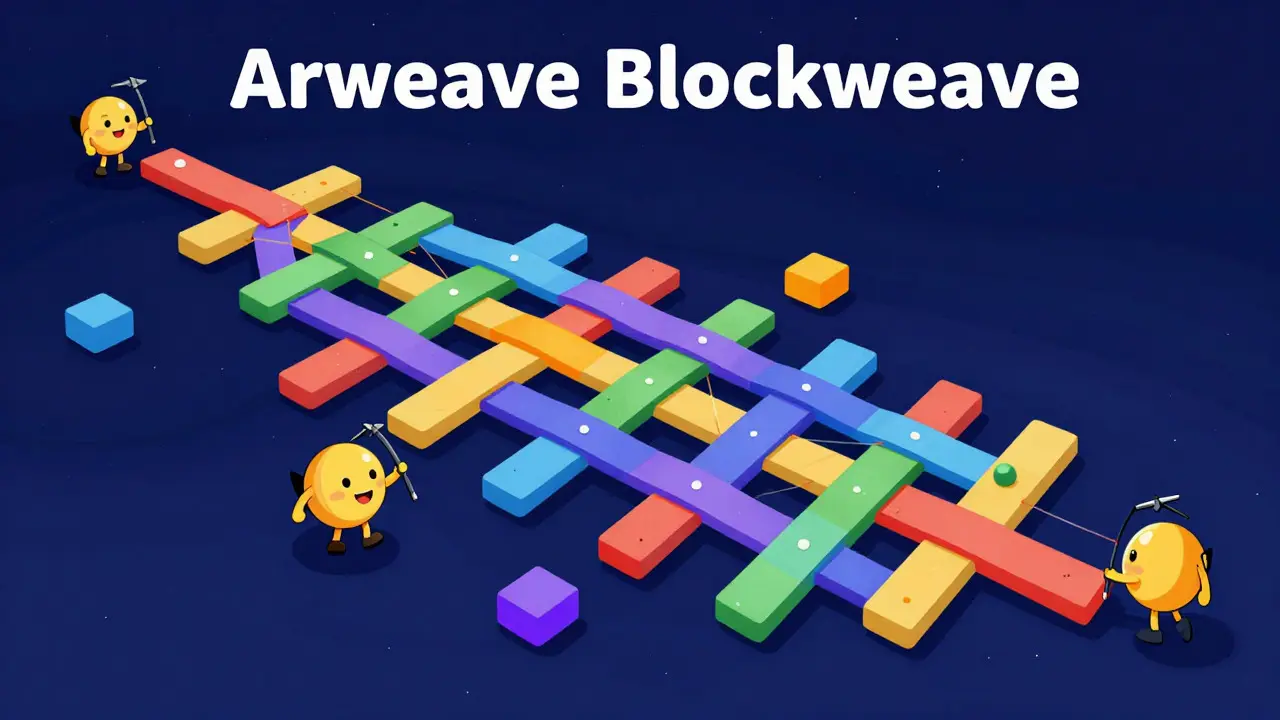
The secret sauce behind Arweave isn't just marketing; it's a unique architectural innovation called the Blockweave. In a traditional blockchain, each new block links only to the one immediately before it. This linear chain means older blocks become less relevant over time as miners focus only on the latest transactions.
Arweave changes this dynamic. When a miner creates a new block, they link it not only to the previous block but also to a randomly selected older block, known as a "recall block." This dual-linking mechanism forces miners to constantly validate and maintain copies of historical data. By referencing old data to create new blocks, the network ensures that older information remains actively stored and verified across the global node network. It turns the entire history of the blockchain into a living, breathing archive that miners have a financial incentive to preserve.
The Economic Model: Pay Once, Store Forever
The most compelling feature of Arweave is its economic structure. Most users assume permanent storage must cost a fortune upfront. While there is an initial cost, the math is surprisingly favorable due to a concept called the endowment model.
When you upload data, you pay a single fee in AR tokens. Approximately 15% of this fee covers the immediate cost of storing your data for the next 200 years. The remaining 85% goes into a shared endowment pool. This pool earns interest from the network’s transaction fees and grows in purchasing power as hardware costs decline over time. Because storage technology gets cheaper every year (Moore’s Law), the endowment’s value increases relative to the cost of storage. This deflationary structure means your data could theoretically be stored for thousands of years, far beyond the initial 200-year projection.
| Feature | Traditional Cloud (AWS/S3) | Filecoin/Sia | Arweave |
|---|---|---|---|
| Payment Structure | Recurring monthly fees | Recurring rental fees | One-time upfront payment |
| Data Lifespan | Until subscription ends | Depends on continuous renewal | Permanent (200+ years projected) |
| Immutability | Data can be altered/deleted | Variable based on contract | Cryptographically immutable |
| Censorship Resistance | Low (centralized control) | Medium (decentralized but rented) | High (global replication) |
Use Cases: Who Needs Permanent Storage?
You might wonder who actually needs data to last centuries. The answer is broader than you think. Here are three primary groups leveraging Arweave:
- Web3 Developers: Decentralized applications (dApps) need their code and assets to remain online without relying on a central server. If a dApp’s frontend disappears, the app breaks. Arweave ensures the codebase stays accessible forever.
- Journalists and Activists: In regions with strict internet censorship, preserving evidence of human rights abuses or political corruption is vital. Uploading documents to Arweave makes them nearly impossible to erase globally.
- Digital Archivists: Organizations like the Internet Archive have partnered with Arweave to preserve millions of historical web pages. This ensures that cultural heritage and historical records survive beyond the lifespan of any single institution.
For example, in May 2023, the Internet Archive announced a partnership to preserve over 250,000 historical web pages using Arweave. This move highlights the protocol’s role in "digital heritage preservation," securing information that defines our collective memory.
Limitations and Challenges
Arweave is not a magic bullet for every storage need. Its strength lies in write-once, read-many scenarios. If you need to frequently update a file-like a live database or a social media feed-Arweave is not the right tool. Each change requires uploading a new version, which can get costly and complex to manage.
Another challenge is the initial cost calculation. Because the price depends on the size of the data and the current price of AR tokens, estimating exact costs for large datasets can be tricky. A GitHub issue from March 2023 highlighted that developers often struggle with fluctuating token prices when budgeting for large uploads. Additionally, while the data is permanent, retrieving it quickly can sometimes be slower than premium cloud services, though upcoming upgrades like "Blockshadows" aim to improve retrieval speeds by up to 400%.

Getting Started with Arweave
If you want to try storing data permanently, the process is straightforward but requires some basic blockchain knowledge. First, you’ll need a wallet that supports AR tokens, such as ArConnect or Drift Wallet. Next, acquire some AR tokens from an exchange. As of early 2024, AR trades around $8.50, but prices vary.
Once funded, you can use gateways like arweave.net to upload files. For developers, the ArweaveJS library simplifies integration, allowing you to programmatically upload data from your applications. The learning curve is moderate; experienced blockchain developers report getting comfortable within two to three weeks. Newcomers should start with small test files to understand the cost dynamics before committing large archives.
The Future of the Permaweb
Arweave is more than just a storage solution; it is the foundation of the "Permaweb," a vision of an internet where data is owned by users, not corporations. With over 450 million pieces of information already stored globally, the network is growing steadily. Analysts predict Arweave could capture 8-12% of the archival storage market by 2027, driven by the increasing demand for verifiable, permanent records in the Web3 ecosystem.
As digital life expands, the need for reliable, censorship-resistant storage becomes critical. Arweave offers a mathematical guarantee of permanence, shifting the paradigm from renting space to owning your digital footprint. Whether you are a developer building the next big dApp or a historian preserving cultural records, understanding Arweave is key to navigating the future of the decentralized web.
Is Arweave really permanent?
Yes, Arweave is designed for permanent storage. Users pay a one-time fee that covers storage costs for approximately 200 years. Due to declining hardware costs and the growth of the endowment pool, data could potentially be stored for thousands of years.
How does Arweave differ from Filecoin?
Filecoin operates on a rental model where users pay recurring fees to store data. If payments stop, data may be deleted. Arweave uses a one-time payment model for permanent, immutable storage, making it better suited for archival purposes.
What is the Blockweave?
The Blockweave is Arweave’s unique data structure. Unlike traditional blockchains that link blocks linearly, the Blockweave links each new block to both the previous block and a random older block. This ensures miners continuously validate and store historical data.
Can I delete data from Arweave?
No, data on Arweave is immutable. Once uploaded, it cannot be altered or deleted. This feature ensures censorship resistance and data integrity but means you should carefully verify files before uploading.
How much does it cost to store data on Arweave?
Costs depend on the size of the data and the current price of AR tokens. Generally, it is very affordable for small files and scales reasonably for larger datasets. The one-time fee covers centuries of storage, often making it cheaper than recurring cloud subscriptions in the long run.