
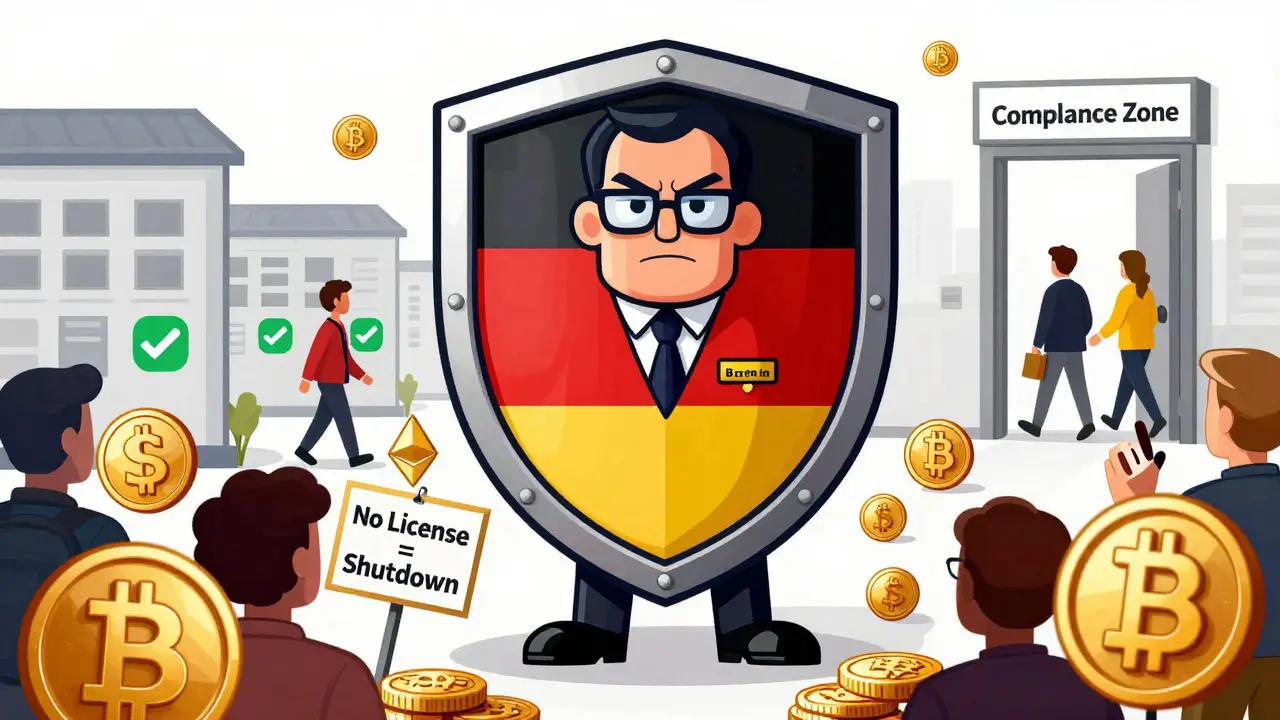
Germany doesn’t treat cryptocurrency like a wild west. If you’re running a crypto business there, you’re not just dealing with code and wallets-you’re dealing with BaFin, the federal financial regulator that holds the keys to legal operation. Unlike countries where crypto exists in a gray zone, Germany has built a clear, strict, and enforceable system. And if you ignore it, you won’t get a warning. You’ll get shut down.
What BaFin Actually Controls
BaFin, short for Bundesanstalt für Finanzdienstleistungsaufsicht, doesn’t just watch banks. Since 2013, when Germany officially recognized Bitcoin as a unit of account, it’s been shaping how crypto fits into the financial system. Today, BaFin regulates every major crypto activity: trading platforms, custody services, exchange operators, and even staking providers. Under the Kreditwesengesetz (KWG), or German Banking Act, crypto assets are treated as financial instruments. That means if your business touches them in any structured way-holding them for clients, trading them, or offering new tokens-you need BaFin’s permission. No exceptions. Even if you’re based outside Germany, if you actively target German customers, BaFin can demand you comply. The big shift came with MiCAR, the EU’s Markets in Crypto-Assets Regulation. It replaced most of Germany’s old rules, but BaFin didn’t just copy-paste. It made sure German enforcement stayed sharp. MiCAR didn’t weaken oversight-it standardized it across Europe, and BaFin became the local enforcer.What You Need to Get Licensed
Getting licensed isn’t a formality. It’s a full audit. BaFin checks your:- Corporate structure and ownership
- IT security systems
- Anti-money laundering (AML) procedures
- Compliance team qualifications
- White papers for new token offerings
AML and the Travel Rule: No More Anonymous Transfers
Germany enforces the FATF’s “travel rule” stricter than most countries. The KryptoWTransferV law requires every crypto transfer over €1,000 to carry full sender and receiver info: names, addresses, account numbers. This applies to exchanges, wallets, and even peer-to-peer platforms that facilitate large trades. You can’t just rely on blockchain’s pseudonymity. BaFin expects you to collect, verify, and store this data for at least five years. If you’re using a third-party payment processor to convert crypto to euros, and that processor isn’t licensed, BaFin can hold you responsible. That’s a trap many small merchants fall into. Accepting Bitcoin for coffee? Fine. Letting a non-licensed payment gateway turn that Bitcoin into euros? That’s a violation.
What Doesn’t Need a License
Not every crypto activity needs BaFin approval. If you’re a small business that accepts Bitcoin as payment for goods or services-like a Berlin bakery taking crypto for bread-you don’t need a license. The key is: you’re not offering financial services. You’re just taking payment. But if you start buying and selling crypto for profit, even just a few times a week, you cross the line. If you’re advertising on forums or social media that you regularly buy or sell crypto, BaFin sees that as a business activity. Same with mining pools that pool resources and distribute rewards. Those are considered financial services now.Recent Crackdowns: Ethena and the Stablecoin Warning
On June 25, 2025, BaFin ordered Ethena GmbH to shut down its USDe stablecoin operations in Germany. The reason? The stablecoin didn’t meet MiCAR’s reserve transparency rules. BaFin didn’t just freeze assets-it appointed a special representative to oversee the redemption process. Token holders had until August 6, 2025, to swap their USDe for other assets. That’s not a fine. That’s a full operational takedown. This wasn’t an outlier. It was a signal: BaFin won’t tolerate opaque stablecoins. If your stablecoin doesn’t prove 1:1 backing with audited reserves, you won’t get approved. And if you’re already operating, you’ll be forced out.
Tax Changes: Crypto Isn’t Just a Payment Anymore
In March 2025, Germany’s Federal Ministry of Finance updated its crypto tax rules. They dropped the term “virtual currencies” and now use “crypto assets.” That’s not just semantics. It means everything-from Bitcoin to DeFi tokens-is now treated under one clear framework. The big changes:- Active staking (running a node, validating blocks) is now considered taxable income
- Passive staking (using a platform like Coinbase) is treated as capital gains
- DeFi transactions-swaps, lending, liquidity pools-are now explicitly taxable events
- You must keep daily market value records for every transaction
- Failure to document? You risk penalties or audit
Who’s Targeted? Foreign Companies Too
You don’t have to be based in Germany to be regulated. If your website is in German, you accept euros, or you advertise to German residents, BaFin considers you operating in Germany. That means a crypto exchange based in Singapore that targets Berlin users still needs a BaFin license. The only exception? If a German customer reaches out to you first, and you don’t actively market to them. That’s called “passive service.” But if you run Google Ads in German, or have a .de domain, you’re no longer passive. You’re in scope.The Bottom Line: Compliance Isn’t Optional
Germany isn’t trying to scare crypto away. It’s trying to bring it into the financial system-safely. The rules are tough, but they’re clear. And that’s why so many firms are choosing Germany over other EU countries. You know exactly what you need to do. No guessing. If you’re starting a crypto business in Germany:- Map out every service you offer
- Identify which ones require a BaFin license
- Build AML/KYC systems that meet KryptoWTransferV
- Prepare your white paper if launching a token
- Apply early-licenses aren’t instant, but they’re faster than ever
- Keep daily records of all transactions and valuations
Do I need a BaFin license if I only accept crypto as payment for my products?
No, you don’t need a license if you’re simply accepting cryptocurrency as payment for goods or services, like selling a product online and getting paid in Bitcoin. But if you use a third-party payment processor that converts your crypto to euros and that processor isn’t licensed by BaFin, you could be held responsible. Always verify your payment provider’s licensing status.
What happens if I don’t get a BaFin license but operate anyway?
BaFin can shut down your operations immediately, freeze your assets, and impose fines. In severe cases, individuals can face criminal charges. The Ethena case in 2025 shows BaFin doesn’t warn twice. If you’re operating without authorization, you’re already in violation.
Are all stablecoins banned in Germany?
No, stablecoins aren’t banned. But they must meet MiCAR’s strict reserve transparency rules. Every euro backing a stablecoin must be verifiable, held in segregated accounts, and audited regularly. Ethena’s USDe was shut down because it failed to prove its reserves. Any stablecoin that can’t meet this standard won’t be allowed to operate in Germany.
How long does it take to get a BaFin crypto license?
In 2024, applications took 12-18 months. By early 2025, BaFin streamlined the process. Now, well-prepared applications can be approved in 3-6 months. The key is submitting complete documentation, especially on IT security and AML controls. Delays usually come from incomplete or unclear submissions.
Do I need to report my personal crypto trades to BaFin?
No, BaFin doesn’t monitor personal crypto trades. But the German tax office (Finanzamt) does. If you trade crypto for profit, you must report it on your annual tax return. BaFin only regulates businesses offering crypto services, not individual investors.
Can I operate a crypto mining pool in Germany without a license?
No. Mining pools that pool resources and distribute rewards to participants are considered financial services under BaFin’s interpretation. If you’re running a pool and taking fees or distributing rewards, you need a license. Solo mining for personal use doesn’t require one.
Is DeFi legal in Germany?
Yes, DeFi is legal-but only if you’re not operating a platform that facilitates it. If you’re using DeFi protocols like Uniswap or Aave as an individual, you’re fine. But if you’re building a DeFi platform that connects users, collects fees, or offers lending services, you need a BaFin license. Tax rules also now treat DeFi transactions as taxable events.
What if my crypto business is based outside Germany?
If you’re targeting German customers-through German-language websites, euro pricing, or local advertising-BaFin considers you operating in Germany and requires a license. Passive service (a German customer finds you on their own) is exempt. But if you’re marketing to them, you’re in scope.
I just started accepting BTC for my handmade soap online and was terrified of BaFin. This post literally saved me. Just don't convert it through some sketchy gateway and you're golden. 🙌
so like... baFin is just the feds but with more paperwork and less coffee? why do we even bother? i mean, if you're smart you just dont tell em you're doing crypto. problem solved.
Honestly the fact that they’re treating crypto as a financial instrument is just common sense. Anyone who thinks this is overreach clearly doesn’t understand how modern finance works. And yes I’ve read MiCAR front to back
It’s interesting how regulation becomes the invisible architecture of trust. We don’t notice it until it’s gone. BaFin isn’t suppressing innovation - it’s giving it a foundation. The blockchain was supposed to be about transparency. Turns out, we still need institutions to hold the mirror up.
This is one of the clearest, most accurate summaries of Germany’s crypto regulatory landscape I’ve seen. The distinction between accepting crypto as payment versus operating a financial service is critical. Many U.S. entrepreneurs misunderstand this entirely. Also, the Ethena case is a textbook example of why reserve transparency matters. Well done.
I read this and just cried. I’ve been trying to launch my token in Europe for 18 months. Every country says one thing, then changes it. Germany at least tells you the rules before you start. Thank you for writing this. I’m finally going to apply.
I run a small crypto arbitrage bot and honestly? I just ignore BaFin. They’re not gonna come after me for $200 in profits. Besides, my server’s in Iceland and I use a VPN. Who’s gonna find me? lol
The part about passive service vs. active targeting is so important. I’ve seen so many founders get burned because they thought having a .com domain and English site meant they were safe. Nope. If you speak German on your homepage, you’re in. Period.
If you’re a small merchant accepting crypto, just use a licensed processor like BitPay or CoinGate. They handle the AML stuff for you. Don’t try to DIY it. The compliance cost is built into their fee - and it’s worth every cent. I’ve been doing this since 2021 and never had a hiccup.
Canada’s just letting crypto run wild. We should be more like Germany. No more of this "anything goes" nonsense. If you want to operate here, you follow our rules. End of story.
I just launched my staking pool and was worried I’d need a license. Turns out, if I’m just pooling for friends and not charging fees, I’m okay. But if I start taking 1%? Boom - BaFin’s knocking. Good to know!
This is all just a distraction. BaFin doesn’t care about crypto. They’re just scared of losing control. The real story? They’re pushing this so banks can launch their own CBDCs. They want to kill decentralization. You think this is about compliance? It’s about power.
MiCAR? More like MIA-CAR. They’re using it as an excuse to shut down anyone who doesn’t have a billion in VC backing. The fact that they shut down Ethena over reserve transparency? That’s just a cover. They didn’t like the yield. That’s all.
Honestly, if you’re not based in the EU and you’re trying to compete with German firms, you’re already behind. The U.S. is a regulatory wasteland. Germany is the only place where you can actually build something that lasts. Stop whining about compliance - embrace it.
Let me tell you something about BaFin - they don’t care how smart you think you are. They don’t care if you’re "just a startup." They don’t care if you "didn’t know." They have a checklist. And if you miss one box - even if it’s something as small as the font size on your AML policy - they will reject you. And then you wait another six months. And then they reject you again. And then you cry. And then you hire a lawyer. And then you pay $50k. And then you finally get approved. And then you realize you’ve lost your entire first year. That’s the real story.
It’s funny how we call this "regulation." But really, it’s just capitalism putting on a suit. The blockchain was supposed to be free. Now we’re filling out forms. I wonder if the original visionaries ever imagined we’d need a compliance officer to run a wallet.
I run a bakery in Austin. We take crypto. No license needed. Simple. I just print out the receipt with the price in euros and BTC. Done. No stress.
I mean like... why does baFin even care about my staking? I’m just earning interest. its not like im running a bank. this feels like overreach. like... why are they even looking at this?
As someone from India, I appreciate how Germany has created clarity. In our country, crypto is in legal limbo. Here, you know exactly where you stand. This is the model other nations should follow.
I’ve spent the last 14 months trying to get licensed in South Africa. We have no framework. No guidance. No one knows what to do. I read this and I almost cried. Not because I’m jealous - but because I realize we’re being left behind. We need this kind of clarity. Not just for businesses, but for ordinary people who want to use crypto safely. Germany isn’t just regulating - they’re protecting.
This is gold. I was about to launch a DeFi lending platform and thought I could skip licensing since I’m "just a tool." Now I know - if I’m taking fees and connecting users, I’m a financial service. Time to start drafting that white paper.