
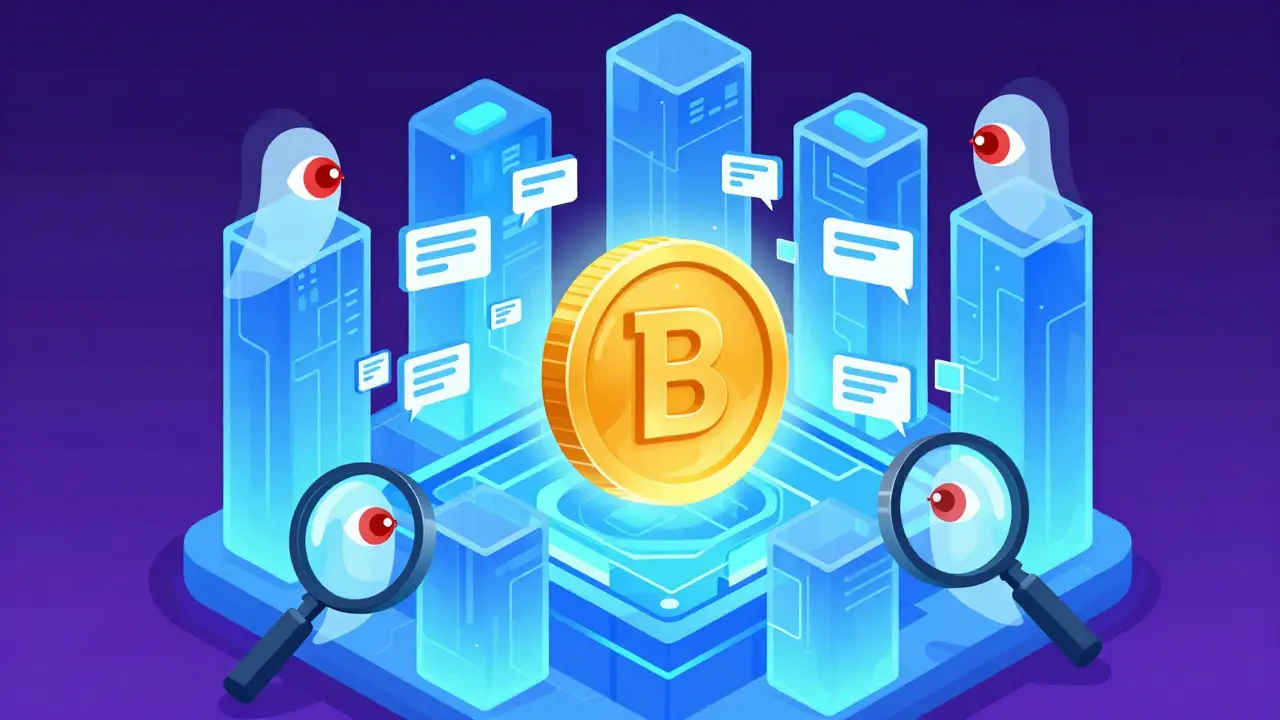
To understand what's going on here, we need to look at Beldex is a privacy-focused blockchain ecosystem launched in 2019 that integrates financial anonymity with private communication tools. Unlike a standard trading platform, it provides the infrastructure for decentralized apps (dApps) that keep your identity off the grid.
The Core Tech: How Beldex Keeps You Invisible
Most blockchains are like open ledgers where anyone can see who sent what to whom. Beldex flips the script. It uses Ring Confidential Transactions (RingCT), which essentially mixes your transaction with others to hide the sender and the amount. It also uses stealth addresses, meaning your actual wallet address isn't blasted across the public web for every transaction.
The network runs on a Proof-of-Stake consensus mechanism. To keep things decentralized, it relies on masternodes. As of mid-2025, there are 1,883 of these nodes working. If you want to run one, you'll need to lock up 5,000 BDX tokens (which is roughly $393 based on recent prices). While the network is secure, it's not the fastest. You're looking at a block time of 30 seconds and a total finality of about 60 seconds. It handles roughly 12-15 transactions per second, which is plenty for a privacy tool but far slower than something like Visa or even some newer layer-1s.
Beyond Money: The Privacy App Suite
What makes Beldex interesting is that it doesn't stop at coins. They've built a suite of tools to tackle the broader problem of surveillance. This is where the project really separates itself from old-school privacy coins.
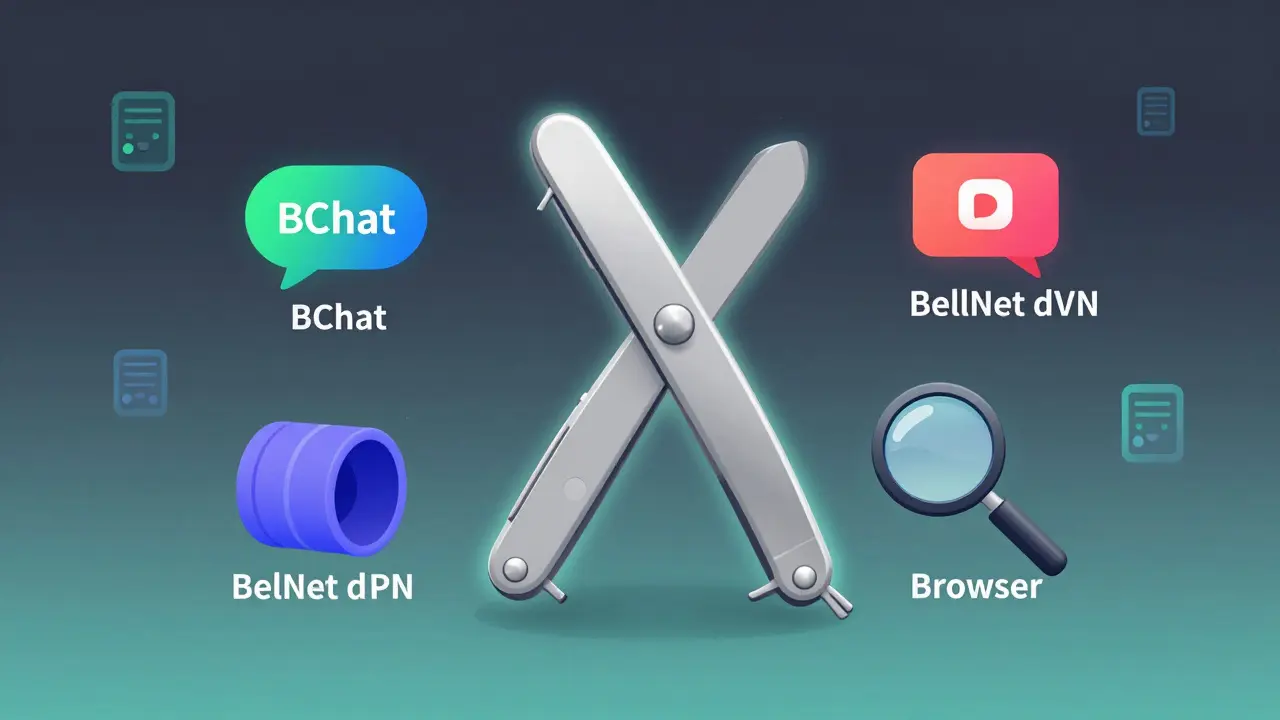
- BChat: A private messaging app that doesn't collect metadata. In June 2025, it was handling over 2.1 million encrypted messages a day.
- BelNet: A decentralized VPN (dVPN). Instead of trusting one company with your data, you route your traffic through a decentralized network. It's seen a massive spike in use in places like Iran and Venezuela.
- Beldex Browser: A web browser designed to minimize tracking and maximize user anonymity.
The newest addition is BeldexAI. This isn't just a chatbot; it's a system that uses machine learning to analyze millions of data points hourly to find vulnerabilities in the network and optimize how traffic is routed to prevent tracking.
Beldex vs the Privacy Giants
When you're looking at privacy, the big names are usually Monero and Zcash. How does Beldex stack up? The biggest difference is the "all-in" approach. While Monero is the gold standard for untraceable money, it doesn't give you a private VPN or a chat app. Beldex tries to be the whole operating system for your private life.
| Feature | Beldex (BDX) | Monero (XMR) | Zcash (ZEC) |
|---|---|---|---|
| Privacy Model | Mandatory (Default) | Mandatory | Optional (Selective) |
| Ecosystem Apps | VPN, Chat, Browser | Wallet only | Wallet only |
| Market Cap | ~$14 Million | ~$2.8 Billion | Moderate |
| Speed (TPS) | ~15 TPS | Varies | Higher |
As you can see, Beldex is a lightweight in terms of market cap compared to Monero, but it offers more tools. However, this smaller size can be a double-edged sword. Some analysts worry that a lower staked value makes the network more vulnerable to validator collusion compared to the massive network effects of Monero.
The Reality Check: Pros and Cons
Is it a perfect system? Far from it. Users on Trustpilot and Reddit have shared a mixed bag of experiences. The praise usually centers on the messaging app-people love that their metadata isn't being harvested. On the flip side, the dVPN can be glitchy. Some users have complained about inconsistent speeds during peak hours, which is a common problem with decentralized VPNs since you're relying on other people's home connections.
Then there's the money side. Getting BDX can be a headache. Many users complain about limited fiat on-ramp options, meaning you can't just link your bank account and buy it easily. You often have to jump through a few hoops on other exchanges first. Furthermore, a CertiK audit in July 2025 flagged "moderate risk" regarding the masternode reward distribution, suggesting that under specific attack scenarios, some transactions could be censored.
Is the BDX Token a Good Bet?
Looking at the numbers, the BDX token has had a rough ride. Since its 2021 peak, it has dropped significantly-more so than Monero or Zcash. Currently, the price hovers around $0.078, with a total supply capped at 265 million tokens. About 67% of those are already in circulation.
Opinions from the pros are split. Some, like George Tung from CoinBureau, think the expanding dApp ecosystem makes it a promising contender. Others, like the data scientists at CoinCodex, have labeled it a "neutral" investment, suggesting the momentum just isn't there right now. The biggest risk isn't the tech, but the law. The Financial Action Task Force (FATF) is constantly tightening the screws on "privacy-enhancing technologies," which could make it harder for Beldex to gain a foothold in regulated markets like Japan or the US.

Getting Started: The Learning Curve
Don't expect to set this up in five minutes. According to data from Binance Academy, the average user spends about 4 to 6 hours just getting the whole ecosystem configured. If you're just using the chat app, it's easy. But if you want to run a masternode or bridge your assets, you'll need some intermediate blockchain knowledge. About 68% of people starting a masternode end up needing help from the community forums because the official documentation has some gaps in advanced troubleshooting.
If you're diving in, the best path is usually through their official Discord. While standard queries can take up to 18 hours for a response, masternode operators get priority and usually hear back within 4.5 hours.
Is Beldex a cryptocurrency exchange?
No, Beldex is not an exchange. It is a privacy-focused blockchain ecosystem that provides its own tokens (BDX) and a suite of private applications like a dVPN and private messenger. If you want to buy BDX, you will need to use a third-party cryptocurrency exchange.
How does the Beldex dVPN differ from a regular VPN?
A regular VPN is centralized, meaning you trust one company to not log your data. BelNet, the Beldex dVPN, is decentralized. Your traffic is routed through various nodes operated by different users, making it much harder for a single entity to track your activity or sell your data.
What is required to run a Beldex masternode?
To operate a masternode, you need a minimum collateral of 5,000 BDX tokens. This helps secure the network and allows you to earn rewards, though these rewards can fluctuate based on network participation.
Is Beldex safer than Monero?
It's not necessarily "safer," but it's broader. Monero is widely considered the industry leader for financial privacy due to its massive network and proven track record. Beldex offers similar financial privacy (via RingCT) but adds communication privacy through its dApps, which Monero does not provide.
What are the risks of investing in BDX?
The primary risks include heavy regulatory pressure on privacy coins, lower liquidity compared to top-tier assets, and technical risks identified in audits, such as potential vulnerabilities in reward distribution.
Next Steps and Troubleshooting
Depending on who you are, your approach to Beldex will differ. If you're a privacy enthusiast, start by downloading BChat and BelNet to see if the speed works for your region. If you're an investor, keep a close eye on the regulatory updates from FATF, as these usually trigger price swings in the privacy sector.
If you run into technical glitches with the dVPN, try switching your node or checking the official Discord for network status updates. For those attempting to set up a masternode, don't rely solely on the manuals-head over to the community forums to see how others have handled the latest version 2.3 protocol updates to avoid configuration errors.
Actually BDX is way more useful than Monero cuz of the dApps!! 🚀 Why just hide money when u can hide your whole internet footprint lol. The masternode setup is a bit tricky but totally worth it for the passive income 💰✨
the ringct implementation is decent but the tps bottleneck is real if they want scaling for the dVPN they gotta optimize the consensus layer more or look at sharding for the state transitions
Oh look, another "privacy" coin promising a digital fortress 🙄. It's cute that people think a dVPN actually hides them from the three-letter agencies who probably wrote the code in the first place 🤡. Imagine thinking 15 TPS is a "feature" and not just a relic from the stone age. Good luck with your little echo chamber 💅✨
totally agree with the dApp side of things 😊 its way better to have a whole kit than just a wallet
It is fascinating to consider how the concept of privacy has shifted from being a basic human right to a luxury product that we have to pay for with specific tokens, and while the technical hurdles of a decentralized VPN are significant, there is something poetic about the idea of a community-owned infrastructure that resists the centralized gaze of modern corporate surveillance, even if the execution is currently a bit glitchy and the learning curve is steep enough to discourage the average user from ever truly escaping the grid.
I've helpd a few ppl with the masternode setup and the main issue is always the config files. Make sure you double check your ports in the firewal because if that's blocked the node wont sync propely and you'll miss out on rewards!!
Honestly, the CertiK audit is such a red flag! Like, how can we trust a "fortress" that has moderate risk in its reward distribution? It's honestly giving me a panic attack just thinking about the potential for censorship. I love the idea of privacy, but the execution here is just... messy! 😱
The dVPN is indeed unstable during peak hours. For those who prioritize stability, I suggest configuring the BelNet client to prefer nodes with higher uptime and lower latency, though this slightly compromises the randomness of the routing.
Most of you are just chasing a pump and don't even understand the social implications of anonymity. It's pathetic how people just blindly follow "experts" without questioning their own digital hygiene first. I've seen a lot of these projects fail because the users have no discipline.
Privacy is a journey, not a destination. Start with BChat. It's the lowest barrier to entry.
The FATF is just a tool for the globalists to track every cent we own and they will come for BDX next because it actually works. We must secure our sovereignty before the central banks implement the kill switch on all privacy tech. The US government cannot be allowed to dictate how we encrypt our own communications. ABSOLUTE CONTROL IS THE GOAL.
It is utterly disappointing that the on-ramp process remains such a hurdle for the average investor. One would expect a project claiming to be a "full-stack ecosystem" to have solved the basic problem of asset acquisition by 2025. This lack of accessibility is an embarrassment to the developers.
the market cap is a joke compared to xmr and realistically that means there is no real liquidity for any serious institutional move so we are just looking at a retail play that will likely get crushed by the next regulatory wave coming from the us and eu which is inevitable given the way the fatf operates and the lack of a legal lobby for privacy coins in the west
just be patient with the setup process it takes time to learn these things and the community is usually very kind if you ask nicely
Oh sure, just spend 6 hours configuring a browser to feel "safe" while the rest of your life is leaked by your smart fridge. Truly a masterclass in efficiency! 🙄
The 30-second block time is insufficient. High latency undermines the utility of the dVPN.
I can't believe people are actually okay with the moderate risk audit! Like, we are literally talking about our privacy and money! It's just so wrong to promote this as a "fortress" when the walls have holes in them. We need a higher moral standard for the tech we trust with our lives! Honestly, it's just greed at this point.