

Picking a consensus mechanism for a business network isn't like picking a coin for your portfolio. In a public network, you fight for decentralization. In an enterprise setting, you're fighting for speed, finality, and a way to keep the lights on without spending the energy of a small country. If you use the wrong protocol, you might find your network freezing during a validator rotation or, worse, crashing entirely because you trusted a "crash fault tolerant" system in a hostile environment.
The goal here is simple: find the balance between how many people you trust and how fast you need your data to move. Most enterprises have moved away from Proof-of-Work, with about 68% of implementations now using specialized business protocols that can hit 1,000 to 10,000 transactions per second (TPS). For context, that makes Bitcoin's 7 TPS look like a dial-up modem.
Best consensus mechanisms for enterprises prioritize "finality"-the moment a transaction is set in stone and cannot be reversed. In business, you can't wait for six confirmations; you need to know that payment is settled in under five seconds.
Quick Summary of Enterprise Options
- Proof-of-Authority (PoA): Best for small, known groups; incredibly fast and lightweight.
- Istanbul BFT (IBFT): The gold standard for consortiums that need high security and Byzantine fault tolerance.
- Raft: Maximum speed for internal corporate use where everyone is 100% trusted.
- PBFT: Highly flexible and secure, though complex to set up; common in healthcare and finance.
- FBA: A middle ground for partial decentralization, used by networks like Stellar.
Proof-of-Authority: The Simple Starting Point
If you're just getting started or running a small supply chain, Proof-of-Authority (or PoA) is usually the way to go. It's a consensus mechanism where a fixed set of approved validator nodes verify transactions based on their identity and reputation. Think of it like a digital board of directors; if a validator lies, they lose their seat and their reputation.
PoA is remarkably efficient. According to benchmarking studies, it can achieve finality in 1-2 seconds. Because it doesn't require massive mining rigs, it uses about 0.001% of the energy that Bitcoin does. However, there's a catch: it doesn't scale infinitely. Once you hit about 25 validators, performance starts to dip. A senior architect at Siemens noted that while their PoA setup had 99.98% uptime, they still had to manually fix the network during a few partition events.
Istanbul BFT: The Consortium Workhorse
When you're working with a group of different companies-like a banking consortium-you can't just assume everyone is honest. This is where Istanbul Byzantine Fault Tolerance (known as IBFT) shines. IBFT is designed to handle "Byzantine" failures, meaning the network stays alive even if some nodes are acting maliciously or sending conflicting data.
IBFT requires a supermajority (roughly 67%) to agree on a block. This gives it a sweet spot of 1,000-2,000 TPS with sub-second finality. It's the go-to for the European Blockchain Services Infrastructure (EBSI) because of this rigor. But be warned: it's finicky. Some developers have reported that validator rotations can occasionally fail, leading to downtime that requires manual recovery. It's powerful, but it requires a specialist to tune correctly.

Raft: Pure Speed for Internal Networks
If you are building a blockchain for internal use within a single company, you probably don't need to protect yourself against "malicious' nodes-you just need to protect against server crashes. Raft is a consensus algorithm that provides crash fault tolerance (CFT), ensuring the network stays consistent as long as a majority of nodes are online.
Raft is the speed king, often hitting 5,000 to 10,000+ TPS. JPMorgan, for instance, uses Raft for internal settlements where speed is the priority. However, Raft is not Byzantine fault tolerant. If a node starts sending fake data intentionally, Raft can't stop it. This is why 71% of financial institutions avoid it for inter-bank transactions. Using Raft in a multi-party consortium is a recipe for disaster; it's like leaving your front door unlocked because you trust your neighbors.
PBFT and the Modular Approach
For those who need the absolute highest security and modularity, Practical Byzantine Fault Tolerance (PBFT) is the heavy hitter. Found in Hyperledger Fabric, PBFT allows the network to tolerate faulty nodes through a complex three-phase voting process.
The big advantage of PBFT is that it's often "pluggable." In Hyperledger Fabric 2.5, you can actually use different consensus mechanisms for different channels within the same network. This is now considered a best practice. The downside? It's a nightmare to configure. Some healthcare consortia have reported spending weeks with specialized consultants just to get the PBFT parameters right. But once it's running, it can handle thousands of patient record updates per minute with bank-grade security.
Comparing the Top Enterprise Mechanisms
| Mechanism | Fault Tolerance | Typical TPS | Finality Speed | Best Use Case |
|---|---|---|---|---|
| PoA | Identity-based | 300-500 | 1-2 sec | Small Consortiums |
| IBFT | Byzantine (BFT) | 1,000-2,000 | <1 sec | Inter-company Networks |
| Raft | Crash (CFT) | 5,000-10,000+ | Instant | Internal Corporate Ops |
| PBFT | Byzantine (BFT) | 3,000-5,000 | 1-3 sec | High-Security Regulated |
How to Choose the Right One
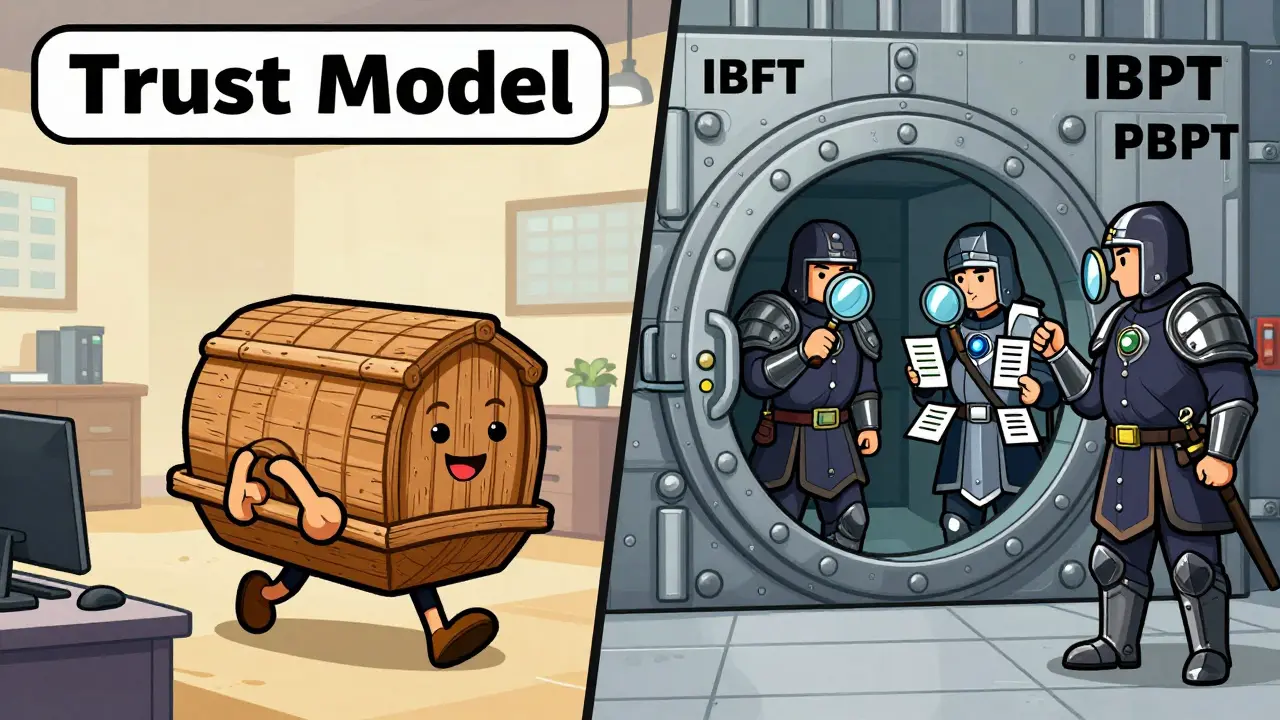
Don't pick based on the highest TPS number. Pick based on your trust model. Ask yourself these three questions:
- Who is running the nodes? If it's all your employees, use Raft. If it's partners you trust but don't control, use PoA. If it's competitors or regulators, you must use IBFT or PBFT.
- What is the cost of a mistake? In a healthcare or financial ledger, a single "Byzantine" error (fake data) could be catastrophic. BFT is non-negotiable here.
- How many validators do you actually need? If you have 100 validators, PoA will choke. You'll need a more robust BFT variant or a hybrid approach.
We are also seeing a shift toward "Consensus-as-a-Service." Some platforms now allow you to switch mechanisms dynamically. For example, you might use Raft for high-volume internal data and then switch to IBFT when settling a final transaction with an external partner. This hybrid approach can improve performance by up to 40% in mixed-workload environments.
What is the difference between BFT and CFT?
CFT (Crash Fault Tolerance) only protects the network if a node goes offline or crashes. BFT (Byzantine Fault Tolerance) protects the network even if a node is intentionally trying to deceive other nodes or send malicious data. Raft is CFT; IBFT and PBFT are BFT.
Can PoA be used in a public blockchain?
While some public chains use a version of it, PoA is primarily for permissioned networks. In a public setting, the centralization of choosing "authorized" validators usually contradicts the core goal of decentralization.
Why is Raft faster than IBFT?
Raft doesn't have to deal with the complex multi-round voting required to prove that no one is lying. It assumes everyone is honest and just needs to stay synchronized, which drastically reduces the communication overhead between nodes.
How long does it take to deploy these mechanisms?
PoA and Raft are relatively quick, often taking 1-3 weeks for a standard dev team. IBFT and PBFT are more complex, usually requiring 4-6 weeks and often necessitating external consultants to ensure the network doesn't collapse during validator rotations.
Which is the most energy-efficient?
All enterprise mechanisms (PoA, Raft, IBFT, PBFT) are incredibly energy-efficient compared to Proof-of-Work. PoA is among the lightest, consuming a tiny fraction (roughly 0.001%) of the power required by a network like Bitcoin.
Next Steps and Troubleshooting
If you're currently experiencing network lag or "consensus failures," check your validator set size. Many BFT networks become unstable once they exceed 50-100 nodes. If you've hit that limit, consider moving toward a modular or hybrid consensus profile.
For those in the planning phase, start by auditing your identity management. 72% of successful enterprise builds integrate with LDAP or Active Directory to manage their validator authentication. Without a solid identity layer, your consensus mechanism is just a fancy lock with no key.
The breakdown on Raft is spot on!!! Most people overlook the lack of BFT and just chase that TPS number, which is a huge mistake in a multi-party setup!!!
Imagine actually thinking a 'digital board of directors' in PoA is a great way to decentralize. Cute.
The shift toward Consensus-as-a-Service suggests a future where trust is no longer a static choice but a fluid variable based on the specific transaction risk profile.
This guide is such a lifesaver for teams starting out! 🚀 Definitely seeing more folks lean towards IBFT for those banking projects lately! ✨
Totally agree on the TPS stuff but we gotta talk about the latency overhead in PBFT because the three-phase commit is basically a bottleneck for real-time scalability and it just kills the throughput when you scale the node count too high!
Raft is just a glorified database sync.
Love how this explains BFT vs CFT so clearly! 💖 It's the kind of stuff that makes a huge difference in a project's success! 🌟
it is a wild ride trying to configure PBFT without a map and a prayer
It is quite regrettable that so many organizations prioritize speed over Byzantine fault tolerance in high-stakes environments. 🙄 One cannot simply ignore the potential for malicious actors when dealing with cross-border settlements.
for those struggling with the setup i recommend starting with a small validator set first then scaling up slowly once you verify the rotation logic
great points here. the mention of ldap integration is a real pro tip because without that identity layer the whole thing just falls apart during onboarding
The modularity of Hyperledger Fabric 2.5 is such a game-changer!!! Being able to pivot the consensus based on the channel's specific requirements is a total win for agility!!! 🚀✨
The data provided on PoA performance is marginally optimistic. In actual production environments, the dip in performance occurs much sooner than at 25 validators, often starting around 15 nodes due to network propagation delays that the author conveniently ignored. It is a common fallacy to believe that identity-based trust eliminates the need for rigorous latency analysis. Furthermore, the mention of Siemens is a anecdotal cherry-pick that doesn't account for the specific hardware specifications used in that instance. If one actually audits the throughput of these systems under load, the 300-500 TPS range is often a peak, not an average. One must consider the block size and the payload complexity, which this guide ignores. The lack of mention regarding the CAP theorem makes this analysis superficial at best. Most enterprise architects would find these generalizations insufficient for a real deployment strategy. It's typical to see these high-level guides ignore the nuance of state machine replication. The author's simplification of BFT versus CFT is acceptable for beginners but insulting to professionals. One should focus on the mathematical probability of failure rather than vague descriptors like 'finicky.' The entire premise of 'Consensus-as-a-Service' is a marketing buzzword that lacks technical depth in this context. It is frankly disappointing to see such a lack of rigorous benchmarking data accompanying these claims. The guide fails to address the trade-offs between safety and liveness in a partitioned network. In conclusion, while the guide is a decent primer for a manager, it is useless for an engineer.
I think we can all agree that starting with a simple PoA setup is a great way to learn the ropes before moving to something more complex!
the comparison table is really helpful for a quick overview
This is such a fantastic guide!!! Really clears up the confusion between the different protocols!!! Thanks for sharing!!!