

Imagine waking up to a massive profit on your Bitcoin trade, only to realize half of it belongs to the government. Or worse, you’re trying to move funds to an exchange, and your bank freezes your account because they don’t understand where the money came from. For many traders in 2024, this was the daily reality. But as we look at the landscape in 2025, the game has changed. The global cryptocurrency market capitalization hit $3.96 trillion in September 2025, a staggering 296% growth since mid-2022. With that money comes scrutiny, but also opportunity.
The "best" country for crypto trading isn't just about low taxes anymore. It’s about finding the sweet spot between regulatory clarity, banking access, and infrastructure. You need a place where the rules are written down, not whispered in backrooms, and where you can actually move your money without jumping through twenty hoops. Whether you're a high-net-worth individual looking to relocate or a startup founder seeking a launchpad, the jurisdiction you choose dictates your success.
The New Gold Standard: Switzerland and the DLT Act
If you ask experts who sets the tone for crypto regulation, most will point to Switzerland. It’s not just hype; it’s law. The Swiss Federal Act on the Adaptation of Federal Law to Developments in Distributed Ledger Technology (DLT Act) came into effect on February 1, 2021, and it remains the gold standard in 2025. This legislation provides comprehensive legal certainty for blockchain operations, something many other countries are still chasing.
The Swiss Financial Market Supervisory Authority (FINMA) mandates strict segregation of staked crypto assets. Why does this matter? Because if an exchange goes bankrupt, your staked tokens are protected. That’s investor protection that works. From a tax perspective, Switzerland imposes no capital gains tax on long-term personal crypto investments. If you’re a professional trader, you face standard cantonal corporate tax rates ranging from 12% to 15%. The Canton of Zug, often called "Crypto Valley," hosts over 1,000 blockchain companies, including the Ethereum Foundation and Cardano. Here, the average corporate tax rate for crypto businesses is just 13.67%.
Dr. Garrick Hileman, Head of Research at Blockchain.com, noted in a Q2 2025 CoinDesk report that Switzerland’s approach represents the "gold standard for balancing innovation with investor protection." Over 40 countries have partially adopted this template. However, there’s a catch. Navigating cantonal variations requires effort. A June 2025 thread on Bitcointalk highlighted that while Zug offers 0% capital gains tax for certain structures, Geneva applies a hefty 24%. You need to know exactly where you’re registered.
The UAE: Speed, Zero Tax, and VARA
If Switzerland is the careful architect, the United Arab Emirates is the sprinter. In March 2022, the UAE implemented its Virtual Assets Regulatory Framework (VARA), establishing the world’s first dedicated virtual assets regulator. In 2025, the UAE ranks #1 for regulatory clarity according to Sumsub’s industry report. What does that mean for you? Certainty. You know the rules before you start playing.
The biggest draw? Zero corporate and personal tax on crypto trading. No capital gains tax. No income tax on your profits. But speed is the real killer feature here. VARA processes license applications within 30-45 days. Compare that to 6-12 months in EU jurisdictions, and you see why startups flock to Dubai. Trustpilot reviews for exchanges operating in the UAE highlight a "24-hour license approval process for business accounts" at Abu Dhabi Digital Assets Reality (AD DART).
However, it’s not free. Maintaining a VARA license requires minimum operational costs of AED 1.2 million ($326,000) annually, including mandatory AED 500,000 ($136,000) in professional indemnity insurance. The Cambridge Centre for Alternative Finance rated the VARA framework 92/100 for regulatory clarity, noting its comprehensive licensing categories covering 19 distinct virtual asset activities. If you have the capital, the UAE offers unmatched efficiency and tax benefits.
Singapore: Infrastructure Powerhouse with High Barriers
Singapore has long been Asia’s financial heart, and in 2025, it remains a top tier choice for those who prioritize stability and infrastructure over pure tax avoidance. The Monetary Authority of Singapore (MAS) enforces no capital gains tax for individual investors. For firms, the corporate tax rate is 17%, but there are numerous incentives for qualifying entities.
The infrastructure here is unbeatable. According to CoinGecko’s 2025 infrastructure report, Singapore boasts 99.99% exchange uptime. Its internet infrastructure supports average exchange API response times of 127ms, compared to 342ms in places like El Salvador. For high-frequency traders, those milliseconds matter. The MAS licensing process is transparent, praised by 68% of professional traders in the Chainalysis 2025 User Experience Report.
But the barrier to entry is steep. To get a Major Payment Institution license under the Payment Services Act (2019), you need a minimum paid-up capital of SGD 1 million ($740,000). For startups, this is prohibitive. Navigating MAS requirements demands approximately 95 hours of regulatory study, according to TokenInsight’s 2025 Crypto Trader Survey. Singapore is for those who want to play in the big leagues and can afford the ticket price.

Portugal: The Tax Haven with a Long Wait
For individual traders, Portugal has been a magnet. The country offers exceptional tax advantages, with zero taxation on crypto gains for individuals. This simple benefit has driven thousands to seek residency. But in 2025, the path to getting there is longer than ever.
The Golden Visa program requires a €500,000 investment, typically in real estate. According to SEF (Serviço de Estrangeiros e Fronteiras) data from 2025, processing times stretch to 18-24 months. One user on Reddit’s r/cryptoforeign subreddit detailed their experience: "After investing €500,000 in a Lisbon apartment... I've saved approximately €38,000 annually on crypto taxes compared to my previous US residency, though the bureaucratic process took 22 months." It’s a classic trade-off: upfront cost and time for long-term savings.
Portugal is ideal if you’re patient and have significant capital to deploy. It’s less suitable for agile startups needing quick setup. Also, keep an eye on policy shifts. While the current regime is favorable, political landscapes change, and relying solely on tax breaks carries risk if laws tighten.
The Wildcards: Ukraine, Moldova, and Eastern Europe
When people talk about "best countries," they usually mean wealthy hubs. But Chainalysis’ 2025 Global Crypto Adoption Index tells a different story. Ukraine ranks #1 globally, leading in retail centralized service value received and DeFi value received. Moldova sits at #2. These nations show immense organic adoption relative to their population and economy.
Why the surge? Necessity drives innovation. With traditional banking systems strained by conflict, citizens turned to crypto for remittances and savings. Slovenia leads in trading volume per crypto owner at $240,000 per individual, according to Multipolitan’s 2025 report. However, these regions come with caveats. Banking integration is tough. Only 37% of local crypto businesses in Eastern Europe can establish traditional banking relationships, per 2025 Chainalysis data. Operational instability remains a concern. If you’re looking for a base for a global enterprise, the infrastructure gaps might outweigh the adoption metrics.
Comparison Table: Top Jurisdictions for Crypto Trading in 2025
| Country | Personal Capital Gains Tax | Corporate Tax Rate | Regulatory Clarity Score (Sumsub) | License Processing Time | Key Requirement/Cost |
|---|---|---|---|---|---|
| Switzerland | 0% (Long-term) | 12-15% | High | 3-6 Months | Cantonal variation; CHF 250k lump-sum option |
| UAE | 0% | 0% | #1 | 30-45 Days | AED 1.2M annual opex for VARA license |
| Singapore | 0% | 17% | #3 | 6-12 Months | SGD 1M minimum paid-up capital |
| Portugal | 0% | 21% | Moderate | 18-24 Months (Visa) | €500k investment for Golden Visa |
| USA (Wyoming) | 0-37% (Federal) | Varies | Low-Moderate | Variable | Complex IRS property rules |
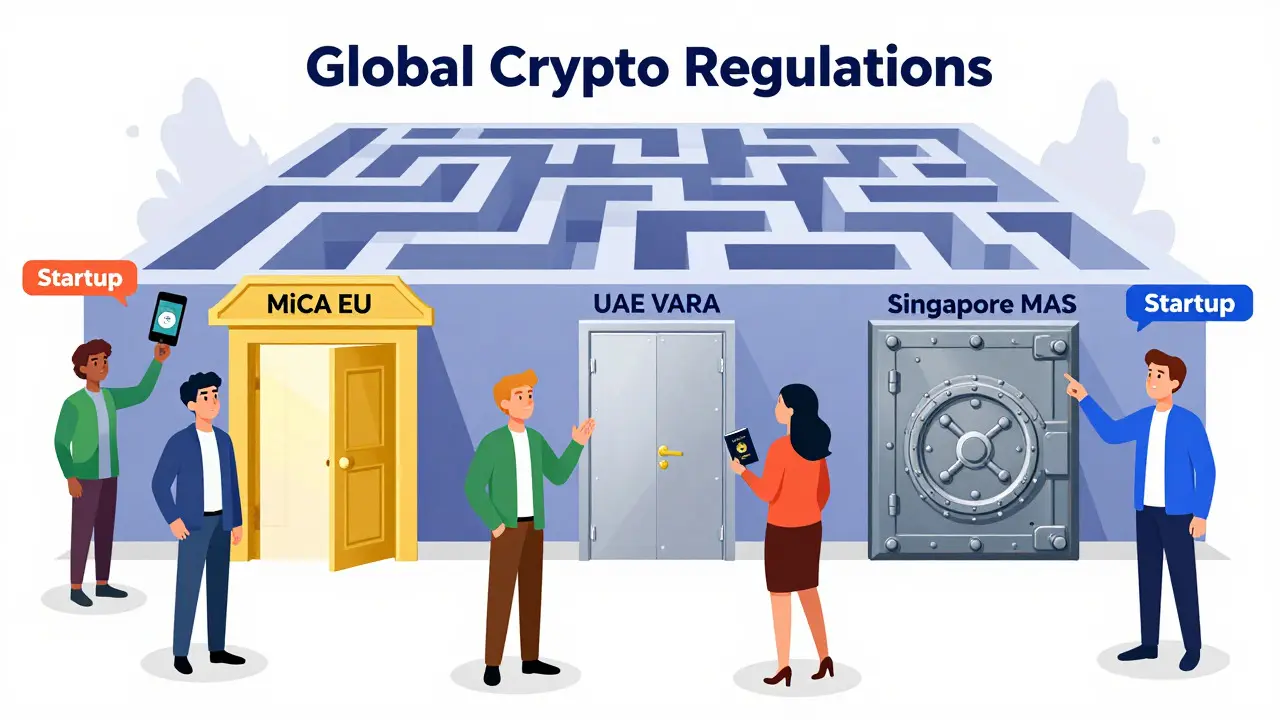
The EU Context: MiCA Changes Everything
You can’t talk about crypto in 2025 without mentioning MiCA (Markets in Crypto-Assets Regulation). Fully implemented in June 2025, MiCA standardized crypto regulations across 27 EU member states. This reduced compliance costs by 37% for pan-European operators, according to PwC’s 2025 Crypto Regulation Cost Analysis. Before MiCA, navigating France, Germany, and Italy meant three different rulebooks. Now, one license works everywhere.
The European Central Bank’s January 2025 Financial Stability Review noted that MiCA implementation has reduced regulatory arbitrage, with 78% of previously unregulated crypto firms now seeking licenses. If you’re operating in Europe, pick a hub like Lithuania or Malta for easier onboarding, knowing your license scales across the bloc. The Transfer of Funds Regulation (TFR) implementation in July 2025 further standardized travel rule compliance, reducing cross-border transaction costs by 22%.
Practical Steps: How to Choose Your Base
Choosing a jurisdiction isn’t just about picking the lowest tax. It’s about matching your profile to the environment. Here’s a decision tree based on common trader personas:
- The High-Net-Worth Individual: If you have >$1M to invest and want zero tax, look at the UAE Investor Visa (AED 750,000 / $204,000 requirement, 30-60 day processing) or Portugal’s Golden Visa (if you can wait 2 years). Switzerland’s lump-sum taxation (approx. CHF 250,000/year) is another elite option.
- The Startup Founder: If you need speed and clarity, go to the UAE. VARA’s 30-45 day timeline beats EU alternatives. If you have deep pockets and want Asian markets, Singapore is the play, but budget for the SGD 1M capital requirement.
- The Solo Trader: If you’re trading personally, Portugal or Switzerland offer great personal tax benefits. Ensure you structure holdings correctly to qualify for long-term exemptions.
- The Institutional Player: Look at the EU post-MiCA. The standardized framework reduces friction for cross-border operations. Switzerland remains strong for banking integration, with 68% of crypto businesses maintaining functional banking relationships, led by specialized banks like Sygnum and SEBA Bank.
Remember, banking integration remains a global pain point. Only 41% of crypto businesses in top 20 jurisdictions maintain functional banking relationships. Always verify banking access before committing to a jurisdiction. A low tax rate means nothing if you can’t move your fiat.
Future Outlook: Where Are We Heading?
The landscape is evolving rapidly. The World Economic Forum’s June 2025 Crypto Outlook predicts that by 2027, 65% of G20 countries will have comprehensive crypto regulatory frameworks, up from 42% in 2025. Asia-Pacific is poised to surpass Europe as the dominant hub. Meanwhile, the IMF warns that continued regulatory fragmentation could increase compliance costs by up to 30% for global operators if international standards fail to converge by 2026.
Innovations continue to drive adoption. Switzerland is expanding its DLT framework to cover decentralized autonomous organizations (DAOs) by Q3 2025. Singapore’s Project Guardian is testing cross-border tokenized asset settlements involving 17 major financial institutions. Canada’s new stablecoin reserve framework, implemented in January 2025, has already attracted 23 issuers. Stay agile. The rules will keep changing, and the winners will be those who adapt fastest.
Which country has the lowest tax on crypto trading in 2025?
The United Arab Emirates (UAE) offers 0% corporate and personal tax on crypto trading. Portugal and Switzerland also offer 0% capital gains tax for individuals under specific conditions (long-term holding in Switzerland, residency in Portugal).
Is it easy to get a crypto license in the UAE?
Yes, compared to other regions. VARA processes applications in 30-45 days. However, the operational costs are high, requiring a minimum of AED 1.2 million annually for compliance and insurance.
How does MiCA affect crypto trading in Europe?
MiCA, fully implemented in June 2025, standardizes regulations across 27 EU member states. This reduces compliance costs by 37% for pan-European operators and allows a single license to operate across the bloc.
What is the best country for crypto startups?
For speed and clarity, the UAE is top-rated. For infrastructure and Asian market access, Singapore is ideal but requires higher capital (SGD 1 million). Switzerland offers strong legal protections but has a slower setup process.
Can I avoid crypto taxes by moving to Portugal?
Yes, Portugal offers 0% tax on crypto gains for residents. However, obtaining residency via the Golden Visa requires a €500,000 investment and takes 18-24 months to process.
Why is Ukraine ranked #1 in crypto adoption?
According to Chainalysis' 2025 index, Ukraine leads in retail and DeFi value received due to high organic usage driven by economic necessity and remittance needs, despite banking integration challenges.
What are the banking challenges for crypto businesses?
Globally, only 41% of crypto businesses in top jurisdictions maintain functional banking relationships. Switzerland leads at 68% due to specialized crypto-friendly banks like Sygnum and SEBA Bank.