
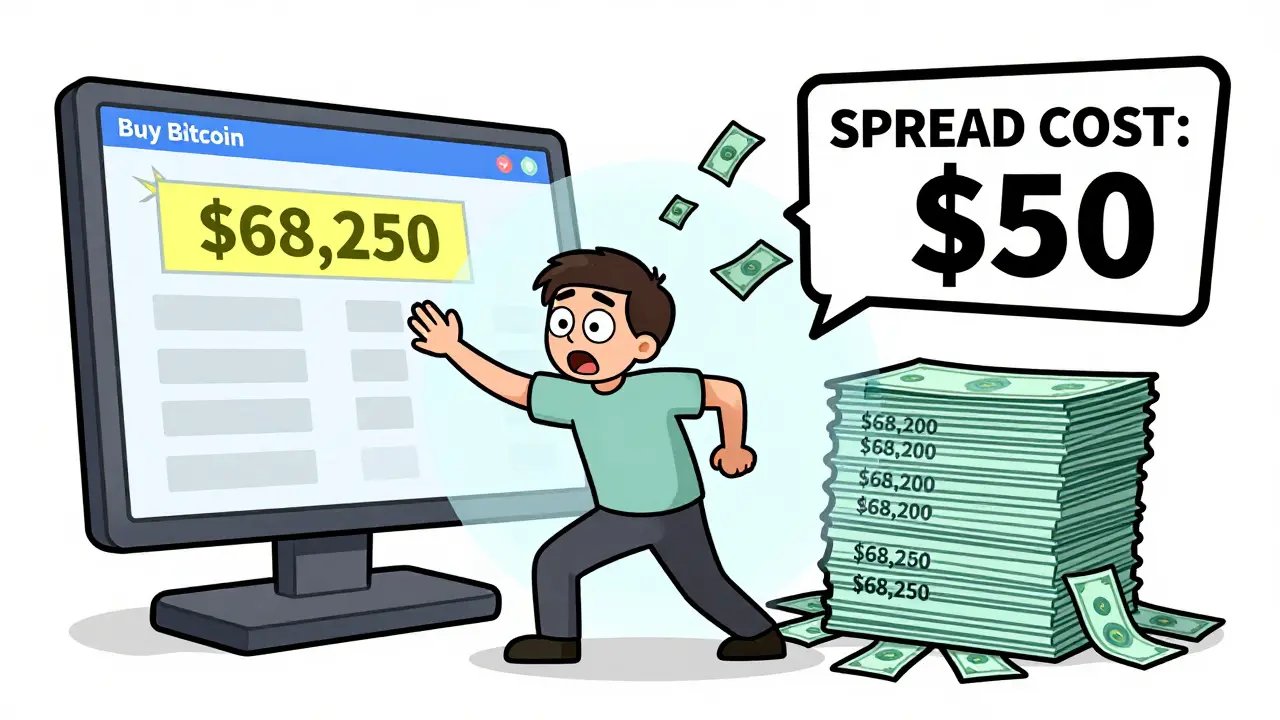
When you buy or sell crypto, you don’t always get the price you see on the screen. That’s because there’s a hidden cost built into every trade called the bid-ask spread. It’s not a fee you pay directly - it’s a gap between what buyers are willing to pay and what sellers are willing to accept. And if you don’t understand it, you’re losing money without even realizing it.
What Exactly Is the Bid-Ask Spread?
Every cryptocurrency market has two sides: buyers and sellers. The bid price is the highest price someone is currently offering to buy. The ask price is the lowest price someone is willing to sell for. The difference between those two numbers? That’s the bid-ask spread.For example, if Bitcoin’s bid price is $68,200 and the ask price is $68,250, the spread is $50. That $50 gap is the cost of trading right now. If you buy at $68,250 and immediately sell, you’d lose $50 - not because of a fee, but because of how the market is structured.
This spread exists because markets don’t have a single price. They’re made up of thousands of individual orders. When you place a market order, you’re not trading with the price you see - you’re taking the best available offer. That’s why your buy price might be higher than expected, and your sell price lower.
How to Calculate the Spread Percentage
To compare spreads across different coins, traders use a simple formula:Bid-Ask Spread Percentage = (Ask Price − Bid Price) / Ask Price × 100%
Using the Bitcoin example above: ($68,250 − $68,200) / $68,250 × 100% = 0.073%. That’s a tiny spread - which means Bitcoin is highly liquid. But if you look at a lesser-known altcoin with a bid of $0.0012 and an ask of $0.0015, the spread is $0.0003. The percentage? ($0.0015 − $0.0012) / $0.0015 × 100% = 20%. That’s a massive cost to trade.
That’s why you can’t just compare dollar values. A $1 spread on a $100 coin is different than a $1 spread on a $2 coin. Percentages tell you the real cost.
Liquidity Is the Key Driver
The wider the spread, the less liquid the market. Liquidity means how easily you can buy or sell without moving the price. High liquidity = tight spreads. Low liquidity = wide spreads.Bitcoin and Ethereum consistently have the tightest spreads because they’re traded everywhere - on hundreds of exchanges, by institutions, and retail traders alike. Their daily trading volume often exceeds $20 billion. That means thousands of orders are sitting just pennies apart.
Now take a new token with $5 million in daily volume. You might see a bid at $0.0008 and an ask at $0.0012. That’s a 50% spread. If you try to buy $1,000 worth, you might end up paying 20% more than you expected because the order book is shallow. And if you sell? You’ll get less than the last price you saw.
This is why smart traders avoid low-volume coins unless they’re willing to accept high costs. The spread isn’t just a number - it’s a barrier to profit.
Why Spreads Widen During Volatility
When news breaks - a regulatory crackdown, a major exchange hack, or a big whale moving coins - spreads expand rapidly. Why? Because no one wants to be the first to quote a price.Buyers get nervous. Sellers hold back. Market makers pull their orders. The result? The bid drops. The ask jumps. The spread doubles or triples.
During the 2022 Terra Luna collapse, some altcoins saw spreads jump from 2% to over 15% in minutes. Traders who placed market orders lost huge chunks of capital not because the price crashed - but because they bought at the top of a bloated ask price.
That’s why experienced traders wait. They watch the order book. They avoid market orders during spikes. They use limit orders to control their entry and exit points - even if it means waiting hours for a fill.
Exchange Differences Matter
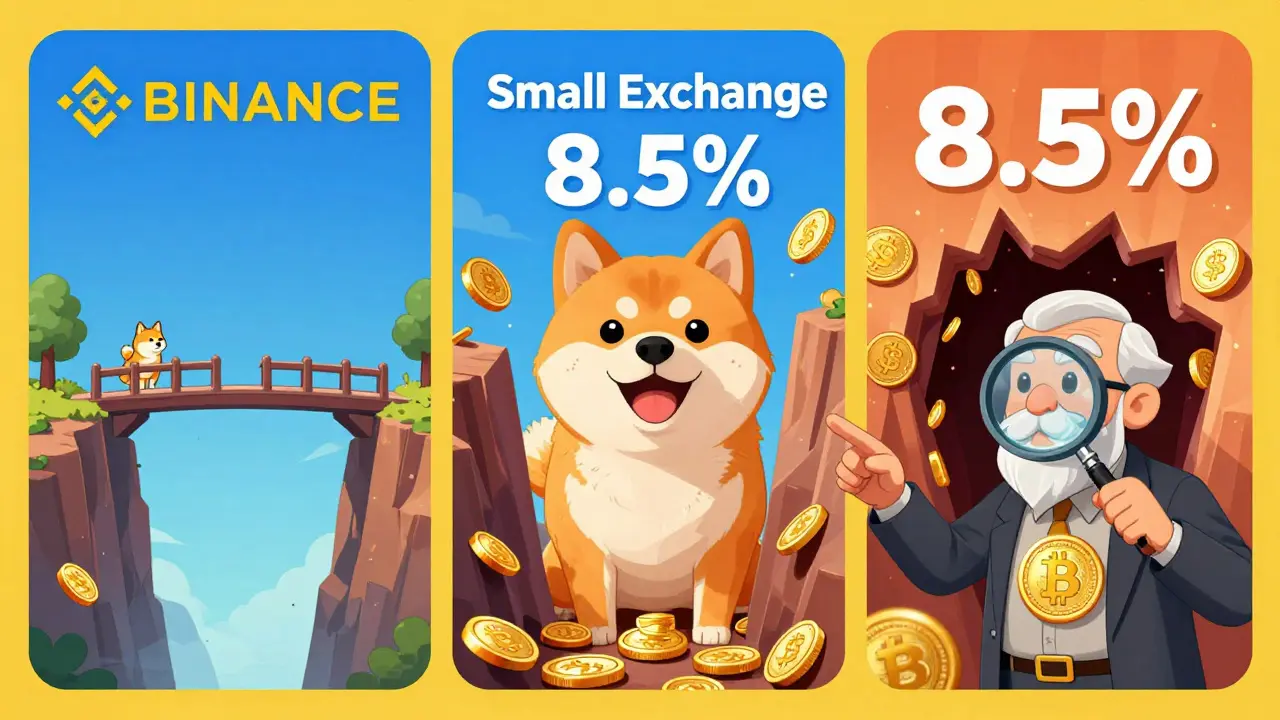
Not all exchanges are equal. Binance, Coinbase, and Kraken typically have tighter spreads than smaller platforms. Why? They have more users, deeper order books, and often employ professional market makers who profit by narrowing the gap.Smaller exchanges? They might have no market makers at all. Just retail traders placing random orders. That leads to gaps of 5%, 10%, even 20% on some tokens.
Here’s a quick comparison of average bid-ask spreads on major coins across different platforms (as of early 2026):
| Cryptocurrency | Binance | Coinbase | Kraken | Small Exchange (avg.) |
|---|---|---|---|---|
| Bitcoin (BTC) | 0.05% | 0.08% | 0.10% | 0.50% |
| Ethereum (ETH) | 0.07% | 0.10% | 0.12% | 0.80% |
| Solana (SOL) | 0.15% | 0.20% | 0.25% | 2.10% |
| Shiba Inu (SHIB) | 0.50% | 0.70% | 0.90% | 8.50% |
Notice how the spread on SHIB is 17 times wider on a small exchange than on Binance. That’s not a coincidence - it’s a direct result of liquidity.
Slippage vs. Spread - Don’t Confuse Them
You’ll often hear traders talk about slippage. It’s not the same as the spread.The spread is the static gap between bid and ask. Slippage is what happens when your order moves the market.
Example: You want to buy 100 BTC at $68,200. But the order book only has 20 BTC at that price. So your order eats through the next 80 BTC at $68,250, $68,300, and so on. Your average price ends up at $68,400. That’s slippage - your order pushed the price up.
Slippage is worse when the market is thin. The spread tells you the cost of a single trade. Slippage tells you the cost of a big trade.
Both matter. But if you’re trading small amounts, the spread is your main enemy. If you’re moving large sums, slippage becomes the killer.
How to Trade Smarter Around the Spread
Here’s what actually works:- Use limit orders - Don’t use market orders unless you’re in a hurry. Place your buy order between the bid and ask. You might wait a few minutes, but you’ll avoid paying the full spread.
- Check multiple exchanges - The same coin can have wildly different spreads. Use a tool or manually compare the order book on Binance, Kraken, and Coinbase.
- Avoid low-volume coins - If a coin trades less than $10 million a day, assume the spread is eating 1-5% of your profit.
- Trade during high-volume hours - UTC 12:00-16:00 and 20:00-24:00 see the most activity. Spreads tighten then.
- Track spreads over time - If a coin’s spread suddenly widens, something’s wrong. Maybe liquidity is drying up. Maybe it’s about to crash. Watch it.
The Bigger Picture
The bid-ask spread isn’t just a trading detail - it’s a window into market health. Tight spreads mean confidence. Wide spreads mean fear or neglect.Institutional investors are slowly bringing more liquidity to crypto. That’s why Bitcoin’s spread has dropped from 0.3% in 2020 to under 0.08% today. But most altcoins? They’re still stuck in the wild west.
Understand the spread, and you stop guessing. You start calculating. You stop losing money on hidden costs - and start making smarter trades.
this is sooo true 😍 i just lost $200 on shib because i used a market order 🥲 thanks for the breakdown!
they dont want you to know this. the exchanges are rigged. the spread is a tax they hide in plain sight. you think you're trading crypto but you're just feeding the machine.
the bid-ask spread is fundamentally a manifestation of ontological uncertainty in decentralized liquidity markets. the ask represents the epistemic limit of seller confidence, while the bid is the emergent consensus of buyer risk aversion. it's not a cost-it's a quantum state of market perception.
Great explanation! I’ve always told new traders: if you’re not using limit orders, you’re giving free money to the market makers. Especially on altcoins. I check the order book on 3 exchanges before I even think about trading. Small moves save big money over time.
lol this is such bs. everyone knows spreads are a myth. the real cost is the exchange fee. why are you even writing this? you're just fearmongering to get ad clicks. i made 500k last year and never even looked at the bid-ask. you're all overthinking it.
This is such a game-changer for new traders. I used to be the guy who just slapped market orders everywhere. Once I started watching spreads and using limits, my win rate jumped. You’re not just saving pennies-you’re protecting your whole strategy. Keep sharing this stuff!
i never knew spread was so important i just buy when price go up sell when go down. now i check bid ask on binance first. thanks for teach me
Oh my god this is so basic. Like, why is this even an article? I’ve been telling people this since 2021. And now you’re writing a 10-section essay like it’s groundbreaking? Also, why is Solana at 0.15% on Binance? That’s a lie. I’ve seen it hit 0.5% at least 3 times last week. You’re outdated.
Thank you for sharing this insightful guide. In India, many new traders overlook spreads entirely and end up frustrated with losses they can’t explain. This clarity helps bridge the gap between theory and practice. I will share this with my students tomorrow.
i mean... like... why do we even care? it’s just crypto. you’re overthinking it. i just buy low, sell high. who cares if the spread is 0.07% or 8%? i’m not here to be a trader. i’m here to vibe. 🤷♂️
I don't know why people are so shocked. The spread? It's always been there. Always. And if you're trading on a small exchange? You deserve to lose. You're not even trying. I saw a guy lose $400 on a 12% spread on some meme coin. He cried. I laughed. It's called karma.
Honestly, this is elementary. If you don’t understand bid-ask spreads, you shouldn’t be trading at all. You’re not a trader-you’re a gambler with a spreadsheet. And let’s be real: most altcoins shouldn’t even exist. The spread is the market’s way of saying, ‘Go back to school.’
I never realized how much I was losing until I started tracking spreads. Now I use a simple script to alert me when a coin’s spread exceeds 0.5%. Saved me over $1k last year. Small habits, big results.
I’ve been trading for 6 years and this still surprised me. I thought I knew everything about liquidity. But seeing the spread comparison between Binance and small exchanges? Eye-opening. I’ve started routing all my altcoin trades through Kraken now. Much better fills. Thanks for the data.
why do americans make everything so complicated. in india we just trade. no spreads no limits no math. if you want to be rich you dont need to understand this. you need to believe. and buy when everyone is scared. thats how we win.
I used to ignore this stuff. Now I check spreads before every trade. It’s weird how much it changes your mindset. Like, suddenly you’re not just chasing pumps-you’re thinking like a market participant. Small shift, huge difference.