
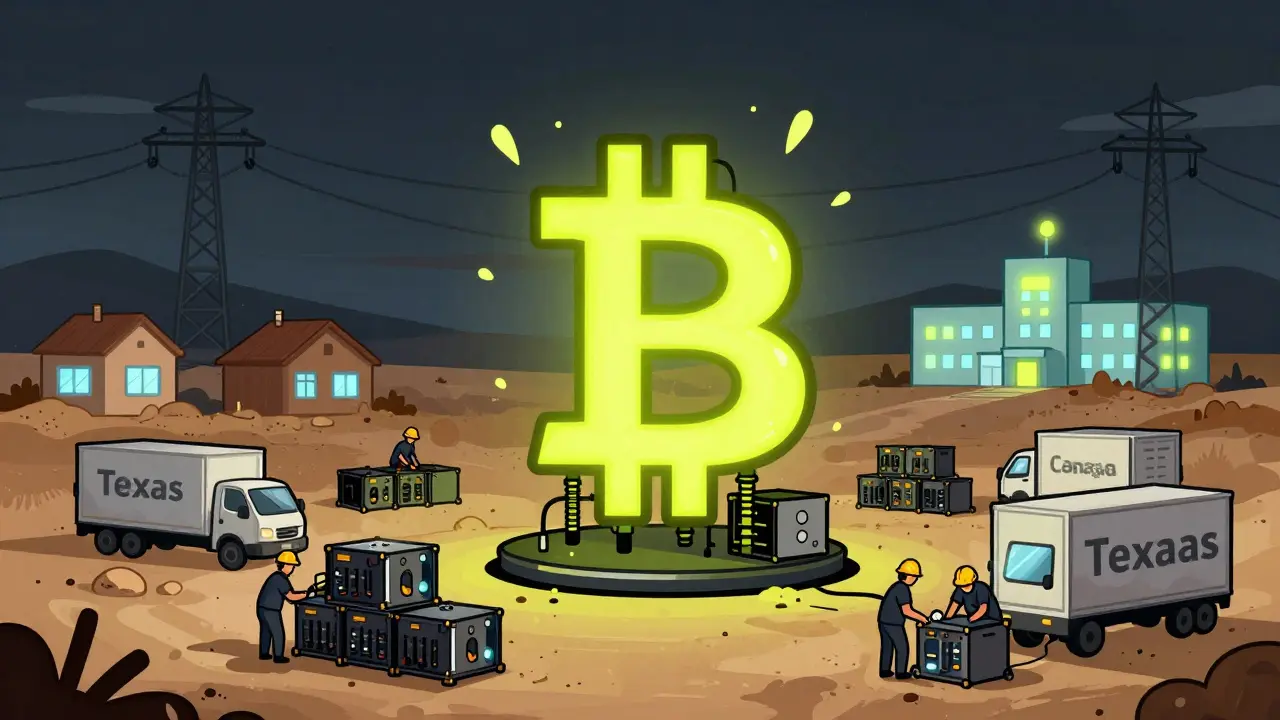
Bitcoin’s network hash rate hit over 1.041 billion terahashes per second in September 2025 - a record that surprised even seasoned observers. But behind that number is a quiet revolution: miners are pulling out of Kazakhstan in droves, and the world’s mining map is being redrawn.
Why Kazakhstan Was a Mining Magnet
Kazakhstan didn’t become a top-three Bitcoin mining hub by accident. After the Soviet Union collapsed, the country inherited massive power plants and cheap coal. By 2018, miners started showing up. The town of Ekibastuz, with its abandoned Soviet-era power stations, became ground zero. Electricity cost as low as $0.02 per kWh. No permits, no questions asked. For a few years, it was the wild west of mining. By 2021, Kazakhstan had climbed to second place globally, controlling nearly 18% of Bitcoin’s total computing power. It wasn’t just small-time operators - big players like Bitfury and Marathon Digital had data centers there. The government didn’t regulate much, but they didn’t stop it either. Mining was seen as a way to use surplus power and bring in foreign investment.The Crackdown Begins
But when mining started using 7% of the country’s entire electricity supply, things changed. Winter came. Homes froze. Hospitals lost power. Protests erupted in early 2022. The government didn’t shut mining down overnight - they throttled it. Grid operators started cutting power to mining farms during peak demand. Some operations lost electricity for days. Others got lucky and kept running on diesel backups, but costs ballooned. The real turning point wasn’t a law. It was a blackout. When a major mining cluster in southern Kazakhstan caused a regional grid failure, the message was clear: miners were a liability, not a partner. By mid-2023, the government started requiring mining companies to sign formal contracts, pay grid fees, and prove they weren’t stealing power. Many couldn’t - or wouldn’t - comply.The Exodus: Canaan’s Exit and the Domino Effect
In July 2025, Canaan - one of the world’s largest Bitcoin miner manufacturers - made it official. They shut down their entire Kazakhstan operation. Their hashrate dropped from 6.67 EH/s to 5.56 EH/s in just two months. They didn’t blame the market. They didn’t blame the price. They blamed the instability. Canaan moved 3,200 ASIC miners out of Kazakhstan. Half went to Texas. The other half to Georgia and Paraguay. They reported mining 89 BTC in July 2025 - down from 112 BTC in May. The loss wasn’t just in power. It was in predictability. Miners need consistent energy. Not a gamble. Canaan wasn’t alone. Smaller operators started packing up too. Some sold their machines at a loss. Others leased them to operators in the U.S. and Canada. The migration wasn’t chaotic - it was strategic. Companies didn’t abandon Kazakhstan because it was bad. They left because it became too risky.
Where the Hash Rate Is Going Now
The U.S. is the big winner. As of late 2025, American mining operations control 35.4% of Bitcoin’s total hashrate. Texas alone accounts for nearly 20% of that. Why? Reliable grid access, clear tax rules, and a business-friendly environment. Even Texas’s notorious heatwaves haven’t stopped miners - they’ve just pushed them to use more efficient hardware and better cooling systems. Canada’s share jumped to 9.6%. Ontario and Quebec, with their cheap hydroelectric power, are now hotspots. Miners there don’t just survive - they thrive. Some even sell excess heat to greenhouses and district heating systems. China’s comeback is real, but quiet. After the 2021 ban, China’s mining vanished overnight. Now, it’s back - but mostly in the shadows. Smaller, decentralized operations in Sichuan and Inner Mongolia are using seasonal hydropower. They don’t report their numbers, but analysts estimate they’re holding steady at around 12% of global hashrate. Other players? Iran, with its subsidized electricity, holds 2.3%. Germany and Malaysia are holding their ground with regulated, low-carbon mining. But none are growing fast. The real action is in North America.Kazakhstan Isn’t Gone - Just Changed
Don’t write Kazakhstan off yet. It still holds 14.8% of Bitcoin’s hashrate - more than Russia, Germany, or Iran combined. The government didn’t give up. They changed tactics. In early 2025, they launched a 70/30 energy rule: 70% of new thermal power plant output goes to the national grid. Only 30% is allowed for crypto mining. It’s not a ban. It’s a cap. And it’s working. Grid blackouts have dropped by 82% since the rule started. They’ve also cracked down on illegal mining. In Q1 2025 alone, Kazakh banks blocked 15,800 unauthorized crypto transactions worth $3.07 million. That’s not just enforcement - it’s signaling. The state wants to be in control, not on the sidelines. Some miners still operate there. But they’re not the ones with 10,000 machines. They’re the small, agile players - the ones who can pivot fast when the lights flicker. The big corporations? They’ve moved on.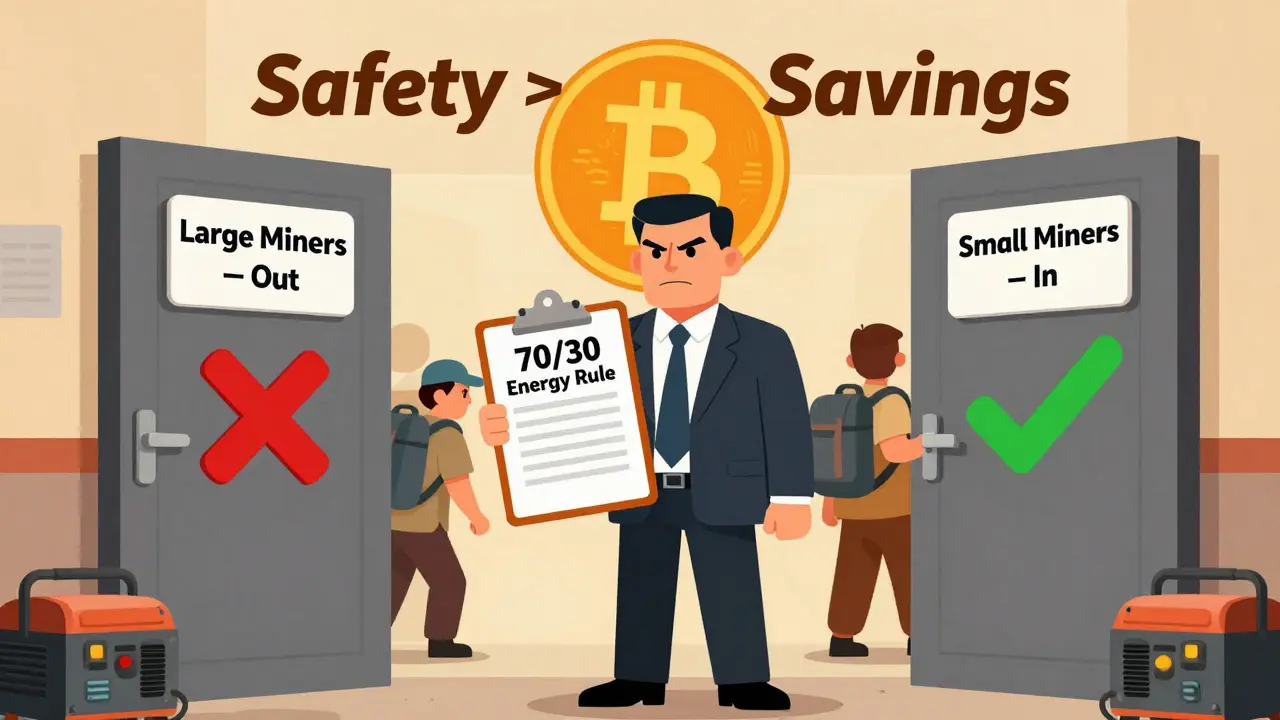
What This Means for Bitcoin’s Future
The migration from Kazakhstan isn’t a crisis. It’s a correction. Bitcoin’s network hashrate keeps rising - even as miners leave one country and enter another. That’s a sign of strength, not weakness. Why? Because Bitcoin’s security depends on distributed computing power. When one region becomes unstable, miners move. The network adapts. That’s the point. This shift also tells institutional investors something important: Bitcoin mining is becoming a real asset class. Companies aren’t just buying hardware. They’re buying location, reliability, and legal clarity. They’re treating mining like a utility - not a gamble. The U.S. isn’t winning because it’s better. It’s winning because it’s predictable. Miners don’t need the cheapest power. They need the most consistent power.What’s Next for Kazakhstan?
Kazakhstan’s leaders know they can’t compete on price anymore. So they’re trying to compete on structure. They’re building data centers with direct power lines. They’re negotiating long-term energy contracts with mining firms. They’re even talking about creating a crypto-friendly zone near the Chinese border. Will they regain their former glory? Unlikely. But they don’t need to. They just need to stay relevant. And with 14.8% of the hash rate still running through their wires, they’re not going anywhere. The lesson? Mining isn’t about where the electricity is cheapest. It’s about where it’s safest. And right now, safety is worth more than savings.Is Kazakhstan Still a Viable Mining Location?
Yes - but only for the right kind of miner. If you’re a small operator with backup generators, a flexible schedule, and a tolerance for risk, Kazakhstan might still work. If you’re managing institutional capital or running a public company? No. The risk-reward ratio is too tight. The miners who stayed are the ones who treat Bitcoin like a long-term bet - not a short-term cash grab. They’re not chasing the next price spike. They’re betting on the network’s resilience. And that’s exactly what Bitcoin needs.Why did miners leave Kazakhstan?
Miners left Kazakhstan because of unreliable power supply, government-imposed energy caps, and regulatory uncertainty. After mining operations consumed 7% of the country’s electricity in 2021, widespread blackouts forced the government to restrict mining access. Companies like Canaan pulled out in 2025 because they needed stable, predictable energy to run their operations profitably.
How much hash rate did Kazakhstan lose?
Kazakhstan’s share of global Bitcoin hash rate dropped from a peak of nearly 18% in 2021 to 14.8% in 2025. While that’s still the third-largest share globally, the decline was sharp between 2022 and 2025, especially after major operators like Canaan exited. The country lost an estimated 1.2 EH/s of hash rate during that period.
Where are the miners going now?
Most miners from Kazakhstan are relocating to the United States - especially Texas - which now controls 35.4% of global Bitcoin hash rate. Canada, with its cheap hydroelectric power, is also gaining ground at 9.6%. Smaller numbers are moving to Georgia, Paraguay, and parts of China where energy is more stable and regulations are clearer.
Is Kazakhstan’s crypto mining industry dead?
No. Kazakhstan still holds 14.8% of Bitcoin’s global hash rate, making it the third-largest mining hub. The government has shifted from laissez-faire to regulated control, limiting mining to 30% of new power plant output. Small, agile miners still operate there, but large institutional players have largely moved on.
How does hash rate migration affect Bitcoin’s security?
Bitcoin’s security improves when hash rate is distributed across multiple countries. The migration from Kazakhstan didn’t reduce total network security - it redistributed it. With more miners in the U.S. and Canada, the network is now more geographically diverse and harder to disrupt. A single country can’t easily shut down the entire network anymore.
Will Kazakhstan ever regain its top mining status?
It’s unlikely. The U.S. and Canada have built infrastructure and regulatory clarity that Kazakhstan can’t easily match. Kazakhstan’s new 70/30 energy rule limits growth. While it may remain a solid mid-tier mining hub, it won’t return to its 2021 peak unless it radically changes its energy policy - something political and economic constraints make difficult.
Kazakhstan didn't die, it just got a stern talking-to from its own grid. Miners left not because Bitcoin failed, but because the lights kept flickering like a bad Netflix stream. Texas? More like Texas Wins.
And honestly? I'm glad. Mining shouldn't be a survival game. It should be a utility.
Interesting how the network just... adapts. No central authority, no panic, just miners packing up and moving to where the power’s reliable. It’s like watching a swarm of bees relocate after a storm. The hive doesn’t break - it just finds a new tree.
And honestly, that’s the beauty of Bitcoin. It’s not about where you mine. It’s about whether you can keep mining.
Yall act like Kazakhstan was some golden land of free power but let me tell you something - they were stealing from grandmas’ heaters and hospitals to keep ASICs running. Now they got rules? Good. Let the big boys go cry in Texas while real miners build stuff that lasts
China’s back and they ain’t even telling anyone. That’s the real story here
I mean... it’s kinda funny. We spent years talking about how cheap power in Kazakhstan was the future. Now it’s just... a cautionary tale. The real winner isn’t Texas. It’s the miners who had the foresight to move before the government turned the screws.
Still, 14.8%? That’s not dead. That’s just... quietly waiting.
So Kazakhstan’s like that one friend who lets you borrow their car... until you crash it into a tree. Now they’re like, ‘Nope, you can have the keys back if you pay me $200 a month and only drive on Tuesdays.’
Meanwhile, Texas is just like, ‘Here’s the keys. Also, here’s a beer. And a fan. Go nuts.’
This is all a distraction. The U.S. government didn’t ‘invite’ miners - they quietly bought up the grid infrastructure. Every new data center in Texas? Tied to a private power deal with BlackRock. This isn’t free market. It’s state-backed crypto colonization.
And don’t get me started on Canada’s ‘hydro’ myth - the dams are owned by Chinese state funds. You think you’re safe? You’re just in a different cage.
The hash rate didn’t drop. It just got smarter. Mining isn’t about raw power - it’s about stability. Like planting a garden. You don’t put seeds in a flood zone. You wait for the soil to settle.
Kazakhstan’s still got heart. But now? The miners who stayed are the ones who understand Bitcoin isn’t about speed. It’s about endurance.
And honestly? That’s the most Bitcoin thing you can do.
This is WHY I believe in Bitcoin. Not because of the price. Not because of the tech. But because when one door slams shut, a hundred others open - and people just keep building.
Kazakhstan didn’t lose. It evolved. Texas didn’t win. It showed up. And the network? It got stronger. That’s the magic. That’s the future. Keep going. Keep mining. Keep believing.
WE GOT THIS.
Let’s be real. The whole ‘miners are fleeing’ narrative is just PR spin from Texas-based mining ETFs trying to inflate their valuations. Kazakhstan still has more hash rate than Germany, Canada, and Iran combined. The real story is how the U.S. media turned a redistribution into a triumph.
And no, ‘predictability’ doesn’t mean ‘safe.’ It just means ‘controlled.’
The migration from Kazakhstan isn’t a collapse - it’s a refinement. Miners are no longer chasing the lowest electricity rate. They’re chasing operational certainty. That’s maturity. That’s professionalism. That’s how an asset class grows.
And the fact that the network hash rate keeps rising? That’s not luck. That’s design.
Texas is not the hero. It’s the puppet. The U.S. government is using Bitcoin mining to justify more fossil fuel infrastructure. They’re not saving Bitcoin - they’re weaponizing it. And Canada? Hydroelectric power is fine until the next pipeline protest shuts it down.
Meanwhile, Kazakhstan was the only place that didn’t ask for your soul in exchange for power.
One must consider the epistemological implications of energy allocation in post-Soviet geopolitical architectures. The transition from anarchic energy extraction to regulated energy commodification reflects a broader ontological shift in the perception of digital labor as a public utility.
Moreover, the institutionalization of mining contracts in Kazakhstan signifies a Hegelian synthesis between state sovereignty and decentralized capital - a phenomenon rarely documented in the literature.
I think people forget that mining isn’t about the machines. It’s about the people behind them. The ones who stayed in Kazakhstan? They’re not losers. They’re the quiet ones who believe in the long game. The ones who know Bitcoin doesn’t care where you mine - only that you keep mining.
That’s the real resilience. Not the hash rate numbers. The human stubbornness.
I mean, it’s kind of beautiful, really - the way the network just... flows. Like water. Kazakhstan was a dam that got too full, so the water found new channels. Texas, Canada, Georgia - they’re all just different rivers now. And the ocean? Still there. Still deep. Still endless.
And the miners? They’re just the rain. Falling where they can. Always finding a way.
I just love how Bitcoin just keeps going. Like a stubborn little plant growing through concrete. Kazakhstan was the crack in the sidewalk. Now it’s just... a memory. And the plant? It’s bigger than ever.
Also, I just bought my first ASIC. Wish me luck. I’m going to mine in my garage. With a fan. And a dream.
I’m from Nigeria and honestly? We’re watching this like a Netflix doc. The way miners just... up and move? It’s wild. We’ve got cheap solar here, but the grid’s a joke. Still, I’ve been thinking - what if we start small? Just a few rigs with solar + battery?
Maybe we’re next. Maybe we’re the quiet revolution. 🤔
The 70/30 rule in Kazakhstan is actually genius. It’s not about banning mining - it’s about making it a responsible neighbor. Power first for people. Then for machines. That’s not control. That’s balance.
And the miners who left? They didn’t abandon Bitcoin. They just upgraded their life choices.
There’s a poetic irony here. The most decentralized network in the world is now being shaped by the most centralized force: energy policy. Kazakhstan didn’t lose Bitcoin. It just reminded us that even decentralized systems need a foundation. And foundations? They need rules.
Texas is winning because they dont care if you run 24/7 as long as you pay your bills and dont scream when the A/C breaks
Miners arent fleeing theyre upgrading their life
Canada’s hydro? All funded by Chinese state capital. Texas? Owned by Big Oil. The U.S. is just rebranding colonial extraction with Bitcoin logos. Kazakhstan was messy - but at least it was honest.
The 70/30 rule is a masterclass in energy governance. It’s not suppression - it’s prioritization. The miners who remain are now part of a regulated energy ecosystem, not a parasitic appendage. This is infrastructure evolution, not decline.
Also, the fact that Kazakhstan still holds 14.8% hash rate under these constraints? That’s not resilience - that’s dominance.