

Imagine being the first person in a room to say "no" to a technology that the rest of the world is just starting to whisper about. In May 2014, while most governments were scratching their heads over what a digital coin even was, Bolivia is a landlocked South American country that became the global pioneer in cryptocurrency prohibition. By issuing a formal decree, they didn't just discourage Bitcoin; they slammed the door shut on the entire concept of decentralized money. This move set a precedent that other nations would later study, copy, or completely ignore.
The Day the Music Stopped: Resolution 24-14-001
On May 6, 2014, the Central Bank of Bolivia (BCB) released Resolution No. 24-14-001. It wasn't a suggestion or a warning; it was an absolute ban. The BCB declared that it was illegal to use any currency not issued or regulated by the government. They didn't just target Bitcoin; they specifically named other early players like Namecoin, Peercoin, Quark, Primecoin, and Feathercoin. Essentially, if the government didn't print it, you couldn't use it.
Why such a drastic move? The government's logic was centered on protecting the Boliviano, the national currency (ISO code BOB). They feared that "uncontrolled currencies" would lead to citizens losing their life savings and, more importantly, undermine the state's monopoly on money. At the time, Bitcoin was trading around $650, and the BCB viewed it as a volatile threat to monetary sovereignty rather than a financial innovation.
How the Ban Actually Worked on the Ground
A law is only as good as its enforcement. To make the ban stick, the BCB and the Financial System Supervisory Authority (ASFI) put commercial banks in a tight spot. Banks were strictly barred from facilitating any transactions linked to crypto. If a bank noticed a payment that looked like a crypto exchange, they were required to report it. By 2016, ASFI mandated daily reports for any suspicious transactions exceeding 5,000 BOB (roughly $725).
For the average person, this meant you couldn't list a product for sale in Bitcoin or use a digital wallet to pay for coffee. The financial infrastructure was scrubbed clean of crypto integration. Security protocols weren't designed to protect users from hackers; they were designed to prevent the adoption of the technology itself. It was a digital wall intended to keep the 21st-century financial revolution at bay.
| Country | Action Taken | Stringency | Outcome |
|---|---|---|---|
| Bolivia | Full Legal Ban (Resolution 24-14-001) | Absolute | Total prohibition for 10 years |
| China | Rumored bans / Exchange restrictions | Moderate | Shifted to targeted bans in 2017/2021 |
| Russia | Draft laws for regulation | Low | Proposed restrictions never became law |
| Japan | Exchange licensing requirements | Regulated | Legalized and regulated frameworks |
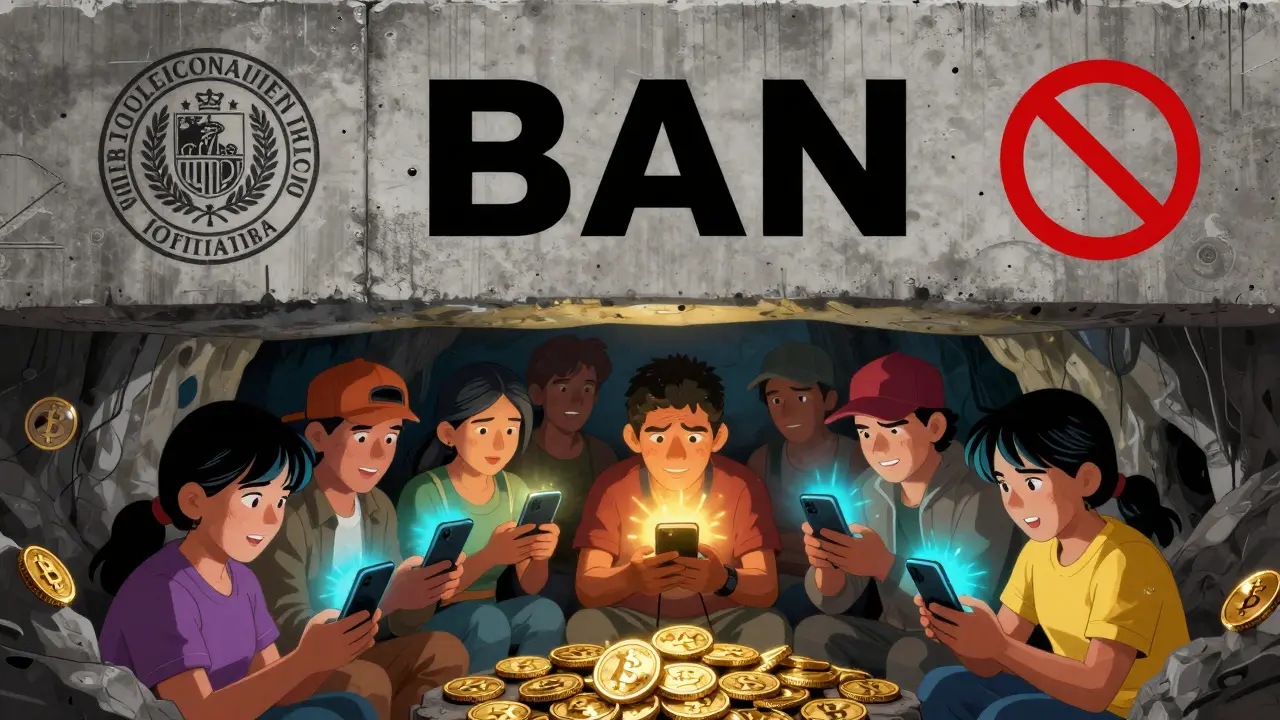
The Paradox: Banning Crypto Didn't Stop It
Here is the irony: the more the government pushed, the more people looked for backdoors. While official adoption rates remained at zero, the underground market exploded. By 2023, estimates showed that roughly 1.2 million Bolivians-about 10% of the population-were using crypto through informal channels. People turned to P2P (Peer-to-Peer) platforms like LocalBitcoins and Paxful to move money.
Why risk a legal ban? For many, it was about survival. As the Boliviano lost value, citizens used stablecoins like USDT to hedge against inflation. Others used it for remittances, avoiding the brutal 15-20% fees charged by traditional money transfer services. However, this "shadow economy" came with a price. Without legal protections, users were prime targets for scams. The Financial Intelligence Unit reported millions of dollars in fraud, though that's likely just the tip of the iceberg since victims were too scared to report crimes involving illegal assets.

Experts Weigh In: Sovereignty vs. Innovation
The intellectual battle over Bolivia's ban was fierce. On one side, advisors like Dr. Carlos Newland argued that emerging economies with unstable currencies couldn't afford a parallel monetary system. In his view, the ban was a necessary shield for national monetary policy.
On the other side, researchers like Dr. Rebecca Liao saw it as a self-inflicted wound. She argued that the ban was a protectionist move that didn't solve the underlying economic issues and simply cut Bolivians off from global innovation. Even the International Monetary Fund (IMF) eventually flipped its stance, suggesting that blanket bans are usually ineffective because they drive activity underground, making it harder for regulators to actually monitor what's happening.
The Great Pivot: From Prohibition to Participation
A decade of strict control eventually hit a wall of reality. On June 26, 2024, the Central Bank of Bolivia did the unthinkable: they lifted the ban. The shift was overnight and the result was explosive. Transaction volumes surged from $46.5 million in early 2024 to $294 million in the first half of 2025. People weren't just dipping their toes in; they were diving in headfirst.
The new framework is a "measured adoption" approach. Instead of making Bitcoin legal tender (like El Salvador), Bolivia is focusing on Virtual Asset Service Providers (VASPs). These companies must register with ASFI and follow strict Anti-Money Laundering (AML) protocols. The government still prohibits using crypto as a direct payment method for goods and services to protect the boliviano, but you can now trade and hold assets legally.
Interestingly, Bolivia has looked to El Salvador for knowledge transfer, though they are avoiding the "all-in" strategy. By allowing trading but banning payments, they hope to capture the economic growth of the crypto sector without risking total monetary collapse.
Was Bolivia really the first country to ban Bitcoin?
Yes, through Resolution No. 24-14-001 issued on May 6, 2014, Bolivia's Central Bank became the first national institution to formally and comprehensively ban Bitcoin and other cryptocurrencies.
Why did Bolivia ban cryptocurrency in the first place?
The primary reason was to protect the boliviano, the national currency, and to maintain monetary sovereignty. The government feared that uncontrolled digital currencies would lead to financial instability and loss of funds for citizens.
Is the Bitcoin ban still in effect in Bolivia?
No, the ban was officially lifted on June 26, 2024. While trading and holding cryptocurrency are now legal, the government still maintains a ban on using crypto as a direct means of payment for goods and services.
How did people use crypto while it was banned?
Most users operated through informal P2P (peer-to-peer) networks using platforms like LocalBitcoins, Paxful, and Binance, often paying high premiums to avoid detection by the banking system.
What is the current status of crypto regulation in Bolivia?
Current regulations require Virtual Asset Service Providers (VASPs) to register with ASFI and adhere to strict AML/CFT (Anti-Money Laundering and Counter-Terrorist Financing) protocols.
It's honestly so awesome to see a country finally opening up to the future! 🚀 Imagine the opportunities for young entrepreneurs in Bolivia now that they can actually engage with global tech without hiding in the shadows. I'm sure there's going to be a huge wave of innovation coming from there soon!
whatever
The irony is palpable. Governments always try to control the flow of value, but they forget that value is basically just a shared hallucination that people agree upon. By banning it, they just proved that the desire for autonomy is stronger than the fear of a decree.
Sure, they "lifted" the ban, but look at the strings attached. VASPs have to register with the government? That's just a fancy way of saying the state now has a direct line to every single wallet. It's not about innovation, it's about surveillance. They waited until they could build a cage before they let the bird back in. Typical globalist move to ensure no one actually escapes the system.
I just think it's really beautiful when we see people finding ways to help each other despite the rules, you know? Like, these folks were using P2P networks just to keep their families afloat and protect their hard-earned money from inflation, which is just so incredibly brave and resourceful if you think about it in the grand scheme of things. It really shows that the human spirit can't be dampened by some piece of paper from a central bank, and I'm just so glad they can finally breathe and trade openly now without that constant fear hanging over their heads every single day!
Please. Calling this a "pivot" is a joke. They only did it because they realized they couldn't stop the bleeding and wanted a piece of the tax pie. It's not a change of heart, it's a change of strategy.
Oh, definitely. Because nothing says "financial freedom" like registering your crypto business with a government agency that spent ten years calling it illegal. I'm sure the AML protocols are just there for our protection and not at all to keep a database of every transaction for future "adjustments." Pure gold.
Interesting transition.
This is what happens when you let foreign tech disrupt a national economy! The US thinks they can just push this stuff everywere but Bolivia was right to protect their own money for a decade because if you dont have strong borders for your currency you end up like some faild state with no control over your own markets and its pathetic how people act like banning it was a mistake when the alternative is total economic chaos caused by these digital tokens that have no real backing!!
It is utterly preposterous that a nation would attempt to legislate the existence of a mathematical protocol! The sheer audacity of the Central Bank of Bolivia to assume their decrees could override the decentralized nature of the blockchain is a tragedy of administrative hubris!
cool story
This is such a vibe shift! 🌟 Imagine the energy in the streets now that people can finally move their money without fear. It's like a digital awakening for the whole country. Let's use this as a lesson: technology always wins over prohibition in the long run!
Omg did anyone actually believe the gov was "protecting" them?? Lmaoo. They just didnt want the boliviano to crash because then they couldnt buy fancy cars with the printed money!! Its so obvious its actually funny haha
It's a step in the right direction, though the restriction on using it for payments is still a bit limiting. Still, legalizing the holding of assets is a huge win for individual liberty.
I mean, I totally get why they did it, but it's just kinda sad that they tried to play god with the economy. Like, just let people use their money, right? It's not that deep. Now they're just doing the same thing everyone else is doing anyway.
Probly just another way for them to track us... the
The sheer, unadulterated chaos of a shadow economy operating for a decade is simply poetic! My heart bleeds for the poor souls who were scammed into oblivion while the government stood by and watched from their ivory towers of "monetary sovereignty." Truly a Shakespearean tragedy of the digital age!
It is a grave error to consider this a victory for the people. The state has merely exchanged a blunt instrument of prohibition for a sophisticated instrument of surveillance. One must realize that true liberation does not come from the permission of a central authority, but from the total transcendence of such systems.
I believe this is a wonderful compromise. By allowing the trading of assets while keeping the local currency for daily payments, Bolivia is attempting to balance modernization with stability. I truly hope this leads to a prosperous era for all Bolivian citizens and serves as a model for other cautious nations.
Love seeing this! 📈 Now we can actually help set up some real educational resources for people over there so they don't get wrecked by the volatility. Let's get those newbies some actual knowledge! 💎🙌
hope people just be careful with there money now that its legal,’cause scammers love a fresh market with lots of new users who dont know the ropes yet
From a professional standpoint, the move toward VASP registration is the only way this scales. You can't have a functional economy if the primary assets are traded in an unregulated black market. It's about risk management and creating a predictable environment for institutional capital to eventually enter the market, which is where the real growth happens.