

By 2025, CBDC is no longer a futuristic idea-it’s a global race. Thirteen-four countries, covering 98% of the world’s GDP, are actively building or testing their own government-backed digital currencies. Meanwhile, private cryptocurrencies like a decentralized digital asset that operates independently of central banks Bitcoin and Ethereum are watching, wondering if they still have a place in this new money system.
CBDCs Are Moving Fast-And They’re Not Alone
It’s easy to think Bitcoin and Ethereum rule the digital money world. But the numbers tell a different story. In 2023, 114 countries were looking into digital currencies. By 2025, that jumped to 134. That’s not a small uptick-it’s a full-scale takeover. Eighty-one central banks are still exploring what a CBDC could look like. Sixty-nine are already running pilots. Four countries-Bahamas, Nigeria, Jamaica, and Zimbabwe-have fully launched theirs. Some reports say eleven are live. Either way, this isn’t theory anymore. It’s real money in real hands.
And it’s not just about replacing cash. The Bank of Japan has been running pilots since April 2023, testing everything from offline payments to user interfaces. The Reserve Bank of India is rolling out both retail and wholesale CBDCs, adding new features like transaction limits and offline use. These aren’t experiments. They’re refinements. And they’re happening fast.
Why CBDCs Are Beating Crypto in Cross-Border Payments
One of the biggest promises of Bitcoin and Ethereum was fast, cheap international transfers. But in 2025, CBDCs are eating that market alive. Twenty-nine countries are working together on cross-border CBDC projects. The mBridge initiative, led by China, Hong Kong, Thailand, and the UAE, already processed $59 billion in cross-border transactions last year-up 45% from 2024. That’s not a fluke. That’s momentum.
Why? Because CBDCs don’t need third-party exchanges. They don’t require users to convert fiat to crypto, then crypto to another fiat. They’re built on interoperable systems. Project Dunbar, led by the Bank for International Settlements, is testing how multiple CBDCs can settle payments directly between central banks. No middlemen. No volatile exchange rates. No waiting days for settlement.
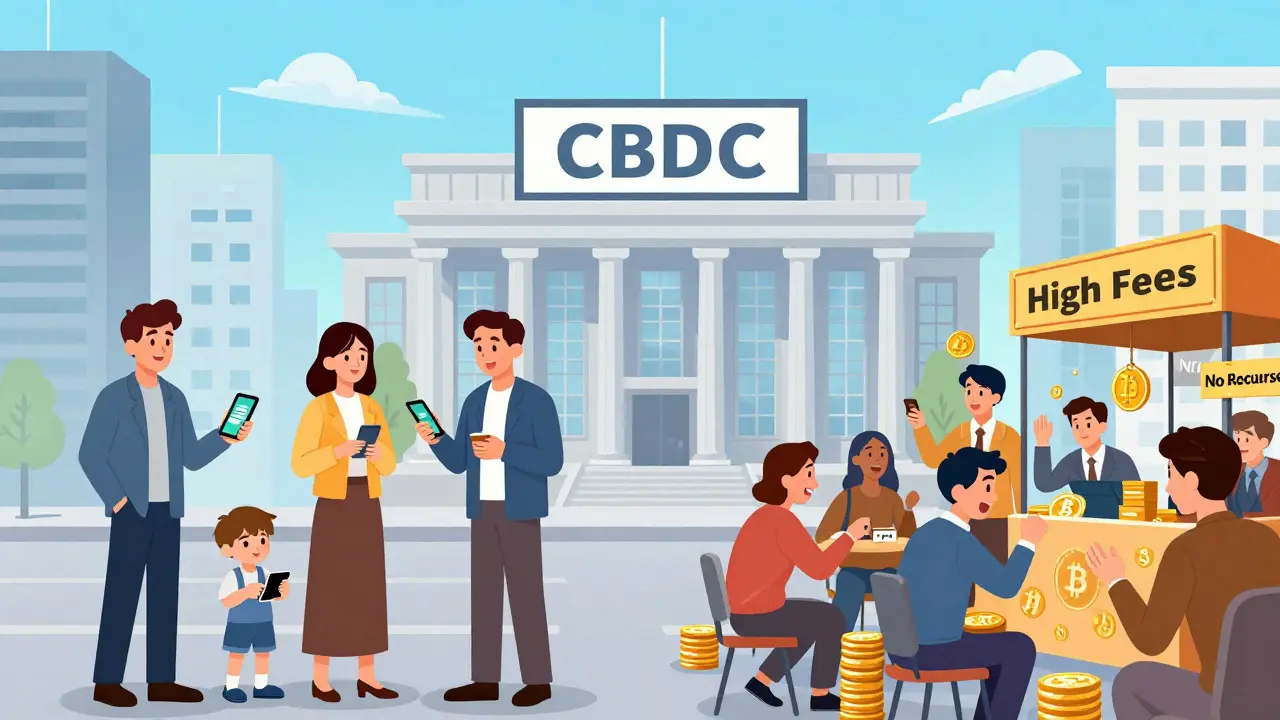
Private crypto still has high fees and long confirmation times on some networks. And while Bitcoin transactions are pseudonymous, they’re not anonymous. Every transaction is on a public ledger. CBDCs, on the other hand, can be designed with privacy controls-some fully anonymous for small payments, others traceable for larger ones. That flexibility? That’s a game-changer.
Regulation: The Hidden Advantage CBDCs Have
Here’s the thing most crypto fans ignore: CBDCs don’t need to be legal. They already are. They’re issued by central banks. They’re legal tender. You can’t get that with Bitcoin.
Forty-eight percent of countries running cross-border CBDCs have aligned their Anti-Money Laundering (AML) and Counter-Financing of Terrorism (CFT) rules specifically for digital currency flows. Thirty-eight percent are testing blockchain-based identity systems to verify users faster. That’s not just compliance-it’s efficiency.
Compare that to private crypto. Exchanges like Binance and Coinbase are under pressure from regulators worldwide. The U.S. SEC is suing crypto firms left and right. The EU’s MiCA rules are forcing exchanges to register as banks. Even in places where crypto is legal, it’s still treated like a risky asset-not money.
CBDCs don’t have that problem. They’re the money. They’re the system. They’re the rulebook.
Security Isn’t Just About Hacks-It’s About Trust
People say crypto is more secure because it’s decentralized. But that’s not how most users experience it. You lose your private key? Your money is gone. Forever. No chargebacks. No customer service. No recourse.
CBDCs are different. If your phone dies, the central bank can restore access. If your wallet gets hacked, the system can freeze the transaction. If someone steals your identity, there’s a legal framework to recover funds. The International Monetary Fund says over 100 central banks are designing CBDCs with built-in cyber resilience-not as an afterthought, but as a core requirement.
That doesn’t mean CBDCs are unhackable. They’re complex systems with new attack surfaces. But they’re built by institutions with billions in resources, decades of experience, and legal authority to respond. Crypto projects? Most are underfunded startups with no legal obligation to protect you.
The Real Threat: Bank Runs and Financial Instability
Here’s where things get scary. If a CBDC becomes too easy to use, people might pull their money out of banks and into it. That’s called a bank run-and it’s a real risk. The Atlantic Council warns that in countries with weak banking systems, a sudden rush to CBDCs could collapse credit markets. Banks rely on deposits to make loans. If everyone moves their savings to a government digital wallet, who’s left to lend money?
That’s why some CBDC designs include limits. You can only hold $5,000 in CBDCs. Or you get no interest on holdings above $1,000. Or you can only use it for payments, not savings. These aren’t bugs-they’re features. Designed to prevent chaos.
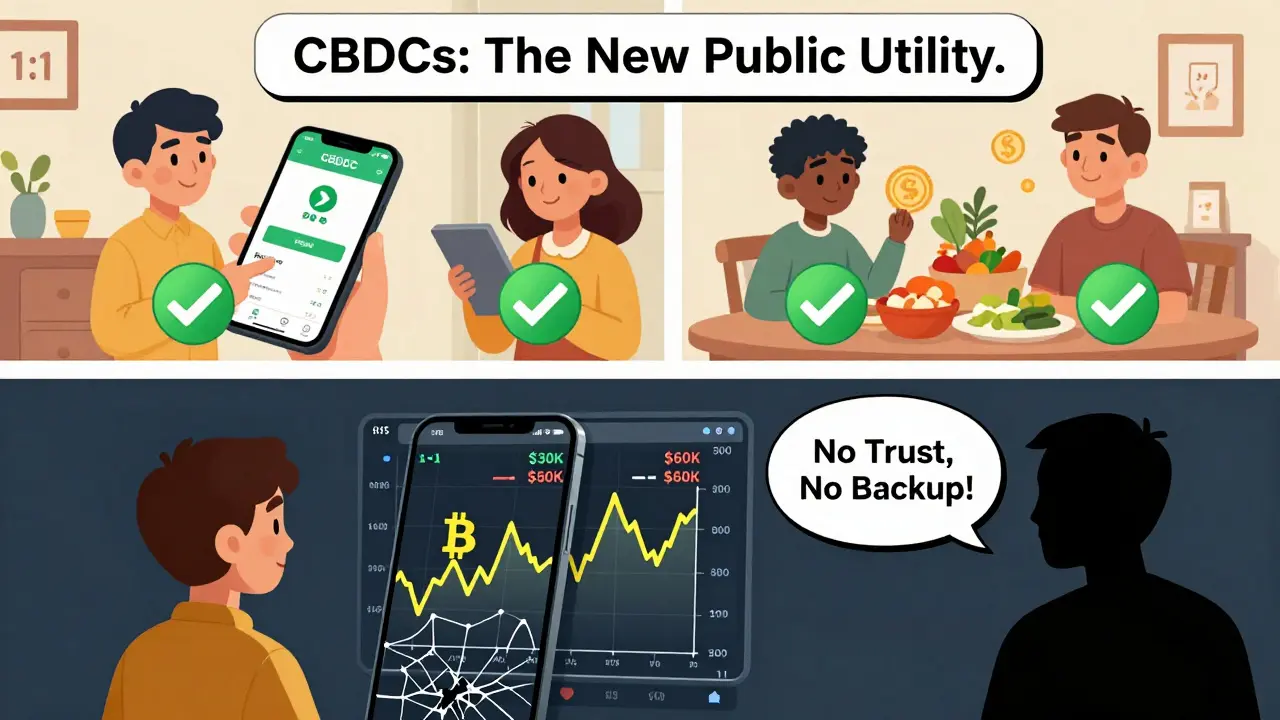
Private crypto doesn’t have this problem. You can hold as much Bitcoin as you want. No bank limits. No government oversight. But that freedom comes with volatility. Bitcoin can swing 20% in a day. CBDCs are pegged 1:1 to the national currency. Stable. Predictable. Safe.
Who Wins? It Depends on What You Need
CBDCs aren’t trying to kill crypto. They’re trying to replace cash and improve payments. For everyday transactions-paying taxes, buying groceries, sending money to family overseas-CBDCs are the clear winner. Faster. Cheaper. More reliable.
But crypto still has its niche. If you live in a country with hyperinflation, like Venezuela or Argentina, Bitcoin is a lifeline. If you’re a developer building a decentralized app, Ethereum gives you tools no CBDC can match. If you believe in censorship resistance-where no government can block your payments-crypto is still the only option.
The future isn’t CBDCs or crypto. It’s CBDCs and crypto. But they’re not competing on the same field. CBDCs are the new public utility. Crypto is the new wild west.
What Happens Next?
By 2027, expect at least five more countries to launch full CBDCs. The U.S. is still hesitating, but the Fed is testing a digital dollar. The EU is pushing for a digital euro. China’s digital yuan is already used by millions. The race is on.
Private crypto won’t disappear. But its role will shrink. It won’t be the main way people pay for things. It’ll be a niche tool-for speculation, for privacy, for decentralized tech. CBDCs will handle the bulk of daily transactions. And that’s not a threat. It’s evolution.
Money is changing. And this time, the government is building the system.
Are CBDCs the same as Bitcoin?
No. CBDCs are digital versions of national currencies like the dollar or euro, issued and controlled by central banks. Bitcoin is a decentralized cryptocurrency with no government backing. CBDCs are legal tender; Bitcoin is not. CBDCs can be traced; Bitcoin transactions are pseudonymous. They serve completely different purposes.
Can CBDCs replace cash completely?
Many countries are designing CBDCs to coexist with cash, not replace it immediately. But in places like China and Nigeria, digital payments are already replacing cash faster than ever. CBDCs are being built with offline functionality so people without internet can still use them. Complete replacement isn’t guaranteed-but cash is clearly on its way out in most developed economies.
Do CBDCs track every transaction?
It depends on the design. Some CBDCs offer anonymous small-value payments (like cash). Others require identity verification for larger amounts. The goal isn’t mass surveillance-it’s balancing privacy with anti-money laundering rules. Most central banks say they’re not building surveillance tools. But they’re building systems that can be used for compliance if needed.
Why are so many countries rushing to launch CBDCs?
Three main reasons: financial inclusion (reaching unbanked populations), efficiency (cutting transaction costs and settlement times), and control (reducing reliance on private crypto and foreign payment systems). Countries like Nigeria and Jamaica launched CBDCs to reduce dependence on the U.S. dollar. China wants to lead global digital finance. The U.S. fears falling behind.
Will CBDCs make crypto obsolete?
Not entirely. Crypto still dominates in areas where decentralization, censorship resistance, or lack of government control matter most-like in authoritarian regimes or for decentralized finance (DeFi) applications. But for everyday payments, CBDCs are becoming the default. Crypto’s role is shifting from "money" to "asset" or "tool."
CBDCs are just government spyware with a digital interface
The architectural asymmetry between CBDCs and private crypto is profound-centralized state infrastructure versus permissionless consensus mechanisms. CBDCs optimize for regulatory compliance and macroeconomic control, while crypto prioritizes censorship resistance and composability. These aren't competitors-they're orthogonal design paradigms operating in different game spaces.
ugh i just want to pay for coffee without a blockchain
Love how CBDCs are finally making cross-border remittances actually usable 💸 No more waiting 3 days for a wire. And yes, I'm from the US-this is a game changer for families sending money home.
cbdc? more like cbdc… i mean… who even…
Bitcoin is dead. CBDCs won. Get over it. The government always wins
lol why are we even talking about this
i think cbdc is cool but what if the bank messes up and i lose my money
Oh wow, a central bank digital currency-how *innovative*. Let me guess, next they’ll tokenize the air we breathe and charge us for oxygen inhalation? Truly, the pinnacle of financial progress. I’m just thrilled to live in a world where my transaction history is pre-approved by a bureaucrat in a suit.
CBDCs aren’t about efficiency-they’re about control. The same people who told us 9/11 was an inside job are now designing your bank account. You think they’ll let you buy Bitcoin if it threatens their monopoly? Think again. This is the beginning of the digital leash.
Imagine… the digital euro… flowing… like a river… through the veins of civilization… the weight of history… in every byte…
CBDCs are gonna be hacked so hard lol imagine your whole life savings just vanish because some hacker found a flaw in the Fed's API 🤡
It's important to recognize that CBDCs and crypto serve different user bases. One is for the mass public seeking stability; the other for the technically inclined seeking autonomy. Neither is inherently superior-it’s about context.
CBDCs are the new plumbing. Nobody notices it until it breaks. Crypto is the fancy faucet you install because it looks cool-until you realize it leaks and costs $500 to fix. Both have their place. Just don’t expect the plumbing to be glamorous.
They'll freeze your CBDC if you protest. That's the whole point