

For years, the idea that cryptocurrency was untraceable gave criminals a false sense of security. That illusion shattered as regulatory pressure mounted and technology caught up with the speed of blockchain transactions. Today, if you move money on Bitcoin or Ethereum, there is a digital footprint. The question isn't whether someone can see it; it's who has the tools to interpret it correctly. For financial institutions, law enforcement agencies, and crypto exchanges, the answer usually comes down to two names: Chainalysis and Elliptic.
These aren't just software programs; they are the backbone of modern cryptocurrency compliance. They turn raw, immutable ledger data into actionable intelligence. If you are looking to implement robust Anti-Money Laundering (AML) controls or investigate illicit flows, understanding the distinct capabilities of these platforms is not optional-it is essential. Here is how they stack up against each other in 2026.
Understanding Blockchain Forensics
To appreciate what these tools do, you first need to understand the problem they solve. Blockchains like Bitcoin and Ethereum are public ledgers. Anyone can view every transaction ever made. However, these transactions are pseudonymous, not anonymous. Instead of names, addresses are used. Without context, an address like 1A1zP1eP5QGefi2DMPTfTL5SLmv7DivfNa means nothing. It’s just a string of characters.
Blockchain forensics is the process of analyzing blockchain data to identify entities behind addresses and trace the flow of funds. This involves clustering algorithms that group multiple addresses under a single entity, heuristic analysis to detect mixing services, and integration with off-chain data like Know Your Customer (KYC) records from exchanges.
The goal is to de-anonymize the chain. When a wallet interacts with a known exchange like Coinbase or Binance, that wallet becomes "labeled." From there, forensic tools can map out where the funds came from and where they went. This capability is critical for meeting global regulatory standards, such as the EU’s Markets in Crypto-Assets (MiCA) regulation and evolving guidance from the US Treasury.
Chainalysis: The Market Leader in Investigation
Founded in 2013, Chainalysis is a blockchain analytics company that provides data and software to help businesses and governments navigate the cryptocurrency ecosystem. It has established itself as the dominant player in the market, largely due to its early adoption by law enforcement and major financial institutions.
Chainalysis offers two primary products that serve different functions within an organization:
- Chainalysis Reactor: This is the investigative tool. It provides a graphical interface that allows investigators to visualize complex transaction networks. You can input an address and see its entire history, including connections to darknet markets, ransomware groups, or sanctioned entities. It excels in deep-dive investigations, helping users cluster wallets and identify patterns that human analysts might miss.
- Chainalysis KYT (Know Your Transaction): This is the real-time monitoring solution. It integrates directly into exchange platforms to monitor transactions as they happen. Using machine learning, it assigns risk scores to incoming and outgoing transactions based on counterparty risk and exposure to illicit funds. If a user tries to deposit money from a high-risk mixer, KYT flags it instantly.
One of Chainalysis’s strongest assets is its proprietary database. It covers approximately 85% of the total cryptocurrency market value. While this might sound less than comprehensive compared to competitors, it focuses on the assets that matter most for volume and risk. Its track record includes helping authorities recover $1 billion in Bitcoin linked to the Silk Road darknet marketplace. This success story cemented its reputation in government circles, leading to partnerships with Europol and major banks like Barclays and MUFG.
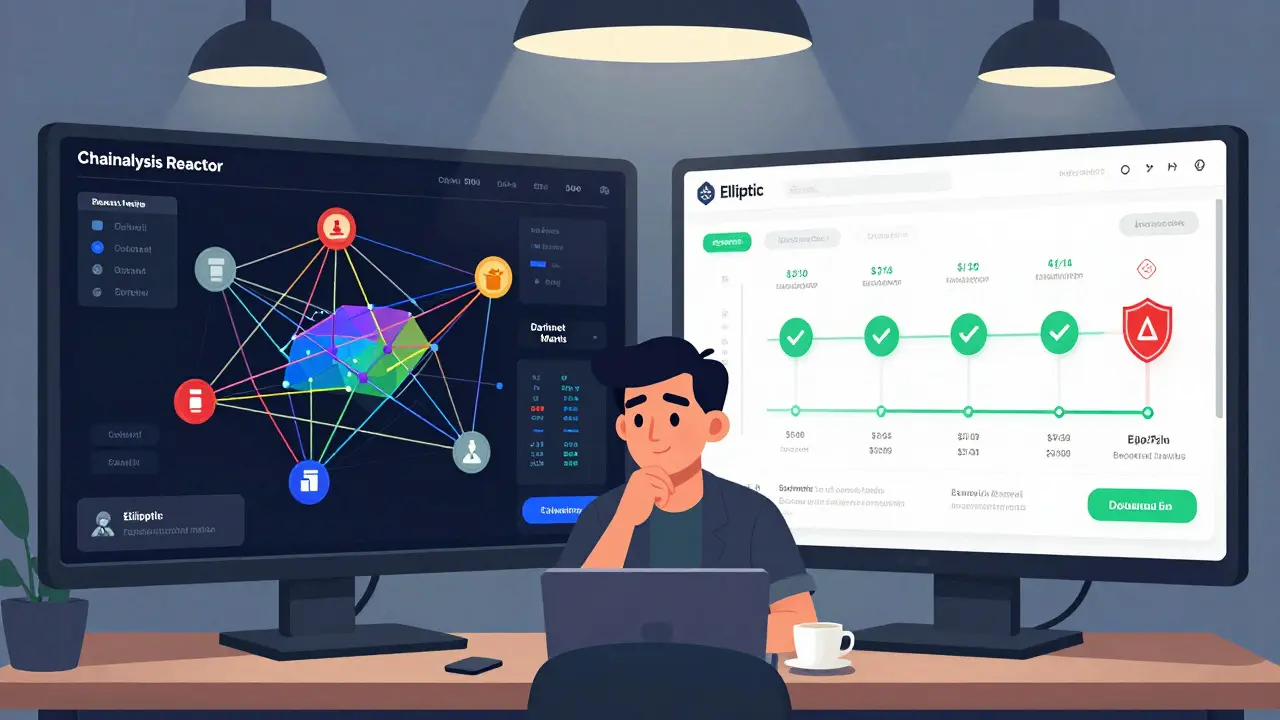
Elliptic: Broad Coverage and Predictive Power
Also founded in 2013, Elliptic is a blockchain analytics provider specializing in preventing financial crime through real-time monitoring and predictive insights. Headquartered in London, Elliptic positions itself as a comprehensive partner for crypto businesses and regulators, emphasizing breadth and forward-looking capabilities.
Elliptic’s approach differs slightly in scope and methodology. It monitors over 100 digital assets, claiming coverage of 97% of all cryptocurrency assets. This broader range is particularly valuable for institutions dealing with diverse portfolios that include smaller altcoins or privacy-focused coins like Zcash (ZEC) and Horizen (ZEN). Elliptic has developed specialized expertise in tracking these opaque assets, which are notoriously difficult to trace due to their built-in anonymity features.
Key features of the Elliptic platform include:
- Predictive Analytics: Elliptic claims to offer the industry’s first predictive functionality. Instead of just reacting to past transactions, it aims to identify potential risks before they materialize. This is crucial for proactive compliance strategies.
- Pre-Registration Analysis: Their API enables automated monitoring and risk scoring even before transactions are fully registered on the blockchain. This reduces latency and allows for faster decision-making in high-volume environments.
- Configurable Risk Rules: Organizations can customize risk rules to match their specific appetite. Whether you are a conservative bank or a more aggressive DeFi protocol, Elliptic allows you to tailor the sensitivity of alerts.
Elliptic has accumulated over 10 billion data points, which feed into its machine learning models. This extensive dataset helps generate accurate insights and reduces false positives. Additionally, Elliptic places a strong emphasis on education, offering comprehensive on-site training programs and certification courses for crypto asset compliance. This support structure is highly valued by organizations building internal expertise from scratch.
Head-to-Head Comparison
Choosing between Chainalysis and Elliptic depends on your specific needs. Are you a law enforcement agency needing to solve cold cases? Or are you an exchange needing real-time screening for thousands of daily transactions? Let’s break down the key differences.
| Feature | Chainalysis | Elliptic |
|---|---|---|
| Market Focus | Law Enforcement & Large Banks | Crypto Businesses & Regulators |
| Coverage | 85% of Market Value | 97% of Assets (100+ coins) |
| Privacy Coins | Standard Support | Advanced Expertise (ZEC, ZEN) |
| Real-Time Monitoring | KYT (Post-transaction focus) | API (Pre-registration analysis) |
| Visualization | Reactor (Highly Intuitive) | Standard Dashboard |
| Predictive Features | Limited | Industry-Leading |
Chainalysis shines in visualization and deep investigation. The Reactor interface is widely praised for its ease of use and ability to handle complex network graphs. If your team needs to present findings in court or conduct detailed forensic audits, Chainalysis is often the preferred choice. Its strength lies in customization for large-scale investigations.
Elliptic, on the other hand, wins on breadth and prediction. If you operate a multi-asset exchange or deal with privacy coins, Elliptic’s wider coverage is indispensable. Its ability to analyze transactions before they hit the blockchain gives you a time advantage that can prevent losses. Furthermore, its predictive analytics help you stay ahead of emerging threats rather than just chasing them.

Implementation Challenges and Costs
Implementing either platform is not a plug-and-play exercise. Both require significant technical expertise and organizational commitment. Integration typically involves API implementations and custom rule configuration to align with your existing compliance workflows.
The learning curve is steep. Basic functionality can be mastered in weeks, but advanced investigative capabilities take months of training. Both companies offer certification programs, but you must invest time in upskilling your compliance teams. Technical requirements include robust data infrastructure to process large volumes of blockchain data without latency.
Cost is another factor. While exact pricing is enterprise-specific, both platforms are premium solutions. Chainalysis may have higher upfront costs due to its extensive feature set and support structure, while Elliptic’s licensing models vary based on the number of assets monitored and transaction volume. Smaller organizations may find the maintenance of detection rules and interpretation of results challenging without dedicated staff.
Future Trends in Blockchain Forensics
The landscape is evolving rapidly. As decentralized finance (DeFi) grows, traditional forensic tools face new challenges. DeFi protocols often lack centralized points of control, making it harder to label addresses. Both Chainalysis and Elliptic are investing heavily in AI and machine learning to adapt.
Chainalysis has announced expanded support for DeFi protocols and cross-chain analysis capabilities. This is crucial as users increasingly move assets across different blockchains using bridges. Elliptic continues to develop predictive analytics and real-time risk assessment features to keep pace with these changes.
Regulatory frameworks will continue to drive demand. With MiCA in Europe and stricter guidelines in the US, compliance is no longer optional. The blockchain forensics market, estimated at $3.2 billion in 2024, is projected to grow at over 15% annually through 2028. Chainalysis and Elliptic currently control about 70% of this market, but emerging players like TRM Labs and CipherTrace are gaining traction.
Success in this space will depend on adaptability. As blockchain technologies become more sophisticated, so too must the tools used to trace them. Institutions that choose the right partner today will be better positioned to navigate the complex regulatory environment of tomorrow.
What is the main difference between Chainalysis and Elliptic?
Chainalysis focuses on deep investigative capabilities and visualization, making it ideal for law enforcement and large-scale forensic audits. Elliptic emphasizes broad asset coverage, including privacy coins, and offers predictive analytics for proactive risk management, suiting crypto businesses and exchanges.
Which tool is better for tracking privacy coins like Monero or Zcash?
Elliptic has specialized expertise in monitoring privacy-focused cryptocurrencies such as ZEC and ZEN. While Chainalysis supports major assets, Elliptic’s broader coverage and specific algorithms for opaque assets give it an edge in this niche.
How much does it cost to implement blockchain forensics tools?
Pricing is enterprise-specific and varies based on usage, number of assets monitored, and level of support. Both Chainalysis and Elliptic are premium solutions requiring significant investment in licensing, integration, and staff training. Contact vendors directly for quotes.
Can these tools trace transactions on decentralized exchanges (DEXs)?
Yes, both platforms are enhancing their capabilities to cover DEXs and DeFi protocols. However, tracing on DEXs is more complex due to the lack of centralized KYC data. Advanced heuristics and clustering algorithms are used to infer entity behavior.
Is blockchain forensics required by law?
While not always explicitly mandated to use a specific vendor, regulations like MiCA and FATF guidelines require Virtual Asset Service Providers (VASPs) to perform effective AML checks. Using professional forensic tools is the standard way to demonstrate compliance and mitigate risk.