
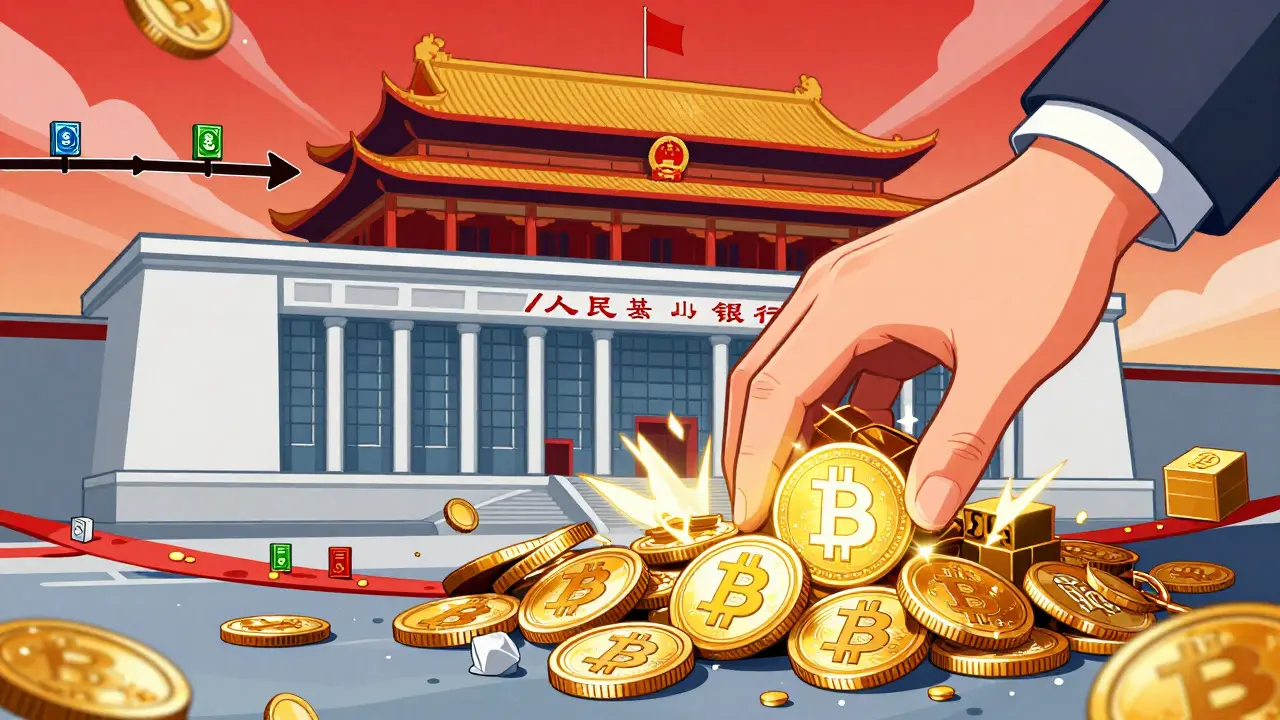
Imagine a country that once accounted for nearly half of the world’s Bitcoin mining power and hosted the largest trading exchanges, only to declare all cryptocurrency transactions illegal within a decade. That is the story of China a major global economy with one of the most restrictive regulatory environments for digital assets. It is not just a simple "ban"; it is a complex web of policies implemented by the People's Bank of China (PBoC) the central banking authority responsible for monetary policy and financial stability in China. If you are trying to understand why the world’s second-largest economy treats Bitcoin the first decentralized cryptocurrency, often viewed as digital gold or a store of value differently than the US or EU, you need to look past the headlines and into the strategic motivations behind the moves.
The Long Road to Prohibition: A Timeline of Restrictions
China did not wake up one day and decide to kill crypto overnight. The process was gradual, escalating from minor restrictions to total prohibition over thirteen years. The clock started ticking in June 2009, when authorities banned the use of digital currencies-initially targeting video game money-to purchase real-world goods. This was a small step, but it set the tone: the state wanted control over how money moved.
The first major shock came on December 5, 2013. The PBoC, alongside other financial watchdogs, prohibited banks from handling Bitcoin transactions. They labeled Bitcoin a "special virtual commodity," not legal tender. Why? They feared money laundering and the lack of central authority backing the asset. The market reacted instantly. Bitcoin prices dropped more than 30% on the Mt. Gox exchange just ten days after the announcement. By December 18, 2013, BTC China, then the largest exchange in the country, stopped accepting Yuan deposits. For many traders, this was the moment they realized the government was serious.
Things got worse in September 2017. This was during Bitcoin’s massive bull run toward $20,000. On September 4, 2017, Chinese authorities banned all domestic Initial Coin Offerings (ICOs), calling them an "illegal fundraising mechanism." Ten days later, on September 15, they ordered all domestic exchanges to cease operations immediately. Major players like ViaBTC and BTCC closed their doors or moved overseas. Yet, even with exchanges gone, Chinese traders didn’t stop. They switched to peer-to-peer (P2P) platforms and offshore exchanges, proving that banning the venue doesn’t always kill the demand.
Why Did China Ban Crypto? It’s Not Just About Technology
You might think the ban was about hating blockchain technology. But if you look closer, it’s really about economics and control. Industry analysts and reports from Bloomberg and CoinDesk suggest the motivation is primarily economic, not technological. China wants to maintain strict control over capital flows. When the Yuan weakens, people tend to move their money into stable assets like Bitcoin to protect their wealth. This drains liquidity from the domestic system, which the PBoC hates.
There is also the environmental angle. In June 2021, China cracked down on Bitcoin mining, citing excessive energy consumption. At that time, four Chinese mining pools-F2Pool, AntPool, BTCC Pool, and BW.com-controlled 50% of Bitcoin’s global hashrate. The ban forced these massive operations to migrate, primarily to the United States. But even before the energy concerns, there was a philosophical divide. President Xi Jinping emphasized the importance of blockchain technology in 2019, but specifically distinguished it from cryptocurrencies. To Beijing, blockchain is a useful tool for efficiency; cryptocurrency is a threat to monetary sovereignty.

The Rise of the Digital Yuan: The State’s Alternative
If you ban the wild west of decentralized finance, what do you offer instead? China offers the Digital Yuan a Central Bank Digital Currency (CBDC) issued by the People's Bank of China, designed for direct retail payments. This is where the strategy becomes clear. While banning private coins like Bitcoin, China is aggressively developing its own state-controlled digital currency. The Digital Yuan allows the government to track every transaction, implement precise monetary policy, and reduce reliance on cash. It is the opposite of Bitcoin’s promise of privacy and decentralization. It is a tool for state oversight, not individual freedom.
| Feature | China | United States / EU |
|---|---|---|
| Regulatory Stance | Prohibition / Illegal Transactions | Permissive / Regulation via Agencies (SEC, MiCA) |
| Primary Goal | Capital Control & Monetary Sovereignty | Consumer Protection & Market Integrity |
| Digital Currency Strategy | State-issued CBDC (Digital Yuan) | Private Sector Led (with potential future CBDCs) |
| Mining Status | Banned (June 2021) | Legal (varies by state/region) |
| Exchange Access | No Domestic Exchanges; Offshore only | Multiple Licensed Exchanges |
How Do Chinese Users Still Trade Crypto?
Despite the heavy-handed enforcement, the desire to hold crypto hasn't disappeared. User experiences shared on forums like Reddit and Telegram reveal a resilient community. Many Chinese users rely on VPN services to access overseas exchanges. Others have relocated to crypto-friendly jurisdictions like Singapore or the United States. For those staying home, the methods are sophisticated. Peer-to-peer trading networks allow individuals to swap Yuan for stablecoins without touching a centralized exchange. Some even incorporate companies abroad to legally hold assets. It’s a cat-and-mouse game, with the government using banking system monitoring and internet traffic analysis to catch violators, while traders adapt their tactics.

The Global Impact of China's Decisions
Because China was such a dominant force in the early days of crypto, its bans sent shockwaves through the global market. Before 2017, Chinese trading volume represented 80-90% of global Bitcoin trades. When they pulled out, liquidity dried up, and volatility spiked. The January 2018 crash saw 90% of Chinese blockchain-focused venture capital firms exit the market, according to PwC reports. Today, China’s influence persists in different forms. While they don’t host exchanges, they still manufacture a significant portion of the world’s mining hardware. Their engineers and developers remain active in the global blockchain scene, often working for foreign companies. This creates a bifurcated global environment: democratic nations building permissive frameworks, and authoritarian regimes potentially following China’s lead of strict state control.
What Does the Future Hold?
Major financial institutions like JPMorgan Chase and Goldman Sachs suggest that a reversal of China’s crypto ban is unlikely barring major political changes. The development of the Digital Yuan is moving forward, signaling a long-term commitment to state-controlled digital assets. For investors, this means China will likely remain a place of high risk and low accessibility for direct crypto participation. However, the technology itself isn’t dead there. Blockchain adoption in supply chain management and government services continues. So, while you won’t find a Bitcoin ATM in Shanghai anytime soon, the underlying tech is very much alive, just under a different flag.
Is holding Bitcoin illegal in China?
Technically, yes, since September 2021, all cryptocurrency transactions were declared illegal. However, simply holding coins in a personal wallet is rarely enforced against individuals directly. The risk lies in buying, selling, or trading, which requires accessing offshore exchanges or P2P networks.
Why did China ban Bitcoin mining?
The primary reasons cited were environmental concerns regarding excessive energy consumption and the desire to regain control over capital flows. Mining was consuming vast amounts of electricity, often from coal-fired plants, which conflicted with national green energy goals.
What is the difference between the Digital Yuan and Bitcoin?
The Digital Yuan is a Central Bank Digital Currency (CBDC) controlled by the government, meaning transactions can be tracked and reversed by the state. Bitcoin is decentralized, meaning no single entity controls the network, and transactions are generally irreversible and pseudonymous.
Can Chinese citizens trade crypto today?
Yes, but it is difficult and risky. Most use Virtual Private Networks (VPNs) to access international exchanges or engage in peer-to-peer trades. There are no legal domestic exchanges, so all activity happens in a gray zone.
Will China ever reverse its crypto ban?
Most experts predict no. With the Digital Yuan advancing and strong political emphasis on monetary sovereignty, a return to allowing free-market cryptocurrency trading seems highly unlikely in the near future.