

Most decentralized exchanges (DEXs) force you to choose between two bad options: accept slippage and impermanent loss with Automated Market Makers (AMMs), or trust a centralized entity with your keys. Clober is a fully on-chain order book decentralized exchange that enables trustless order matching and settlement directly on blockchain smart contracts. Launched in early 2023 by an anonymous team, it aims to be "DEX 2.0" by bringing the precision of traditional stock trading to DeFi without sacrificing self-custody.
If you've ever lost money because a limit order didn't fill at the exact price you wanted, or felt frustrated watching your liquidity pool bleed value due to price swings, Clober might be the solution you've been waiting for. But does it actually work as promised? And is the user experience worth the learning curve? Here is the honest breakdown.
The Core Problem: Why AMMs Aren't Enough
To understand why Clober exists, you have to look at what's wrong with the current standard. Platforms like Uniswap use liquidity pools. You deposit tokens, and the protocol uses a mathematical formula to determine prices. This works, but it has two major flaws for serious traders:
- Slippage: If you buy a large amount of a token, the price moves against you during the transaction. You rarely get the exact price you saw on the screen.
- Impermanent Loss: If you provide liquidity, your assets can lose value compared to just holding them if the price of one token changes significantly relative to the other.
Clober solves this by using a Limit Order Book. Instead of pools, users place bids (buy orders) and asks (sell orders). When a buyer's bid matches a seller's ask, the trade executes at that exact price. No math formulas determining the price after the fact; no slippage. It feels more like trading on Coinbase or Binance, but your funds never leave your wallet.
The Technology: How LOBSTER Changes the Game
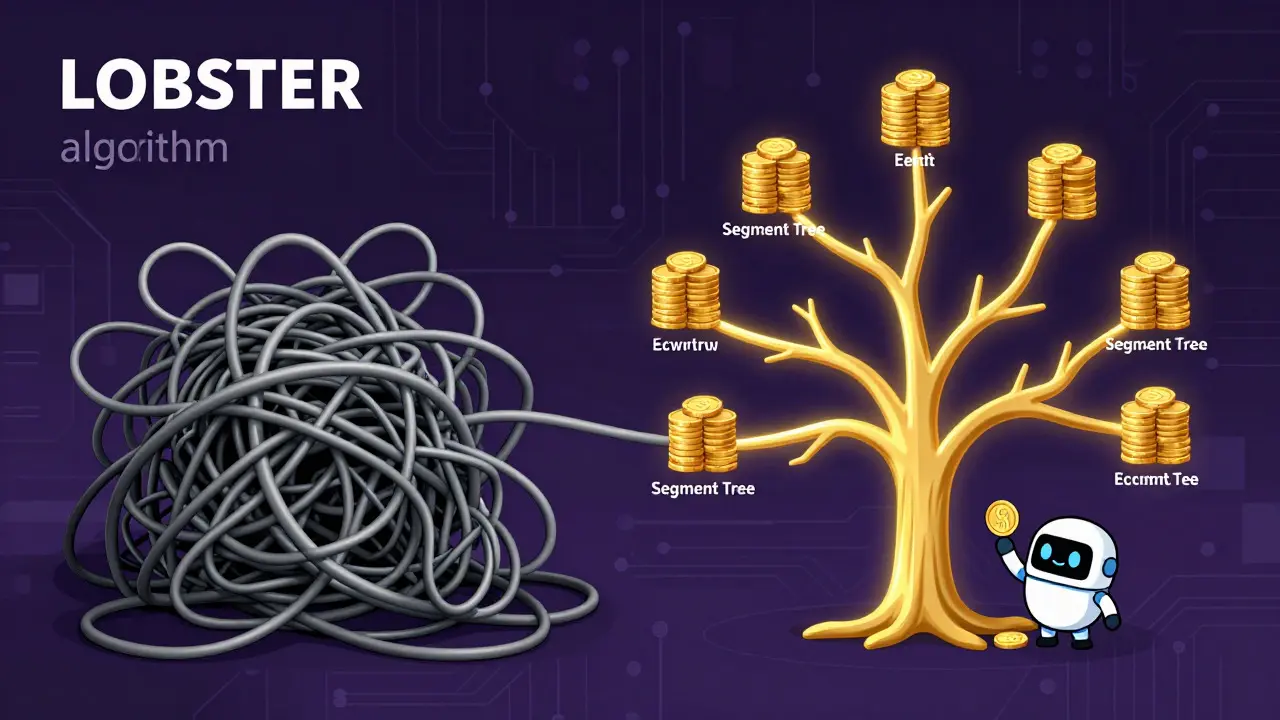
Historically, building an order book on Ethereum was a nightmare. Gas fees were so high that placing a single order could cost $50 or more. That’s why most "on-chain" order books were actually hybrid systems where matching happened off-chain. Clober changed this with its proprietary algorithm called LOBSTER (Limit Order Book with Segment Tree for Efficient oRder-matching).
Here is how it works in simple terms:
- Segmented Data Structure: Instead of processing every single order in the book when a new trade happens, LOBSTER uses a "Segment Tree." This data structure allows the smart contract to find the best match in O(log n) time rather than O(n).
- Reduced Storage Writes: Taker orders (the ones initiating the trade) only update a single variable: the "Total Claimable Amount." They don't rewrite the entire order book history.
- Manual Claiming: Maker orders (the ones waiting in the book) don't automatically receive funds. Instead, they must manually claim their proceeds by comparing their specific "Claim Range" with the total available.
This architectural shift reduced gas costs dramatically. While previous on-chain attempts cost over $20 per interaction, Clober brings it down to roughly $2-$3 on Ethereum mainnet under normal conditions. For context, that is comparable to a standard Uniswap swap, making precise order book trading economically viable for the first time.
User Experience: The Good, The Bad, and The Annoying
Using Clober isn't quite as plug-and-play as swapping tokens on Uniswap. There is a learning curve, primarily because you need to understand basic order book mechanics like bid-ask spreads and order cancellation.
The Pros:
- Precise Execution: You set the price, and you get that price. This is huge for stablecoin pairs or institutional-sized trades where even 1% slippage matters.
- No Impermanent Loss: Since you are placing orders rather than depositing into a pool, your capital efficiency is 100%. Your funds are only locked at specific price points, not spread across a range.
- Non-Custodial: Your private keys stay with you. If Clober's website disappears tomorrow, your funds are still safe in your wallet.
The Cons:
- Manual Claiming Friction: This is the #1 complaint from users. When your sell order fills, the money doesn't appear in your wallet instantly. You have to go back to the interface and click "Claim." If you forget, your funds sit in the contract until you remember. Many users now use community scripts to automate this, but it adds a layer of complexity.
- Limited Liquidity Depth: Compared to giants like Uniswap, Clober has fewer token pairs and thinner liquidity. If you try to move a massive amount of a low-cap token, you might struggle to find enough counterparty interest.
- Gas Spikes: During periods of extreme Ethereum congestion (gas above 100 gwei), transaction costs can spike to around $8-$10. While still cheaper than old order books, it's higher than Layer 2 solutions.
Clober vs. The Competition
How does Clober stack up against other ways to trade crypto? Let's compare it to the main alternatives.
| Feature | Clober (On-Chain Order Book) | Uniswap (AMM) | Coinbase/Binance (CEX) |
|---|---|---|---|
| Custody | Non-Custodial (Self-Custody) | Non-Custodial (Self-Custody) | Custodial (Platform Holds Keys) |
| Price Execution | Exact Price (Limit Orders) | Approximate (Slippage applies) | Exact Price (Limit Orders) |
| Impermanent Loss | None | Yes (For LPs) | N/A |
| Gas Fees (Est.) | $2 - $10 (Variable) | $2 - $10 (Variable) | Low/Zero (Paid via spread/fee) |
| Liquidity Depth | Moderate/Growing | High | Very High |
| Learning Curve | Medium (Order Book + Claiming) | Low | Low |
Clober sits in a unique niche. It offers the precision of a CEX with the security of a DEX. However, it lacks the raw speed and depth of a centralized giant. If you are a high-frequency trader who needs sub-millisecond execution, stick to CEXs. If you are a passive holder who wants to earn yield without worrying about claiming funds, Uniswap is easier. Clober is for the active trader who values control and precision over convenience.
Roadmap and Future Outlook
Clober isn't standing still. The v2 launch introduced cross-margin functionality, allowing users to use collateral across multiple positions, which boosts capital efficiency further. The roadmap focuses heavily on scalability and accessibility:
- Layer 2 Expansion: Moving to Arbitrum and Optimism will drastically reduce gas fees, addressing the main pain point of Ethereum mainnet trading.
- Institutional API: Building tools for professional desks to integrate Clober into their workflows.
- Multi-Chain Aggregation: Pulling liquidity from different chains to create a deeper, unified order book.
Analysts predict that as Ethereum scales, on-chain order books could capture 15-20% of DEX volume by 2025. Clober is currently the primary player in this segment, holding a significant lead in technical implementation. However, competition is heating up. Hybrid models and other L2-native order books are emerging. The key risk for Clober remains regulatory scrutiny; while its permissionless design offers some protection, the SEC's stance on "order books" in DeFi is still evolving.

Who Should Use Clober?
Clober is not for everyone. It is specifically designed for:
- Active Traders: People who place limit orders regularly and want to avoid slippage.
- Stablecoin Pairs Traders: Those trading USDC/USDT or similar pairs where price stability is critical.
- DeFi Power Users: Individuals comfortable managing wallets, understanding gas dynamics, and willing to handle manual claiming steps.
- Privacy-Focused Investors: Those who refuse to KYC or hand over custody to a third party.
You should probably avoid Clober if you are a beginner, a passive investor, or someone who hates dealing with technical friction. In those cases, the simplicity of an AMM or the convenience of a CEX is likely a better fit.
Frequently Asked Questions
Is Clober safe to use?
Yes, largely. Because it is non-custodial, you don't have to trust the company with your funds. The main risks are smart contract bugs (though audited by Quantstamp) and user error (like forgetting to claim funds). Always check the contract address before interacting.
Why do I have to manually claim my funds?
This is a feature of the LOBSTER algorithm designed to save gas. By not auto-updating every maker's balance, the protocol reduces storage writes. It saves you money on transactions but requires you to take an extra step to collect your earnings.
Which blockchains does Clober support?
Clober is EVM-compatible. It launched on Ethereum Mainnet and has expanded to several ecosystem chains. Roadmap updates indicate further expansion to Layer 2 networks like Arbitrum and Optimism to lower costs.
How does Clober compare to Serum?
Serum uses a hybrid model where matching happens off-chain and settlement on-chain. Clober is fully on-chain, meaning greater censorship resistance but potentially slower execution during network congestion. Clober also generally has lower gas costs due to the LOBSTER optimization.
Are there any hidden fees?
There are no hidden trading fees beyond the standard protocol fee (which is typically very low or zero depending on the pair). The main "cost" is the gas fee paid to the blockchain network for executing the trade and claiming the funds.