
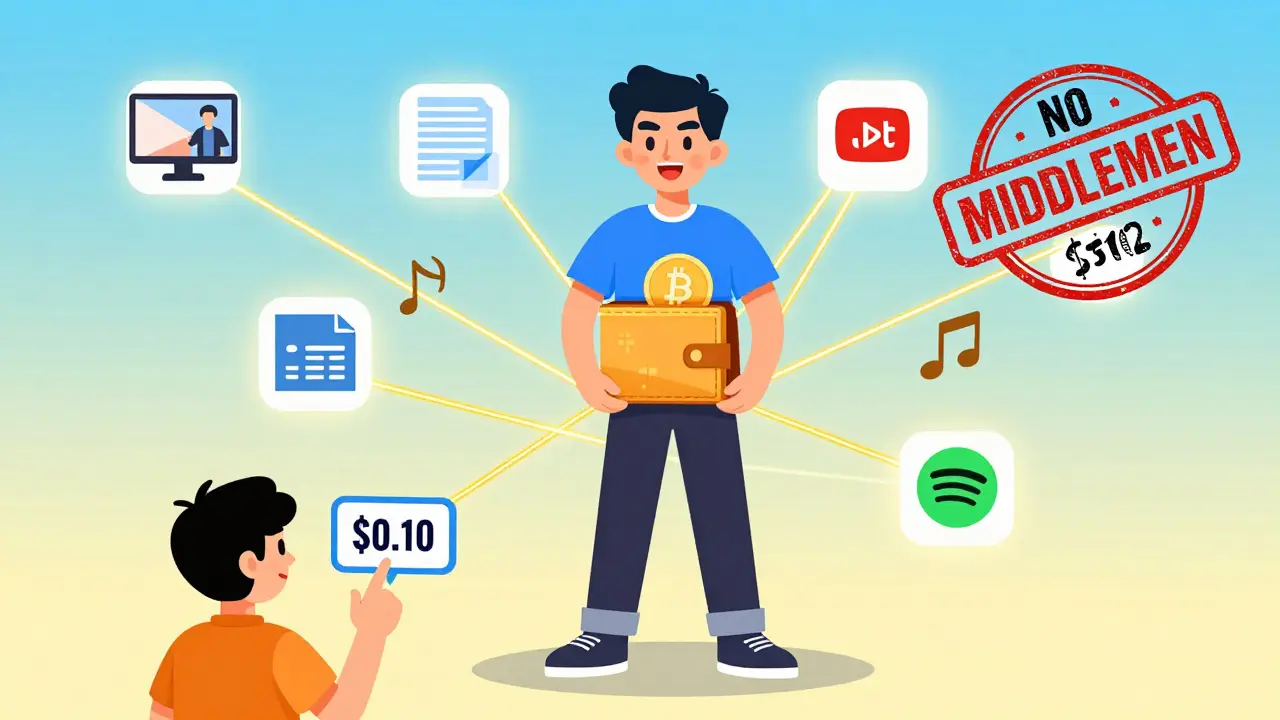
Imagine posting a video, article, or song online-and getting paid instantly the moment someone watches or downloads it. No middlemen. No delayed payments. No hidden fees. That’s not science fiction. It’s what content monetization smart contracts do today.
What Exactly Are Content Monetization Smart Contracts?
A smart contract is just code that runs on a blockchain. But when it’s built for content, it becomes a self-executing deal between creator and fan. You write the rules once-like “pay $0.15 every time this video is viewed”-and the contract handles everything automatically. No invoices. No PayPal delays. No platform taking 30%.
These contracts live on networks like Ethereum, Polygon, or Solana. They use languages like Solidity to lock in conditions: if a user pays, unlock the file. If a subscriber renews, send the next episode. If someone resells your digital art, give you 10% royalty. All of it happens without a human stepping in.
Before smart contracts, creators relied on platforms like YouTube, Spotify, or Patreon. Those platforms decide the rules, take a cut, and sometimes change them overnight. With smart contracts, you own the deal. The blockchain enforces it. No one can cancel it. No one can alter it. That’s the power of immutability.
How Creators Get Paid: Real Models in Action
There’s no one-size-fits-all way to monetize content with smart contracts. But here are the models that actually work today.
- Micropayments: Users pay pennies to read a single article or watch a short film. Tools like Supertab make this easy-no wallet setup needed. A reader clicks “pay $0.05,” and the smart contract sends the money straight to your wallet. This works great for journalists, podcasters, or indie filmmakers with niche audiences.
- Subscription Access: Instead of Patreon’s monthly fee, you use a smart contract that auto-renews. Pay $5/month? The contract gives you access to a private feed. Miss a payment? Access locks. No manual cancellations. No chargebacks. Ethereum-based platforms like Mirror let writers publish and collect subscriptions directly.
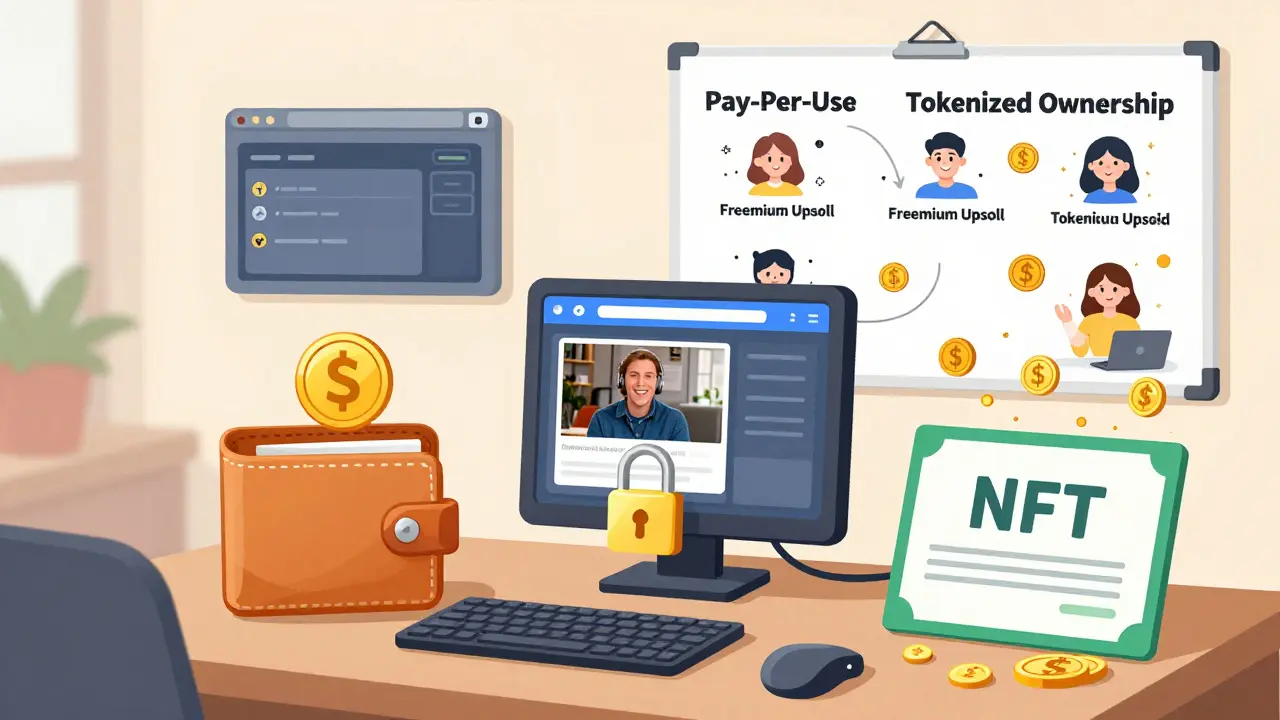
- Tokenized Ownership: You don’t just sell content-you sell a piece of it. Fans buy NFTs that represent shares in your next album or documentary. When it earns money, they get a cut. This isn’t speculation-it’s real revenue sharing. Artists like Grimes and RAC have used this to fund projects with thousands of small investors.
- Pay-Per-Use: A photographer sells access to a high-res image for $2. A designer sells a Canva template for $1.50. Each sale triggers a smart contract that splits the payment: 85% to you, 10% to the marketplace, 5% to the network. No bank account needed. Payments come in crypto, instantly.
- Freemium + Upsell: Give away free content with ads. But if someone wants the clean version, they pay a small fee via smart contract to remove ads and unlock extras. This lowers the barrier to entry while still converting casual viewers into paying supporters.
Why This Beats Traditional Platforms
YouTube pays $0.0006 per view. Spotify pays $0.003 per stream. Patreon takes 5-12% on top of that. And you’re stuck with their rules.
With smart contracts:
- You keep 90%+ of every payment.
- Payments settle in seconds, not weeks.
- You can set your own pricing-no algorithm deciding your value.
- Global audience? No currency conversion headaches. Crypto works everywhere.
- Automatic royalties mean you earn every time your work is resold or reused.
One musician in Berlin used a smart contract to release a 3-minute track. He set it to pay $0.10 per play. In three months, it was streamed 12,000 times. He earned $1,200. No label. No distributor. Just him, the blockchain, and his listeners.
What You Need to Get Started
You don’t need to be a coder to use smart contracts for content-but you do need the right tools.
- Choose a blockchain: Ethereum is the most established but has high gas fees. Polygon and Solana are cheaper and faster-better for micropayments.
- Use a platform: Try Mirror for writing, Zora for art, Audius for music, or Superfluid for recurring payments. These handle the code for you.
- Set up a wallet: MetaMask or Phantom. You’ll need crypto (like ETH, SOL, or MATIC) to pay for gas fees when you deploy your contract.
- Connect to your content: Upload your file, set the price, and define the rules. Done.
Some platforms even let you accept credit cards. The smart contract still runs on-chain, but the user pays like they’re buying on Amazon. That’s the future: seamless for the buyer, powerful for the creator.
Challenges You Can’t Ignore
It’s not all smooth sailing.
- Gas fees: On Ethereum, sending a micropayment can cost more than the payment itself. That’s why most creators avoid it for anything under $1. Stick to Polygon or Solana for small transactions.
- Wallet complexity: Most people don’t know what a private key is. Platforms that let users pay with Apple Pay or Google Pay are winning here.
- Regulation: Some countries treat crypto payments as taxable income. Others ban them. Know your local rules before you start collecting.
- Scalability: High traffic can slow down networks. If your video goes viral, will the blockchain keep up? Layer 2 solutions (like Optimism or Arbitrum) help, but they’re still new.
Still, these are growing pains-not dealbreakers. The tools are improving fast. Gas fees on Polygon are under $0.01. Wallets now auto-convert crypto to USD. Regulations are catching up.
The Bigger Picture: What This Means for the Future
This isn’t just about money. It’s about power.
For decades, tech giants controlled who got seen, who got paid, and how much. Smart contracts flip that. Now, the creator owns the relationship. The audience owns the value. The blockchain owns the trust.
Imagine a novelist who sells chapters as NFTs. Each buyer gets a share of future royalties if the book becomes a movie. Or a teacher who sells a 10-minute lesson for $0.25-and earns every time it’s reused in a classroom. Or a photographer whose images are used in AI training-and gets paid every time the model generates a new image.
This is the rise of the direct economy. No gatekeepers. No middlemen. Just people exchanging value, securely and transparently.
By 2027, Gartner predicts over 30% of digital creators will use blockchain-based monetization tools. The ones who wait for platforms to catch up? They’ll be left behind.
What Comes Next?
AI is starting to interact with smart contracts too. Imagine this: an AI analyzes your audience and suggests the perfect price for your next video. It auto-deploys a new smart contract with that pricing. You approve it with one click. Done.
Or: your content is sampled in a song. The smart contract detects it, triggers a royalty payment, and sends it to your wallet-no lawyer needed.
This isn’t far off. Companies are already building it.
The tools are here. The technology is proven. The only thing left is for creators to take control.
You don’t need permission to monetize your work anymore. You just need to start.
Can I use smart contracts to monetize my YouTube videos?
Yes, but not directly through YouTube. You can use smart contracts to sell access to exclusive content, behind-the-scenes footage, or early releases via platforms like Mirror or Zora. Then link to those from your YouTube description. Some creators use YouTube for discovery and smart contracts for revenue-keeping the platform’s reach without its cut.
Do I need to know how to code to use smart contracts?
No. Platforms like Mirror, Audius, and Superfluid let you create and deploy monetization contracts with a few clicks. You set the price, the access rules, and the payout address. The platform writes and deploys the code for you. You only need to understand the basics of wallets and crypto payments.
What happens if the blockchain crashes?
Blockchains like Ethereum, Polygon, and Solana are designed to be decentralized and fault-tolerant. They run on thousands of computers worldwide. Even if one node fails, the network keeps going. Your contract and payments are stored across the network-not on a single server. It’s far more reliable than any company-run platform.
Are smart contract payments taxable?
Yes. In most countries, crypto received as income is treated as taxable property. You need to track each payment’s value in your local currency at the time you received it. Tools like Koinly or CoinTracker help automate this. Always consult a tax professional familiar with crypto in your jurisdiction.
Can I monetize old content with smart contracts?
Absolutely. Upload your existing articles, videos, music, or images to a platform like Zora or Foundation. Set a price or subscription model. The smart contract will start collecting payments immediately. Your old work becomes a new income stream-with no extra effort.
How do I get paid in real money?
You can convert crypto to fiat (USD, AUD, EUR) through exchanges like Coinbase, Kraken, or Binance. Some platforms, like Superfluid, let you auto-sell crypto to your bank account daily. Others let you link your PayPal or Stripe account to receive payouts in your local currency-no manual conversion needed.
Is this only for artists and musicians?
No. Bloggers, educators, software developers, photographers, podcasters, researchers-anyone who creates digital content can use this. A technical writer sells a PDF guide for $3. A podcast host offers bonus episodes via subscription. A game developer sells in-game assets as NFTs. The model works for any digital product.
Content monetization smart contracts are no longer experimental. They’re the new standard for creators who want control, fairness, and real income. The question isn’t whether you should use them. It’s when you’ll start.
Let me break this down slowly, because I think most people are missing the real paradigm shift here: smart contracts don't just automate payments-they rewire the entire power structure of digital creation. For centuries, art, writing, and music were filtered through gatekeepers who decided what was valuable. Now, the value is determined at the point of consumption, not by algorithms or corporate boards. Every microtransaction is a vote. Every NFT purchase is a declaration of belief. This isn't monetization-it's decentralized democracy in action, where the audience becomes the curator, the investor, and the patron all at once. And the scary part? It's only just beginning. We're not talking about replacing YouTube; we're talking about making YouTube irrelevant by offering something fundamentally more honest.
Oh wow, so now we’re trusting code written by anonymous devs on a blockchain to pay artists instead of, I don’t know, actual human beings with accountability? 😏 Let me guess-next they’ll say ‘trust the algorithm’ when your video gets demonetized for saying ‘climate change’? This is just crypto bros repackaging the same exploitation with more buzzwords. And don’t get me started on gas fees-your $0.05 payment costs $2 in Ethereum fees? That’s not freedom, that’s a scam with a whitepaper.
Enough with the crypto utopian fairy tales. America built the internet, America funds innovation, and America doesn’t need some decentralized ledger from a foreign server to pay its creators. You want to monetize content? Use PayPal. Use Stripe. Use Patreon. Not some blockchain toy that requires you to memorize a 12-word passphrase just to buy a $0.10 article. This isn’t progress-it’s ideological nonsense dressed up as economics. The real innovation is in payment processing, not in replacing banks with unregulated, energy-hungry digital ghosts. And if you think blockchain is ‘immutable’-tell that to the 2022 Terra collapse or the $600M Ronin hack. Your ‘trustless’ system? It’s trusting hackers.
They’re not telling you the whole story. Blockchain-based payments? Sure. But who owns the nodes? Who controls the mining pools? Big tech already owns 80% of Ethereum mining through cloud services. This isn’t decentralization-it’s rebranding. The same corporations that run YouTube are now running the blockchain infrastructure. They just moved the money to a different ledger and called it ‘revolutionary.’ And don’t forget: every time you pay with crypto, you’re feeding a system that uses more electricity than entire countries. You think you’re empowering artists? You’re just funding climate collapse with a side of delusion.
Wow. So you’re saying the solution to exploitative platforms is… more platforms? And more complexity? And more crypto wallets? And more taxes? And more ‘trust the code’ nonsense? I’m not a creator-I’m just someone who likes to watch videos without having to learn Solidity first. This isn’t liberation. It’s a tax on attention. You want to make money? Make good content. Not a smart contract. The market doesn’t care about your blockchain. It cares about your voice. And your voice doesn’t need a wallet to be heard.
I just love how this gives people like me-small-town teachers, hobby photographers, indie poets-a real shot. No gatekeepers. No ‘algorithm didn’t like your vibe.’ Just me and my audience. It’s quiet. It’s real. And it feels… human again.
Smart contracts are the future but only if you accept that the present is broken. The current system is a feudal economy where tech lords hoard attention and monetize your soul through ads. Blockchain doesn’t fix everything-but it fixes the most critical flaw: ownership. You created it. You own it. You set the price. No one else gets to decide your worth. That’s not tech-that’s justice. And if you’re too lazy to learn a wallet? Then you’re not ready to be a creator in the 21st century. Period.
Interesting but I wonder how this works in countries where crypto is banned or heavily regulated. In India, we can't legally receive crypto as payment. So even if the tech is brilliant, the legal framework doesn't support it. Is this really global or just for Western crypto enthusiasts?
For creators who are already building communities-this is a game-changer. But for beginners? The barrier is still too high. You need to understand wallets, gas fees, tax implications, blockchain selection, platform compatibility, and how to explain all of this to your audience. Most people just want to post and get paid. The tools are getting better, but we’re still in the ‘early adopter’ phase. Patience. The UX will catch up. It always does.
Let’s quantify this. YouTube pays $0.0006 per view. You claim smart contracts pay $0.10 per play. But how many views does your content actually get? 12,000 views = $1,200? That’s a tiny niche. The average YouTuber gets 1,000 views/month. At $0.10 per view, that’s $100/month. But you need to pay gas fees for every transaction. At $0.05 per transaction, 1,000 views = $50 in fees. Net = $50. Meanwhile, YouTube gives you $0.60 with zero friction. So your ‘revolution’ only works if you already have 100k+ followers. This isn’t democratization. It’s elitism with a blockchain logo.
Blockchain is just the new religion. People worship code because they don’t understand it. They think immutability means truth. But code is written by humans. Humans are biased. Humans make mistakes. And humans can be corrupted. The blockchain doesn’t care about fairness-it cares about consensus. And consensus is just the majority opinion. So who controls the majority? The miners. The whales. The corporations. You’re not free. You’re just paying a different landlord.
Just tried Mirror for my blog. Set up a $0.25 paywall on my essays. Got 47 readers in a week. Made $11.75. Paid $0.30 in gas. Net: $11.45. Not rich. But I didn’t have to beg for sponsorships. Didn’t have to sell my soul to ads. Just wrote. People paid. That’s enough for me. 🚀
There’s a philosophical tension here: if the blockchain enforces payment, does that mean the creator is no longer responsible for the quality of their work? If someone pays $0.10 for a poorly written article, and the contract still pays out, is that justice-or moral abdication? The market doesn’t care about merit. It only cares about access. And that’s a dangerous shift in how we value creativity.
For Indian creators, this is very promising. We have millions of writers, musicians, and educators who are ignored by global platforms. With low-cost blockchains like Polygon, we can reach global audiences without middlemen. I started selling my Hindi poetry as NFTs. Got buyers from Canada, Germany, Japan. No bank. No currency issues. Just direct payments. It’s not perfect, but it’s real. And it’s mine.
Y’all are overthinking this. Just upload your stuff. Set the price. Let people pay. If they like it, they’ll pay. If they don’t, they won’t. No drama. No lectures. No ‘this changes everything’ speeches. Just create. Get paid. Repeat. 💪
I used to feel invisible as a poet. Now, strangers send me crypto to read my words. Not because they have to. Not because an algorithm pushed it. Because they wanted to. That’s magic. And it’s real. 🌸
The premise is flawed. Smart contracts assume perfect rationality. But humans are irrational. They pay for content they never consume. They dispute transactions. They demand refunds. They pirate. The blockchain cannot enforce ethics. It can only enforce code. And code cannot replace trust, empathy, or human judgment. This is automation without humanity. And automation without humanity is not progress-it is alienation.