

When COSS first launched in 2017, it promised something rare: a crypto exchange that wasn’t just about trading. It claimed to be a one-stop solution - trade, store, launch tokens, and even send crypto via GPS. At the time, that sounded revolutionary. But today, COSS isn’t a platform you use. It’s a warning sign.
What COSS Actually Offered (Back When It Worked)
COSS wasn’t just an exchange. It had three core parts: the COSS Exchange for trading, the COSS Wallet for storing assets, and COSS Lift-Off for launching new tokens. Its biggest draw? A fee-sharing model. If you held the native COS token, half of all trading fees collected by the platform were distributed to you. That’s rare. Most exchanges keep those fees. Binance gives discounts on fees if you use BNB. COSS gave you cash - in COS tokens. Trading fees were competitive too. Makers (those placing limit orders) paid 0.00%. Takers (market orders) paid 0.25%. That beat Kraken and Binance at the time. Withdrawal fees were low: just 0.0004 BTC per withdrawal. That’s cheaper than most competitors. And for a while, users liked it. The interface was clean. Deposits via bank transfer worked in USD, EUR, GBP, HKD, and JPY. No credit cards - a big miss - but still, it was functional. The COSS Wallet had features most wallets didn’t: in-wallet swaps, crypto-based mobile top-ups, and even GPS-based peer-to-peer transfers. If you were near someone else with the wallet, you could send crypto just by standing next to them. It sounded like sci-fi. And in 2020, they launched COSS DEX - their own decentralized exchange. It promised cross-chain trading, fast execution, deep liquidity. The idea was solid. But execution? That’s where everything fell apart.The Turning Point: When Everything Went Silent
By mid-2021, users started reporting the same thing: they couldn’t withdraw their funds. It wasn’t a glitch. It wasn’t a slow server. It was a full shutdown. COSS suddenly locked all accounts into "audit mode." No explanation. No timeline. No contact. Trustpilot reviews from August 2021 tell the story clearly. One user wrote: "Had traded at COSS since it opened shop and never once believed Rune would one day scam us all. Now all my cryptos with COSS are in their audit mode - which means little or no chance of returning back to me." Another said: "With no zero doubts now, I'm certain COSS pulled an exit scam on everyone." Support channels vanished. The compliance email listed in their terms of use stopped working. The official Telegram group went silent. The website’s FAQ section was deleted. Even the link to their "new" DEX - https://dex_coss_io/trade - either redirected to junk sites or showed a 404 error. Users who tried to complete new KYC (Know Your Customer) checks after being told to do so found themselves stuck in an endless loop. Submit documents. Wait. Get told to submit again. No response. No progress. No refund.Why COSS Failed When Others Succeeded
COSS didn’t die because the market crashed. It died because it never built trust. Compare it to Kraken or Coinbase. Both survived multiple bear markets. Kraken reported $4.5 billion in reserves in Q1 2023. Coinbase has regulatory licenses across dozens of countries. COSS had none. It was registered in Singapore, but never obtained a Payment Services Act license. That’s not a technicality - it’s a dealbreaker. Its token, COS, was supposed to be its lifeline. But unlike BNB or KCS, COS had no real utility beyond fee discounts. No staking. No governance. No burning. No ecosystem growth. Just a promise. And when users couldn’t withdraw, the token’s value collapsed. It went from $0.20 in 2019 to under $0.001 by 2022 - and today, it’s essentially worthless. COSS also never upgraded its tech. While competitors added futures, margin trading, API v3, and institutional tools, COSS stuck with a basic interface. No mobile app worth using. No 2FA recovery options. No transparency reports. No proof of reserves. When users asked for proof, they got silence.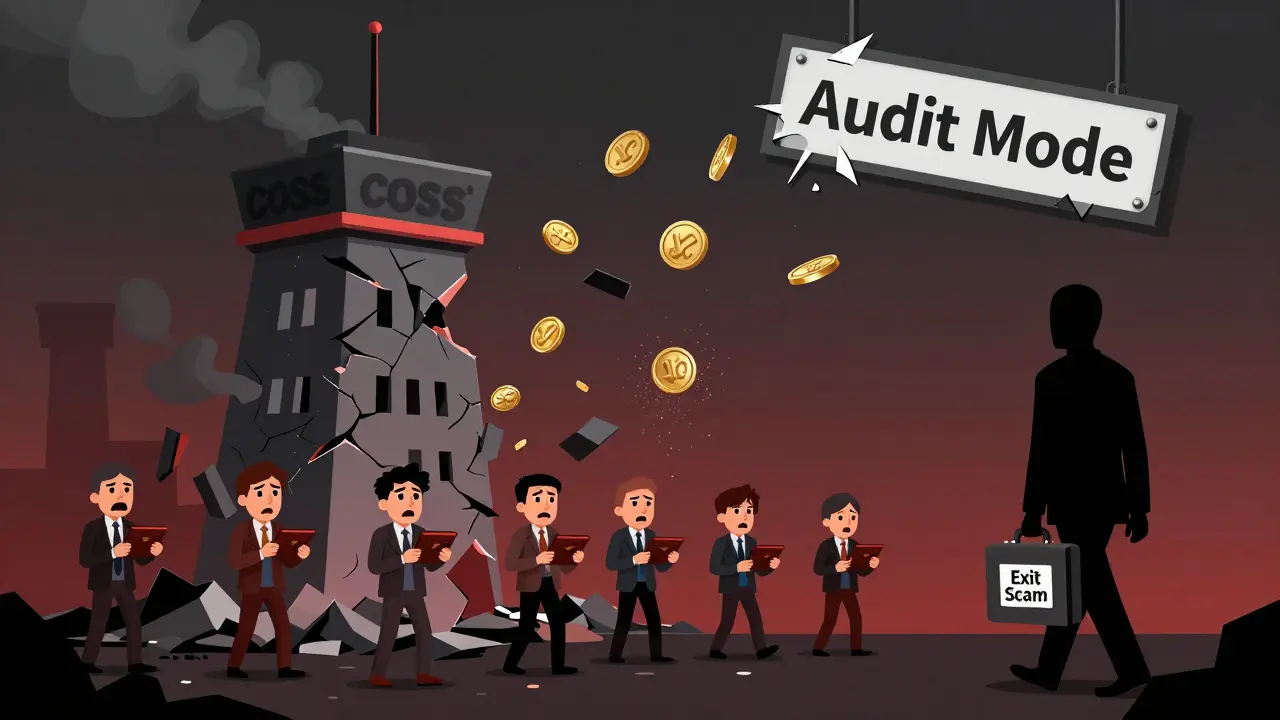
What Experts and Users Say Now
CaptainAltcoin’s 2023 review said it best: "COSS has a legal paper trail, but no regulatory oversight." That’s the core problem. You can register a company in Singapore. But if you don’t follow the rules, you’re just a shell. Finder’s 2023 exchange comparison framework doesn’t even list COSS anymore. It’s not in the top 100. Not even in the "caution" section. It’s gone. CoinMarketCap’s page for COSS now says: "No data is available now." That’s not a technical error. That’s a death notice. User sentiment is unanimous. Reddit threads from September 2021, like the one titled "Anyone else stuck with COSS exchange?", are filled with users sharing screenshots of locked accounts and unanswered tickets. One user summed it up: "I trusted them because they looked professional. Turns out, professional-looking scams are the worst kind."Current Status: Is COSS Still Operating?
No. Not even close. As of March 2026, COSS has no active trading pairs. No customer service. No website updates. The domain coss.io redirects to a placeholder page with no content. The COSS Wallet app is gone from both Apple App Store and Google Play. The COS token trades on a handful of obscure decentralized exchanges - but even there, volume is near zero. There’s been no official announcement of closure. No press release. No email to users. Just silence. That’s the hallmark of an exit scam: no warning. No explanation. Just disappearance.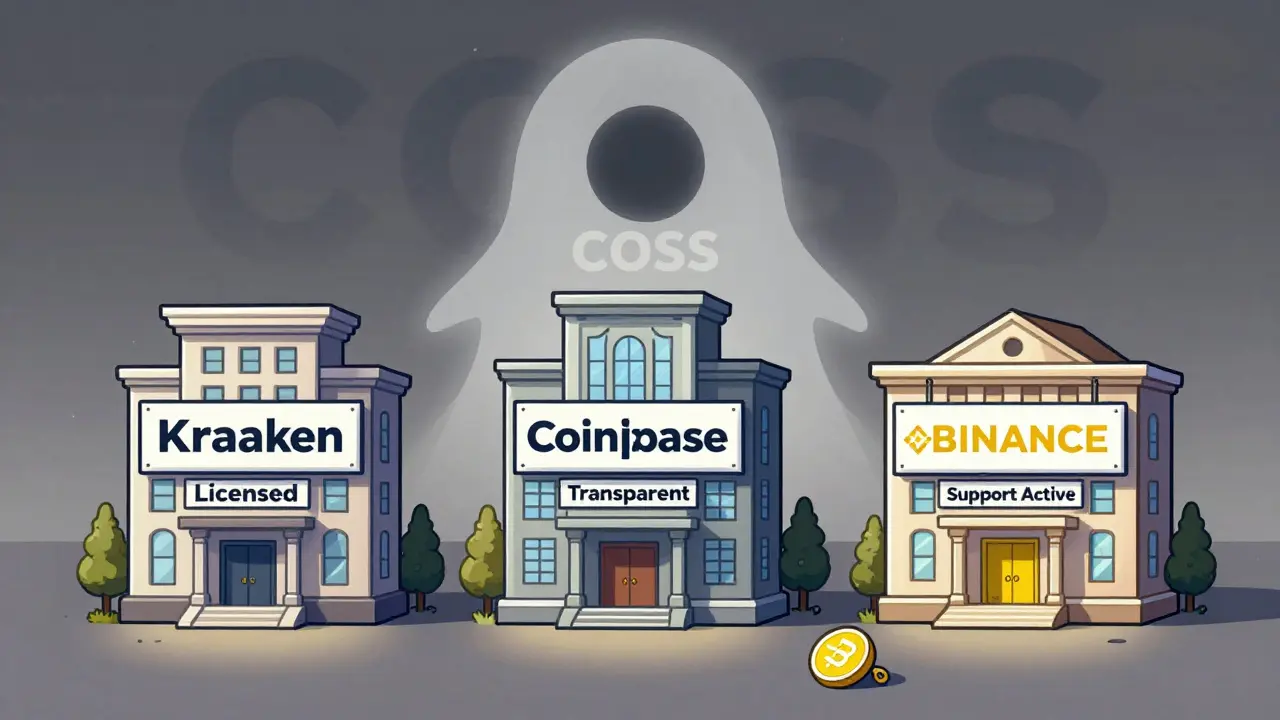
What You Should Do If You Still Have Funds on COSS
If you’re one of the few still holding assets on COSS, you’re not alone. But you’re also not getting them back. There is no recovery process. No legal avenue. No regulator to file a complaint with. Singapore’s Monetary Authority doesn’t recognize COSS as licensed. No law enforcement agency has taken action. The company behind COSS - Crypto One Stop Solution Pte. Ltd. - still exists on paper, but it has no public officers, no active filings, and no operational presence. Your best move? Accept the loss. Document everything. Report the incident to your local financial crime unit if possible. And never use another exchange that doesn’t have clear regulatory status, public reserves, and active customer support.Alternatives That Actually Work
If you’re looking for a reliable exchange, here are three that still deliver:- Kraken: Licensed in multiple jurisdictions, offers margin, futures, staking, and has $4.5B+ in reserves. Transparent reporting. Active support.
- Coinbase: Publicly traded, fully regulated in the U.S. and EU, supports credit card buys, and has a simple interface for beginners.
- Binance: Highest volume globally, low fees, strong token economy (BNB), and deep liquidity. Still controversial, but operational and transparent about risks.
Final Verdict
COSS wasn’t just a bad exchange. It was a broken promise. It started with a smart idea - fee-sharing, wallet integration, a unified ecosystem. But it never built the infrastructure to back it up. No compliance. No transparency. No accountability. It’s now a textbook example of how not to run a crypto platform. If you see "COSS" mentioned anywhere as a viable option - walk away. It’s not a platform. It’s a graveyard.Is COSS exchange still operational in 2026?
No, COSS is not operational. As of 2026, the platform has completely shut down. Trading pairs are gone, the website redirects to a blank page, and the mobile app has been removed from app stores. User funds remain locked, and there is no official communication or recovery process.
Can I get my crypto back from COSS?
Almost certainly not. Multiple user reports from 2021 confirm that withdrawals were blocked under "audit mode," and support channels were shut down. There is no known legal or technical path to recover funds. COSS never published proof of reserves or underwent third-party audits, making recovery impossible.
Was COSS ever regulated?
No. Although COSS was registered as a company in Singapore, it never obtained a Payment Services Act license required by Singapore’s Monetary Authority. This lack of regulatory oversight was a major red flag even before its collapse.
Why did COSS fail when other exchanges survived?
COSS failed because it prioritized marketing over infrastructure. It promised features like fee-sharing and GPS transfers but never built reliable systems to support them. It lacked transparency, regulatory compliance, and customer support. While competitors like Kraken and Coinbase invested in security, licensing, and user trust, COSS took shortcuts - and users paid the price.
Is the COS token still worth anything?
The COS token has effectively no value. Trading volume is near zero, and it’s only listed on a few low-liquidity decentralized exchanges. Even if you still hold COS, it cannot be used on the COSS platform because the platform no longer functions. Its market cap has collapsed from millions to near zero.
COSS serves as a lesson: never trust a crypto exchange that doesn’t answer your questions - especially when your money is on the line.
This is why America needs to stop letting foreign crypto scammers operate here. COSS was a Trojan horse for Chinese and Russian oligarchs to launder money. I told everyone this back in 2020. Nobody listened. Now we're stuck with a graveyard of wallets and broken dreams. Wake up, people.
I knew it was a scam the second they said GPS transfers. That's not tech that's sci-fi fantasy. They were using AI voice bots to fake support. I called them 17 times. Every time it was the same robotic voice saying 'your case is under review.' I swear they had a script. 'We are sorry for your inconvenience.' Yeah right. They were just waiting for the rug to be pulled.
It’s wild, honestly. COSS had such potential. Clean UI, real fee-sharing… I remember when I first got my COS distribution. Felt like I was part of something. But then… silence. No email. No update. Just… gone. Like someone flipped a switch. It makes you wonder how many other platforms are doing the same thing right now. Quietly. While we’re all chasing the next moonshot.
We keep talking about regulation like it’s some magic bullet. But here’s the truth: most people don’t care about licenses. They care about trust. COSS looked legit. Their website was polished. Their team had LinkedIn profiles. They even had a blog with real articles. That’s the danger. The scammers aren’t the ones with broken sites anymore. They’re the ones who built beautiful traps. And we fell for it. Again.
I used COSS back in 2019. It was one of the few exchanges that accepted Indian rupees via UPI. I deposited 50k INR. Lost it all. No one responded. No one cared. Now I only use platforms with physical offices. If they don’t have a building you can visit, they’re not real. Simple.
COS token was worthless even before the shutdown
I still have a screenshot of my COSS dashboard. 3.2 BTC. 12k COS. 450 ETH. All gone. I don’t blame the market. I blame myself. I thought ‘professional design’ meant ‘legit.’ Turns out, scammers hire the same web designers as Kraken. The lesson? If you can’t find their CEO’s LinkedIn, walk away.
I just cried watching my wallet balance drop to zero. I put my entire life savings into COSS because they said I’d be ‘part of the revolution.’ Now I’m just another ghost in their server logs. I don’t even know if they’re still breathing. Or if they’re just… floating. Somewhere. In the dark.
I’m so sorry to everyone who lost money here. I’ve been through this too. It’s not just about the crypto. It’s about the betrayal. You trusted them. You believed in their vision. And they just… vanished. I’m here if anyone needs to vent. You’re not alone.
Let’s be real: COSS didn’t fail because of poor tech. It failed because of poor incentives. Fee-sharing sounds great until you realize you’re the only one paying for it. The team kept 90% of the revenue. They used COS as a Ponzi fuel. They didn’t build a platform. They built a cash funnel. And now the funnel’s dry. Classic.
I used to tell people COSS was the future. Now I cringe every time I hear its name. The irony? They had the right idea. Fee-sharing. Wallet integration. But they never cared about users. Only the next funding round. And when the money ran out? Poof. No warning. No apology. Just… silence.
i still have a few cos tokens in my wallet lol. like a weird little trophy. a reminder. dont trust anyone who says 'trust us'. ever. even if their website looks like apple's. i lost 8k. it hurt. but now i only use coinbase and kraken. they answer emails. and they dont disappear. sorry for those still holding out hope. its not coming back.
I lost my entire portfolio. I was so sure they were legit. I even told my mom about it. She said 'if it sounds too good to be true'... I didn’t listen. Now I can’t sleep. I keep checking their website. Hoping. It’s been years. I’m not mad. I’m just… hollow.
I still remember the day I first sent crypto via GPS. I stood next to my buddy at Starbucks and tapped send. 0.01 BTC. He got it instantly. We high-fived. That was magic. Then… it just vanished. Like the whole thing was a dream. I miss that feeling. Not the money. The trust. The wonder. That’s what they stole.
We keep calling this an 'exit scam' like it’s some new phenomenon. It’s not. It’s the oldest trick in the book. Build hype. Create a narrative. Promise community. Then vanish. The only difference now? They’ve got AI-generated press releases and LinkedIn influencers shilling their token. It’s not a failure. It’s a system. And we’re all just data points in their exit plan.
COSS never had a real team. I checked the domain registration. The same guy who registered COSS also registered 14 other crypto projects. All shut down. All with the same 'contact@' email. All with identical 'about us' pages. This wasn’t a company. It was a template. And we were the test subjects.
Let’s not romanticize this. COSS wasn’t a 'failed platform.' It was a poorly executed fraud. The fee-sharing model? A bait. The GPS feature? A distraction. The 'DEX'? A mirror. They never had liquidity. Never had security. Never had oversight. And yet, people gave them millions. That’s not a platform failure. That’s a societal failure. We worship aesthetics over accountability.
I’m still hopeful someone will bring COSS back. Maybe a white hat hacker. Maybe a DAO. Maybe… just maybe. I hold on to that. Not for the money. But because I refuse to believe that something so promising could just… disappear.