

For millions of people sending money across borders, traditional banking still feels like dial-up internet in a 5G world. You wait days. You pay high fees. You get hidden exchange rates that eat up your cash. And if something goes wrong? Good luck getting answers. That’s why, in 2025, more businesses and individuals are turning to crypto payments-specifically stablecoins-to move money internationally. It’s not magic. It’s just faster, cheaper, and transparent.
Why Traditional Banking Still Falls Short
Let’s be real: SWIFT transfers are slow. The World Bank’s 2024 report shows the average cost of sending money across borders is 6.4%. For someone sending $500 to Mexico, that’s $32 just in fees. And it takes 2 to 5 business days. Why? Because your money hops between banks, each one charging a cut, adding delays, and marking up the exchange rate. By the time it lands, you’ve lost more than you expected. Even worse, if you’re sending money to Nigeria, Vietnam, or Argentina, the system often breaks down. Local banks don’t have direct relationships with U.S. or European institutions. Your transfer gets stuck in a limbo of intermediaries. And if the recipient’s bank doesn’t support the currency? You’re out of luck.How Stablecoins Fix This
Enter stablecoins. These are digital coins pegged to real money-like the U.S. dollar, euro, or Australian dollar. They’re not volatile like Bitcoin. They move like cash, but on the blockchain. The magic trick? The stablecoin sandwich. Here’s how it works: You start with USD. You convert it to USDT or USDC (two of the most trusted stablecoins). That digital token travels across the blockchain in minutes. Then, at the other end, it’s converted to pesos, naira, or rupees and deposited into a local bank account. All of it happens in under 10 minutes. Fees? Around 0.5% to 1.2%. That’s a 90% drop from traditional banking. In Mexico, this isn’t theoretical. As of March 2025, the Bank of Mexico reported that USDT-based remittances now make up 22% of all inbound payments from the U.S. That’s over $10 billion a year flowing through crypto rails instead of banks.Which Blockchains Are Actually Used?
Not all blockchains are created equal when it comes to payments. Ethereum is reliable but expensive during peak times. Solana handles 65,000 transactions per second and settles in 2.5 seconds-perfect for high-volume corridors. Polygon offers low fees and is widely used in Latin America and Southeast Asia. The top stablecoins you’ll see in cross-border use:- USDT (Tether) - Still the most used, especially in emerging markets. Available on Ethereum, Solana, Tron, and Polygon.
- USDC (Circle) - Backed by U.S. regulators, preferred by businesses. Fully audited, transparent reserves.
- EUROAU - Launched in January 2025, approved by Germany’s BaFin. The first euro stablecoin with full regulatory clearance. Used by European companies sending money to Brazil and India.
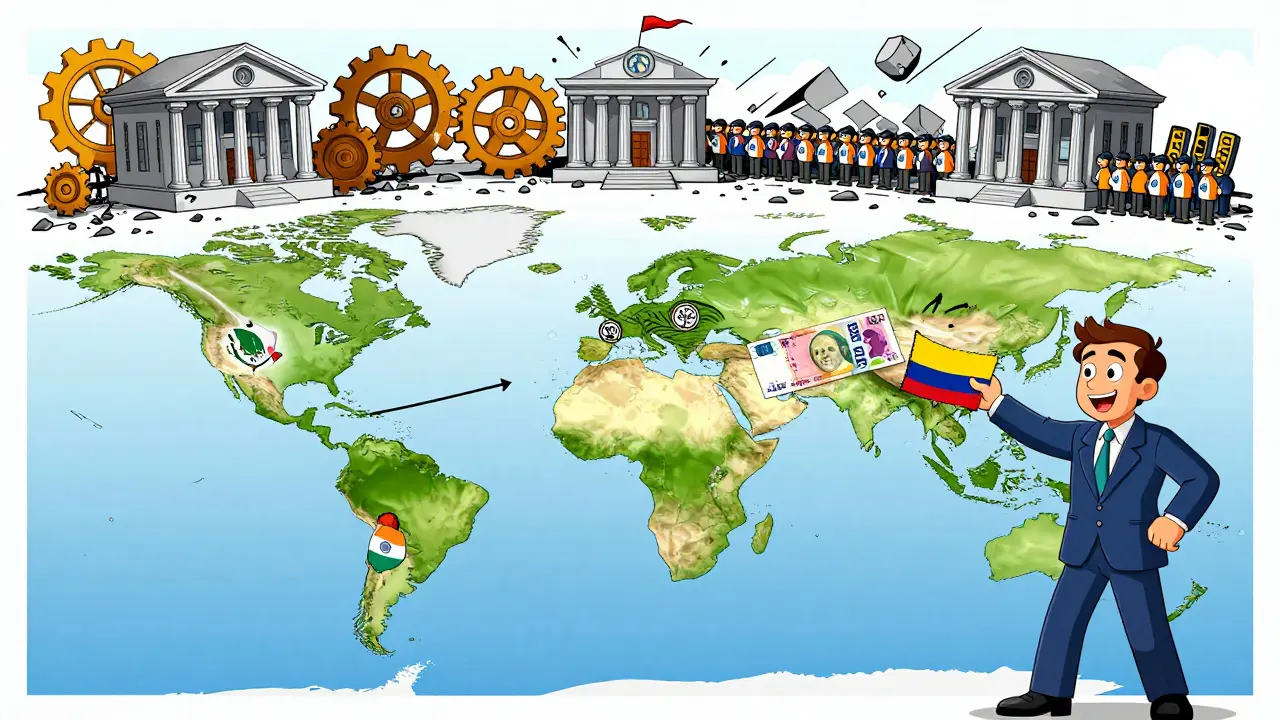
Real-World Savings: What This Means for You
A small business owner in Brisbane sending $10,000 to a supplier in Colombia used to pay $640 in fees and wait 4 days. Now, they use USDC via a crypto payment gateway. Fees: $85. Time: 7 minutes. The supplier gets the exact amount-no hidden FX markup. That’s $555 saved per transaction. Multiply that by 20 payments a month? That’s over $11,000 a year back in the business. On Reddit, users in Mexico, India, and the Philippines are sharing similar stories. One user, u/MexicoExporter, wrote: “I used to wait 4 days for payments from U.S. clients. Now I get paid in 10 minutes. No more chasing banks.”Where It Still Fails
This isn’t a perfect system. The biggest problem? Liquidity. If there’s no local partner in the destination country to convert the stablecoin into cash, the payment stalls. In Nigeria, where the naira is tightly controlled, success rates for crypto remittances drop to 68.4%. In countries with strict capital controls, like Venezuela or Zimbabwe, banks block crypto off-ramps entirely. Another issue: regulation. There are 37 different stablecoin rules around the world. In the U.S., you need a money transmitter license. In the EU, MiCA requires full audits. In some Asian countries, crypto payments are outright banned. If you’re a small business, navigating this is a nightmare. And yes, there’s still risk. During the crypto crash in March 2024, blockchain congestion spiked. Settlement times jumped from 7 minutes to 25 minutes. One Brazilian fintech lost $1.2 million when their off-ramp provider went insolvent during a liquidity crunch.Who’s Using This Today?
This isn’t just for crypto enthusiasts. Major players are already in:- PayPal - Rolled out crypto payments to 12,000+ merchants in July 2025, cutting their cross-border processing costs by 34%.
- Ripple - Used by banks and remittance firms for enterprise-grade transfers. Holds 38% of the corporate market.
- Circle - USDC is now integrated into Shopify, Stripe, and major payroll platforms.

Getting Started: What You Need
If you’re a business or freelancer ready to try this:- Choose a regulated provider - Look for companies like BVNK, Coinbase Commerce, or OpenPayd. Avoid unlicensed exchanges.
- Set up an on-ramp in your country - This is where you convert fiat to stablecoin. Most providers integrate with local banks.
- Partner with an off-ramp in the destination - This converts stablecoin back to local currency. Providers like BitPay and Remitano have networks in 80+ countries.
- Test with a small amount - Send $100 first. Watch the time and fees. Confirm the recipient gets the right amount.
The Future: What’s Next?
2025 is the tipping point. The U.S. Federal Reserve is testing stablecoin integration into FedNow by Q4 2025. The Eurosystem plans to launch its own digital euro for wholesale payments in September 2025. And the Financial Stability Board is working on global standards for stablecoins-expected in early 2026. McKinsey predicts stablecoins will handle 20-25% of all cross-border payments by 2027. That’s up from 12.7% today. The growth isn’t slowing. It’s accelerating. But here’s the catch: adoption won’t be universal. Countries with strong central banks and strict controls will lag. Emerging markets with weak banking systems? They’ll leapfrog. That’s where the real disruption is happening.Final Thought: It’s Not About Replacing Banks
This isn’t about killing traditional banking. It’s about giving people a better option. For $500 remittances from the U.S. to Guatemala? Crypto wins. For $5 million corporate treasury transfers between London and Tokyo? Banks still have the edge in compliance and trust. The future isn’t crypto vs. banks. It’s crypto and banks-working together, with crypto handling the fast, cheap, global parts. And for anyone who’s ever waited days for money to arrive? That’s not just progress. It’s liberation.Are crypto payments legal for cross-border transfers?
Yes, in most countries-but with rules. The U.S., EU, Japan, and Australia have clear frameworks. In the EU, MiCA regulates stablecoin issuers. In the U.S., the GENIUS Act requires reserve backing and audits. Some countries, like China and Nigeria, restrict or ban them. Always check local laws before sending.
Can I use crypto payments to send money to family overseas?
Absolutely. Platforms like BitPay, Remitano, and Wise (with crypto options) let individuals send stablecoins to recipients who cash out via local banks or mobile wallets. In Mexico, Colombia, and the Philippines, this is already common. The recipient doesn’t need a crypto wallet-they just need a bank account.
What’s the fastest way to send crypto across borders?
Using USDC or USDT on Solana or Polygon. Solana settles in 2.5 seconds. Polygon adds a few more seconds for lower fees. Combine that with a reliable on-ramp/off-ramp provider, and you can send money from Australia to India in under 5 minutes. Avoid Bitcoin or Ethereum mainnet for speed-critical transfers-they’re too slow and expensive.
Do I pay taxes on crypto cross-border payments?
Yes. In most countries, converting fiat to stablecoin and back is treated as a taxable event. Australia, the U.S., and Canada treat stablecoins as property. Keep records of every transaction: dates, amounts, values in fiat, and fees. Use crypto tax tools like Koinly or CoinTracker to stay compliant.
Is it safer than traditional wire transfers?
It’s faster and cheaper, but not always safer. Blockchain transactions are irreversible and transparent-good for accountability. But if you send to the wrong address, there’s no chargeback. Traditional banks offer fraud protection and dispute processes. Use regulated providers with insurance and KYC to reduce risk.
What happens if a stablecoin loses its peg?
USDT and USDC have held their peg since 2014, even during market crashes. They’re backed by cash and short-term U.S. Treasuries. EURAU, launched in 2025, is fully audited by German regulators. But if a stablecoin does depeg (like TerraUSD in 2022), you could lose value. Stick to regulated, transparent issuers with daily reserve reports.
Used this to send money to my sister in Delhi. 7 mins. $2 fee. No more waiting 5 days. Game changer.
YES!!! Finally someone gets it 🙌 No more bank drama. I sent $5k to my cousin in Manila last week - done before my coffee got cold. Crypto is the real MVP.
This is exactly what we’ve been waiting for. I run a small Etsy shop and used to lose $300 a month in fees and delays. Now I use USDC with OpenPayd. My margins improved by 18%. Thank you for laying this out so clearly.
Just tried this with my mom in Mexico. She doesn’t even know what a blockchain is - but she got her money in 8 minutes and was like ‘why did we ever do this the old way?’ 😭
But what about the environmental impact? You people just ignore the energy waste. This isn’t progress, it’s greed wrapped in tech buzzwords.
While the efficiency gains are undeniable, we must consider the systemic risks. Stablecoins are not currency - they’re liabilities backed by opaque reserves. Regulatory fragmentation creates dangerous arbitrage opportunities. We’re building a financial superhighway without guardrails.
The Bank of Mexico’s 22% adoption figure is misleading - it doesn’t account for the 14% of transactions that failed due to off-ramp liquidity crunches. This isn’t a panacea. It’s a fragile, high-speed alternative that only works when the ecosystem holds.
And yes, fees are lower - but so is recourse. If your off-ramp provider collapses, as happened in Brazil last quarter, you lose everything. No FDIC. No chargeback. No recourse. That’s not innovation - that’s financial roulette.
Yes, SWIFT is broken. But replacing it with a patchwork of unregulated, privately issued digital tokens? That’s not liberation. It’s a regulatory void with faster settlement times.
Let’s not confuse speed with stability. The real win is when regulated institutions integrate these rails - not when individuals are left to navigate them alone.
Let’s be honest - this is just a Trojan horse for dollar hegemony. USDT and USDC are not ‘stablecoins’ - they’re digital IOUs issued by private corporations with zero constitutional accountability. The fact that you call this ‘liberation’ while ignoring that 98% of stablecoin volume is USD-pegged is either naive or complicit.
The EuroAU mention is a red herring. Germany didn’t approve it - they merely tolerated it under MiCA’s regulatory gray zone. And don’t get me started on Solana’s 2.5-second settlement - that’s only possible because they’ve sacrificed decentralization for throughput. It’s a centralized proxy with a blockchain veneer.
And the McKinsey projection? Please. They’ve been wrong about crypto adoption since 2017. The real adoption curve is flatlining in the U.S. and EU - growth is entirely concentrated in countries with collapsing currencies and weak institutions. This isn’t the future of finance. It’s the future of currency collapse.
Anyone who thinks this replaces banks is delusional. Banks still control capital, compliance, and credit. Crypto is a side-channel for the unbanked and the tax-avoidant. Don’t mistake desperation for innovation.
And before you say ‘but it’s cheaper!’ - have you accounted for the tax liabilities? The IRS treats every conversion as a capital gain. That $555 you saved? You’ll pay $165 in taxes on it. Net gain? $390. And you still need to file Form 8949. Good luck explaining that to your CPA.
My cousin in Lagos got paid via USDT last week - took 6 minutes. He cashed out via Opay mobile wallet. No bank account needed. That’s the real win. This isn’t about replacing banks - it’s about bypassing them entirely where they don’t work.
And yes, liquidity is an issue in Nigeria - but that’s changing fast. Local fintechs are onboarding new off-ramp partners every week. The real bottleneck isn’t tech - it’s regulation. And guess what? Governments are starting to catch up.
Also, environmental concerns? Solana and Polygon use less energy than a single SWIFT transaction. The math doesn’t lie. Stop using ‘energy waste’ as a blanket excuse.
Oh please. You all sound like crypto bros who just read the first page of a whitepaper. ‘Fees are lower’ - yeah, until you get hacked. ‘Faster’ - sure, until the chain gets congested. ‘No hidden FX’ - funny, because every off-ramp provider slaps on a 3% spread and calls it ‘processing.’
And don’t get me started on ‘regulated’ stablecoins. Circle? Audited by a firm that also audited FTX. USDT? Tether’s ‘reserves’ are still mostly commercial paper. You think that’s safe? It’s a house of cards built on trust in people who’ve broken it before.
And yes, I know you’re going to say ‘but my cousin got paid!’ - congrats. You got lucky. Now try doing this at scale with $500k monthly volume. See how fast your ‘98.7% success rate’ drops when regulators start cracking down.
This isn’t finance. It’s gambling with your money, dressed up as innovation.
For anyone new to this: start small. Test with $20. Use Coinbase Commerce or BVNK. They handle the compliance. Don’t try to self-custody unless you know what a private key is.
Also - if your recipient doesn’t have a bank account, they can still get paid via mobile wallets in India, Mexico, Kenya. No crypto wallet needed. Just a phone number.
This isn’t about ideology. It’s about access. If you’ve ever waited 3 days for your paycheck to clear across borders - you already know this is better.
I used to be skeptical. Then I watched my uncle in Guatemala receive a $300 payment from his son in Chicago. Used to take 4 days. Now it’s 9 minutes. He didn’t know what a blockchain was. He just knew the money showed up - and it was all there.
That’s the real metric. Not fees. Not speed. Not regulation. It’s dignity. The ability to send love without being taxed, delayed, or diminished.
Technology doesn’t need to be perfect to be transformative. It just needs to work when it matters.
Biggest mistake people make? Thinking stablecoins = crypto. They’re not. USDC is basically a digital checking account with blockchain rails. It’s not speculative. It’s infrastructure.
Also - if you’re worried about volatility, stick to USDC or EUROAU. Avoid USDT unless you’re okay with the Tether question marks. And for love of god, don’t use Bitcoin for remittances. It’s like using a horse carriage to deliver pizza.
And yes, taxes are a pain - but Koinly auto-fills your forms. You’re not doing it manually anymore. Tools exist. Use them.
And to the guy who said ‘it’s not safe’ - neither is handing cash to a stranger at a Walmart MoneyCenter. At least with crypto, you can track it.
USA pushing USDT everywhere while India bans crypto. Hypocritical much? We need local stablecoins. Not dollar clones. Let India launch INR-pegged tokens. Not this colonial digital currency.
Just sent $100 to my sister in Manila using USDC on Polygon. 4 minutes. $0.80 fee. She got pesos. I got a photo of her eating noodles with the money. That’s the real ROI.
Also - I’m a 62-year-old retired teacher. I didn’t need a PhD to do this. Just a phone and 10 minutes. If I can do it, anyone can.
Mark my words - the Fed will ban this by 2026. They can’t control it. They’ll crush it. This is the last stand of decentralized finance. Enjoy it while it lasts.
It’s fascinating how everyone ignores the elephant in the room: this model depends entirely on the stability of the U.S. dollar. If the dollar collapses, so do USDT and USDC. You’re not building an alternative system - you’re just betting on the dollar’s survival.
And if you think MiCA or the GENIUS Act makes this ‘safe,’ you’re living in a fantasy. Regulations are written by lobbyists who profit from the status quo. They’ll regulate this into irrelevance.
And the ‘98.7% success rate’? That’s from providers who cherry-pick the easiest corridors. Try sending to Zimbabwe. Try sending to Venezuela. Try sending to Iran. The system breaks. Hard.
This isn’t liberation. It’s a temporary workaround for people who have no other options. And when those options return - the crypto rails will be abandoned.
India will never allow this. We have our own CBDC. No foreign stablecoin will touch our financial sovereignty. 🇮🇳
USDC on Polygon is the sweet spot. Low fees. Fast. Regulated. Works in 85 countries. Start here.
There’s a deeper philosophical question here: are we optimizing for efficiency, or are we optimizing for human connection? The speed of crypto payments is undeniable. But what do we lose when transactions become invisible? When the act of sending money - once a ritual, a gesture, a moment of care - becomes a silent API call?
I’ve seen families in rural Mexico wait for weeks for remittances. The anxiety, the uncertainty - it’s part of the emotional labor of migration. Now, it’s gone. The money arrives instantly. But so does the erasure of the waiting. Of the shared anticipation. Of the human rhythm.
Is faster always better? Or are we trading depth for velocity? I don’t have an answer. But I wonder if we’re asking the right questions.
Let’s not sugarcoat this - the stablecoin sandwich is a brilliant hack. But it’s a hack. It’s not a system. It’s a workaround built on regulatory arbitrage and liquidity gaps. And hacks get patched.
When the FedNow integration drops in Q4 2025, guess what? Banks will start offering instant cross-border rails with lower fees and full compliance. Suddenly, your ‘liberation’ becomes a legacy feature.
And here’s the kicker - the banks will still use the same blockchain rails. They’ll just rebrand it as ‘FedLink’ and charge you 1.5% instead of 1.2%. The tech doesn’t change. The power structure does.
This isn’t the end of banking. It’s the beginning of banking 2.0. And the winners won’t be the crypto bros. They’ll be the institutions that absorb these innovations quietly and make them look like their own.
So yes - use it now. But don’t mistake the disruption for the revolution. The revolution is still being written - and it’s being written by lawyers, not developers.
In Nigeria, the Central Bank has blocked crypto off-ramps since 2021. But we’ve built a parallel ecosystem - P2P platforms, mobile wallets, and cash agents. We don’t wait for permission. We build around it.
Yes, it’s riskier. Yes, it’s slower. But we’ve moved over $3 billion in crypto remittances since 2023. No bank. No approval. Just community trust.
Maybe the real story isn’t stablecoins - it’s how people in the Global South innovate when the system refuses to serve them.
The Federal Reserve is not going to allow private stablecoins to compete with its digital dollar. This is a temporary window. The regulatory crackdown is imminent. Use it while you can - but don’t build your business on it.
Compliance is not optional. It’s the new cost of doing business. And the cost of non-compliance? Asset seizure. Bank account closure. Criminal charges.
Stick to regulated providers. Document everything. And pray the regulators don’t decide to retroactively tax every past transaction.
Oh wow. You actually think this is ‘liberation’? You’re not a financial pioneer - you’re a financial tourist. You get to skip the lines while the rest of us are stuck in the same old system. How noble.
Meanwhile, my grandmother in Ohio still waits 3 days for her Social Security check to clear. But hey - at least you got your $500 to your cousin in Colombia in 7 minutes. How very egalitarian.
Real liberation would be universal access to fast, cheap banking. Not a crypto loophole for the tech-savvy few.
Did you know that Tether’s reserves are mostly commercial paper issued by companies linked to Chinese state-owned banks? And that the U.S. Treasury is secretly monitoring all USDC transactions through a backdoor in Circle’s API? This isn’t freedom. It’s surveillance with a blockchain coat of paint.
The ‘98.7% success rate’? That’s because they only count transactions that go through approved gateways. The 1.3% that fail? Those are the ones where people got their funds frozen by OFAC. And they never talk about those.
And the ‘regulatory clarity’? Please. The SEC is still trying to classify stablecoins as securities. That means you could be sued for owning one.
This isn’t innovation. It’s a Ponzi scheme with better PR.
Just wanted to say - my mom got her payment. She cried. Not because of the money. Because she didn’t have to call the bank again. That’s the real win.
Thank you for sharing that. That’s exactly why I started using this - not for the numbers, but for the peace of mind. No more ‘where’s my money?’ calls.