

Imagine you’re trading Bitcoin in Jakarta. For years, the rules were simple but strange: you could buy and sell it like a bag of coffee beans, but you couldn’t use it to buy that coffee. That landscape shifted dramatically on January 10, 2025. This date marks the end of an era where cryptocurrency was treated strictly as a commodity under one regulator and the beginning of a new chapter where it is managed as a digital financial asset under another.
If you are an investor, a trader, or just curious about how Southeast Asia’s largest economy handles digital money, understanding this switch is critical. It’s not just bureaucratic shuffling; it changes who protects your money, how much capital exchanges need to hold, and how you pay taxes. Let’s break down what happened, why it matters, and what you need to do now.
The Big Switch: From BAPPEBTI to OJK
For a long time, if you wanted to trade crypto in Indonesia, you dealt with BAPPEBTI (Commodity Futures Trading Regulatory Agency). Think of them as the police for physical goods like gold, oil, and agricultural products. Since crypto was classified as a "commodity," it fell under their jurisdiction. But commodities don’t have the same risks as financial instruments. They don’t involve complex lending, leverage, or systemic banking risks in the same way.
That changed with Law No. 4 of 2023 (PPSK Law). This law paved the way for moving oversight to the Financial Services Authority, known locally as OJK. Why? Because OJK regulates banks, insurance, and securities-sectors where consumer protection and market stability are paramount. By moving crypto to OJK, Indonesia signaled that digital assets are no longer just speculative tokens; they are part of the formal financial system.
This transition wasn’t overnight chaos. It was a planned migration. The legal framework was set in 2023, but the operational handover became effective in early 2025. Now, OJK sets the rules for licensing, capital requirements, and consumer rights. BAPPEBTI still exists, but its role in crypto has diminished significantly.
What Is Still Legal (And What Isn’t)
Here is the most common confusion point for newcomers: Is crypto legal in Indonesia? Yes, but with a major caveat.
- Trading is Legal: You can buy, sell, and hold cryptocurrencies through licensed platforms. These platforms must be registered with OJK.
- Payments Are Illegal: You cannot legally use Bitcoin, Ethereum, or stablecoins to pay for goods and services directly. Bank Indonesia (the central bank) maintains that only the Rupiah is legal tender.
This dual status creates a specific market dynamic. People treat crypto as an investment vehicle, similar to stocks or bonds, rather than currency. If you try to pay for your lunch with ETH, you’re technically breaking the law. However, the industry is pushing hard for changes here, especially regarding stablecoins, which might eventually bridge this gap.
Tax Changes: The End of VAT on Crypto?
If you’ve traded crypto before August 2025, you likely paid Value Added Tax (VAT). That rule is gone. On July 28, 2025, the Ministry of Finance issued three new regulations, including PMK 50 of 2025, which overhauled how crypto is taxed.
Previously, under PMK 68, crypto was viewed as an intangible commodity. Selling it triggered VAT because it was seen as delivering a good. Now, under the new framework, crypto is aligned with financial sector views. The transfer of crypto assets is no longer subject to VAT. Instead, the focus shifts entirely to Income Tax.
| Feature | Old Framework (Pre-August 2025) | New Framework (Post-August 2025) |
|---|---|---|
| Regulatory View | Intangible Commodity | Digital Financial Asset |
| VAT on Transactions | Yes (Subject to VAT) | No (Exempt from VAT) |
| Income Tax | Final Income Tax on Sales | Income Tax based on gains/transactions |
| Primary Regulation | PMK 68 / PMK 81 | PMK 50 / PMK 53 / PMK 54 |
This change simplifies things for traders. You no longer need to worry about calculating VAT on every swap. However, you still owe income tax on profits. The exact rates depend on whether you are an individual or a corporation, and how you classify your holdings. Always consult a local tax professional, as the implementation details of PMK 50 are still being refined by tax authorities.

Stricter Rules for Exchanges
If you run a crypto exchange in Indonesia, the bar has been raised significantly. OJK doesn’t play around when it comes to financial stability. To operate, exchanges now face stringent capital requirements.
Under OJK Regulation No. 27 of 2024, Crypto Asset Traders must maintain a minimum paid-up capital of IDR 100 billion (roughly USD 6.5 million at current exchange rates) and sustain a minimum equity of IDR 50 billion. This isn’t just a suggestion; it’s a hard barrier to entry. Smaller startups may struggle to meet these numbers without significant external funding or mergers.
Furthermore, the source of this capital matters. It cannot come from money laundering or terrorism financing sources. OJK works closely with PPATK (Financial Transaction Reports and Analysis Center) to ensure clean money enters the ecosystem. If an exchange fails to prove the legitimacy of its funds, they risk license revocation.
The Whitelist Shake-Up
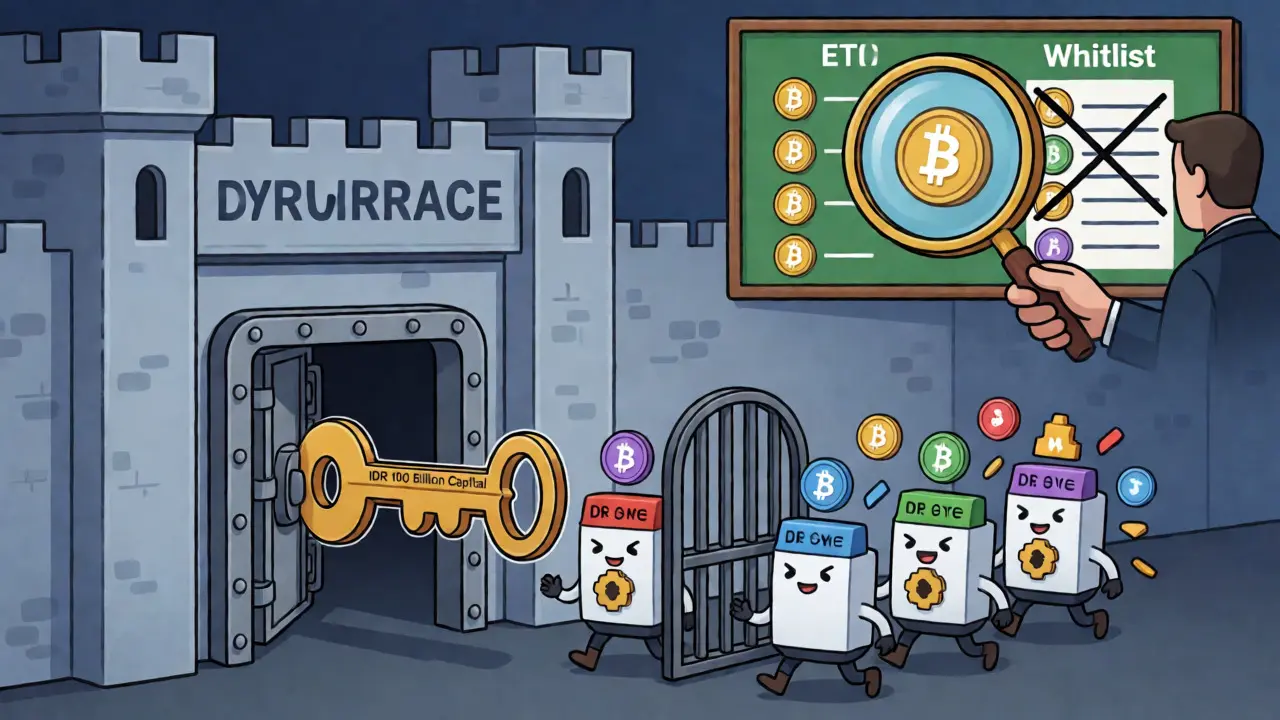
Remember when exchanges listed hundreds of obscure altcoins? That freedom is restricted. Under the new regime, exchanges had to revalidate their asset lists. By February 2025, any digital asset not explicitly reapproved by regulators had to be delisted.
This move aims to protect retail investors from pump-and-dump schemes and low-quality projects. While BAPPEBTI previously allowed over 850 assets, the new whitelist is tighter. If you hold a coin that got delisted, you might find yourself unable to trade it on local Indonesian platforms, even if it trades globally. You’ll need to decide whether to move those assets to international exchanges or hold them in cold storage until/if they get approved.
Consumer Protection and AML/KYC
One of the main reasons for moving to OJK was consumer protection. In the old commodity model, protections were thinner. Now, exchanges must implement robust Anti-Money Laundering (AML) and Know-Your-Customer (KYC) procedures.
You will notice stricter identity verification processes. Expect requests for more documentation, proof of address, and sometimes proof of income. This aligns Indonesia with global standards set by the Financial Action Task Force (FATF). Suspicious transactions are reported to PPATK automatically. If you make large, unexplained transfers, you might get flagged. It’s not personal; it’s compliance.
OJK also demands periodic reporting. Exchanges must submit detailed reports on trading volumes, user activity, and financial health. This transparency helps OJK monitor market integrity and intervene if a platform looks unstable.
Impact on Investors and the Market
So, what does this mean for you as an investor? The short answer: safer, but potentially less accessible.
The Good: * **Higher Security:** With OJK oversight, there is a clearer path for recourse if an exchange goes bankrupt or commits fraud. * **Legitimacy:** Institutional investors feel more comfortable entering a market regulated by a financial authority rather than a commodity board. * **Clarity:** Tax rules are becoming more defined, reducing legal ambiguity.
The Challenges: * **Fewer Choices:** The whitelist means fewer altcoins available on local exchanges. * **Higher Fees:** Compliance costs are high. Exchanges may pass these costs to users via higher trading fees. * **No Payments:** You still can’t spend your crypto easily. If you want liquidity, you must sell for Rupiah first.
Industry players are advocating for stablecoin recognition. Stablecoins like USDT or USDC could theoretically serve as payment methods if regulations evolve. Until then, Indonesia remains a trading-only jurisdiction for digital assets.
Looking Ahead: What’s Next for 2026?
We are currently in September 2026. The initial shock of the regulatory shift has settled, but enforcement is ongoing. OJK is actively testing its powers. We’ve seen some smaller exchanges merge or exit the market due to capital pressures. Larger players are investing heavily in compliance tech.
Key areas to watch: 1. **Stablecoin Legislation:** Will Bank Indonesia allow stablecoins for payments? This is the holy grail for utility. 2. **DeFi Regulation:** Decentralized Finance is tricky. How does OJK regulate protocols without a central entity? Expect guidance soon. 3. **CBDC Integration:** Indonesia is developing its Digital Rupiah. How will it coexist with private cryptocurrencies?
The transition from commodity to financial asset is complete on paper. The real test is practical application. As an investor, stay informed. Check if your exchange is fully licensed by OJK. Keep records of all transactions for tax purposes. And remember, while the rules are stricter, they are designed to keep your money safer in the long run.
Is cryptocurrency legal to use for payments in Indonesia?
No. While trading cryptocurrency is legal and regulated by OJK, using it as a direct payment method for goods and services is prohibited. Bank Indonesia mandates the Rupiah as the sole legal tender.
Who regulates cryptocurrency in Indonesia now?
As of January 10, 2025, the Financial Services Authority (OJK) regulates cryptocurrency trading. Previously, it was overseen by BAPPEBTI (Commodity Futures Trading Regulatory Agency).
Do I still pay VAT on crypto transactions in Indonesia?
No. Under Minister of Finance Regulation No. 50 of 2025 (PMK 50), effective August 1, 2025, Value Added Tax (VAT) on crypto asset transfers was revoked. Income tax still applies.
What are the capital requirements for crypto exchanges?
Crypto Asset Traders must maintain a minimum paid-up capital of IDR 100 billion and a minimum equity of IDR 50 billion to obtain and retain their license from OJK.
Can I trade all cryptocurrencies in Indonesia?
No. Exchanges must adhere to a strict whitelist of approved digital assets. Assets not reapproved by regulators by early 2025 were delisted from local trading platforms.
It is honestly heartbreaking to see the spirit of decentralization get strangled by bureaucratic red tape like this. We are trading freedom for security and I am not sure that is a fair trade at all. The idea that you can hold Bitcoin but cannot buy your morning coffee with it feels like a cruel joke played on the common man. Governments always find a way to tax what they do not understand or control completely. It is sad to watch Indonesia, a vibrant economy, lock itself into these rigid frameworks while the rest of the world moves forward. We should be celebrating innovation not suffocating it under layers of compliance costs that only benefit the wealthy elites. This shift to OJK oversight feels less like progress and more like a power grab by traditional financial institutions who fear losing their monopoly. The consumer protection angle is just a mask for increased surveillance and control over individual wealth. I truly believe that true freedom comes from being able to transact without permission from a central authority. Every new regulation seems to push us further away from the original promise of cryptocurrency. It is a tragedy for the dreamers and the builders who believed in a borderless financial system. Now we are left with digital commodities that act nothing like money. The soul of crypto is dying one regulation at a time and nobody seems to care enough to fight back. This is exactly why mass adoption will never happen if rules keep changing based on political whims. We deserve better than this half-hearted embrace of technology.