
Imagine walking into a gas station or a mall, seeing a flashy machine that promises a quick way to buy Bitcoin, and thinking you've found a shortcut to the digital economy. For thousands of people, that shortcut turned into a financial cliff. In 2024 alone, the FBI's Internet Crime Complaint Center (IC3) tracked over 10,950 complaints involving these machines, with victims losing a staggering $246.7 million. The problem isn't just a few bad actors; it's a systemic failure where convenience has completely overridden security.
The Danger of the "Easy Button"
At first glance, Crypto ATMs is a network of automated kiosks, also known as convertible virtual currency (CVC) kiosks, that allow users to trade cash or debit card funds for digital assets like Bitcoin. They are designed to be the "easy button" for crypto. However, that very accessibility is what scammers love. Unlike a traditional bank transfer, where you might have a few days to dispute a charge or a fraud department to call, crypto transactions are permanent. Once you hit "send" at a kiosk, your money is gone into a digital void.
The Financial Crimes Enforcement Network (or FinCEN) issued a stark warning in August 2025, noting that these machines are being weaponized by transnational criminal organizations. They don't just trick individuals; they use the kiosks to move illicit funds quickly and anonymously, bypassing the rigorous checks you'd find at a standard bank.
Why Crypto ATMs Are a Scammer's Paradise
Why do fraudsters prefer these machines over an app or a website? It comes down to three things: anonymity, speed, and a lack of oversight. Most Money Services Businesses (MSBs) operating these kiosks often ignore their Bank Secrecy Act (BSA) obligations. This means they might skip the identity verification (KYC) and transaction monitoring that keep traditional finance safe.
When a scammer convinces a victim to use a crypto ATM, they are essentially asking the victim to hand over cash in a way that cannot be traced or reversed. It's the digital equivalent of handing a briefcase of cash to a stranger in a dark alley, but the bright lights of a shopping mall make it feel safe. This psychological gap is where the crypto ATM scams thrive.
| Feature | Traditional Bank ATM | Crypto ATM (CVC Kiosk) |
|---|---|---|
| Regulatory Oversight | Strict Federal/Banking Laws | Largely Unregulated/Fragmented |
| Transaction Reversibility | Possible via Bank Dispute | Virtually Impossible |
| Identity Verification | Required (Account Based) | Often Minimal or Skipped |
| Fraud Protections | Multi-layer Monitoring | Minimal to None |
Technical Holes: More Than Just Social Engineering
While most people lose money because they're tricked, some of these machines are actually broken at the software level. Security researchers at IOActive found critical holes in the Lamassu Douro Bitcoin ATM. Specifically, vulnerabilities like CVE-2024-0674 allow someone to gain "root execution"-basically total control-over the machine by creating a simple malicious file during an update process.
If a hacker controls the machine, they can redirect funds, steal user data, or install malware. This means that even if you aren't being scammed by a person on the phone, the hardware itself might be compromised. When you combine these technical flaws with a lack of government oversight, you get a perfect storm for financial loss.
The Human Cost: Who is Being Targeted?
The data on who is losing money is heartbreaking. According to the FBI, over two-thirds of the victims in 2024 were over 60 years old. This represents a nearly 100% increase in complaints from seniors compared to previous years. Scammers target this demographic because they often have more savings and may be less familiar with the irreversible nature of blockchain technology.
Take Arizona as a concrete example. In 2024, residents of that state alone lost $177 million to crypto fraud. In Scottsdale, the police reported $5 million in losses in just one year. These aren't just numbers; they are life savings, retirement funds, and emergency cash gone in a matter of minutes.
The Fight Back: New Restrictions and Laws
Governments are finally waking up to the problem. In 2025, at least 40 states introduced legislation to handle digital assets, and 11 states passed specific laws to target crypto ATM abuse. Arizona has led the way with the Cryptocurrency Kiosk License Fraud Prevention law. This law introduces several critical cryptocurrency restrictions to protect the public:
- Strict Limits: New customers are capped at $2,000 per day, while existing customers are limited to $10,500.
- Mandatory Warnings: Machines must show a clear warning on the screen that the user must acknowledge before the transaction starts.
- Refund Requirements: Operators must provide full refunds (including fees) to new customers who report fraud within 30 days.
While these steps are a start, the challenge is that the very nature of cryptocurrency-decentralization and anonymity-is the opposite of what you need for a safe consumer experience. The industry is currently struggling to find a middle ground where the tech remains accessible but doesn't act as a vacuum for people's life savings.
Practical Tips to Avoid the Trap
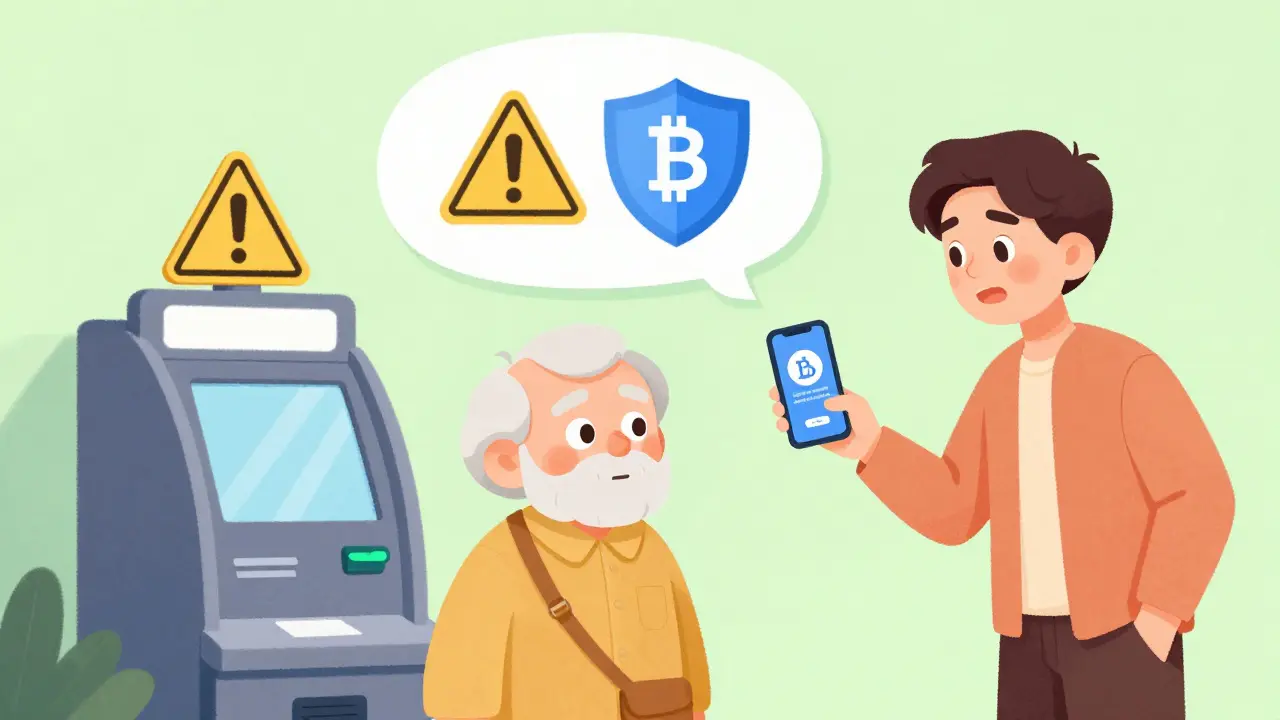
If you or a family member are considering using a crypto ATM, keep these rules of thumb in mind. If any of these red flags appear, walk away from the machine immediately.
- The "Secret" Request: If someone on the phone tells you to use a crypto ATM to pay a fee, a tax, or a "security deposit" to get a larger sum of money, it is 100% a scam.
- Urgency and Fear: Scammers will tell you that your bank account is compromised or that you'll be arrested if you don't move your money to Bitcoin right now. Legitimate agencies never do this.
- The Remote Access Trick: Never use a crypto ATM while someone is guiding you through a remote desktop app (like AnyDesk or TeamViewer). They are watching your screen and guiding you into a trap.
- Verification: Always double-check the wallet address. Once the money leaves the kiosk, there is no "undo" button.
Can I get my money back after using a crypto ATM?
In most cases, no. Cryptocurrency transactions are irreversible by design. However, if you used a machine in a state like Arizona under the new Fraud Prevention law, you may be eligible for a refund from the operator if you report the fraud within 30 days. Generally, once the Bitcoin is sent to a scammer's wallet, it is gone forever.
Why are crypto ATMs more dangerous than apps like Coinbase?
Apps typically have stricter Identity Verification (KYC) and can flag suspicious patterns before the money leaves the platform. Crypto ATMs often have fewer regulatory safeguards, allowing scammers to move cash into digital assets quickly and with less scrutiny from financial institutions.
What are the red flags of a crypto ATM scam?
The biggest red flag is someone instructing you to use the machine. Real investment opportunities or government agencies will never ask you to go to a physical kiosk to pay them in Bitcoin. Other signs include extreme urgency, threats of arrest, or requests for "processing fees" to unlock a prize.
Are all crypto ATMs technically insecure?
Not all of them, but some specific models have known vulnerabilities. For example, researchers found that some Lamassu Douro models allowed root access through specific file exploits. While manufacturers patch these, the fragmented nature of the kiosk industry means many machines are running outdated, vulnerable software.
What should I do if I've already been scammed?
Immediately report the incident to the FBI's Internet Crime Complaint Center (IC3) and your local police. If the machine was in a regulated state, contact the kiosk operator to request a refund. Be wary of "recovery scammers" who claim they can get your money back for a fee-these are almost always a second scam.
What to do next
If you are a senior or have elderly parents, the best defense is education. Talk about how these kiosks work and explain that no legitimate business will ever ask for payment via a Bitcoin ATM. For those who want to enter the crypto market, sticking to reputable, regulated exchanges with strong security protocols is a much safer bet than trusting a machine in a convenience store. Keep a close eye on your local state laws, as more regions are likely to implement the kind of transaction limits and warning systems seen in Arizona to curb this epidemic.
The software vulnerabilities mentioned are pretty concerning, especially the root execution flaw in the Lamassu models. It's a classic case of prioritizing rapid deployment over a secure boot process or proper firmware signing. Most people think it's just social engineering, but the hardware risk is a huge blind spot here.
Oh, look at that, another shocking discovery that trusting a random machine in a gas station is a bad idea. Truly groundbreaking stuff. I'm sure the 'decentralization' excuse works wonders for the people who just lost their life savings while the operators keep collecting fees. What a brilliant system we've built here!
Pathetic security. This is why India's digital infrastructure is superior. We don't need these archaic kiosks when we have seamless, regulated systems. Absolute failure of Western oversight.
imagine thinking a machine at a 7-eleven is a safe financial portal... honestly the level of delusion required for this is almost poetic lol
It's great that Arizona is stepping up with these laws! We can all learn from this and help our community stay safe. Let's keep pushing for more transparency across all states so we can protect our elders!
just keep talking to your parents about this it really helps to make them aware before they see a flashy ad at the mall
This is such an important warning!!! Thank goodness we have people speaking out about this before more people get hurt!!!
I feel like we need to question why we allow these machines to exist in public spaces at all. It's almost a moral failing of the city planners to let these traps be placed where vulnerable people walk every day. It's just wrong.
People need to stop being so gullible. It is common sense that you do not give money to strangers. The lack of education is the real problem here
The intersection of trust and technology is where these scams thrive. We've spent decades training people to trust the 'ATM' interface as a secure portal for money, and scammers are simply leveraging that ingrained behavioral trust to bypass the critical thinking part of the brain. It's a psychological exploit as much as a technical one.
just check the wallet address twice and use a reputable exchange instead if you want to avoid the mess
I completely agree with the points made about the BSA obligations!!! Many of these MSBs are just cutting corners to maximize profit, which is absolutely unacceptable!!!
Man, the L1 latency and slippage on these kiosks must be wild compared to a proper CEX. It's basically just a front-end for a high-fee swap that’s totally unoptimised. Total rugpull vibes for the non-techy crowd.
It is most regrettable that such a significant number of senior citizens have been victimized by these schemes. The implementation of strict transaction limits is a prudent step toward mitigating these losses.
Who actually uses these? lol :)
I can't stop thinking about the people who lost their savings. I'm actually shaking just reading this. Does anyone else feel like they can't sleep knowing this is happening?
Too long. Just don't use the machines. Not that anyone cares anyway.