
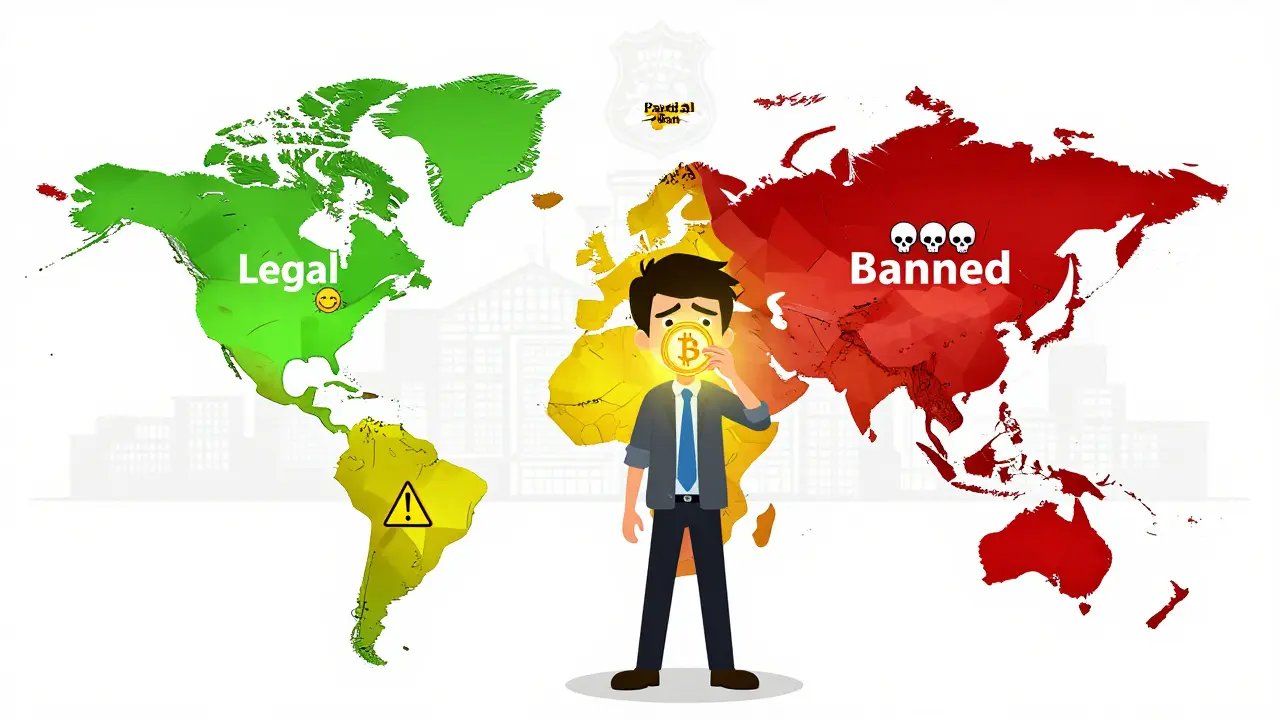
You hold Bitcoin in your wallet. Your government says that is a crime. What happens next? Do you go to jail? Do you lose your money? Or does nothing happen at all?
The answer depends entirely on where you live. In 2026, the global map of cryptocurrency legality is a patchwork of strict bans, loose restrictions, and full acceptance. According to data from the Atlantic Council's Cryptocurrency Regulation Tracker, 75 countries were studied globally, revealing that cryptocurrency is fully legal in 45 nations, partially banned in 20 countries, and generally banned in 10 countries.
If you are reading this because you live in a country with a ban, or you plan to travel to one, you need to know the real risks. The gap between what the law says and what actually happens on the street is huge. Let’s look at the facts, the fines, and the freedom.
The Reality of Crypto Bans vs. Enforcement
First, we need to clear up a myth. A ban on paper does not mean zero usage in reality. In fact, adoption rates remain high even in countries with strict prohibitions. This suggests that blanket bans are often ineffective tools for stopping individual users.
Dr. Sarah Bloom Raskin, former Deputy Secretary of the U.S. Treasury, noted in January 2025 that "the criminalization approach to cryptocurrency bans creates significant enforcement challenges, particularly when adoption rates remain high despite prohibitions." The Atlantic Council’s empirical findings support this: even for countries with partial or general bans, people still use crypto.
Why do governments ban it then? The primary purpose centers on preventing three things:
- Money laundering
- Terrorist financing
- Capital flight (money leaving the country illegally)
When you violate these bans, the government isn't usually angry about you holding digital coins. They are angry about you bypassing their financial controls. Understanding this motive helps explain why some penalties are harsh while others are non-existent.
Strict Bans: Algeria, Morocco, and Egypt
Some countries have written very clear laws against crypto. These are the places where you face the highest legal risk if you are caught.
Algeria prohibits "the purchase, sale, use, and holding of so-called virtual currency" under Article 117 of its official journal dated December 28, 2017. The law states that "any breach of this provision is punishable in accordance with the laws and regulations in force." However, specific penalty amounts are not quantified in the public text. This vagueness can be dangerous. It gives judges wide discretion, meaning your punishment could range from a small fine to prison time depending on the severity they assign to your case.
Morocco takes a similar stance. On November 20, 2017, the Office des Changes issued a public statement declaring that "transactions via virtual currencies constitute an infringement of the exchange regulations, liable to penalties and fines provided for by [existing laws] in force." Bank Al-Maghrib Governor Abdellatif Jouahri clarified later that month that bitcoin is not recognized as currency but as a "financial asset" carrying significant risks. Here, the violation is treated as a foreign exchange offense. In many jurisdictions, breaking exchange laws carries heavy fines and potential imprisonment.
Egypt maintains an outright prohibition where "individuals, banks, and other financial institutions are prohibited from dealing in cryptocurrencies." While the enforcement mechanisms remain unspecified in available documentation, Egyptian authorities have historically targeted exchanges more than individuals. Still, the lack of clarity means any user could theoretically be prosecuted under anti-money laundering statutes.
| Country | Ban Type | Legal Basis | Enforcement Focus |
|---|---|---|---|
| Algeria | Full Ban | Article 117 (2017) | Undisclosed/Vague |
| Morocco | Full Ban | Exchange Regulations | Financial Assets/Fines |
| Egypt | Full Ban | Central Bank Decree | Institutions > Individuals |
| China | Business Ban | 2021 Regulatory Framework | Exchanges & Mining |
The China Model: Banning Business, Not Users
China represents one of the strictest regulatory environments in the world. Since 2021, the country has implemented comprehensive bans on exchanges, trading, and crypto mining. But here is the key distinction: enforcement primarily targets business operations rather than individual holders.
If you run a crypto exchange in China, you will face severe criminal penalties, including long prison sentences. If you mine Bitcoin, your equipment will be seized, and you may be fined. But if you simply hold Bitcoin in a personal wallet? Specific criminal penalty figures for individual violations remain undocumented in public search results.
This nuance matters. It means millions of Chinese citizens likely hold crypto without fear of immediate arrest, provided they do not engage in commercial activities. Chainalysis estimated $28.7 billion in peer-to-peer cryptocurrency transactions originated from China in 2024 despite official prohibitions. The underground market thrives because the state focuses its police power on infrastructure providers, not retail users.
Sanctions Over Sentences: The New Enforcement Trend
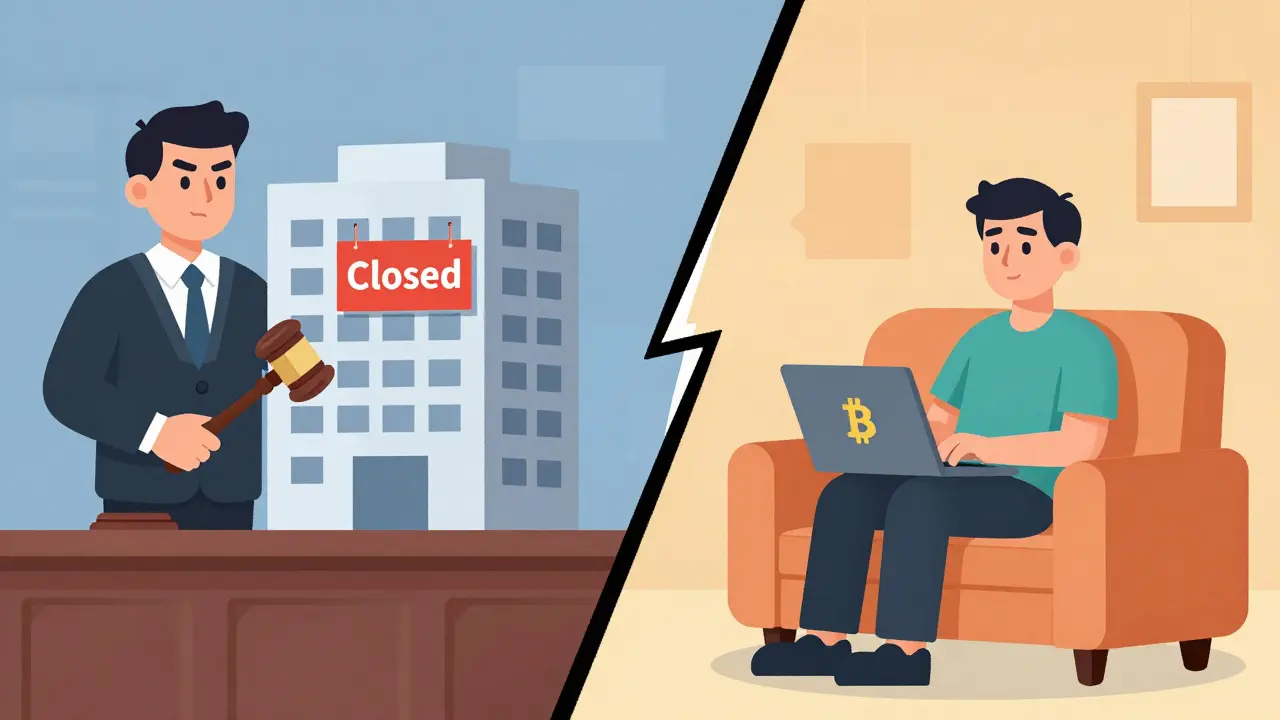
In 2026, the trend is shifting away from jailing regular users and toward sanctioning bad actors. The U.S. Department of Justice’s April 2025 memorandum titled "Ending Regulation by Prosecution" signaled a major change. It re-scoped digital asset enforcement to prioritize:
- Misappropriation of client assets
- Sanctions evasion
- Fraud
- Unlicensed money transmission
The memo explicitly deprioritized using criminal tools to resolve regulatory classification disputes. In plain English: prosecutors are less interested in charging you for "breaking a vague rule" and more interested in charging you for stealing or funding terrorism.
The TRM Labs 2025 Crypto Crime Report highlights how sanctions designations function as the new enforcement mechanism. The U.S. Department of the Treasury's Office of Foreign Assets Control (OFAC) increasingly targets cryptocurrency infrastructure supporting illicit activities. For example, OFAC issued 13 sanctions designations that included 86 cryptocurrency addresses targeting Russia-related entities in 2024.
Look at the case of Elena Chirkinyan and Khadzi-Murat Dalgatovich Magomedov. They were designated following the United Kingdom's National Crime Agency (NCA) "Operation Destabilise" for their roles in money laundering and sanctions evasion through cryptocurrency channels. Their punishment wasn't just a fine; it was global isolation. Their assets were frozen, and no compliant bank or exchange could touch them.
Another notable case involved Mustafa Ayash, founder of GazaNow, who was sanctioned for "raising funds for Hamas following the October 7 attack." This demonstrates how terrorist financing cases trigger more severe enforcement actions than general ban violations. If your crypto activity touches terrorism or war crimes, you will face international manhunt-level consequences, regardless of local bans.
What Users Actually Experience
Laws are written by politicians, but lived by people. What does it feel like to use crypto in a banned country? Community feedback reveals widespread circumvention through peer-to-peer exchanges and decentralized finance platforms.
On Reddit's r/CryptoCurrency, a March 2025 thread titled "Using crypto in banned countries" documented user experiences from Algeria, Morocco, and Egypt. User u/MaghrebTrader reported "successful use of LocalBitcoins for 18 months without incident" despite Morocco's prohibition. Meanwhile, u/CairoCrypto noted "frequent payment processor blocks but no personal legal consequences" in Egypt.
These anecdotes align with broader data. A CoinDesk May 2025 survey of users in banned jurisdictions found that only 12% of respondents reported personal legal consequences for cryptocurrency usage. The vast majority faced technical hurdles-like blocked websites or frozen bank accounts-but not handcuffs.
However, trust issues remain. Trustpilot reviews of platforms like KuCoin (listed by Canadian Securities Administrators as prohibited) show average ratings of 3.2/5 based on 1,247 reviews through June 2025. Common themes include "easy access from restricted regions" (mentioned in 37% of positive reviews) and "account freezes when KYC verification fails" (cited in 68% of negative reviews). The risk shifts from the government to the platform. If an exchange decides to comply with a ban, they freeze your funds. You don't go to jail, but you lose your money.
Regional Shifts: Europe, Asia, and the Americas
Not every country is banning crypto. Many are regulating it. This distinction is crucial for travelers and remote workers.
The European Union implemented MiCA (Markets in Crypto-Assets) in 2024. This framework avoids criminal penalties for usage while establishing strict licensing requirements for service providers. If you are in Germany or France, buying Bitcoin is legal. You just need to use a licensed provider.
Japan recognizes cryptocurrencies as legal property under the Financial Services Agency's oversight. However, Japan has recently "toughened its rules on sharing customer information between crypto exchanges" to combat money laundering. The focus is on transparency, not prohibition.
South Korea presents an intermediate model. They passed the Virtual Asset Users Protection Act in 2023 to "create stronger protections for users by adding requirements around record keeping and transparency." Financial authorities published guidelines for listing virtual assets, moving away from the chaotic early days of unregulated trading.
The United States remains unique. It is "the only advanced economy to consistently rank among the top ten in crypto-asset adoption" despite evolving regulatory uncertainty. The GENIUS Act, signed into law by President Donald J. Trump in July 2025, regulates stablecoins as payment instruments rather than as securities or commodities. This stops short of criminalization but gives the Treasury Department enhanced powers to combat illicit stablecoin activities.
Risks Beyond Jail: Financial Exclusion
Even if you don't go to prison, violating a crypto ban can ruin your financial life. Banks are terrified of regulatory fines. If they detect crypto transactions in your account, they may close your account entirely. This is known as "de-banking."
In countries like Morocco and Egypt, using traditional banking channels to buy or sell crypto is effectively impossible. You must use cash-based peer-to-peer methods. This exposes you to scams, theft, and fraud. There is no recourse if someone sends you fake money or disappears after receiving your crypto. The lack of legal protection is the real penalty for living in a banned jurisdiction.
Furthermore, if you travel with crypto hardware wallets, border agents in strict countries may confiscate them. While rare, there are reports of devices being seized under customs laws related to undeclared currency or prohibited goods. Always check the specific customs regulations of your destination before traveling with private keys.
How to Stay Safe in Restricted Zones
If you live in or visit a country with crypto restrictions, follow these practical steps to minimize risk:
- Use Decentralized Protocols: Avoid centralized exchanges that require KYC (Know Your Customer) identification. Use peer-to-peer networks where possible, but verify counterparty reputation thoroughly.
- Avoid Banking Links: Never transfer fiat currency directly to/from crypto vendors through your main bank account. Use cash or alternative payment methods to keep your banking profile clean.
- Understand Local Laws: Read the actual legal text if possible. Don't rely on rumors. In Algeria, the law is vague. In China, businesses are targeted. Tailor your behavior to the specific threat model.
- Secure Your Keys: If you are operating in a high-risk environment, ensure your private keys are backed up securely offline. If your device is seized, you want to make sure your funds cannot be easily accessed by authorities without your password.
- Monitor Sanctions Lists: Ensure you are not accidentally interacting with sanctioned entities. Using a wallet address linked to OFAC-designated groups can lead to permanent freezing of assets across the entire compliant financial system.
The landscape is changing fast. The Atlantic Council predicts that both emerging-market and advanced economies will develop more sophisticated enforcement mechanisms by 2027. These will likely target "sanctions evasion, fraud, and unlicensed money transmission" rather than simple possession. Stay informed, stay cautious, and remember: the law is written, but enforcement is human.
Can I go to jail for holding Bitcoin in a banned country?
It depends on the country. In most places with bans, such as China or Egypt, enforcement targets businesses and exchanges, not individual holders. However, in countries like Algeria, laws are vague and could theoretically lead to prosecution. Generally, the risk of jail for simple possession is low, but the risk of fines or asset seizure exists.
Which countries have the strictest crypto bans?
Countries with full bans include Algeria, Morocco, Egypt, Bangladesh, Nepal, Qatar, and Uzbekistan. Among these, Algeria and Morocco have explicit legal texts prohibiting purchase, sale, and use. China has a strict ban on business operations and mining, though individual holding is largely tolerated.
What is the difference between a crypto ban and a sanction?
A ban is a domestic law prohibiting the use or trade of crypto within a country. A sanction is an international measure, often led by the US OFAC or EU, that freezes assets and prohibits interaction with specific individuals, entities, or addresses. Violating a ban might get you fined locally; violating a sanction can get you blacklisted globally.
Is it safe to use crypto in Egypt?
Legally, no. The Central Bank of Egypt prohibits dealing in cryptocurrencies. However, enforcement against individuals is rare. Most users face technical barriers like blocked websites or frozen bank accounts rather than legal action. Proceed with caution and avoid using formal banking channels for crypto trades.
How do governments enforce crypto bans?
Governments typically enforce bans by blocking internet access to exchange websites, freezing bank accounts involved in crypto transactions, and prosecuting exchange operators. Direct prosecution of individual users is uncommon due to the difficulty of tracking blockchain transactions and the political sensitivity of arresting citizens for holding assets.
What happened to the GENIUS Act in the US?
The GENIUS Act was signed into law in July 2025. It regulates stablecoins as payment instruments, improving the Treasury Department's ability to combat illicit activities. It does not ban crypto but establishes a clearer regulatory framework for stablecoin issuers and enhances sanctions evasion detection capabilities.
Can my bank close my account for using crypto?
Yes. Even in countries where crypto is legal, banks may choose to close accounts if they perceive high compliance risks. In banned countries, this is almost guaranteed if they detect crypto-related transactions. This is known as de-banking and is a common non-criminal penalty for violating crypto restrictions.