
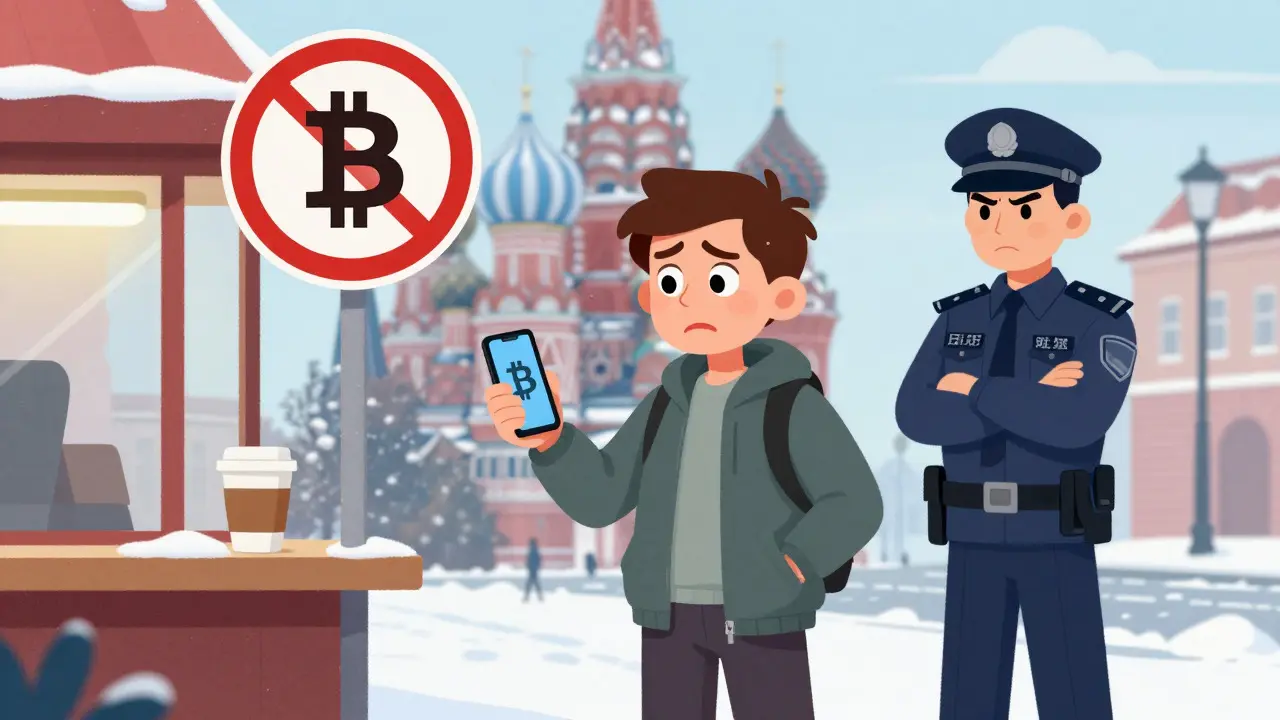
Imagine paying for a coffee in Moscow using Bitcoin. Today, that simple act could land you with a fine of up to 200,000 rubles and have your coins confiscated. Yet, just across the border, Russian exporters are legally using crypto to settle millions of dollars in trade deals with China and Iran. This stark contrast defines the current landscape of Russia crypto ban rules, creating a confusing maze for anyone holding digital assets in the region.
The situation isn't black and white. It's a two-tier system where what is illegal at home might be perfectly legal abroad, provided you meet strict financial thresholds. If you are navigating this space, understanding the difference between domestic prohibition and international allowance is critical to staying compliant and avoiding costly mistakes.
Key Takeaways
- Domestic Ban: Using cryptocurrency to pay for goods or services within Russia is strictly prohibited since January 1, 2021.
- International Allowance: Since 2024, crypto can be used for cross-border trade, but only under the Experimental Legal Regime (EPR) with heavy compliance requirements.
- High Barriers: Individual access to trading is restricted to "especially qualified investors" with assets over 100 million rubles (~$1.2 million).
- Upcoming Fines: New penalties taking effect in January 2026 will impose fines and asset confiscation for domestic payment violations.
- Tax Status: Crypto is legally recognized as property, subject to a 13% capital gains tax starting January 1, 2025.
The Legal Foundation: Why Russia Splits the Difference
To understand why Russia treats Bitcoin differently inside its borders versus on the global stage, we have to look at the legislative timeline. The turning point came in July 2020 when Federal Law No. 114-FZ was signed. This law did two things simultaneously: it legalized the ownership and mining of cryptocurrencies while explicitly banning their use as a means of payment for domestic transactions.
This distinction stems from the philosophy of the Bank of Russia. Under Chair Elvira Nabiullina, the central bank has consistently argued that cryptocurrencies are not issued or guaranteed by any state jurisdiction. They view these assets as highly volatile mathematical constructs rather than stable currencies suitable for everyday spending. By keeping them out of the domestic economy, regulators aim to protect the ruble and prevent inflationary shocks from speculative digital assets.
However, the geopolitical landscape shifted dramatically after 2022. With Western sanctions cutting off many traditional banking channels, Russia needed alternative ways to conduct international trade. In response, Law No. 382-FZ was passed in summer 2024. This legislation created a specific exception: allowing digital currency payments for international trade settlements. This move transformed crypto from a purely speculative asset into a strategic tool for sanctioned trade, primarily benefiting exports to countries like China, Iran, and Belarus.
Domestic Use: What Is Actually Prohibited?
For the average resident in Moscow, St. Petersburg, or Vladivostok, the rules remain tight. You can own Bitcoin, Ethereum, or Tether. You can mine them. You can even sell them for rubles through an exchange. But you cannot hand over a QR code and pay for rent, groceries, or car repairs directly with crypto.
The definition of "payment" here is broad. It covers any direct settlement of debts for goods or services within Russian territory. This includes peer-to-peer (P2P) transfers intended to settle a commercial deal locally. While informal barter or personal gifts between friends exist in a gray area, any transaction that looks like a commercial exchange risks scrutiny.
Enforcement is ramping up. A bill drafted jointly by the Bank of Russia and the Ministry of Finance, announced by Anatoly Aksakov in July 2025, introduces concrete penalties. Effective January 1, 2026, individuals caught using crypto for domestic payments face fines ranging from 100,000 to 200,000 rubles. For businesses, the stakes are higher, with fines reaching 1,000,000 rubles. Crucially, the law also mandates the confiscation of the cryptocurrency involved in the violation, meaning you don't just pay a fee; you lose the asset itself.

International Use: The Experimental Legal Regime (EPR)
If you want to use Bitcoin or other major cryptocurrencies for international business, you must operate within the Experimental Legal Regime (EPR). Launched in summer 2024, this framework allows cross-border payments but comes with a heavy compliance burden designed to keep the market controlled and transparent.
Participation in the EPR is not open to everyone. Companies must register with the Central Bank and implement real-time transaction monitoring systems. These systems need to process at least 1,000 transactions per second with 99.9% uptime. Furthermore, they must integrate with the Federal Tax Service's new CryptoTrack system for AML screening against 15 sanctioned jurisdictions.
The operational cost of entering this regime is significant. According to data from Moscow-based consultancy BitLegal, companies spend an average of 220 staff hours and 1.8 million rubles ($22,500) to achieve full compliance. Documentation requirements include maintaining seven years of transaction records with blockchain forensic analysis capabilities. As of mid-2025, only 1,842 entities had registered under the EPR, far below the projected 10,000, indicating that the high barrier to entry keeps most small and medium enterprises out.
Who Can Trade? The Qualified Investor Threshold
One of the most controversial aspects of Russia's current framework is who is allowed to trade freely. The March 2025 regulatory submission established stringent criteria for "especially qualified investors." To qualify, an individual must possess financial assets exceeding 100 million rubles (approximately $1.2 million) or demonstrate an annual income above 50 million rubles (approximately $580,000).
This threshold creates a distinct divide in the market. For the ultra-wealthy, crypto remains a viable investment vehicle. For the remaining 98% of the population, direct access to regulated exchanges is severely limited. Critics, such as Dr. Ivan Sidorov of HSE University, argue that this restricts market development and drives activity underground. Indeed, a Chainalysis report from July 2025 noted that 68% of Russian users now employ non-custodial wallets to bypass KYC requirements, highlighting the tension between regulation and user preference.
| Feature | Domestic Use | International Use (EPR) |
|---|---|---|
| Legal Status | Prohibited for payments | Permitted for trade settlements |
| Eligibility | N/A (Banned) | Registered EPR entities |
| Investor Threshold | N/A | 100M RUB assets / 50M RUB income |
| Compliance Cost | Low (if no payment made) | ~1.8M RUB setup + ongoing monitoring |
| Penalties (2026) | Fine + Confiscation | Regulatory sanctions for non-compliance |
| Tax Rate | 13% Capital Gains | 13% Capital Gains |

Taxation and Reporting Requirements
Since January 1, 2025, the Tax Code of the Russian Federation officially recognizes cryptocurrency as property. This change ended years of ambiguity regarding how to treat crypto gains. Now, all profits from selling crypto are subject to a 13% capital gains tax rate, which is notably lower than the global average of 20% reported by PwC in 2025.
However, low tax rates come with high reporting demands. Investors must file quarterly reports detailing their transactions. Mining operations face additional hurdles, requiring registration with Roskomnadzor and adherence to energy consumption limits of 150 MW per facility. Failure to report correctly can lead to back-taxes and interest, adding another layer of risk for those operating in the gray zones of domestic usage.
Practical Challenges for Users and Businesses
The theory behind the split regulation sounds logical, but the execution presents significant friction. For individual traders, the lack of accessible domestic exchanges pushes many toward offshore platforms. User 'MoscowTrader88' on Reddit’s r/CryptoRussia community noted in August 2025 that using offshore exchanges added 3-5 business days to transactions and incurred 2.5% in additional fees. This inefficiency is a direct result of the domestic ban forcing users to route funds through third-party jurisdictions.
Businesses face even steeper challenges. A June 2025 case study by Interfax highlighted a Moscow-based IT exporter who abandoned crypto payments despite the international allowance. The reason? The EPR registration process required 17 different documents and took eight weeks to process. Such bureaucratic hurdles discourage smaller firms from adopting the technology, leaving the field largely to large financial institutions and state-backed entities.
Furthermore, banks remain reluctant to facilitate crypto-related fiat conversions. The National Settlement Depository reports that 82% of respondents cited "bank reluctance" as a primary obstacle. Many Russians experience account freezes when attempting to move large sums of rubles linked to crypto activities, driving them further into unregulated channels where fraud risk is higher.
Future Outlook: Tightening Screws or Opening Doors?
Looking ahead, the trend appears to be toward tighter control rather than liberalization. The Central Bank plans to expand transaction monitoring to include non-custodial wallets by Q2 2026. Additionally, biometric verification for all crypto transactions above 500,000 rubles ($6,250) is slated for implementation by Q4 2026. These measures aim to close the loopholes that currently allow private individuals to bypass KYC checks.
There is also a proposal to extend the domestic payment ban to all stablecoins by 2027, citing systemic risks following the TerraUSD collapse. While this would stabilize the regulatory environment, it may further isolate Russia's crypto market from global trends. Despite these restrictions, Russia maintains a strong position in the global hierarchy, ranking 15th in crypto adoption with an estimated 18 million users. The question remains whether the government will eventually ease the 100 million ruble investor threshold to tap into the broader retail market, or if it will continue to reserve crypto exclusively for elite investors and state-sanctioned trade.
Can I use Bitcoin to buy groceries in Russia?
No. Since January 1, 2021, using cryptocurrency to pay for goods or services within Russian territory is illegal. Doing so can result in fines and asset confiscation starting in January 2026.
Is mining cryptocurrency legal in Russia?
Yes, mining is legal. However, large-scale mining facilities must register with Roskomnadzor and comply with energy consumption limits of 150 MW per facility. Profits from mined coins are subject to taxation.
What is the minimum income to trade crypto in Russia?
To qualify as an "especially qualified investor" under the current experimental regime, you need financial assets exceeding 100 million rubles or an annual income above 50 million rubles. Without meeting these criteria, access to regulated trading platforms is restricted.
How much tax do I pay on crypto gains in Russia?
As of January 1, 2025, cryptocurrency is treated as property. Capital gains from selling crypto are taxed at a rate of 13%. Quarterly reporting is mandatory for all taxable events.
Can businesses use crypto for international payments?
Yes, but only if they register under the Experimental Legal Regime (EPR). This involves significant compliance costs, including real-time transaction monitoring and integration with federal tax systems. It is primarily feasible for larger enterprises.
It is truly fascinating to observe how a nation can simultaneously criminalize the most basic form of digital commerce for its own citizens while leveraging that same technology as a strategic shield against Western sanctions. One must wonder if this dichotomy is merely a pragmatic response to geopolitical pressure or a deeper commentary on the nature of state control over monetary sovereignty. The irony is not lost on those who study economic history; regimes often ban what they fear most, yet embrace it when it serves their immediate tactical needs. This two-tier system creates a bizarre legal landscape where legality is determined less by the asset itself and more by the direction of the transaction vector. It reminds one of the old Soviet barter economies, but with blockchain wrappers and higher fines. The moral hazard here is significant, as it implies that the 'right' to use money is a privilege granted by the state, not an inherent right of the individual. If you cannot buy bread with your own property without risking confiscation, can we really call it private property? The distinction between domestic prohibition and international allowance suggests a lack of coherent long-term vision, replaced instead by reactive legislative patchwork. It is a testament to the flexibility of authoritarian governance to bend rules until they snap, then re-tie them in a different knot. We should all be watching closely, for this experiment in bifurcated currency law may set precedents for other nations facing similar isolationist pressures.
Oh, look at them playing games!
While the rest of us are fighting for financial freedom, these guys are just hiding behind their little ruble curtain.
I bet the elites have offshore accounts in Switzerland and Dubai, don't they?
They ban it for the poor people so the rich can keep hoarding their gold and crypto in secret vaults.
It's all part of the global conspiracy to keep us down, I tell you!
The US government does the same thing, just better.
We need to watch out for the next move, because once they crack down here, they'll come for our wallets too.
Stay vigilant, patriots! 🇺🇸
The concept of 'qualified investor' is a classic example of regulatory capture disguised as protectionism. By setting the threshold at 100 million rubles, the state effectively excludes the general populace from the market, leaving only those who are already wealthy enough to influence policy. This is not about protecting consumers from volatility; it is about creating a closed loop of capital that remains under state surveillance. The moral implication is clear: the poor are deemed incapable of making rational financial decisions, while the elite are trusted to manage their own risk. Such paternalism stifles innovation and drives activity underground, as evidenced by the high usage of non-custodial wallets. True financial literacy should be encouraged, not gated behind a paywall of wealth. Until the barrier is lowered, the market will remain fragmented and inefficient, benefiting only those with connections and capital. The lesson for other emerging markets is clear: do not mistake exclusion for stability.
Honestly, it feels like a lot of noise for very little actual change on the ground for regular people. I get the logic of using crypto for trade deals since banks are tricky right now, but banning it for coffee? That seems extreme. I think most folks just want to hold onto value without having to worry about getting fined for buying groceries. It’s interesting to see how different countries handle this stuff. Some go full ban, some go full embrace, and Russia is stuck in this weird middle ground that probably confuses everyone involved. Hopefully, they figure it out soon because uncertainty isn’t great for anyone. But hey, at least mining is still legal? That’s something. Just makes me wonder how long this setup will last before they change their minds again. Time will tell, I guess!
Just wanted to add a bit of context on the EPR compliance costs since that number (1.8M RUB) might seem low to some, but remember that's just the initial setup! 😊
You also have to factor in the ongoing cost of maintaining those real-time monitoring systems. For a small business, that's a huge overhead. It’s why so many are sticking to traditional methods even for international trades if possible. Also, the 13% tax is nice compared to some places, but the quarterly reporting is a nightmare for anyone who doesn't have a dedicated accountant. I’ve seen friends struggle with just tracking their transactions across multiple wallets. So yeah, the 'opportunity' is there, but the friction is real! 💻✨
THIS IS A DISASTER FOR AMERICAN INTERESTS!
By allowing China and Iran to settle trades in crypto, Russia is strengthening their axis of evil!
We must strike back!
The US should impose secondary sanctions on any company that touches Russian crypto!
It’s a threat to global security!
These people are playing with fire and they will burn!
Wake up America! 🇺🇸🔥
It is worth noting that the definition of 'payment' in the domestic ban is arguably broader than in most jurisdictions. It includes P2P transfers intended to settle commercial deals locally. This means that even informal arrangements between businesses could be construed as violations if they appear to be commercial exchanges. The line between a gift and a payment is thin and likely to be tested in courts. Furthermore, the upcoming biometric verification for transactions above 500,000 rubles will likely make privacy even harder to maintain. This level of intrusion into personal financial life is unprecedented in many parts of the world. It raises serious questions about data security and the potential for misuse by third parties. As always, when the state demands total transparency, the individual loses leverage. One must tread carefully in such an environment.
Sigh. Another country trying to reinvent the wheel and breaking it in the process. The idea that you can separate domestic and international crypto use is fundamentally flawed. Money flows. People find ways around bans. The fines are toothless if the enforcement is lax, and if the enforcement is strict, it crushes the economy. It’s a lose-lose situation dressed up as sophisticated policy. I’m tired of reading these half-baked analyses that pretend this is a stable solution. It’s chaos. Pure, unadulterated chaos. And we’re supposed to learn from this? Doubtful.
The 100 million ruble threshold is absurd. It’s not regulation, it’s segregation. You’re telling me the average person can’t touch the regulated market? That’s not protecting them, that’s excluding them. The 'qualified investor' label is just a fancy way of saying 'rich people only.' Meanwhile, the rest of us are stuck in the gray zone, dodging bullets. It’s lazy policy-making. They didn’t think it through. Now they’re surprised when people use offshore exchanges. Of course they do! Why wouldn’t they? The door was locked, so we found a window. Don’t blame the user for bad design. Fix the system. Stop pretending this works. It doesn’t.
So, let me get this straight. You can’t buy a sandwich in Moscow with Bitcoin, but you can use it to ship oil to China?
That’s... a specific kind of logic, isn’t it?
I mean, sure, geopolitics is a thing, but does it really justify treating your own citizens like second-class financial subjects?
It feels less like a strategy and more like a panic button being pressed repeatedly.
I suppose if you’re running out of options, you grab whatever tool is closest, even if it’s a rusty hammer.
But calling it a 'legal regime' is doing a lot of heavy lifting in that sentence.
Anyway, good luck keeping the ruble stable while your best traders are off in Cyprus.
Maybe they’ll figure it out by 2027? Or maybe they’ll just ban the internet next. Who knows.
Keep dreaming, folks. :)
One observes with a certain degree of bemusement the continued insistence on the term 'experimental legal regime.' In practice, it functions as a permission slip for the privileged few. The average citizen, lacking both the capital and the bureaucratic stamina, is left to navigate a minefield of fines and confiscations. It is a system designed not to foster growth, but to curate access. The result is a bifurcated society: those who can afford compliance, and those who must rely on the shadows. The inefficiency is staggering, with weeks spent on paperwork that adds no value to the underlying transaction. It is a reminder that when regulation becomes a barrier to entry rather than a safeguard, it ceases to serve the public interest. We must ask ourselves: who is this system truly serving? The answer, as ever, lies in the pockets of the few.
It’s wild to think about how much this impacts everyday people, right? 🤔 Like, imagine you’re just trying to save for something important, and suddenly the rules change and you have to worry about taxes and fines. It’s stressful! But I think the key takeaway is that knowledge is power. If you know the rules, you can navigate them better. And honestly, seeing how different countries handle crypto is super educational. It shows there’s no one-size-fits-all solution. Maybe one day we’ll have a global standard that makes sense for everyone. Until then, stay informed and keep learning! 📚💡
Wow, this is such a complex mess!! 😱 I mean, who would have thought paying for coffee could be such a legal headache?? It’s like they’re trying to stop progress with one hand while holding it back with the other! The fact that they allow it for big trade deals but not for little things is so confusing! It feels like they’re playing a game where only the winners get to play. And the fines?? Yikes! That’s scary! I hope they sort it out soon because it’s just too much drama for something that should be simple! Let’s hope for better days ahead! ✨🌟
From a British perspective, this looks like a recipe for disaster, doesn’t it? The sheer amount of bureaucracy required to participate in the EPR is daunting. Seven years of records? Real-time monitoring? It sounds more like a prison sentence than a business opportunity. I suspect many small firms will simply give up and stick to SWIFT, despite the sanctions headaches. The contrast with the UK’s approach, which has been more open to innovation, is stark. Perhaps we can learn from their mistakes. After all, history repeats itself, especially when regulators are involved. Let’s hope they don’t end up isolating themselves completely. It would be a pity to see such a large market shut out of the global crypto conversation. Keep an eye on this one, folks. It’s going to be a bumpy ride.
It’s interesting to consider the philosophical implications of this split system. On one hand, we have the state asserting its monopoly on legal tender within its borders, a concept rooted in centuries of monetary theory. On the other, we have the pragmatic acceptance of digital assets as a tool for international engagement. This duality reflects a deeper tension between sovereignty and globalization. The question is not just whether crypto should be allowed, but who gets to decide. In Russia, the answer is clearly the state, acting in its own perceived interest. For individuals, this leaves little room for autonomy. Yet, as history shows, markets find a way. The underground economy will grow, and the gap between the official and the unofficial will widen. This is not a new phenomenon, but it is particularly acute in the digital age. How will this resolve? Only time will tell, but the current trajectory suggests increasing fragmentation.
Let’s break down the KPIs here! The EPR registration rate is sitting at 18% of the projected target. That’s a massive red flag for adoption velocity. The friction coefficient is too high for SMBs. We need to look at the unit economics of compliance versus the revenue generated from cross-border settlements. If the ROI isn’t positive within 12 months, expect a drop-off in participation. The biometric verification rollout in Q4 2026 will likely spike the churn rate among retail users. We need to monitor the NPS (Net Promoter Score) of the qualified investor segment closely. If they feel restricted, they’ll migrate offshore. It’s a classic case of regulatory drag slowing down innovation. Let’s optimize for speed-to-market! 🚀📈
So, you’re telling me I can’t buy chai with Bitcoin, but the government can use it to pay for oil? Hilarious. Really, what did you expect? The moment you try to regulate something decentralized, it becomes a centralized mess. The 'qualified investor' rule is just a way to keep the common man out, isn’t it? Nice trick. I’m sure the average Russian is thrilled about this 'experiment.' Oh wait, they’re too busy worrying about fines. Makes sense. Anyway, good luck with that. Hope the ruble holds up. Probably won’t. But hey, at least the lawyers will be busy! 😂