

Imagine you are sitting in a coffee shop in Jakarta, checking your crypto wallet on your phone. Now imagine doing the exact same thing in Algiers or Beijing. In one scenario, you are just managing your savings. In the other, you could be facing immediate arrest and heavy fines for simply holding digital assets. The gap between these two realities is not just about regulation; it is about criminal enforcement. As we move through 2026, the global landscape for cryptocurrency has split into two distinct camps: those that treat crypto as a financial tool to be regulated, and those that treat it as a crime to be prosecuted.
If you are an active user, trader, or developer, knowing where you stand legally is no longer optional. It is a safety requirement. The question isn't just "is crypto legal here?" but rather "who are they prosecuting?" Understanding this distinction saves you from becoming a statistic in a crackdown. Let's break down which countries are actively targeting individual users and which are focusing their firepower elsewhere.
The Zero-Tolerance Zone: Where Holding Crypto Is a Crime
At the extreme end of the spectrum lies a small group of nations where cryptocurrency is not merely restricted-it is banned outright with criminal penalties attached. These jurisdictions do not wait for you to launder money or commit fraud. The mere act of owning, trading, or mining crypto can trigger prosecution. For users in these regions, the risk is existential.
China remains the gold standard for prohibition. Since its comprehensive ban in 2017, Chinese authorities have systematically dismantled the domestic crypto ecosystem. They don't just block exchanges; they hunt miners. If you are running mining rigs in China, you are likely to face confiscation of equipment and potential criminal charges. The government views crypto as a threat to financial stability and capital controls, so enforcement is aggressive and relentless. Peer-to-peer (P2P) trading is also heavily monitored, with individuals frequently fined or detained for facilitating transactions.
Then there are Algeria and Bolivia. These countries represent the most hostile environments outside of China. Algeria has declared all crypto-related activities illegal under strict financial laws. There is no gray area. If you trade Bitcoin in Algiers, you are breaking the law. Bolivia’s Central Bank has taken a similar stance, citing fears of fraud and money laundering. In both nations, the central banks actively police the financial system, and violations are prosecuted under existing financial crime statutes. You aren't just breaking a regulatory rule; you are committing a felony.
Bangladesh joins this dangerous tier. Authorities there classify crypto use as illegal under anti-money laundering and counter-terrorism financing laws. The message from Dhaka is clear: involvement in crypto transactions leads to fines or prison time. Unlike countries that might turn a blind eye if you stay quiet, Bangladesh enforces these bans actively, making it one of the highest-risk places for any crypto enthusiast.
The Tax Trap: India’s De Facto Enforcement
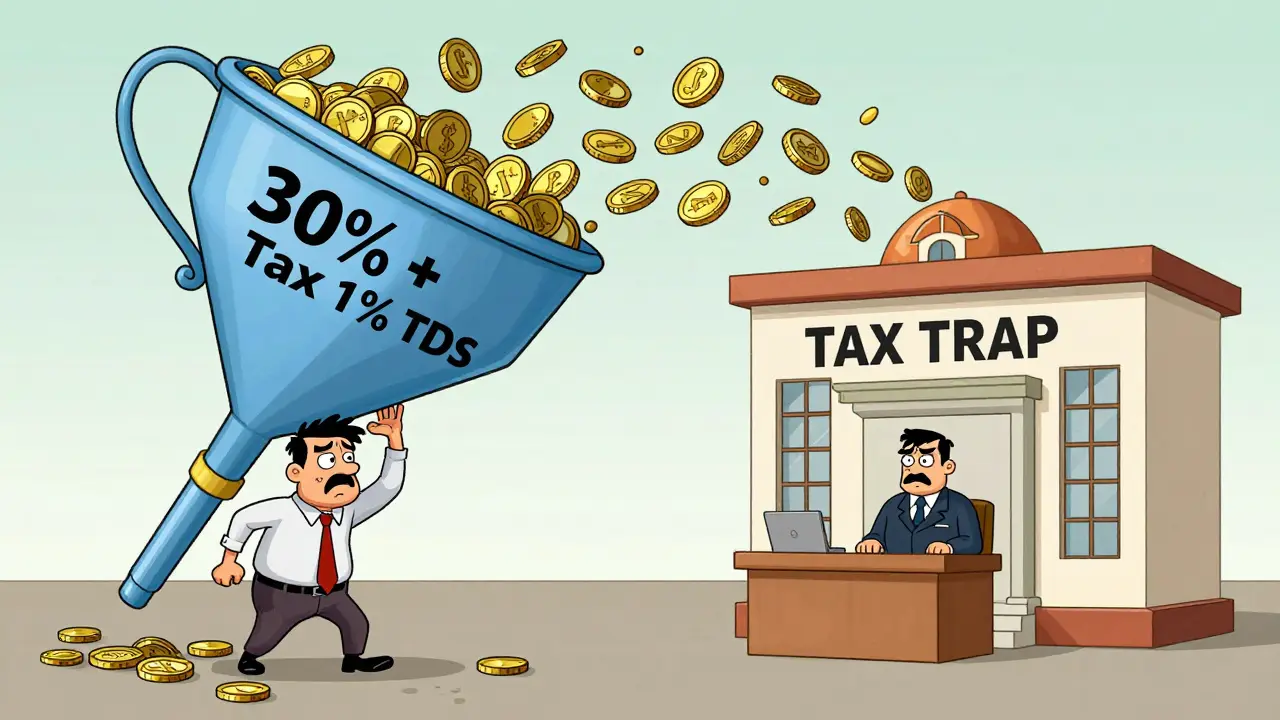
Not every country sends police to your door, but some send tax auditors. India offers a different kind of enforcement model. While owning crypto is not technically illegal, the government has made it so financially painful that it acts as a deterrent. This is what experts call "enforcement through taxation."
In India, you face a flat 30% tax on all crypto gains. That alone is steep compared to traditional stock markets. But the real kicker is the 1% Tax Deducted at Source (TDS) on every single transaction. Imagine buying a cup of coffee with crypto and having 1% instantly withheld and reported to the government. Then sell that asset later and pay 30% on the profit. This structure creates a massive paper trail. The Indian government doesn't need to prosecute you criminally to control the market; they just make sure you report everything. For traders, this environment is challenging, bordering on punitive, even if you aren't wearing handcuffs.
| Country | Status | Primary Enforcement Method | Risk to Individual Users |
|---|---|---|---|
| China | Banned | Criminal Prosecution & Confiscation | Extreme |
| Algeria | Banned | Criminal Prosecution | Extreme |
| Bolivia | Banned | Criminal Prosecution | Extreme |
| Bangladesh | Banned | Fines & Criminal Charges | High |
| India | Legal but Heavily Taxed | 30% Gain Tax + 1% TDS | Moderate (Financial) |
| United States | Regulated | Selective Sanctions (OFAC) | Low (for average users) |
| Portugal | Legal/Friendly | Minimal Oversight | Very Low |
The US Approach: Hunting Whales, Not Minnows
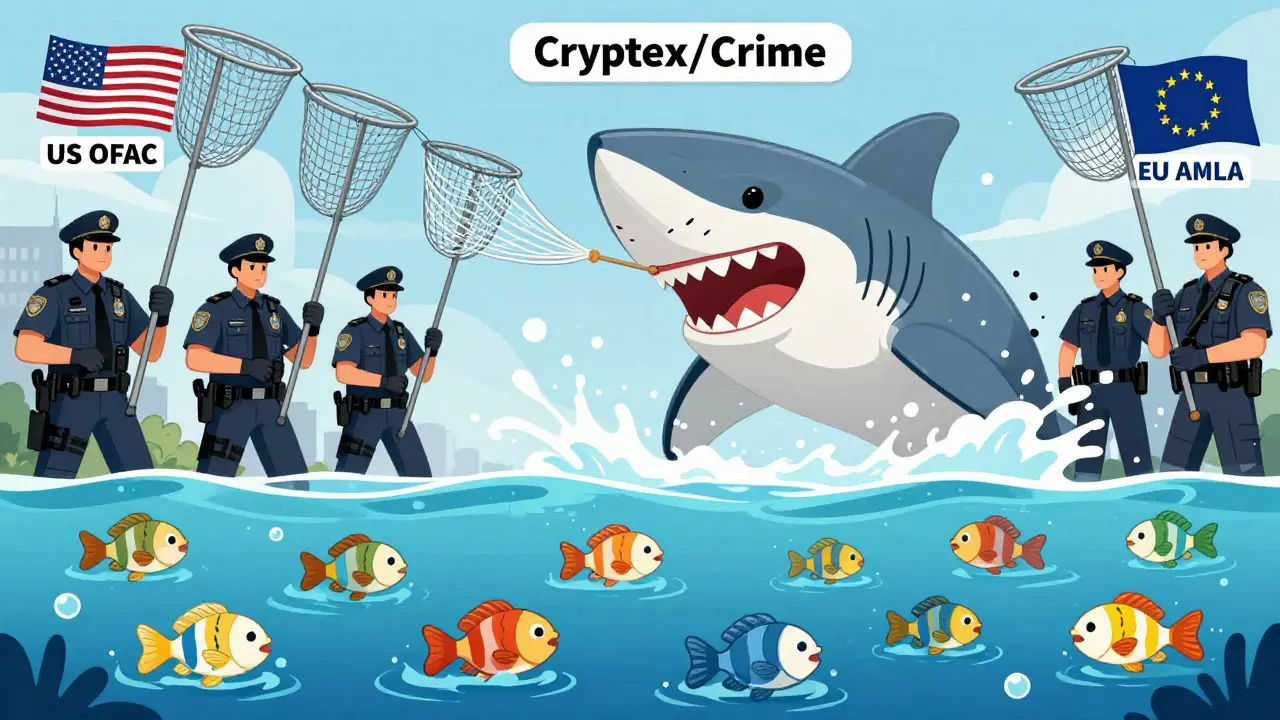
In the United States, the narrative around crypto enforcement has shifted dramatically. Under previous administrations, there was fear that the SEC would sue everyone who held tokens. However, by 2026, the approach is much more surgical. The U.S. government is not interested in prosecuting the average person who buys Bitcoin on Coinbase. They are hunting the big fish involved in illicit finance.
Look at the case of Cryptex. In September 2024, the Office of Foreign Assets Control (OFAC) sanctioned this Russia-based exchange and its operator, Sergey Sergeevich Ivanov. Why? Because Cryptex wasn't just an exchange; it was a pipeline for ransomware payments, darknet markets, and fraud shops. It processed over $5.88 billion in transactions since 2018. The U.S. State Department even put a $10 million bounty on Ivanov’s head. This shows the U.S. strategy: target the infrastructure of crime, not the consumers.
This selective focus means that if you are a regular user in the U.S., your risk of prosecution is minimal, provided you aren't mixing funds with known bad actors. The Trump administration’s generally pro-crypto stance has further reduced the pressure on individual users. However, you must remain vigilant. If your wallet addresses interact with sanctioned entities like Cryptex, you could inadvertently become part of an investigation. The key is to avoid platforms that serve as financial intermediaries for illicit actors.
Europe’s New Iron Fist: AMLA and Operation Endgame
While the U.S. focuses on sanctions, Europe is building a bureaucratic fortress. The launch of the Anti-Money Laundering Authority (AMLA) in July 2025 marked a turning point. This new body is scaling up rapidly, planning to grow from 30 to over 400 employees by 2028. Its job? To ensure that every euro moving through crypto channels is clean.
European exchanges now face intense scrutiny. The EU’s Fifth Anti-Money Laundering Directive (AMLD5) requires strict customer due diligence. This means your identity is tied to your wallet activity more tightly than ever before. If you try to hide behind anonymity, European regulators will shut you out.
But Europe isn't just watching; it's striking back. Operation Endgame was a coordinated effort between U.S. and Dutch authorities that demonstrated this new power. Law enforcement seized domains and infrastructure linked to cybercrime networks. With help from blockchain analytics firms like Chainalysis and stablecoin issuer Tether, Dutch police seized €7 million in funds. The target was UAPS, a payment processor that funneled nearly $100 million to the sanctioned Cryptex exchange in 2024 alone. This operation proves that European authorities have the tools and the will to trace and freeze illicit crypto flows. For legitimate users, this brings security. For criminals, it brings prison.
The Compliant Middle Ground: Singapore and South Korea
Between the bans and the bounties lies the pragmatic middle ground. Countries like Singapore and South Korea have chosen regulation over repression. They want crypto in their economies, but they want it clean.
Singapore operates under the Payment Services Act, enforced by the Monetary Authority of Singapore (MAS). In August 2023, MAS introduced strict rules for stablecoins, requiring full reserve backing. The goal is consumer protection, not criminalization. If you follow the rules, you are safe. Singapore focuses on ensuring that businesses comply, rather than prosecuting individual holders.
South Korea took a major step forward with the "Act on Protection of Virtual Asset Users" (VAUPA), which fully took effect in July 2024. This law forces exchanges to segregate client assets and maintain insurance. It’s designed to prevent collapses like FTX from happening again. The Financial Services Commission has been working closely with exchanges to boost compliance. Like Singapore, South Korea sees crypto as a legitimate financial sector that needs guardrails, not a criminal underworld that needs policing.
How to Stay Safe in a Patchwork World
The global crypto enforcement landscape is a patchwork. One day you might be traveling from Portugal, where crypto is friendly, to Ecuador, where it is discouraged but not banned. To navigate this safely, you need a strategy.
- Know Your Jurisdiction: Before you buy, sell, or mine, check the local laws. If you are in China, Algeria, or Bolivia, the answer is simple: don’t do it. The risk of prosecution is too high.
- Avoid Sanctioned Entities: Use blockchain explorers to check if your wallets have interacted with addresses linked to OFAC sanctions or operations like Endgame. Mixing funds with illicit sources can flag your account globally.
- Keep Records: In countries like India and the EU, transparency is your shield. Keep detailed records of your transactions, taxes paid, and sources of funds. If audited, being organized prevents criminal suspicion.
- Use Reputable Exchanges: Stick to platforms that comply with local regulations. Unregulated offshore exchanges may offer privacy, but they often lack legal protections and are prime targets for seizures.
The era of wild west crypto is over. Governments have the tools to track you, and they are using them. But they are mostly focused on stopping crime, not punishing savers. By understanding where the lines are drawn, you can participate in the digital economy without crossing into the danger zone.
Which countries actively prosecute individual crypto users?
China, Algeria, Bolivia, and Bangladesh are the primary countries that actively prosecute individual users for holding or trading cryptocurrency. In these nations, crypto activities are classified as criminal offenses under financial or anti-money laundering laws.
Is it safe to use crypto in the United States?
Yes, for the average user. The U.S. focuses its enforcement efforts on large-scale criminal enterprises, money laundering, and sanctioned entities like Cryptex. Regular users who comply with tax laws and avoid illicit platforms face minimal prosecution risk.
What is Operation Endgame?
Operation Endgame was a joint international law enforcement effort involving U.S. and Dutch authorities. It targeted financial enablers of cybercrime, resulting in the seizure of domains and €7 million in funds linked to the sanctioned exchange Cryptex and payment processor UAPS.
How does India enforce crypto regulations?
India uses taxation as its primary enforcement tool. It imposes a 30% flat tax on crypto gains and a 1% Tax Deducted at Source (TDS) on every transaction. This creates a strict reporting requirement, making non-compliance difficult and financially punitive.
What is the role of AMLA in Europe?
The Anti-Money Laundering Authority (AMLA), launched in July 2025, oversees crypto compliance across the EU. It ensures exchanges implement strict customer due diligence and transaction monitoring, aiming to prevent money laundering and protect investors through regulatory oversight rather than criminal prosecution of users.
Stop crying about taxes and just use a privacy coin or run your own node. The government wants to control you because they can't print infinite value anymore. You're all sheep waiting for the slaughter.
America is doing exactly what it should be doing by hunting down the criminals instead of banning freedom like China does. We protect our citizens from scammers while allowing innovation. Other countries are just jealous of our strength.
the india tax thing is literally designed to kill retail traders 📉😭 why would anyone stay here when every click costs you money? its not regulation its robbery plain and simple
good point karthikeyan but we have to work within the system right now. keeping records properly helps avoid bigger issues later on i think. better safe than sorry with these auditors around.
You fools dont understand that this is merely a transitional phase for the elite. The real power lies in controlling the narrative through these so-called regulations. Only those with true insight see the matrix crumbling around us.
i mean like... if u r gonna hold crypto u gotta know where u stand right? this map is super helpful tho. thanks for sharing the info everyone.
The article clearly states that ignorance is no excuse. If you are in a banned country, you are choosing to break the law. Do not come to Reddit complaining when you get arrested. Read the laws before you transact.
This entire framework is a trap set by the globalist banking cartel to monitor every movement of wealth. They want you to believe compliance keeps you safe, but it only makes you easier to track and freeze. Wake up.
It is important to recognize that legal frameworks vary significantly across jurisdictions. While some nations adopt prohibitive measures, others seek to integrate digital assets into their financial systems through robust regulatory structures.
I find it fascinating how people ignore the obvious signs of centralized control. The fact that OFAC targets specific entities proves they have total surveillance capabilities. You are already watched; pretending otherwise is delusional.
We need to crush these foreign threats immediately. Any exchange helping terrorists or criminals should be destroyed without hesitation. America leads the way in justice, and we will not tolerate weakness in our financial borders.
Stay focused on your goals and keep learning about security. The landscape is changing fast, but knowledge is your best defense. Keep your records clean and you will navigate this successfully.
One must consider the philosophical implications of state control over individual sovereignty. When a government bans an asset class, it is essentially declaring war on personal freedom. Yet, many comply out of fear rather than principle.
I am curious about the practical steps for someone moving between countries. If I travel from India to Singapore, do my previous transactions follow me legally? It seems complicated to manage different tax laws simultaneously.
Understanding cross-border jurisdictional issues requires careful planning. Generally, your tax residency determines your obligations, but criminal bans can have extraterritorial effects depending on local enforcement cooperation. Consult a legal expert for your specific case.
hey guys just a tip make sure u check chainalysis reports before buying anything weird. dont be that guy who buys stolen coins 😅🔒 stay safe out there!
its hilarious how europe thinks adding more bureaucrats will stop crime. operation endgame sounds like a video game level not real policy. theyre just creating more paperwork for lawyers to profit from.
While Europe's approach is strict, it brings stability that attracts institutional investors. It's not just about bureaucracy; it's about building trust in the market. Different cultures prioritize safety differently, and that's okay.
Let's remember to support each other during these changes. It can feel overwhelming, but we are all learning together. Share your experiences so we can grow stronger as a community.
i totally agree with kelly. its scary stuff but we gotta stick together. also typos happen dont worry about them too much lol.
why do we even need governments telling us what to buy its just another form of slavery disguised as protection. the truth is hidden in plain sight if you look past the noise.
I really want to understand the technical side of how they trace these transactions. Is it just blockchain analysis or do they have backdoors in wallets? Please explain simply because the jargon confuses me sometimes.