
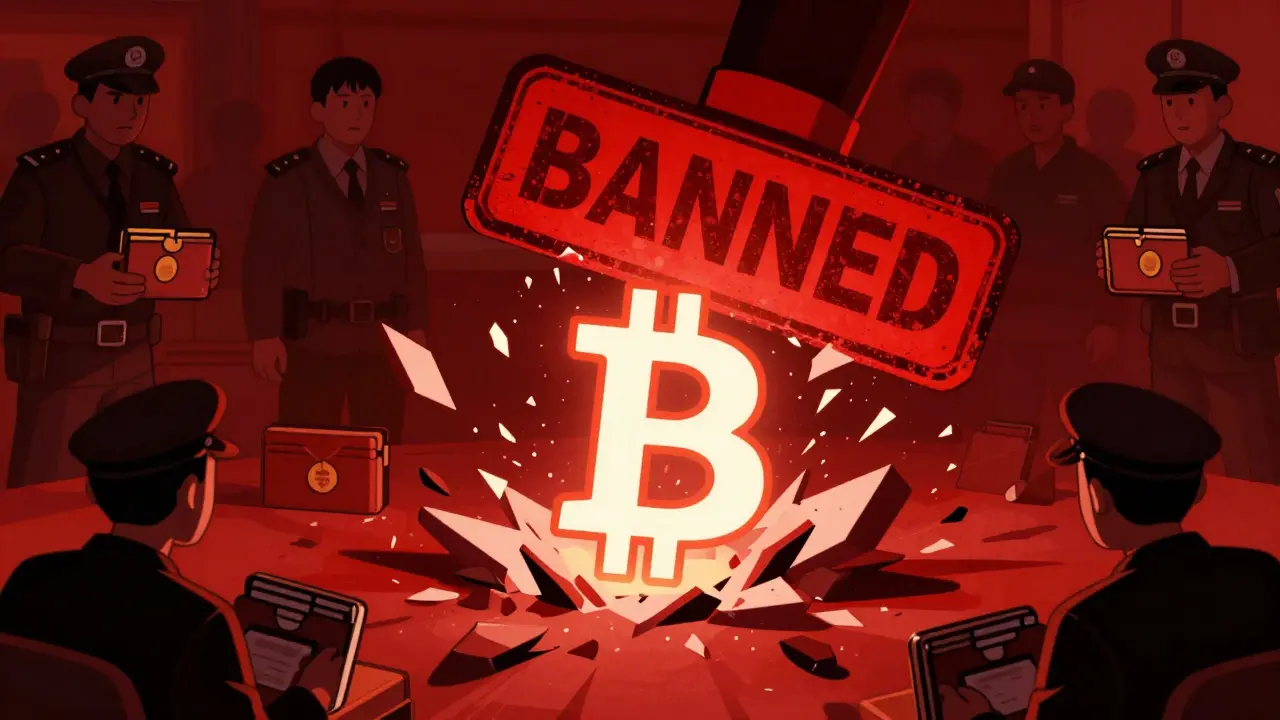
Here is the short answer that might surprise you: there is no such thing as crypto taxation in China because the activity itself is illegal. You do not file a tax return for Bitcoin gains here. Instead, if authorities catch you trading or mining, they treat your assets as illicit proceeds subject to confiscation. This makes China’s approach radically different from almost every other major economy on Earth.
If you are wondering how to declare your Ethereum staking rewards to the State Taxation Administration of China, stop looking. The framework simply does not exist. Since June 1, 2025, the People's Republic of China has enforced a comprehensive ban on all cryptocurrency activities, including individual ownership. This means the question isn't "what is my tax rate?" but rather "how do I avoid criminal charges?" Understanding this distinction is critical for anyone with ties to the Chinese financial system.
The Zero-Tolerance Regulatory Framework
To understand why there is no tax code for crypto in China, you have to look at how the government defines these assets. In most Western countries, cryptocurrencies like Bitcoin are treated as property or commodities. This classification triggers capital gains taxes when you sell them for a profit. In China, however, the People's Bank of China (PBOC) classifies cryptocurrency transactions as illegal financial activities.
This legal definition changes everything. When an activity is deemed illegal, it falls outside the scope of civil tax law and into the realm of criminal enforcement. The PBOC, along with ten other government departments, issued a notice in September 2021 that banned virtual currency business activities. Then, on May 30, 2025, a new decree expanded this prohibition to include individual ownership, effective June 1, 2025.
Under this regime, holding Bitcoin is technically a violation of the ban on "illegal fundraising" and "financial fraud." Consequently, any profits generated from buying low and selling high are not taxable income; they are considered illegal gains. The state’s response is not a tax bill-it is asset seizure. Financial institutions are strictly forbidden from providing services related to crypto, meaning you cannot even open a bank account linked to a crypto exchange without risking immediate closure and investigation.
A 16-Year Path to Prohibition
China did not arrive at this total ban overnight. It was a slow, systematic tightening of controls over more than a decade. For those trying to predict future policy shifts, understanding this timeline is essential. The journey began in June 2009, when the PBOC issued its first warning against virtual currencies, citing risks to economic stability.
- December 2013: Banks and payment processors were banned from handling Bitcoin transactions. This cut off the easy on-ramps for retail users.
- April 2014: The PBOC ordered the closure of existing Bitcoin trading accounts, effectively shutting down domestic exchanges.
- September 2017: Initial Coin Offerings (ICOs) were banned. This halted the primary way projects raised funds within China.
- January 2018: A crackdown on crypto mining forced many operations to relocate to regions with cheaper energy and looser regulations, such as Kazakhstan and Texas.
- June 2021: Mining was explicitly banned nationwide due to concerns over excessive energy consumption and environmental impact.
- September 2021: A comprehensive ban on all crypto trading and related business activities was enforced.
- June 2025: The final piece of the puzzle fell into place with a ban on individual ownership, closing the last legal gray area.
This progression shows a clear strategy: eliminate the infrastructure first, then the businesses, and finally the individual participants. By 2025, the regulatory net had tightened to the point where no aspect of the crypto ecosystem could operate legally within Chinese borders.
Enforcement and Penalties
Since taxation is off the table, what happens if you get caught? The penalties are severe and vary depending on the scale of your involvement. For individual traders, the primary risk is administrative. Your bank accounts may be frozen, and your crypto assets seized by local authorities. These seizures are permanent; there is no appeal process for recovering confiscated digital assets.
For larger players, the stakes are much higher. Engaging in large-scale trading, operating a mining farm, or facilitating cross-border transfers can lead to criminal charges. Authorities often frame these actions under laws concerning illegal business operations, money laundering, or disrupting financial order. Prison sentences are possible for those deemed to be leading organized crypto-related crimes.
It is also important to note that nationality does not offer protection. Foreigners residing in or visiting China are subject to the same comprehensive prohibition. If you are an expat living in Shanghai or Beijing, you cannot use offshore exchanges to trade crypto without violating local laws. The Chinese government monitors cross-border capital flows closely, and any attempt to move money out of the country via crypto channels is flagged as potential capital flight.

The Digital Yuan Alternative
While China crushes decentralized cryptocurrencies, it is aggressively promoting its own digital currency: the Digital Yuan (e-CNY) is a Central Bank Digital Currency (CBDC) designed to replace cash and provide a state-controlled alternative to private cryptos. This duality is key to understanding Beijing’s broader financial goals.
The e-CNY is not a cryptocurrency in the traditional sense. It is fully centralized, issued by the PBOC, and tied directly to the fiat Renminbi (RMB). Unlike Bitcoin, which operates on a decentralized ledger, the e-CNY allows the government to track every transaction in real-time. This level of transparency appeals to regulators who fear the anonymity and volatility of decentralized assets.
By banning private cryptos and promoting the e-CNY, China aims to maintain strict control over its monetary policy and prevent capital flight. The digital yuan offers consumers the convenience of digital payments without the perceived risks of decentralization. As of 2026, the e-CNY is being rolled out across major cities, with incentives for merchants and individuals to adopt it. This strategic pivot explains why the government has little interest in taxing crypto-there is no room for it in their vision of the future financial system.
Comparison with Global Standards
To appreciate how unique China’s position is, consider how neighboring jurisdictions handle crypto. Most countries have moved toward regulation and taxation rather than prohibition. For example, Taiwan implements a 5% value-added tax (VAT) on cryptocurrency trading revenue. While strict, this approach acknowledges crypto as a legitimate asset class and integrates it into the existing tax framework.
| Jurisdiction | Legal Status | Tax Treatment | Key Authority |
|---|---|---|---|
| China | Banned (Illegal) | No taxation; assets seized | PBOC |
| Taiwan | Regulated | 5% VAT on trading revenue | Ministry of Finance |
| United States | Legal (Property) | Capital Gains Tax | IRS / SEC |
| European Union | Regulated (MiCA) | Varies by member state | ESMA |
In the United States, the Internal Revenue Service (IRS) treats crypto as property, requiring users to report capital gains and losses annually. The European Union has implemented the Markets in Crypto-Assets (MiCA) regulation, which provides a unified framework for issuance and service providers. China stands alone among major economies in choosing complete eradication over integration.

Signs of Potential Softening?
Despite the hardline stance, some experts believe cracks may be forming in China’s armor. On July 10, 2025, the Shanghai State-owned Assets Supervision and Administration Commission held a debate on digital assets. Agencies discussed strategic responses to stablecoins and the rapid evolution of global digital finance.
Participants suggested that the sheer momentum of blockchain technology might force China to reconsider its absolute ban. However, no concrete policy changes have been announced. Any shift would likely involve allowing limited, highly regulated activities rather than reopening the floodgates to decentralized trading. The focus remains on maintaining state control through the e-CNY while potentially exploring enterprise-level blockchain applications that do not involve public token sales.
For now, investors and residents must assume the ban remains absolute. Relying on rumors of deregulation is a dangerous strategy that could lead to significant legal and financial consequences. Until official guidance changes, the safest course of action is total avoidance of crypto-related activities within China.
Practical Implications for Individuals
If you live in China or have significant financial ties there, the implications are straightforward. Do not hold crypto in wallets accessible from Chinese IP addresses. Do not use Chinese bank cards to fund exchanges. Do not engage in peer-to-peer (P2P) trading platforms that target Chinese users, as these are frequently targeted by police raids.
Businesses must also exercise extreme caution. Offering services related to crypto, such as consulting, development, or hosting, can be interpreted as participating in illegal financial activities. Even if your clients are overseas, operating from within China exposes you to jurisdictional risk. Many tech companies have relocated their crypto divisions to Singapore or Dubai to mitigate this exposure.
Education is your best defense. Stay informed about updates from the PBOC and other regulatory bodies. Join professional networks that discuss compliance strategies for fintech in Asia. Remember that ignorance of the law is not a valid defense in Chinese courts. When in doubt, consult with a local attorney specializing in financial crime before engaging in any digital asset activity.
Is it illegal to own Bitcoin in China?
Yes. As of June 1, 2025, the People's Bank of China banned individual ownership of cryptocurrency. Holding Bitcoin is considered an illegal financial activity, and assets can be seized by authorities without compensation.
Do I need to pay tax on crypto gains if I am a Chinese citizen living abroad?
This depends on your tax residency status. If you are a tax resident of another country, you follow that country's rules. However, China claims worldwide income for its citizens. Since crypto is illegal in China, declaring such income could expose you to legal scrutiny regarding the source of funds. Consult a cross-border tax specialist.
Can foreigners trade crypto while living in China?
No. The ban applies universally to all individuals within Chinese territory, regardless of nationality. Using offshore exchanges while residing in China violates local regulations and can result in frozen bank accounts and deportation for severe cases.
What is the penalty for crypto mining in China?
Mining is explicitly illegal. Penalties include confiscation of equipment, fines, and potential criminal charges for illegal business operations or energy theft. Authorities actively raid mining farms and shut down power supplies to suspected facilities.
Will China ever legalize cryptocurrency again?
There is no indication of a full legalization. While officials debated digital assets in mid-2025, the focus remains on the state-controlled Digital Yuan. Any future changes would likely involve tightly regulated institutional frameworks, not open retail trading.
It is frankly amusing how the West continues to pretend these digital tokens are anything other than a chaotic mess of speculation. The Chinese government simply recognized that this 'innovation' was nothing more than a vehicle for capital flight and money laundering, so they pulled the plug. It is not about oppression; it is about maintaining order in a financial system that actually functions. You cannot have your cake and eat it too, expecting decentralized anarchy to coexist with state stability.
Actually, Barclay, you are missing the nuance here. While the ban is strict, the comparison to Taiwan’s 5% VAT shows that regulation is possible without total prohibition. China’s approach is extreme because they view crypto as a threat to monetary sovereignty, not just a speculative asset. The timeline from 2013 to 2025 wasn't just about pulling a plug; it was a systematic dismantling of infrastructure to prevent any gray areas from existing. It is less about 'order' and more about control over every single transaction via the e-CNY.
Hey folks! 👋 Just wanted to add some color to this discussion. The shift to the Digital Yuan (e-CNY) is fascinating because it represents a completely different philosophy of money. Bitcoin is about privacy and decentralization, while the e-CNY is about transparency and centralization. It is like comparing a wild horse to a trained racehorse 🏇. One runs free, the other goes exactly where the jockey wants. For businesses operating in Asia, understanding this distinction is crucial. You can't treat them as interchangeable assets. The e-CNY allows real-time tracking, which is great for anti-money laundering but terrifying for anyone who values financial privacy. It really highlights why the ban on private crypto is so absolute-they don't want competition for their own digital currency!
i mean its kinda scary tbh. like if u get caught holding bitcoin ur bank account gets frozen? thats brutal. i had no idea it was that serious in china. most people think its just a tax issue but nope straight up illegal. makes me glad im in the us even though the irs is annoying lol
I hear you, Rosie. It is definitely a stark contrast to what we experience here. In the US, we have to deal with the complexity of capital gains taxes and reporting requirements, but at least our assets aren't subject to immediate confiscation just for holding them. It is important to remember that for many people in China, this isn't just a policy choice; it is a daily reality that affects their financial freedom. We should be empathetic to those navigating such restrictive environments, especially expats who might not fully understand the legal risks until it is too late.
Let's cut the sympathy act. These are grown adults engaging in illegal activities in a country that explicitly banned them. If you live in China, you follow Chinese law. There is no moral high ground for hoarding volatile digital coins when the state has declared it a threat to national security. The 'Toxic Analyst' in me sees this as pure negligence by individuals who refuse to adapt to local regulations. Don't cry about frozen accounts when you were playing with fire. The system works exactly as designed to protect the economy from these speculative bubbles.
Kamal, you are being incredibly harsh! Not everyone understands the legal implications immediately, especially when regulations change so rapidly. Look at the timeline-it took 16 years to get to this point. People were trading in 2013 when it was technically ambiguous. To call them negligent ignores the confusing nature of evolving crypto laws globally. We need to focus on education and clear communication rather than blaming victims of overly broad enforcement. Let's try to find a middle ground where we acknowledge the severity of the law but also the human element of adapting to new technologies.
hey lorna i see ur point but kamal isnt entirely wrong either. its just that the line between legal and illegal got blurry for a long time. i always thought mining was fine until 2021. now its crazy how fast things changed. do u think the shanghai debate in 2025 means anything or was it just talk? seems like they might be softening slightly on enterprise blockchain but retail is still dead. curious if anyone knows more about that specific meeting.
Oh my goodness, this is such a dramatic situation! I feel so much anxiety just reading about the penalties. Imagine having your life savings seized because you believed in technology! It is absolutely heart-wrenching. The way the government tracks everything through the e-CNY feels like a nightmare scenario for privacy lovers. I hope people are staying safe and educated. This whole saga is a wild ride, and I am just trying to keep up with all the changes. Please stay safe everyone!
Saradee, take a deep breath. While the situation is intense, panic doesn't help. The key takeaway here is awareness. If you have ties to China, you need to be proactive, not reactive. Consult a lawyer. Do not use P2P platforms. Understand that the ban applies to foreigners too. Being aggressive in your compliance strategy is the best way to protect yourself. Do not wait for the authorities to come to you. Take charge of your financial safety by adhering strictly to the current laws. Knowledge is power, and ignorance is a liability.
It is truly remarkable to observe the trajectory of cryptocurrency regulation across the globe, particularly when contrasting the Western approach of integration and taxation with the Eastern approach of prohibition and replacement, which ultimately leads us to consider the profound implications for global financial interoperability and the future of decentralized finance, especially as we look toward the potential adoption of stablecoins and the ongoing debates within Shanghai regarding strategic responses to digital assets, which suggests that while the door may not be wide open, it might not be completely sealed shut either, offering a glimmer of hope for those who believe in the transformative power of blockchain technology despite the current harsh realities faced by individual traders and miners alike.
The philosophical divide here is clear: control versus freedom. China has chosen control through the e-CNY, viewing anonymity as a risk. The US and EU choose freedom with oversight, viewing innovation as a benefit. Neither is inherently right or wrong, but they represent two different visions of society. We must accept that these systems will likely remain incompatible for the foreseeable future.
man i just wish they would let people trade in peace. its not like its hurting anyone directly. the whole confiscation thing is just plain wrong.
Mark, I understand your frustration, but we have to respect the boundaries set by each nation's legal framework. What hurts one person might be seen as protecting another by the state. It is better to focus on how we can navigate these differences safely rather than judging the policies themselves. Let's keep the conversation respectful and informative.