
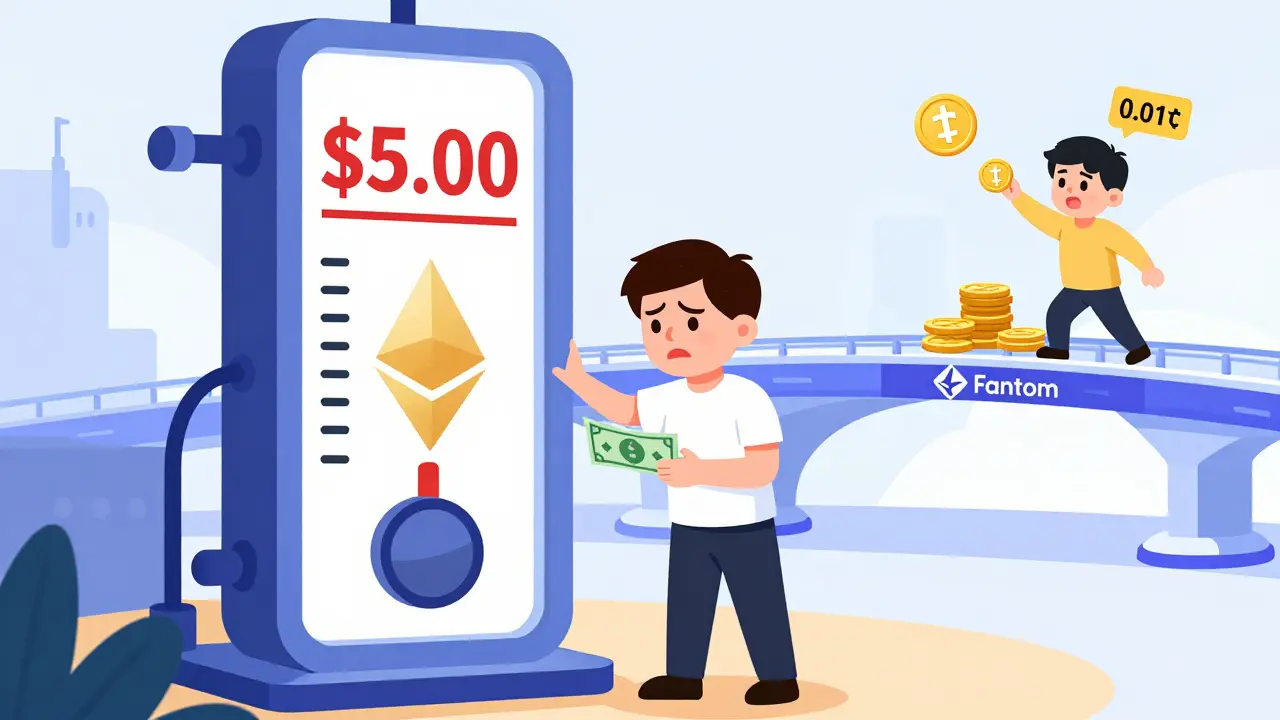
Swapping stablecoins on Ethereum feels like paying a luxury tax. You want to move $100 from USDC to USDT, and suddenly you’re staring at a $5 gas fee. That is the exact problem Curve (Fantom) is designed to solve. It offers near-instant swaps with costs that often drop below one cent. But here is the catch: while the technology works beautifully, the ecosystem it lives in carries significant baggage. Before you deposit your funds, you need to understand what makes this decentralized exchange unique, where the hidden risks lie, and whether it still holds value in 2026.
What Is Curve (Fantom)?
Curve (Fantom) is not a standalone company or a new invention. It is a deployment of the popular Curve Finance protocol onto the Fantom Opera blockchain. To break that down: Curve Finance is a decentralized automated market maker (AMM) created by Michael Egorov in 2020. Its specialty is swapping assets that should have similar values-mostly stablecoins like USDC, USDT, and DAI-with minimal slippage.
Fantom Opera is a Layer-1 blockchain known for speed and low costs. When these two combine, you get a trading venue that executes trades in seconds rather than minutes, costing fractions of a penny in gas. The platform launched on Fantom in 2021 during the height of the DeFi boom. Today, it serves as a critical piece of infrastructure for users who already operate within the Fantom ecosystem, allowing them to rotate between different types of stablecoins without losing money to high fees or wide price spreads.
How the StableSwap Technology Works
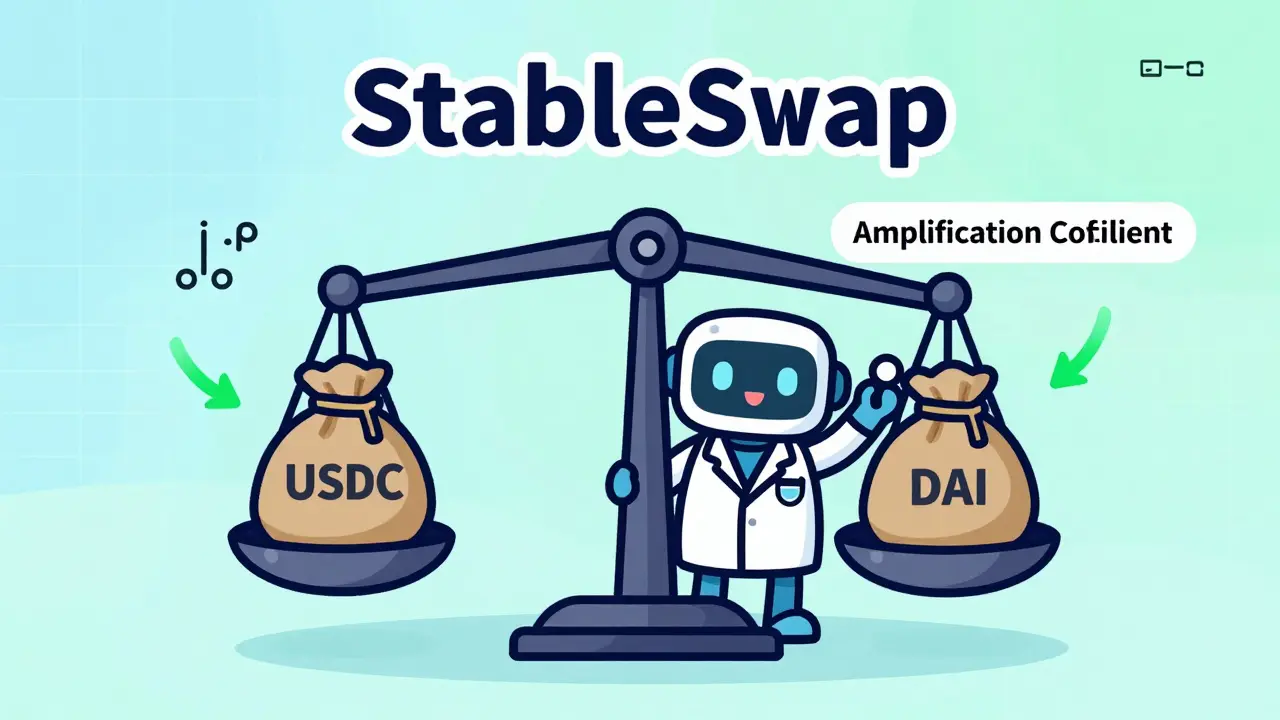
The secret sauce behind Curve is its StableSwap invariant. Most decentralized exchanges use a "constant product" formula (like Uniswap), which assumes assets can fluctuate wildly in price. This causes slippage when swapping tokens that are pegged to the same dollar value. Curve’s math assumes the assets stay close to their peg. This allows you to trade larger amounts with significantly less price impact.
On Fantom, this translates to real-world savings. If you try to swap $10,000 worth of stablecoins on a standard AMM, you might lose 0.5% or more in slippage. On Curve (Fantom), that loss is often less than 0.02%. The protocol uses an amplification coefficient (A) to control how tightly the pool sticks to the peg. Higher A values mean lower slippage for small deviations but higher impermanent loss if a depegging event occurs. For most daily traders, this means getting exactly the amount of dollars you expect, minus a tiny fee.
Fees, Costs, and Trading Limits
Let's talk about what actually comes out of your pocket. Curve (Fantom) charges a trading fee, typically around 0.04% for standard stablecoin pools. Some volatile "crypto" pools charge up to 0.3%. Here is how that splits:
- 50% goes to Liquidity Providers (LPs): People who lock up their capital to enable these trades.
- 50% goes to veCRV holders: Users who lock the governance token CRV to earn rewards and influence emissions.
Then there is the network gas fee. Because Fantom Opera uses a DAG-based consensus mechanism called Lachesis, transactions settle in 1-3 seconds. The cost? Usually less than 0.01 FTM, which is well under $0.01 USD. Even complex multi-hop swaps rarely exceed $0.02 in total transaction costs. Compare that to Ethereum mainnet, where a simple swap can cost $5-$20 during congestion, and the advantage is clear.
However, liquidity is the bottleneck. Recent data shows Curve (Fantom) handles roughly $2,570 in 24-hour volume, with the FRAX/FUSDT pair being the busiest at around $1,065. This is a massive drop from the peak in 2022, when Total Value Locked (TVL) reached hundreds of millions. Today, if you try to swap more than $50,000 in a single transaction, you will likely encounter significant slippage because the pools simply do not have enough depth anymore. It is best suited for retail-sized trades, not institutional treasury movements.
| Feature | Curve (Fantom) | SpookySwap | Beethoven X |
|---|---|---|---|
| Best For | Low-slippage stablecoin swaps | Wide token variety, meme coins | Balanced portfolios, yield farming |
| Trading Fee | 0.04% - 0.3% | 0.3% - 0.5% | Variable (usually ~0.3%) |
| Liquidity Depth | Low (approx. $2.5k daily vol) | Medium | Medium-High |
| User Interface | Minimalist, text-heavy | Visual, trader-friendly | Modern, dashboard-style |
| Risk Profile | High bridge risk, smart contract risk | Smart contract risk, rug pulls | Smart contract risk, impermanent loss |
The Hidden Danger: Bridge Risks
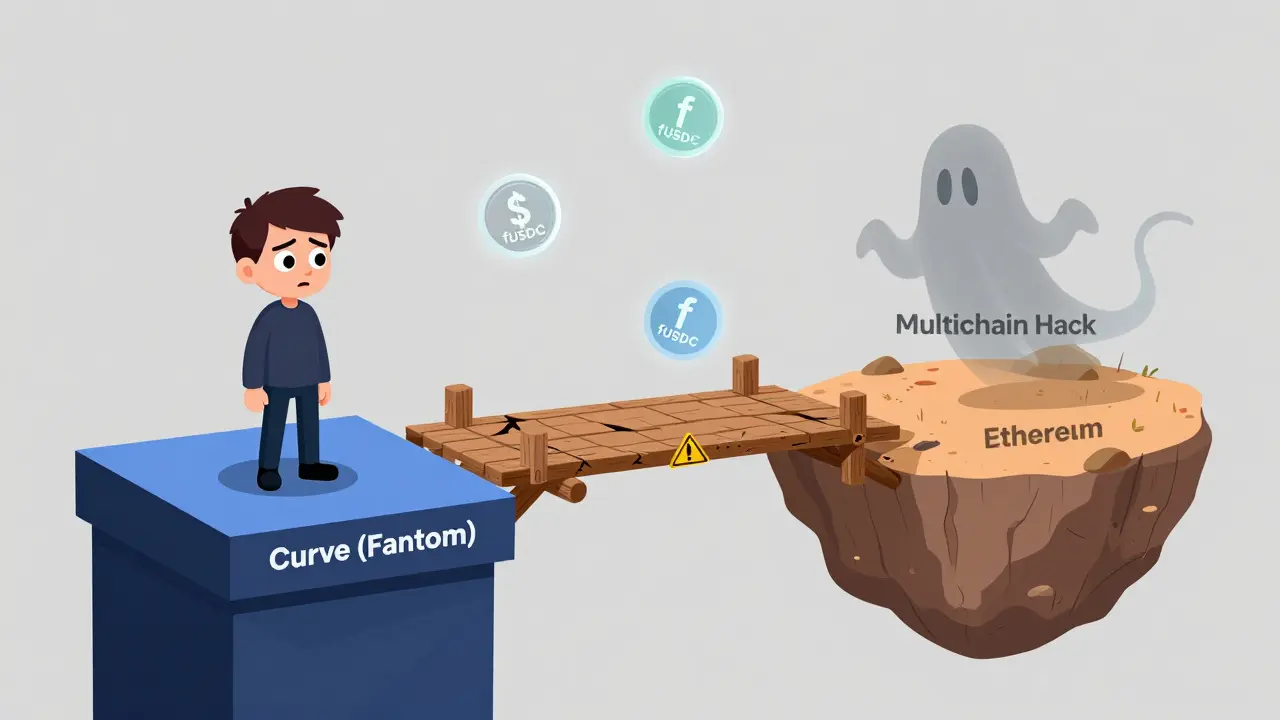
This is the part most reviews skip, but it is crucial. Curve (Fantom) itself has never suffered a direct smart contract exploit specific to its Fantom deployment. The code is battle-tested, audited by firms like Trail of Bits and Quantstamp, and runs on open-source standards. However, the assets inside the pools are often "bridged" versions of stablecoins.
To get USDC or USDT onto Fantom, you usually pass through a bridge. In mid-2023, the Multichain (formerly Anyswap) bridge, which was heavily used to move assets to Fantom, suffered severe security issues resulting in over $100 million in losses. While Curve’s contracts remained intact, the confidence in bridged stablecoins took a hit. If the bridge backing your FUSDT or fUSDC fails again, the asset in your Curve pool could lose its peg permanently. You are not just trusting Curve; you are trusting the entire cross-chain infrastructure feeding into it. Always verify which version of a stablecoin you are holding. Native minted stablecoins are safer than bridged ones, but they are harder to find on smaller chains like Fantom.
Who Should Use Curve (Fantom)?
You should use Curve (Fantom) if:
- You are already active in the Fantom ecosystem and need to rotate between stablecoins efficiently.
- You are providing liquidity and want exposure to the CRV token incentives, though yields have normalized to low single digits (2-5% APY) compared to the 20-30% seen in 2022.
- You are running arbitrage bots that require sub-second finality and negligible gas costs to remain profitable on small margins.
You should avoid it if:
- You are moving large sums of capital (over $10,000) where slippage will eat your profits.
- You are a beginner who finds minimalist interfaces confusing. Curve’s UI is functional but lacks the hand-holding of newer platforms.
- You prioritize safety above all else. The reliance on third-party bridges adds a layer of counterparty risk that does not exist on centralized exchanges.
How to Get Started
If you decide to proceed, setting up takes about 15-30 minutes. Here is the practical path:
- Configure Your Wallet: Use MetaMask or Rabby. Add the Fantom Opera network manually if it isn’t pre-loaded. Key details: Chain ID 250, RPC URL `https://rpc.ftm.tools`.
- Acquire Gas: Buy or transfer some FTM to your wallet. You only need $1-$5 worth to cover dozens of transactions.
- Bridge Assets Carefully: Move your stablecoins to Fantom. Avoid obscure bridges. Stick to reputable options and check if the stablecoin is natively minted or wrapped.
- Connect to Curve: Go to the official Curve interface, ensure your wallet is connected to Fantom, and select the pool you want (e.g., FRAX/FUSDT).
- Test Small: Execute a small test trade ($10-$50) to confirm everything works before committing larger amounts.
Is Curve (Fantom) safe to use?
The smart contracts themselves are highly secure and have been audited multiple times. However, the safety of your funds depends heavily on the stability of the bridged assets you deposit. If the bridge connecting Ethereum to Fantom fails, your assets could be at risk regardless of Curve's security.
Why is the trading volume so low on Curve (Fantom)?
Fantom's overall DeFi ecosystem shrank significantly after 2022 due to broader market conditions and bridge controversies. Most liquidity migrated back to Ethereum or larger Layer-2 networks like Arbitrum and Optimism, leaving Curve (Fantom) with modest daily volumes around $2,500.
Can I make money by providing liquidity?
Yes, but yields are much lower than in the past. Currently, APRs range from 2% to 5% for most stablecoin pools, driven by trading fees and residual CRV emissions. During peak periods in 2022, yields exceeded 30%, but those days are unlikely to return soon without major ecosystem growth.
What is the difference between Curve (Fantom) and SpookySwap?
Curve specializes in low-slippage swaps for similar-value assets like stablecoins. SpookySwap is a general-purpose DEX better suited for trading volatile tokens, meme coins, and assets with wider price fluctuations. Use Curve for efficiency; use SpookySwap for variety.
Do I need to hold CRV tokens to use Curve (Fantom)?
No. You can swap tokens without holding any CRV. However, holding and locking CRV (veCRV) allows you to earn a share of the trading fees and vote on where emissions go, which can boost your returns if you are providing liquidity.
You are completely missing the forest for the trees here. The bridge risk is not just a "hidden danger" it is the fundamental flaw of the entire cross-chain narrative that has been bleeding value since 2023. Multichain didn't just have issues, it was a systemic failure of trustless bridging assumptions. If you think swapping stablecoins on Fantom is safe because the gas is cheap, you are ignoring the fact that the assets themselves are often wrapped liabilities with no real recourse if the custodian fails. I have seen too many retail users get wrecked by assuming L1 parity means L1 security. It does not. The math might be beautiful but the infrastructure is rotting from the inside out.
It is quite pathetic how people still cling to these zombie chains like Fantom. The volume numbers speak for themselves, don't they? $2,500 daily volume is an insult to anyone who actually understands market dynamics. You might as well be trading in a ghost town. The elitist truth is that liquidity flows where the smart money is, and right now, that is Ethereum L2s or Solana. Sticking your nose into Curve on Fantom is like trying to find a good steak at a gas station diner. Just admit the ecosystem is dead and move on.
I really appreciate this detailed breakdown because it highlights such an important nuance about decentralized finance that often gets overlooked in the hype cycles, specifically regarding the difference between protocol security and bridge security which are two entirely different beasts when you start looking at the technical architecture of how assets move across chains. It is fascinating to see how the StableSwap invariant works so efficiently for pegged assets but I always wonder if there is a way to educate users more effectively about the risks involved without making them feel overwhelmed by the complexity of the technology. Perhaps we need better interfaces that explain the provenance of the tokens being swapped so that users can make informed decisions about whether they are holding native minted stablecoins or bridged versions which carry that extra layer of counterparty risk that Crystal mentioned earlier.
So let me get this straight, you are telling me I should avoid moving large sums because of slippage but then you also tell me the bridge risk is high? Which one is it? Is it safe or not? This article is full of contradictions. I want to know if I can trust my funds or if I am just gambling on a broken system. Stop beating around the bush and give me a straight answer about whether Fantom is worth using in 2026 or if it is just a relic of the past.
Hey folks, I think there is some serious gold in this discussion even if the tone is a bit harsh! I remember back in the day when Fantom was buzzing with activity and everyone was talking about the speed and low fees. It feels like a lost era almost. But hey, maybe there is still a niche for those of us who like tinkering with small amounts and don't mind the occasional hiccup. Who else remembers the early days of DeFi on Fantom? Let's share some stories!
I totally get where everyone is coming from with the concerns about bridge risk and low liquidity. It is definitely scary to think about losing money due to a third-party failure. However, I have found that starting small and doing thorough research on which bridges are most reputable can help mitigate some of that anxiety. It is all about taking baby steps and understanding the trade-offs. Good luck to everyone navigating this space!
omg i cant believe ppl are still using fantom lol like seriously?? the ui is so outdated and the fees are low but its not worth the hassle imo. just stick to eth l2s u guys are wasting ur time tbh
Listen up people! We need to stop bashing Fantom and start fixing it! Yes the volume is low but that is because we gave up on it too easily! I say we rally together and bring the liquidity back! Who is with me?! Lets show the haters what we can do! No more excuses! Action now!
Just watching this unfold. Seems like a mix of valid concerns and some pretty strong opinions. I guess time will tell if Fantom makes a comeback or stays a ghost chain. Interesting read though.
so im curious bout the bridge thing... like if multichain failed does that mean all my fUSDT is gone forever? or can i just claim it somewhere else? kinda confusing stuff for someone who just wants to swap coins without reading a novel abt it lol
Oh my goodness, this is such a dramatic situation! 😱 I mean, really, who would have thought that a simple swap could lead to such a big debate about safety and trust? It is truly heartbreaking to see how much fear there is out there. But let us not forget that innovation comes with risks, and perhaps we can learn from these mistakes to build a better future for everyone. 🌟
Let me tell you something right now, you people are sleeping on the potential here! Yes, the volume is down, but that is exactly why it is a buying opportunity for those who understand the tech! Do not listen to the haters who just want to see everything fail! Get in now before it pumps again! Trust me on this one!
Great points raised here! 🚀 I think it is important to remember that while the risks are real, the benefits of low fees and fast transactions cannot be ignored. For those who are cautious, I recommend sticking to smaller amounts and using only the most trusted bridges. Also, keep an eye on the CRV emissions as they can provide a nice boost to yields. Happy trading! 💰✨
The philosophical implications of relying on centralized bridges for decentralized finance are profound. Are we truly decentralizing if our assets depend on a single point of failure? This question deserves deeper contemplation. Nevertheless, the practical utility of Curve on Fantom remains undeniable for specific use cases. Balance is key.
I remain optimistic that Fantom will rise again because the technology is solid and the community is passionate! Even though things look bleak right now, history has shown us that crypto markets are cyclical and what goes down must come up! So hang in there and keep believing in the dream! The best is yet to come for sure!
nah man i just use spooky swap cause its easier and doesnt give me a headache tryna figure out which bridge is safe. curve is fine if u know what u r doing but honestly why bother when other options exist?
I respect the detailed analysis here. It is important to have these conversations about risk. I personally prefer to keep my funds on mainnet Ethereum until the bridge technology matures further. But for those who are experienced, Fantom does offer unique advantages. Thanks for sharing this perspective.
The epistemological crisis inherent in cross-chain asset transfer protocols necessitates a rigorous re-evaluation of foundational trust assumptions within the decentralized finance paradigm. One must consider the ontological status of bridged tokens: are they merely representations or genuine equivalents? The reliance on third-party custodial mechanisms introduces a latent vulnerability that undermines the very ethos of decentralization. Furthermore, the socio-economic implications of liquidity fragmentation across disparate blockchain ecosystems warrant scholarly attention. It is imperative that stakeholders engage in dialectical discourse to ascertain the veracity of security claims propagated by various platforms. Until such clarity is achieved, prudence dictates a conservative approach to capital allocation in these environments.
wake up people!!! stop sleeping on this!!! fantom is gonna moon soon!!! buy now cry later!!! dont listen to the FUD!!! lets gooo!!!
i am so tired of hearing about how great fantom used to be like yeah it was great until it sucked and now it sucks again why do we keep pretending otherwise? nobody cares about your nostalgia trip just deal with reality already
lol another day another dead chain review. yall really think adding emojis changes the fact that tvl is toilet bound? sarcasm aside the tech is cool but adoption is zero. move along nothing to see here.
hey guys i was wondering if anyone knows a good tutorial on how to set up metamask for fantom properly? i tried following the steps in the article but got stuck at the rpc url part. any help would be greatly appreciated thanks in advance!
This entire thread is a disgrace to logical discourse. People are throwing around terms like 'bridge risk' without understanding the nuanced economic incentives at play. It is morally reprehensible how easily the masses are manipulated by fear-mongering narratives. Wake up sheeple! The elites want you to believe Fantom is dead so they can accumulate cheaply. Don't fall for it! Demand accountability from the developers!