
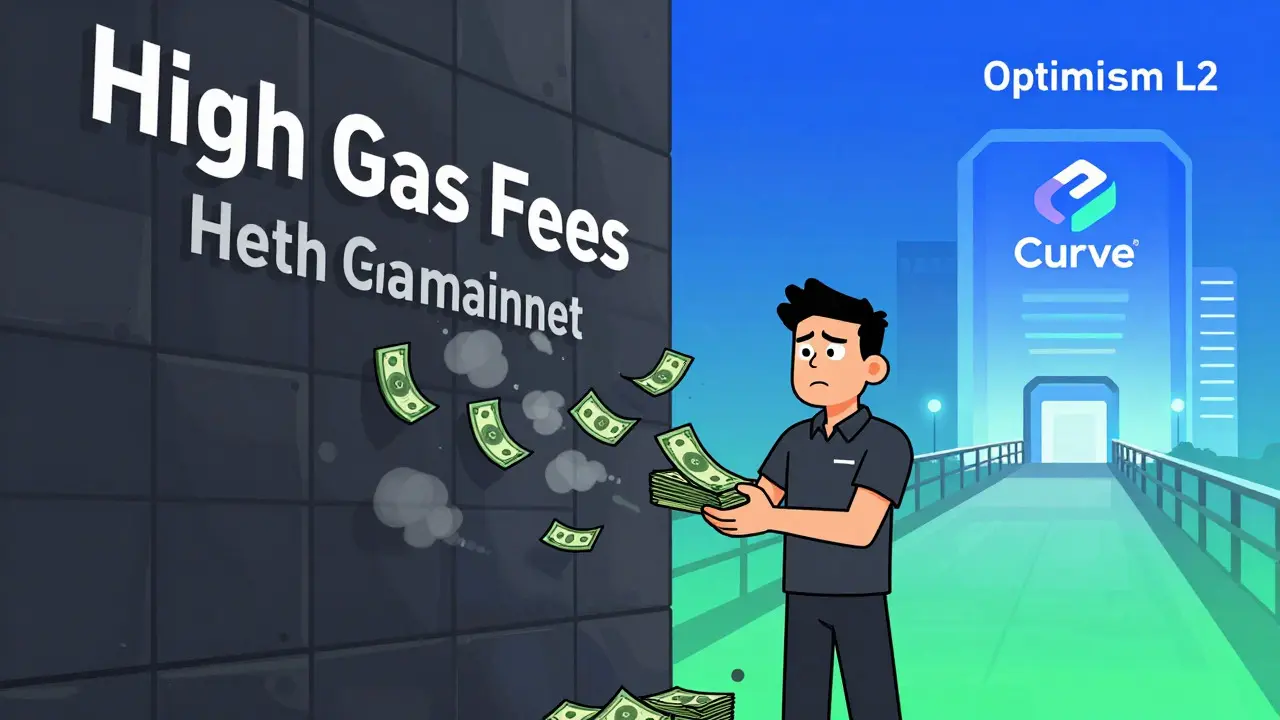
Swapping stablecoins on Ethereum mainnet used to feel like paying a luxury tax. You’d move $1,000 from USDC to USDT and watch $50 vanish in gas fees before the transaction even settled. That frustration is exactly why Curve (Optimism) has become the go-to destination for traders who value efficiency over hype. By moving Curve Finance’s renowned stablecoin-focused liquidity pools to the Optimism Layer-2 network, you get the same deep liquidity at a fraction of the cost.
If you are looking for high-frequency trading or large-volume arbitrage, this combination is hard to beat. But if you want to swap volatile meme tokens, you might be in the wrong place. This review breaks down whether Curve on Optimism fits your specific DeFi strategy, covering costs, security, and the real-world user experience as we head through 2026.
What Is Curve (Optimism)?
Curve (Optimism) is the deployment of Curve Finance, a decentralized exchange protocol specializing in low-slippage stablecoin swaps, on the Optimism Layer-2 blockchain. Founded by Michael Egorov, a former physicist with a PhD in applied mathematics, Curve launched its mainnet in January 2020. Its core innovation was an Automated Market Maker (AMM) algorithm designed specifically for assets that trade at similar prices-like USDC, USDT, and DAI.
When Curve expanded to Optimism, it brought this specialized technology to a faster, cheaper environment. Optimism uses an optimistic rollup architecture, meaning transactions happen off-chain first and are then submitted to Ethereum mainnet in compressed batches. For you, the user, this means near-instant settlement times and negligible fees. As of early 2025, Curve’s Optimism deployment held over $842 million in Total Value Locked (TVL), representing more than 21% of Curve’s total cross-chain liquidity.
Why Use Curve on Optimism? Key Benefits
The primary reason traders flock to Curve (Optimism) is the drastic reduction in friction. Here is what makes it stand out:
- Negligible Gas Fees: Average transaction costs on Optimism sit around $0.0004. Compare that to Ethereum mainnet’s average of $1.27, and the savings are obvious. If you are executing multiple trades a day, these cents add up quickly.
- Minimal Slippage: Curve’s V2 AMM algorithm maintains slippage of just 0.04% on standard stablecoin pools. Uniswap typically charges 0.3% on similar pairs. On a $10,000 trade, that difference saves you roughly $26.
- Speed: Settlement times average 2 seconds on Optimism, compared to 15 seconds on Ethereum mainnet. This speed is critical for arbitrageurs who need to react to price discrepancies instantly.
- Deep Liquidity: With $842 million locked in the Optimism pools, you can execute large trades without significantly moving the market price.
These benefits make Curve (Optimism) ideal for stablecoin swaps, yield farming strategies involving stable assets, and bridging funds between chains efficiently.
How It Compares to Other DEXs
Not all decentralized exchanges are built for the same job. While Uniswap is the king of general token swapping, Curve dominates the stablecoin niche. Let’s look at how Curve (Optimism) stacks up against its competitors.
| Feature | Curve (Optimism) | Uniswap (Ethereum L2) | Balancer |
|---|---|---|---|
| Average Fee (Stablecoins) | 0.04% | 0.30% | 0.50% - 1.00% |
| Slippage (Standard Pool) | 0.04% | ~0.30% | Variable |
| Gas Cost (Avg) | $0.0004 | $0.05 - $0.20 | $0.05 - $0.20 |
| Best For | High-volume stablecoin swaps | Volatile asset trading | Custom portfolio weights |
| TVL (Optimism/Cross-chain) | $842M (Optimism) | $8.2B (Total) | $1.5B (Total) |
As the table shows, Curve wins on cost and slippage for stable assets. However, if you are trying to swap ETH for a new NFT project token, Uniswap is your better bet because it supports thousands of volatile pairs where Curve’s model becomes inefficient.

Security and Trust Factors
In DeFi, security is non-negotiable. Curve (Optimism) inherits security from two robust layers: the Curve protocol itself and the Optimism network.
Optimism’s Fraud Proofs: Optimism uses a fraud proof mechanism with a 7-day challenge period. This means if a validator tries to submit invalid data, anyone can dispute it within seven days. This system has kept Optimism secure since its Bedrock upgrade in June 2023.
Curve Governance: Protocol changes require approval from the Curve DAO. Specifically, it needs a 4-of-7 multi-signature approval from key signatories. This decentralized control reduces the risk of a single point of failure.
However, there is a centralization concern regarding voting power. According to governance data from late 2024, about 62.3% of voting power is concentrated among just 15 entities holding veCRV (vote-escrowed CRV). While this hasn’t led to malicious outcomes yet, it’s a risk factor to keep in mind. Always remember: you are responsible for your own keys. Connect only via trusted wallets like MetaMask or Ledger.
User Experience: Is It Easy to Use?
Curve’s interface is clean but not beginner-friendly. If you have never used a DEX before, expect a learning curve of 8-12 hours to understand basic functionality, according to Koinly’s 2025 DEX guide. Here is what you need to know:
- Wallet Setup: You need an Ethereum-compatible wallet like MetaMask. Ensure your RPC settings are configured for Optimism.
- Bridging Assets: To use Curve on Optimism, you must bridge your assets from Ethereum mainnet or other chains. Using the official Optimism Bridge takes 1-2 hours for deposits but offers instant withdrawals back to L2. Note that withdrawing from Optimism to Ethereum mainnet requires a 7-day withdrawal period due to the fraud proof window.
- Swapping: Once bridged, swapping is straightforward. Select your input and output tokens, approve the spend, and confirm the transaction. The low fees mean you won’t hesitate to retry if something goes wrong.
- Governance Complexity: If you plan to earn rewards by providing liquidity, you’ll encounter the veCRV locking mechanism. Users often miscalculate lock durations, leading to missed rewards. Start small until you understand the math.
Community support is strong, with Discord resolving 82% of queries within 24 hours. However, complex governance questions can take up to 72 hours to answer.
Who Should Use Curve (Optimism)?
This platform isn’t for everyone. Here is a quick decision tree:
- Use Curve (Optimism) if:
- You trade large volumes of stablecoins (USDC, USDT, DAI).
- You are an arbitrageur looking to minimize gas costs.
- You want to provide liquidity to stablecoin pools for yield.
- You already hold assets on Optimism and need efficient swaps.
- Avoid Curve (Optimism) if:
- You primarily trade volatile altcoins or NFTs.
- You are a complete DeFi novice unwilling to learn about bridging and gas.
- You need immediate access to funds on Ethereum mainnet (due to the 7-day withdrawal period).
Future Outlook and Risks
Curve continues to evolve. In January 2025, they deployed crvUSD v2.1 on Optimism, which grew to $120 million in circulation. Looking ahead, “Curve Warp,” a planned cross-chain settlement layer launching in Q3 2025, aims to reduce bridging times from hours to minutes. This could further cement Curve’s dominance in stablecoin infrastructure.
However, regulatory risks persist. The SEC’s October 2024 guidance classified CRV as a security in certain jurisdictions, which may limit centralized exchange listings and create compliance hurdles. Additionally, reliance on veTokenomics creates centralization risks. Despite these challenges, Gartner predicts Curve’s TVL will grow to $6.2 billion by 2026, with Optimism deployments accounting for 35% of that total.
Is Curve (Optimism) safe to use?
Yes, it is considered highly secure. It relies on Optimism’s fraud-proof mechanism and Curve’s audited smart contracts. However, always verify contract addresses and be aware of the 7-day withdrawal period when moving funds back to Ethereum mainnet.
What are the fees on Curve (Optimism)?
Trading fees are extremely low, typically around 0.04% for stablecoin pairs. Gas fees on the Optimism network average $0.0004 per transaction, making it one of the cheapest DEX options available.
How do I get assets onto Curve (Optimism)?
You need to bridge your assets from Ethereum mainnet or another supported chain using the Optimism Bridge or a third-party bridge like LayerZero. Bridging to Optimism is usually instant, but withdrawing back to Ethereum takes 7 days.
Can I trade volatile tokens on Curve (Optimism)?
While possible, Curve is optimized for stablecoins and low-volatility assets. For volatile tokens, you will likely face higher slippage and lower liquidity compared to general-purpose DEXs like Uniswap.
What is the CRV token used for?
CRV is the governance token of Curve Finance. Holders can vote on protocol changes and lock their tokens as veCRV to earn trading fee rebates and increased yield from liquidity pools.
the whole optimism narrative is just a sophisticated pump scheme designed to keep retail liquidity trapped in l2 while validators extract value via sequencer fees nobody talks about. the fraud proof window is a theoretical safety net that has never been stress tested under actual adversarial conditions meaning your funds are effectively held hostage by a centralized validator set pretending to be decentralized. curve’s veCRV model exacerbates this by concentrating voting power among whales who dictate protocol parameters to favor their own yield strategies over genuine market efficiency. it is not innovation it is financial engineering disguised as decentralization.
feels like everyone is sleeping on the gas savings 😴💸
there is something profoundly beautiful about how technology can reduce friction in human exchange. when we look at curve on optimism we see not just a tool but a step toward more equitable access to financial infrastructure for people everywhere. the fact that a swap costs less than a penny allows small traders in emerging markets to participate fully without being taxed out of existence by legacy systems. it reminds me of the early days of the internet where bandwidth was expensive and now we stream 4k video for free. we are witnessing the democratization of finance through clever engineering and community governance. let us embrace this shift with open hearts and minds because efficiency serves humanity best when it is accessible to all.
i love the idea of swapping stablecoins without losing my shirt to fees but the interface still feels like it was designed by someone who hates buttons. why does every dex have to look like a spreadsheet from 1998? i want colors and vibes not just numbers going up and down. also bridging takes forever which kills the mood completely. maybe if they added some neon lights or a progress bar that actually moves fast it would feel less like waiting for a bus in the rain.
you think you are trading but really the algorithm is trading you. the slippage metrics are manipulated to show better performance than reality. deep liquidity is an illusion created by synthetic assets backing the pools. wake up sheeple.
it is absolutely disheartening to observe the gullibility of the masses who blindly trust these so-called decentralized protocols. the SEC guidance was merely a polite warning shot before the main artillery of regulation fires upon these unregistered securities exchanges. the centralization of voting power among fifteen entities proves beyond any reasonable doubt that curve is a cartel operating under the guise of democracy. furthermore the reliance on optimistic rollups introduces systemic risk that could cascade across the entire ethereum ecosystem should a single validator act maliciously during the challenge period. one must question whether the convenience of low fees outweighs the existential threat to one's capital sovereignty in an increasingly surveilled digital landscape.
one might ponder the philosophical implications of a market maker that prioritizes stability over volatility. is true freedom found in the ability to trade anything or in the security of knowing your principal will remain intact? curve seems to argue for the latter suggesting that wisdom lies in avoiding the chaos of meme coins. yet this raises questions about the nature of risk itself. if we eliminate slippage do we also eliminate the possibility of unexpected gain? perhaps the answer lies not in choosing between platforms but in understanding our own relationship with uncertainty.
actually if you read the whitepaper carefully you will notice that the invariant function used in curve v2 is mathematically superior to constant product formulas for correlated assets. most users here probably dont understand convexity adjustments which is why they get rekt. :)
its all rigged anyway. the big players move the price before the bots react. you are just providing liquidity for them to dump on. stay away from defi its a scam.
honestly i tried using it last week and it was kinda confusing but the fees were super low so i guess thats good? i got stuck trying to bridge my eth though and waited like two hours which was annoying af. but then i swapped and made a tiny bit of profit so whatever. just wish the ui wasnt so boring lol.
i think both sides have valid points here. on one hand the technical benefits of lower fees are undeniable for active traders. on the other hand the complexity barrier is real for newcomers. maybe the solution is better education rather than blaming the protocol. we should encourage each other to learn the ropes instead of dismissing those who find it difficult. after all every expert was once a beginner struggling with rpc settings.
i feel like we are missing the emotional toll of managing keys and bridges. it is exhausting to constantly worry about security and withdrawal periods. i just want to trade and sleep well at night. the anxiety of potential smart contract bugs keeps me awake more than the market volatility does. please consider the mental health aspect of defi participation when designing these platforms.
everyone says curve is best for stables but have you considered that uniswap v3 concentrated liquidity actually offers better capital efficiency if you know how to manage ranges properly? i mean sure curve is easier but easy is boring and usually means you are leaving money on the table. i switched back to uni last month and despite the slightly higher fees i am making more yield because i control the exposure. plus the interface updates are way cooler and the community is more vibrant. stop following the herd and start thinking for yourself about what actually maximizes your roi based on your specific strategy and time horizon.
just wanted to say thx for the info i was looking for this. hope it works for me too!
this is exactly the kind of practical analysis we need in the space. focusing on real costs and real slippage rather than hype cycles. kudos to the author for breaking down the numbers clearly. it helps us make informed decisions instead of gambling on narratives. let us continue to support projects that deliver tangible utility to users.
as someone from india i can tell you that gas fees on mainnet were killing us. moving to l2s like optimism changed everything for local traders. now we can compete globally without losing half our profits to network congestion. 🇮🇳🚀
indeed! the reduction in transaction costs is nothing short of revolutionary for the global economy. it allows for micro-transactions that were previously economically unviable. this technological advancement paves the way for a more inclusive financial system where geography is no longer a barrier to entry. we must celebrate such progress with enthusiasm and diligence.
morality dictates that we should use tools that minimize waste. high fees are wasteful. therefore curve is morally superior. simple logic.