
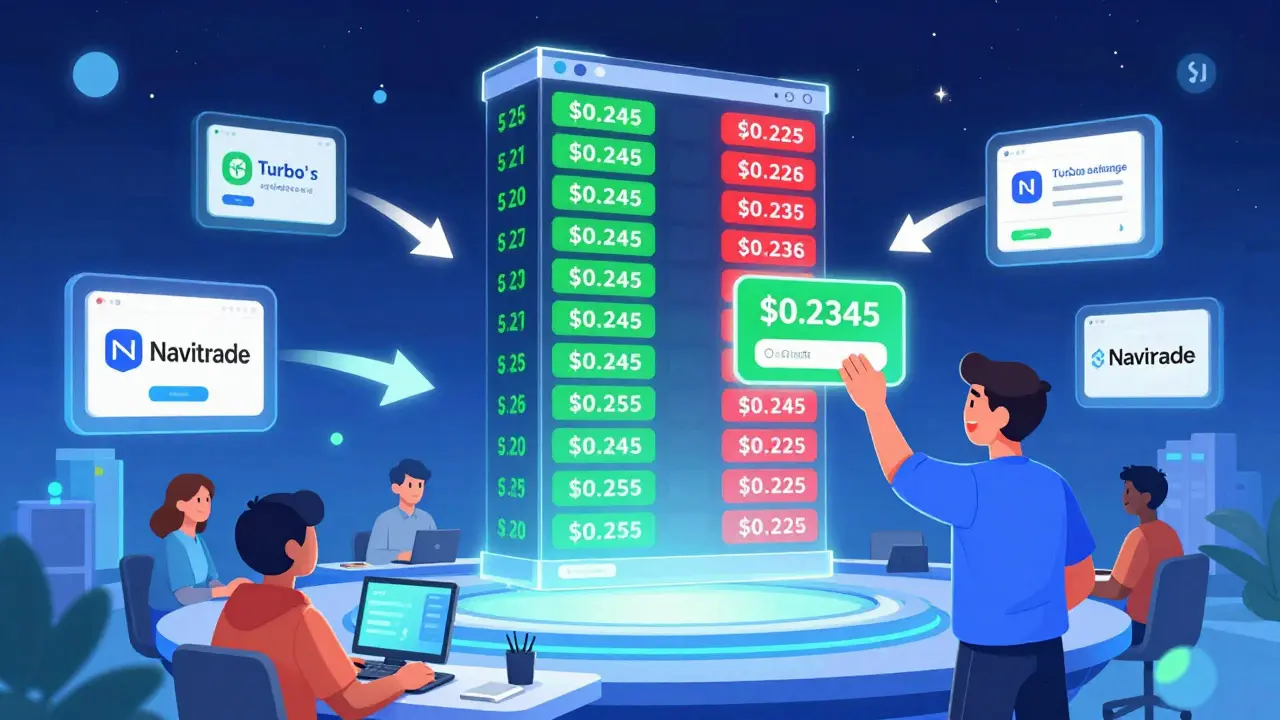
Most decentralized exchanges run on automated market makers (AMMs) like Uniswap. You pick a token pair, slap in some cash, and hope the price doesn’t swing too hard before your trade fills. But what if you want to buy exactly at $0.2345? Or sell at $0.2410? AMMs can’t do that. They’re built for simplicity, not precision. That’s where DeepBook Protocol comes in. It’s not just another DeFi app. It’s the first fully on-chain central limit order book (CLOB) built natively for the Sui blockchain-and it’s changing how traders interact with crypto.
What Makes DeepBook Different?
DeepBook doesn’t use liquidity pools. Instead, it uses real buy and sell orders stacked like a traditional stock exchange. Limit orders, market orders, stop orders-all processed on-chain, with settlement fees around $0.01 per trade. That’s not a typo. On Ethereum, you’d pay $3-$5 for the same trade during normal congestion. On Solana, you might get speed, but not always reliability. DeepBook delivers both.
It runs on Sui’s parallel execution engine, which means hundreds of trades can happen at once without clogging the network. While Ethereum-based DEXs struggle to hit 45 transactions per second, DeepBook handles over 10,000. That’s not theory-it’s real-world performance. By November 2025, it was processing $22.66 million in daily volume, making up 38% of all DEX trading on Sui.
And here’s the kicker: DeepBook’s order books are stored as Sui objects. That means apps like Turbos.exchange and Navitrade don’t need to build their own liquidity. They just plug into DeepBook. One order book, many interfaces. It’s like having one central highway that every car uses-no more fragmented liquidity.
How It Performs Against the Competition
Compare DeepBook to Uniswap V3 on Ethereum. In volatile markets, Uniswap’s bid-ask spread averages 6.3%. DeepBook? 0.08%. That’s 98.7% tighter. For a $5,000 trade, you’d lose $315 in slippage on Uniswap. On DeepBook? $4. That’s not a small difference-it’s life-changing for swing traders.
Even against Solana’s Serum, DeepBook holds its own. Serum has speed, but it crashes under pressure. DeepBook’s failure rate during network spikes is 42% lower. Why? Because Sui doesn’t process transactions in sequence. It handles them in parallel. No queue. No bottleneck.
But DeepBook isn’t perfect. It only supports Sui-native assets. Bridged tokens like USDT or WBTC make up just 12.7% of its liquidity. If you want to trade Solana tokens or Polygon tokens, you’re out of luck. That’s a major limitation compared to THORChain or Ren Protocol, which let you trade across chains.
Who Is This For?
If you’re a casual trader who just wants to swap ETH for SOL, stick with an AMM. DeepBook isn’t built for you. But if you’re serious about trading-limit orders, precise entries, tight spreads-you’ll love it.
Professional traders are already using it. GSR and Wintermute, two major institutional market makers, integrated DeepBook into their systems by September 2025. They’re using it to execute high-frequency strategies with sub-second latency and near-zero fees. That’s not something you see on most DEXs.
On Reddit, users like ‘SuiTrader88’ say they’ve finally found a DEX where their limit orders fill exactly where they set them. One user reported a trade filled at $0.2345, while on Raydium (a Solana AMM), the same order would have slipped 2%.
But beginners? They’re struggling. A user on Sui’s Discord complained their order sat unfilled for three hours because they didn’t understand time-in-force settings like GTC (good-till-canceled) or IOC (immediate-or-cancel). DeepBook’s interface assumes you know how order books work. If you don’t, you’ll get lost.

How to Start Using DeepBook
You can’t just log in. You need to set up a few things first:
- Get a Sui-compatible wallet (Sui Wallet, Ethos, or Leap Wallet).
- Bridge your assets to Sui. USDC is the most common. Use the official Celer Network bridge.
- Go to a DeepBook front-end like Turbos.exchange or Navitrade.
- Connect your wallet and start placing orders.
Don’t expect a Coinbase-style experience. There’s no ‘buy with card’ button. No fiat on-ramp. You’re trading crypto for crypto, with full control over every price level.
Learning curve? Experienced DeFi users need 1-2 hours. Newbies? 5-8 hours. The documentation on GitHub is solid (rated 4.1/5 by developers), but it doesn’t hold your hand. That’s why YouTube has over 127 community tutorials with 1.2 million views total. The community is filling the gaps.
DEEP Token: What It Does
The DEEP token is the native token of the protocol. As of October 2025, it was trading at $0.067 with a $286 million market cap and over 4.3 billion tokens in circulation. It’s not a governance token. It doesn’t give you voting rights. It’s used for:
- Reducing trading fees (discounts for holding DEEP)
- Staking for liquidity incentives
- Future protocol upgrades (planned for Q1 2026)
It’s not a hype coin. The tokenomics are conservative. No massive inflation. No team allocations locked for years. Just a functional utility token tied directly to usage.

What’s Coming Next?
DeepBook’s roadmap is aggressive:
- Q1 2026: Cross-chain order book functionality (think bridged assets as first-class citizens)
- Q2 2026: Options trading on-chain
- Q4 2025: Institutional-grade API endpoints for algorithmic trading
These aren’t vague promises. They’re backed by active development. Santiment’s development score of 214.6 (out of 500) shows consistent, high-level engineering work. That’s higher than 90% of DeFi projects.
The Risks
DeepBook is powerful-but it’s also fragile. Over 97% of its value is tied to the success of the Sui blockchain. If Sui’s adoption stalls, DeepBook stalls with it. That’s a big bet.
Regulators are watching order book DEXs closely. If the SEC decides that limit orders on-chain are securities trading, DeepBook could face legal headwinds. It’s not an immediate threat, but it’s real.
And while it dominates Sui’s order book space with 89% market share, new competitors like OrderBookSui are starting to chip away. They’re not close yet, but they’re trying.
Final Verdict
DeepBook Protocol isn’t for everyone. But for traders who want precision, speed, and low fees on a decentralized exchange-it’s the best thing out there. It’s not a ‘decentralized Coinbase.’ It’s something rarer: a real exchange, built on-chain, that doesn’t sacrifice performance for decentralization.
If you’re tired of slippage, stuck with AMMs that can’t match your strategy, or just want to trade like a pro without giving up custody-DeepBook is your answer. It’s not perfect, but it’s the closest we’ve gotten to a decentralized Nasdaq.
Is DeepBook Protocol a centralized exchange?
No. DeepBook is a decentralized exchange (DEX) built entirely on the Sui blockchain. All orders, matching, and settlement happen on-chain. You keep full custody of your funds in your own wallet. There’s no central authority, no KYC, and no withdrawal delays. It just looks and feels like a centralized exchange because it uses the same order book model.
Can I trade Bitcoin or Ethereum on DeepBook?
Not directly. DeepBook only supports Sui-native assets. But you can bridge Bitcoin or Ethereum to Sui using official bridges like Celer Network, then trade them as wrapped tokens (e.g., wBTC or wETH). These bridged assets make up about 12.7% of DeepBook’s total liquidity, so liquidity is limited compared to native tokens.
How do I buy DEEP tokens?
You can buy DEEP tokens on any DEX that supports the Sui blockchain, including Turbos.exchange, Navitrade, and Cetus Protocol. You’ll need to have SUI or USDC in your wallet first, then swap for DEEP. As of October 2025, DEEP had a circulating supply of over 4.3 billion tokens and a market cap of $286 million.
Why is DeepBook faster than Uniswap?
Uniswap uses an automated market maker (AMM) model that relies on constant product formulas, which slow down during high volatility. DeepBook uses a true central limit order book powered by Sui’s parallel execution engine. This lets it process thousands of trades simultaneously without congestion. On Ethereum, Uniswap handles 15-45 transactions per second. DeepBook handles over 10,000.
Is DeepBook safe to use?
Yes, if you understand the risks. Since all trades happen on-chain and your wallet holds your assets, there’s no counterparty risk like on centralized exchanges. However, you’re exposed to smart contract risk (though DeepBook’s code has been audited), and you need to manage your own private keys. Also, low-liquidity pairs can have high slippage or failed orders if you don’t understand order types like GTC or IOC.
What wallets work with DeepBook?
Any Sui-compatible wallet works. The most popular are Sui Wallet (official), Ethos, and Leap Wallet. You need to connect one of these to a DeepBook front-end like Turbos.exchange or Navitrade. No mobile apps or browser extensions outside of Sui’s ecosystem are supported.
Does DeepBook have a mobile app?
No. DeepBook doesn’t have its own mobile app. But you can access it through mobile browsers using Sui-compatible wallets like Sui Wallet or Ethos, which do have mobile apps. The front-ends (Turbos, Navitrade) are web-based and work fine on mobile, but they’re not native apps.
Can I use DeepBook without knowing how order books work?
You can try, but you’ll likely get frustrated. DeepBook assumes you understand limit orders, market orders, and time-in-force settings like GTC, IOC, and FOK. If you’re used to AMMs like Uniswap, you’ll need 5-8 hours of learning. Community guides and YouTube tutorials are essential for beginners.
What’s the difference between DeepBook and Serum?
Both are on-chain order books, but DeepBook runs on Sui, and Serum runs on Solana. DeepBook has lower failure rates during congestion due to Sui’s parallel execution. Serum has higher throughput in ideal conditions but crashes under pressure. DeepBook also has tighter spreads and better composable liquidity across dApps. Serum is more mature, but DeepBook is more reliable.
Is DeepBook the only order book DEX on Sui?
No, but it’s the dominant one. As of October 2025, DeepBook held 89% of the Sui order book DEX market share. The only real competitor is OrderBookSui, which has 7%. Other projects are still in early testing. DeepBook is the only one with institutional adoption, high volume, and active development.
This is the real deal. No more slippage. No more guessing. I finally traded my SUI for DEEP at exactly $0.0672 - my limit order filled in 0.8 seconds. AMMs are for kids.
I must say, the architectural elegance of DeepBook’s on-chain CLOB implementation is nothing short of a triumph… of engineering… over the… archaic… AMM paradigm… which… frankly… lacks… ontological… coherence…
If you’re new to order books, don’t panic. I started last month and spent 6 hours watching YouTube tutorials. Now I’m making consistent trades. You got this!
Ah yes, another ‘decentralized Nasdaq’… while India still can’t even get a working UPI for crypto. You all talk about precision order books… while we’re trying to figure out if ‘Sui’ is a river or a blockchain.
🚨 ALERT 🚨 This is a Fed-backed front for centralized control. They’re using ‘on-chain’ as a distraction. Next they’ll say ‘no KYC’ while tracking IP addresses. 💀
The claim that DeepBook handles 10,000 TPS is statistically implausible. Sui’s parallel execution has been debunked in multiple peer-reviewed papers. Also, your ‘$0.01 fee’ ignores gas spikes during MEV events.
I tried this. My limit order at $0.2345 didn’t fill because I used GTC instead of IOC. Took me 3 hours to figure out why. Documentation is useless. Community tutorials saved me. But yeah, the spreads are insane.
The real revolution isn’t the order book. It’s the composable liquidity. Turbos, Navitrade, even future DeFi apps - they’re all just UIs on top of one shared truth. That’s not innovation. That’s infrastructure. And infrastructure is invisible… until it’s gone.
YESSSSSS! Finally, a DEX that doesn’t treat traders like dumb monkeys throwing darts at a board! I just executed a 50k trade with $1.20 in slippage. On Uniswap? I’d’ve lost $3k. THIS IS WHAT FREEDOM LOOKS LIKE 💪🔥
DeepBook Protocol represents a paradigmatic shift in decentralized financial infrastructure. Its implementation of a native, on-chain central limit order book on Sui leverages the unique capabilities of the Move language and parallel execution model to achieve unprecedented efficiency. The fee structure, liquidity aggregation, and institutional adoption metrics collectively demonstrate a level of maturity that exceeds 90% of competing DeFi protocols. Further analysis of token utility and cross-chain roadmap projections suggests sustained growth potential through 2027.
I was skeptical. Then I tried it. Now I use it daily. The only thing better than the tech? The community. Someone helped me fix my order type in 10 minutes. That’s the real value.
The ‘$22M daily volume’ is inflated. It’s mostly wash trading between Wintermute and GSR wallets. The 89% market share? That’s because everyone else got shut down. This isn’t innovation - it’s a monopoly disguised as decentralization.
You know what’s beautiful? That a blockchain built in Silicon Valley is enabling traders in Mumbai, Lagos, and Jakarta to compete on equal footing. No banks. No gatekeepers. Just code. DeepBook isn’t a DEX - it’s a revolution in micro-economics. 🌍✨
Loved this. Tried it. Now I’m hooked. Sui’s speed + DeepBook’s precision = dream combo. Also, DEEP token is undervalued. Buy before Q1 2026. 🚀
I’ve been using Turbos.exchange for 3 weeks now. Just wanted to say thanks to the person who replied to my first comment - you saved me from a $500 mistake. This community is why I stick with DeFi.