
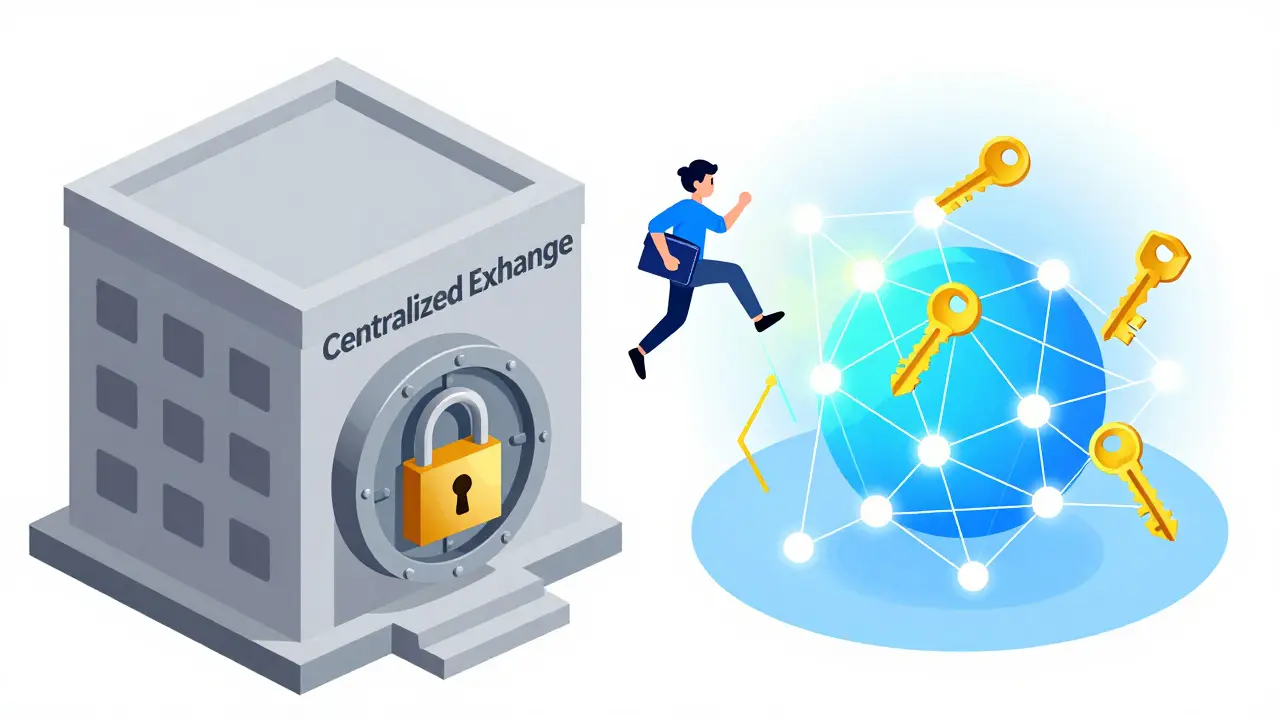
If you're living in Iran and trying to move your digital assets, you've probably realized that the "easy" way-using a big centralized exchange-is becoming a minefield. Between the Central Bank of Iran (CBI) demanding total data transparency and the constant threat of funds being frozen by global issuers, the risk of keeping money in a custodial account is higher than ever. This is why more people are shifting toward DEX access Iran as a way to keep control of their private keys and avoid the "kill switch" of a centralized entity.
The Breaking Point for Centralized Exchanges
For years, platforms like Nobitex were the go-to. But the landscape shifted violently in 2025. First, the massive security breach in June that saw over $90 million vanish. Then, the July hammer blow: Tether froze 42 Iranian-linked addresses in one of its largest enforcement actions. If your funds were sitting in a centralized wallet that Tether or the U.S. Treasury could flag, they simply vanished.
When a company like Tether freezes a centralized account, you have zero recourse. You aren't just fighting a company; you're fighting international sanctions laws. This has pushed a massive wave of users toward non-custodial solutions where no single entity can click a button and lock you out of your life savings.
Why DEXs Are the Logical Pivot
A Decentralized Exchange (DEX) is a peer-to-peer marketplace where trades happen via smart contracts. Unlike a centralized exchange (CEX), a DEX doesn't hold your funds in their own pockets. You connect your own wallet, swap your tokens, and disconnect. There is no "account" to freeze because there is no central authority managing the ledger.
For an Iranian citizen, the primary value of a DEX is the removal of the intermediary. If you use a DEX, you don't need to provide a passport or a utility bill to a company that might be forced to hand that data over to the Central Bank of Iran. As long as you have a connection to the blockchain, you have access to the market.
The Polygon-DAI Migration: A Case Study in Survival
One of the most fascinating moves happened in late 2025. After the Tether freezes, Iranian users didn't just quit crypto; they migrated. There was a coordinated shift away from USDT (which is centrally controlled) toward DAI, specifically on the Polygon network.
Why this specific combination? Polygon offers incredibly low transaction fees compared to Ethereum, making it viable for retail users. DAI, while still having some centralized components, is often seen as a more resilient alternative when specific USDT addresses are being targeted. By swapping into DAI on a DEX, users effectively "laundered" their risk away from a single point of failure. This move proved that the community knows how to pivot quickly when the regulatory heat turns up.
| Feature | Centralized (CEX) | Decentralized (DEX) |
|---|---|---|
| Fund Control | Exchange holds the keys | You hold the private keys |
| KYC Requirements | Strict / Government linked | Generally none (Wallet-based) |
| Freeze Risk | High (via Issuer/Exchange) | Low (Smart contract based) |
| CBI Visibility | High (Direct data access) | Low (On-chain pseudonymity) |
Practical Steps to Accessing DEXs from Iran
Getting into a DEX isn't as simple as downloading an app from the local app store. You need a specific stack of tools to remain invisible and secure.
- Secure Your Connection: A high-quality VPN is non-negotiable. The CBI monitors traffic patterns, and many DEX front-ends (the websites you use to interact with the blockchain) are blocked at the ISP level.
- Set Up a Non-Custodial Wallet: Download a wallet like MetaMask or Trust Wallet. This is where your private keys live. Never, under any circumstances, share your seed phrase.
- Choose Your Network: While Ethereum is the gold standard, the fees are often too high for smaller trades. Polygon, BNB Smart Chain, and Solana are the preferred "fast lanes" for Iranian users due to cost.
- Sourcing Initial Assets: This is the hardest part. Most users buy crypto via a local P2P (Peer-to-Peer) dealer or a domestic exchange like Nobitex, then immediately move those assets to their private wallet to strip away the CEX link.
- Interacting with the DEX: Connect your wallet to a platform like Uniswap or PancakeSwap. Swap your assets for stablecoins like DAI or other liquid assets.
Navigating the Legal and Tax Minefield
It's not all smooth sailing. In August 2025, Iran introduced the Law on Taxation of Speculation and Profiteering. This means the government now views crypto gains similarly to gold or real estate. While a DEX makes it harder for the CBI to see your every move, the "on-ramps" and "off-ramps" (where you turn crypto back into Rials) are where you are most vulnerable to tax audits.
The CBI also prohibits using foreign-mined coins for domestic transactions. While this is mostly targeted at businesses, it creates a grey area for individuals. The reality is that most users ignore this, relying on the sheer volume of transactions to stay under the radar, but the legal risk is shifting from "is this allowed?" to "how much will I be taxed?"
Avoiding Common Pitfalls
When you move to a DEX, you become your own bank. That sounds great until you realize there is no "forgot password" button. If you lose your keys, your money is gone forever. Furthermore, be wary of "fake" DEXs. Scammers often create phishing sites that look exactly like Uniswap to steal your seed phrase. Always double-check the URL and never sign a transaction that asks for permissions to "spend all your tokens."
Another risk is the "Tether Trap." Even on a DEX, if you hold USDT, the issuer (Tether) can still freeze that specific token if they identify the address. This is why the move to DAI or other algorithmic/decentralized stables is so critical for those in high-risk jurisdictions.
Can the Iranian government track my DEX trades?
While they can't "stop" a smart contract, they can track the blockchain. If your DEX wallet is linked to a centralized account (like Nobitex) that has your ID, the CBI can use blockchain analysis tools to link your anonymous wallet to your real identity. Using a VPN and avoiding direct transfers from CEXs to your primary DEX wallet helps mitigate this.
Is DAI safer than USDT for Iranians?
Generally, yes. Because Tether (USDT) has shown a willingness to freeze funds based on sanctions lists, DAI is often viewed as a more neutral alternative. Especially on the Polygon network, it provides a faster and cheaper way to maintain a stable value without the same level of centralized freeze-risk associated with USDT.
Do I need a license to use a DEX in Iran?
Technically, the CBI wants all crypto participants to be licensed. However, since DEXs are decentralized protocols with no one to apply for a license from, this is practically impossible to enforce for individual users. The main risk is not the "use" of the DEX, but the taxation of the profits under the 2025 speculation laws.
What happens if my funds are frozen on a CEX?
If a company like Tether or a CEX freezes your funds, you usually have very little power to get them back, especially if they are frozen due to international sanctions (OFAC). This is the primary reason why moving assets to a non-custodial wallet and using a DEX is the only way to ensure you maintain absolute control over your funds.
Why use Polygon instead of Ethereum for DEX trading?
Cost and speed. Ethereum gas fees can sometimes cost more than the trade itself for retail users. Polygon offers a compatible environment with near-zero fees, making it the primary choice for Iranian users moving assets into DAI or other stablecoins.
Next Steps and Troubleshooting
For the Beginner: Start by setting up a MetaMask wallet and learning how to use a VPN. Don't move large sums of money until you've done a few small "test transactions" to ensure you understand how the network addresses work.
For the Experienced Trader: Diversify your stablecoin holdings. Don't keep everything in one token. Splitting assets between DAI, USDC (though still centralized), and potentially decentralized wrappers can prevent a single enforcement action from wiping out your liquid capital.
Troubleshooting Connection Issues: If a DEX website isn't loading even with a VPN, try clearing your browser cache or switching VPN protocols (e.g., from OpenVPN to WireGuard). Some Iranian ISPs use Deep Packet Inspection (DPI) to find and block VPN tunnels.
Really glad to see people finding ways to keep their assets safe. It's all about staying adaptable.
Financial autonomy is basically the modern version of freedom. If you don't own your keys, you're just renting your money from a corporation that doesn't like you. It's kind of poetic how the tech designed for decentralization is the only thing actually working here.
Oh sure, because swapping from one centralized stablecoin to another 'decentralized' one that still has centralized collateral is definitely the foolproof plan here. Good luck with that.
The absolute sheer audacity of thinking a VPN will protect you from state-level Deep Packet Inspection is honestly comical. It is a tragedy that people actually believe this simplistic guide will save their life savings from a government that manages the actual internet cables.
Tether did the right thing by freezing those accounts because these people are probably funding thing's that we dont even want to talk about!! Why are we helping them bypass sanctions that the US government put in place for a la reason?? Its absolutey ridiculous that we provide these guides to help them hide money from the law!!
The CBI isn't just monitoring traffic, they're probably using AI to map out wallet clusters before the funds even hit a DEX. Its all a trap to get everyone on one chain so they can freeze everything at once in a single sweep. Just my theory but its too perfect.
Absolutely brilliant pivot! The community's ability to dance around these restrictions with such agility is nothing short of legendary. We need more of this kind of bold, boundary-pushing energy in the crypto space to truly break the old chains!
If you're moving a significant amount, please consider using a hardware wallet like Ledger or Trezor instead of just MetaMask. A browser extension is a massive single point of failure if your computer gets compromised. The risk of a phishing site is high, so double-check every single URL before signing any transaction. Stay safe and keep your seed phrases offline on physical paper or metal.
Whatever. Still feels like a lot of effort for pennies.
This is the real heart of crypto! 🚀 Using tech to bypass unfair systems and empower the individual is exactly why this all started. It's a wild ride but so worth it for the freedom it brings!
I think it's really important to highlight that while DAI is better, the most robust path is actually diversifying across several different assets. You could look into things like LUSD which is more truly decentralized and doesn't rely on the same collateral types as DAI. It takes more time to manage, but when you're dealing with sanctions, a little extra work is a small price to pay for the peace of mind knowing that no single entity can wipe you out. Keep pushing forward and keep learning!
The irony is that while these people struggle with sanctions, the real innovation is happening elsewhere. But hey, if you want to play hide-and-seek with your government using a DEX, go right ahead. I've already mastered these protocols years ago.
One must ponder the ethical implications of escaping state oversight through algorithmic means. 🧘 Is it a liberation of the spirit or merely a shift in the nature of our bondage to the machine? Truly a fascinating dilemma. ✨
The slippage on these low-liquidity pairs can be brutal. If you're doing high-volume swaps, you'll want to aggregate your trades across multiple DEXs to avoid getting wrecked by the MEV bots.
Just a heads up that the VPNs are probably all backdoored anyway. They want you to think you're safe so you'll move more money into the system where they can track it. It's a honey pot, plain and simple.
This is just basic survival at this point. People who still trust CEXs in high-risk zones are just asking to get liquidated by the government.
The absolute horror of losing a seed phrase is enough to give me a panic attack just thinking about it! Imagine your entire life's work vanishing because you misplaced a piece of paper! The drama of this industry is honestly exhausting!
It's so inspiring to see people helping each other out in such tough situations. We're all just global citizens trying to find a way to make things work. If anyone is feeling overwhelmed, just take it one step at a time and don't be afraid to reach out for help in the community forums. We've all been beginners once!
I mean, it's kind of funny that people think they're hacking the system when they're just using a website. But whatever, good for them for trying to be edgy with their money.
Wait, you guys actually think the government doesn't have a direct line to the P2P dealers? That's cute.
Oh please, like DAI is some magical shield. The creators of these protocols always find a way to implement a blacklist when the US Treasury knocks on their door. It's just a slower fuse on the same bomb. Enjoy your 'decentralization' while it lasts.
Keep grinding everyone! 💎 Just remember to double-verify those contract addresses so you don't get scammed by a fake token! 🛡️ Stay strong and keep those keys safe! 🚀
Its so sad that peopel have to go through all this just to save their money. Hope everything works out for them in the end.
The sheer catastrophie of the Nobitex breach was just the tip of the iceburg!! People are still treating this like a hobby when it's a literal war for financial survival! My god, the incompetence is staggering!
Imagine thinking Polygon is the 'fast lane' when you're basically just trading one set of risks for another. The desperation is palpable, yet the execution is so predictably mid. Truly pathetic.