
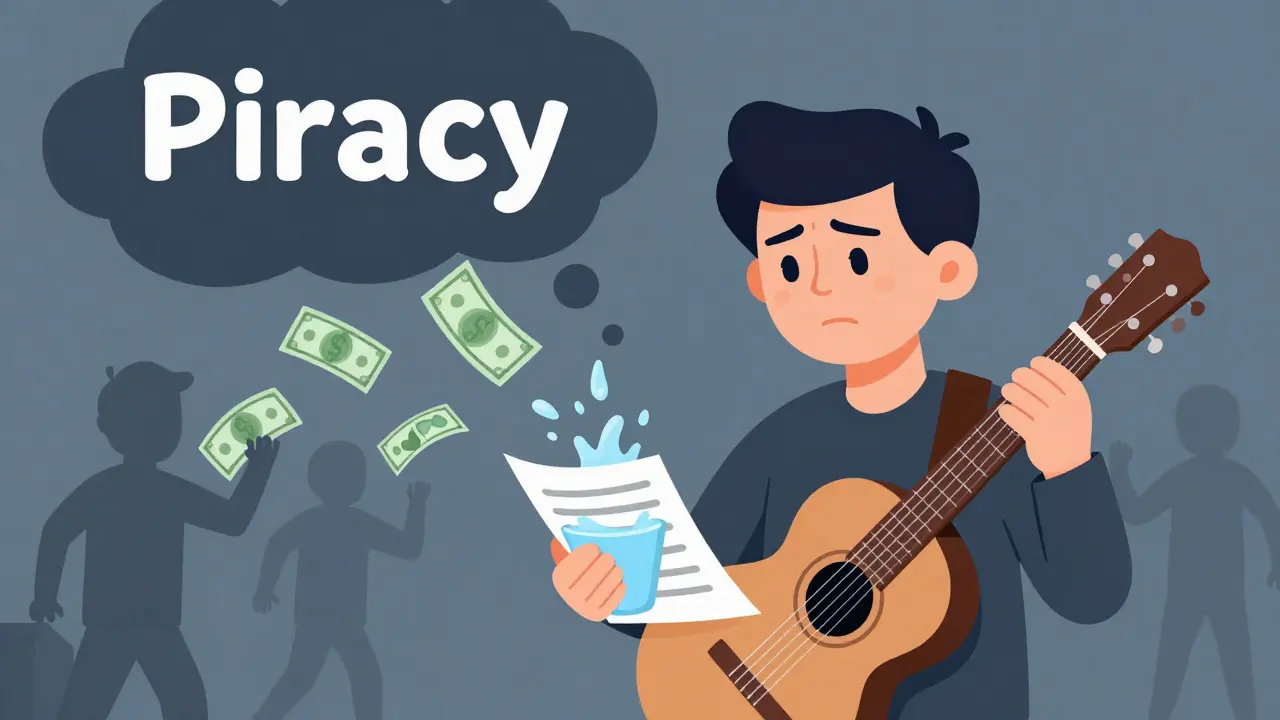
Imagine spending months writing a song, only to have it stolen and sold by someone else before you even hit publish. For decades, this has been the nightmare of digital creators. Traditional Digital Rights Management (systems designed to control access to copyrighted material) (DRM) was supposed to stop this, but it often feels like trying to hold water in your hands. It’s restrictive, prone to hacks, and leaves creators fighting for their fair share of royalties.
Enter blockchain technology. This isn't just about cryptocurrency anymore. By using a decentralized, unchangeable ledger, blockchain offers a way to prove who owns what, when they created it, and how much money it made. It turns the chaotic world of digital piracy into a transparent system where every stream, download, or view is recorded permanently. If you are tired of opaque royalty statements and broken security, understanding how blockchain changes the game for rights management is essential.
How Blockchain Fixes Broken Copyright Systems
The core problem with traditional DRM is centralization. When Apple’s FairPlay or Google’s Widevine manages your rights, they sit on servers controlled by one company. If that server gets hacked-or if the company decides to change the rules-you lose control. Between 2018 and 2022, these centralized systems suffered 14 major security breaches. That is a lot of vulnerable data.
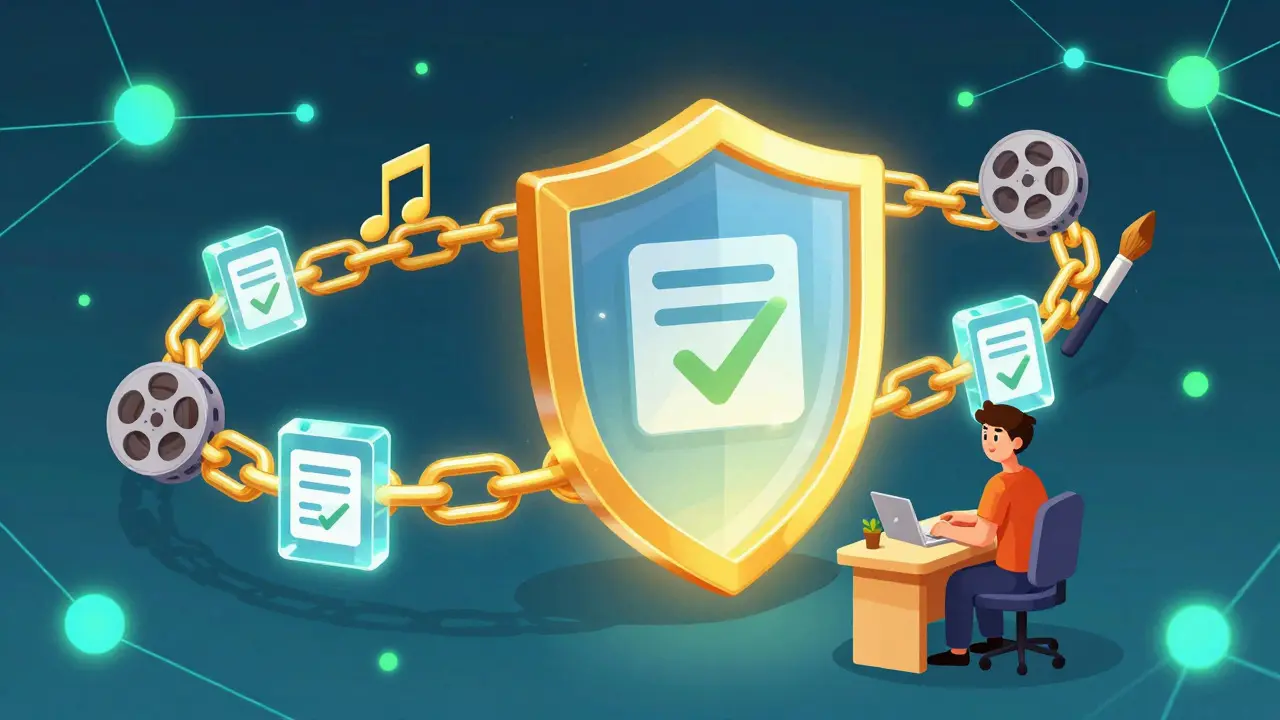
Blockchain (a distributed ledger technology that records transactions across many computers so that the record cannot be altered retroactively) solves this by removing the middleman. Instead of one company holding the keys, the ownership record is spread across a network. Once data is written to the chain, it cannot be deleted or changed without everyone noticing. This immutability creates an irrefutable chain of custody. Dr. Jane Smith from MIT Media Lab noted that this timestamping fundamentally changes copyright enforcement by reducing dispute resolution time by up to 92% in pilot programs.
Think of it like a public notary that never sleeps and can’t be bribed. Every time your content is used, the blockchain records it. This transparency eliminates the ambiguity that currently plagues the music and film industries, where creators often don’t know who is using their work or how much they owe.
The Role of Smart Contracts in Royalties
The real magic happens with Smart Contracts (self-executing contracts with the terms of the agreement directly written into code). In the old system, collecting royalties was a bureaucratic mess. You’d wait six months for a statement, and half the time, the numbers didn’t add up. According to IBM, 43% of content creators experience revenue loss because rights tracking is inadequate.
Smart contracts automate this process. When a user pays to stream your song or license your photo, the contract executes instantly. The money goes straight to your wallet, minus any agreed-upon fees. No waiting for quarterly reports. No lost paperwork. Ujo Music, a platform built on Ethereum, demonstrated this by cutting royalty processing time from six months down to just seven days for independent musicians.
This automation also handles complex splits. If a song has three writers and two producers, the smart contract knows exactly what percentage each person gets and distributes the funds simultaneously. This level of precision is impossible with manual accounting.
Performance and Cost: Blockchain vs. Traditional DRM
You might wonder if this new tech is too expensive or slow. Let’s look at the numbers. Traditional DRM systems require an initial setup cost of $250,000 to $500,000, plus annual maintenance fees of 15-20%. In contrast, implementing blockchain-based DRM averages $180,000 to $350,000 upfront, with lower ongoing maintenance costs of 8-12% because there are fewer intermediaries to pay.
| Feature | Traditional DRM (e.g., FairPlay) | Blockchain DRM |
|---|---|---|
| Initial Setup Cost | $250,000 - $500,000 | $180,000 - $350,000 |
| Annual Maintenance | 15-20% of value | 8-12% of value |
| Transaction Speed | 24-72 hours for processing | 2-5 seconds per transaction |
| Security Model | Centralized (single point of failure) | Decentralized (distributed ledger) |
| Royalty Transparency | Opaque, delayed statements | Real-time, visible ledger |
Speed is another huge factor. While traditional systems take days to process rights transactions, enterprise blockchain platforms like Hyperledger Fabric (an open-source framework for building distributed application solutions) can handle 1,500 to 2,000 transactions per second. This means millions of streams can be tracked and paid out almost instantly.
Challenges You Need to Know
It’s not all perfect. There are real hurdles to adopting blockchain DRM. First, there’s the issue of scalability on public chains. Ethereum, for example, historically struggled with high gas fees during peak times. One producer reported losing 22% of his micro-transaction revenue to network congestion fees. However, newer networks like Polygon (a protocol and framework for building and connecting Ethereum-compatible blockchain networks) offer near-zero fees and faster speeds, solving much of this problem.
Second, user adoption is still low. Only 22% of consumers are familiar with blockchain-based rights management compared to 89% who know traditional DRM. This means creators still need to educate their audience on why they should buy directly through these secure channels rather than pirating.
Finally, there’s the legal gap. Professor Alan Grant from Stanford Law points out that while blockchain solves verification, it doesn’t solve enforcement. Having proof on the chain is great, but if someone steals your work, you still need to go to court to make them stop. The EU’s Digital Services Act now recognizes blockchain records as valid evidence, which helps, but the U.S. Copyright Office still requires formal registration for full legal protection.
Who Is Winning With Blockchain DRM?
Early adopters are seeing real results. Independent musician Sarah Johnson shared on Reddit that using the blockchain platform Audius increased her royalty payments by 37% and cut her admin time by 80%. She finally sees exactly where her streams come from without waiting for monthly statements.
On a larger scale, the Norwegian Grammy Awards implemented blockchain DRM in 2022. The result? Royalty distribution errors dropped from 12% to just 0.3%, and payment times fell from nine months to 14 days. These aren’t small improvements; they’re life-changing for artists who rely on timely income.
However, failures exist. Startup RightsChain collapsed in 2021 after its system failed to integrate with major streaming platforms, costing investors $4.2 million. This highlights a critical lesson: interoperability is key. Your blockchain solution must talk to the existing tools creators already use, like Adobe Creative Cloud or Apple FairPlay.

Getting Started: Practical Steps for Creators
If you want to protect your work with blockchain, here is how to approach it:
- Choose the Right Platform: Don’t build from scratch. Use established protocols like Audius for music or Verisart for visual arts. They handle the heavy lifting of smart contract deployment.
- Understand Gas Fees: If using Ethereum, check network activity. Consider Layer-2 solutions like Polygon to keep transaction costs low, especially for micro-payments.
- Secure Your Keys: Blockchain relies on private keys. If you lose your key, you lose access to your assets. Use hardware wallets or reputable multi-signature authorization services.
- Integrate Gradually: Start by minting your most valuable assets as NFTs (Non-Fungible Tokens) to establish ownership records, then expand to automated licensing.
- Educate Your Audience: Explain to your fans why buying through your direct link supports you more fairly than streaming on centralized platforms.
Expect a learning curve. About 78% of creators need 20-40 hours of training to understand cryptographic keys and wallet management. But once set up, the system runs itself.
The Future of Digital Ownership
The market for blockchain DRM is exploding. Valued at $235 million in 2023, it is projected to reach $1.2 billion by 2027. Major players like Amazon are launching templates to reduce implementation time by 40%, making it easier for smaller creators to jump in.
We are moving toward a world where every piece of digital content carries its own history. From fact-checking news articles to verifying the authenticity of AI-generated images, blockchain provides the trust layer the internet has always lacked. While challenges like environmental impact (though reduced by 99.95% with Ethereum’s switch to Proof of Stake) and legal enforcement remain, the direction is clear. Decentralized rights management is no longer a niche experiment; it’s becoming the standard for serious creators.
Is blockchain DRM legally binding?
Blockchain records provide strong evidence of ownership and creation date, which is recognized in jurisdictions like the EU under the Digital Services Act. However, in places like the U.S., blockchain registration does not replace formal copyright registration with the Copyright Office for full legal enforcement against infringement.
How much does it cost to implement blockchain DRM?
For enterprises, initial implementation costs range from $180,000 to $350,000, with annual maintenance around 8-12%. For individual creators using existing platforms like Audius, the cost is primarily limited to small transaction fees (gas fees), which can be minimized by using efficient networks like Polygon.
Can blockchain prevent piracy completely?
No technology can completely stop piracy. However, blockchain makes it easier to track unauthorized use and automate penalties or claims. It solves the verification and payment problem, ensuring that when your work is used legitimately, you get paid instantly and accurately.
What is the difference between traditional DRM and blockchain DRM?
Traditional DRM relies on centralized servers controlled by companies like Apple or Microsoft, which can be hacked or censored. Blockchain DRM uses a decentralized ledger, meaning no single entity controls the records. It offers greater transparency, lower long-term costs, and instant, automated royalty distribution via smart contracts.
Which blockchain is best for DRM?
Ethereum is widely used but can have high fees. Polygon is popular for its speed and low costs. Hyperledger Fabric is preferred by large enterprises for its privacy and permissioned structure. The best choice depends on whether you prioritize public transparency (Ethereum/Polygon) or corporate privacy (Hyperledger).