
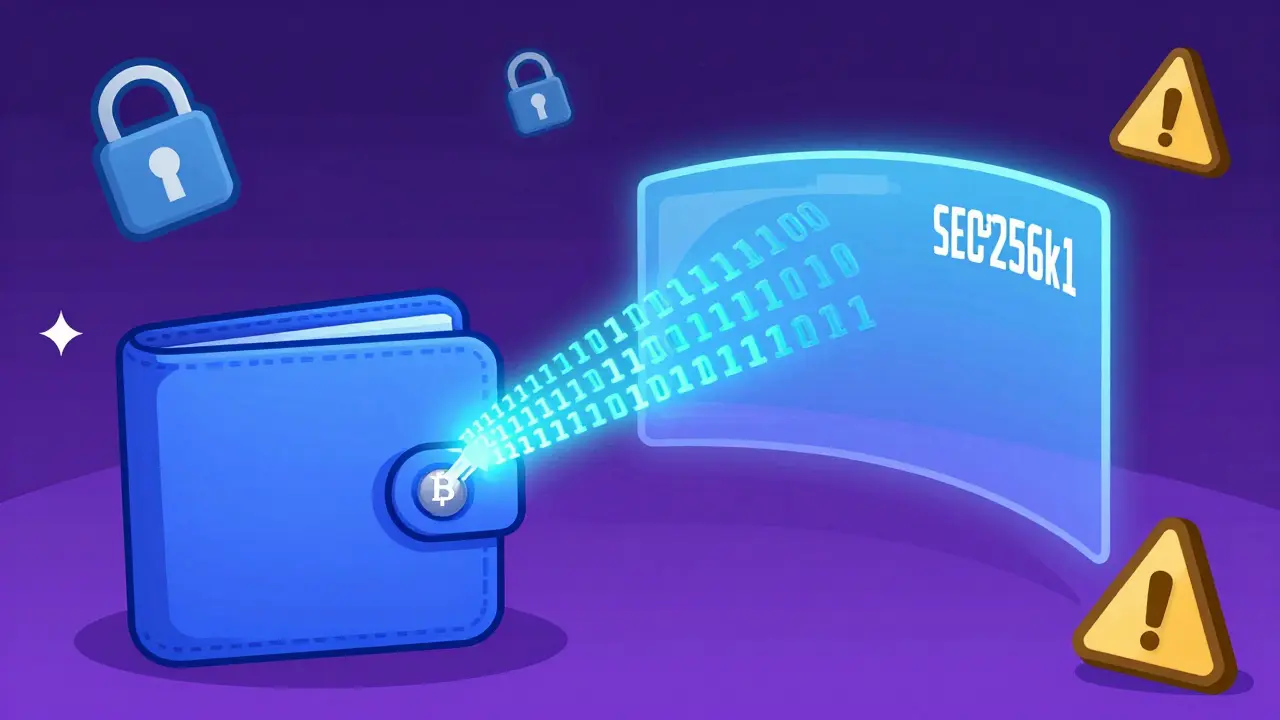
Every time you send Bitcoin or Ethereum, you’re not just clicking a button-you’re using advanced math to prove it’s really you. That math is called a digital signature algorithm. Without it, blockchains wouldn’t be secure. Anyone could fake a transaction. But these algorithms make sure only the real owner can spend their coins. And not all digital signatures are the same. Some are old but reliable. Others are faster, smaller, or more secure. Understanding which ones blockchains use-and why-helps you see how the whole system actually works.
ECDSA: The Backbone of Bitcoin and Ethereum
ECDSA, or Elliptic Curve Digital Signature Algorithm, is the most common digital signature used in blockchain today. It’s what Bitcoin uses. It’s what Ethereum uses. It’s what Binance Coin, Avalanche, and dozens of others rely on. Why? Because it’s been around since 1992, it’s well-tested, and it’s efficient.
ECDSA works by using something called elliptic curve cryptography. Instead of huge numbers like RSA, it uses points on a curved line defined by a math equation. The curve used in Bitcoin is called secp256k1. To sign a transaction, your wallet generates a private key-a random 256-bit number. From that, it calculates a public key using the curve. The signature is created by combining your private key, the transaction data, and a random number. Anyone can check that signature using your public key and confirm you own the coins, without ever seeing your private key.
The big win? Security with small keys. A 256-bit ECDSA key gives the same security as a 3072-bit RSA key. That means smaller transaction sizes, faster verification, and less storage needed on nodes. Bitcoin transactions would be way bigger and slower without it.
But ECDSA has a flaw: it needs a good random number every time you sign. If that random number is predictable-or reused-your private key can be stolen. There have been real-world hacks because of bad random number generators in wallets. That’s why some experts call ECDSA “battle-tested but fragile in implementation.”
EdDSA: The Secure Alternative
EdDSA was built to fix ECDSA’s weak spots. It stands for Edwards-curve Digital Signature Algorithm. Instead of the same elliptic curves, it uses twisted Edwards curves-specifically Curve25519. That’s the same curve Monero and Stellar use.
The biggest difference? EdDSA doesn’t need a random number generator at all. It creates signatures deterministically. That means the same message and private key always produce the same signature. No randomness = no chance of a bad RNG breaking your security. That’s why security researchers love it. It’s also faster at signing and verifying, and more resistant to side-channel attacks.
Monero uses EdDSA to protect its privacy features. Nano uses it for fast, feeless transactions. Stellar uses it to keep its network secure while scaling. But adoption is still limited. Most wallets, exchanges, and tools were built for ECDSA. Switching means rewriting software, testing everything again, and convincing users it’s safe. That’s hard when ECDSA has been working for over a decade.
EdDSA isn’t perfect-it’s newer, so it hasn’t been attacked as much as ECDSA. But that’s also a plus. Less exposure means fewer known exploits. For new blockchains, EdDSA is often the better starting point.
Schnorr Signatures: The Future of Aggregation
Schnorr signatures aren’t new-they were invented in 1989-but they’ve only recently become practical for blockchains. Bitcoin is planning to adopt them through a soft fork called Taproot. Why? Because Schnorr lets you combine multiple signatures into one.
Imagine a 5-of-10 multi-signature wallet. With ECDSA, you’d need 5 separate signatures in the transaction-each taking up space. With Schnorr, those 5 signatures can be merged into one. That cuts transaction size by up to 40%. Smaller transactions mean lower fees and faster block times. It also improves privacy. If you see a Schnorr signature, you can’t tell if it came from one person or ten.
Schnorr also fixes ECDSA’s signature malleability problem. In ECDSA, someone could tweak a signature slightly and still make it valid-messing up transaction IDs. Schnorr signatures are non-malleable. That’s critical for smart contracts and payment channels like the Lightning Network.
The catch? Schnorr requires a network upgrade. You can’t just swap it in. Bitcoin had to wait for years of research, testing, and consensus. Ethereum hasn’t adopted it yet. But for any blockchain looking to scale, Schnorr is the next logical step.
BLS Signatures: The Power of Batch Verification
BLS (Boneh-Lynn-Shacham) signatures are even more powerful than Schnorr. They use pairing-based cryptography-a more complex math system. That means they’re slower for single signatures, but they can verify thousands at once.
That’s why BLS is used in Ethereum 2.0 and other proof-of-stake chains. In Ethereum’s validator system, hundreds of validators sign off on each block. With BLS, all those signatures can be aggregated into one. The whole block can be verified with a single check. That saves massive amounts of processing power.
BLS signatures are also about 50% smaller than ECDSA. That helps with storage and bandwidth. But there’s a trade-off: BLS is computationally heavier for individual verification. It’s not ideal for simple payments. It’s designed for systems where you need to verify many signatures at once.
Some blockchains, like Algorand and Zcash, use BLS for consensus. But it’s not common in payment networks because of the complexity. It’s a tool for high-throughput systems, not everyday transactions.
How They Compare: Speed, Size, and Security
Here’s how these four algorithms stack up:
| Algorithm | Key Size | Signature Size | Signature Speed | Verification Speed | Batch Verification | Adoption |
|---|---|---|---|---|---|---|
| ECDSA | 256-bit | 70-72 bytes | Medium | Medium | No | Bitcoin, Ethereum, Binance, Avalanche |
| EdDSA | 256-bit | 64 bytes | Fast | Fast | Partial | Monero, Stellar, Nano |
| Schnorr | 256-bit | 64 bytes | Fast | Fast | Yes (aggregation) | Bitcoin (Taproot), future chains |
| BLS | 256-bit | 48 bytes | Slow | Very fast (batch) | Yes (full block aggregation) | Ethereum 2.0, Algorand, Zcash |
ECDSA is the default because it’s familiar. EdDSA is the safer choice for new projects. Schnorr is the upgrade path for Bitcoin-style chains. BLS is the backbone for proof-of-stake networks.
What’s Next? Post-Quantum Signatures
Right now, all these algorithms rely on math problems that classical computers struggle with. But quantum computers could break them. A powerful enough quantum machine could solve the elliptic curve discrete logarithm problem-meaning your private key could be cracked.
That’s why researchers are testing post-quantum signature algorithms like Dilithium, Falcon, and Rainbow. These are based on different math-lattices, hash functions, multivariate equations-that even quantum computers can’t easily solve. NIST is finalizing standards for these right now.
Some blockchain teams are already experimenting. But switching entire networks to post-quantum signatures won’t be easy. It requires updating every wallet, node, and exchange. It’s not a simple patch. It’s a full overhaul.
Most experts think we have 5-10 years before quantum threats become real. That gives time to plan. But the clock is ticking. The next big upgrade in blockchain security won’t be about speed or fees. It’ll be about surviving the quantum era.
Why This Matters to You
If you’re holding crypto, you’re relying on one of these algorithms to keep your money safe. If you’re building a blockchain project, choosing the right signature algorithm affects your security, scalability, and future-proofing.
ECDSA is fine for now. But if you’re starting fresh, consider EdDSA for better security. If you’re scaling a network, look at Schnorr or BLS. And if you’re thinking long-term, start researching post-quantum options.
Blockchain isn’t magic. It’s math. And the math behind digital signatures is what makes it all possible. Understanding it isn’t just for developers-it’s for anyone who wants to know how their money stays safe.
What is the most common digital signature algorithm in blockchain?
ECDSA (Elliptic Curve Digital Signature Algorithm) is the most common. It’s used by Bitcoin, Ethereum, Binance Coin, and most major cryptocurrencies. It’s been the standard since the early days of crypto because it’s efficient, secure, and widely supported.
Why is EdDSA considered more secure than ECDSA?
EdDSA eliminates the need for a random number generator during signing, which removes a major vulnerability in ECDSA. If ECDSA uses a weak or reused random number, attackers can steal private keys. EdDSA creates signatures deterministically, making it immune to this type of attack. It’s also faster and more resistant to side-channel attacks.
Can Schnorr signatures improve Bitcoin’s scalability?
Yes. Schnorr signatures allow multiple signatures to be combined into one, reducing transaction size and lowering fees. This is especially useful for multi-signature wallets and the Lightning Network. Bitcoin’s Taproot upgrade introduced Schnorr to make transactions more private and efficient.
Why does Ethereum 2.0 use BLS signatures?
Ethereum 2.0 uses BLS because it can aggregate thousands of validator signatures into a single signature. This makes block verification much faster and reduces the data stored on the network. BLS is ideal for proof-of-stake systems where many parties need to sign off on each block.
Are digital signatures in blockchain vulnerable to quantum computers?
Yes. Current algorithms like ECDSA, EdDSA, Schnorr, and BLS all rely on math problems that quantum computers could solve. Researchers are testing post-quantum alternatives like Dilithium and Falcon. A transition to quantum-resistant signatures will be needed in the next 5-10 years to keep blockchains secure.
What to Do Next
If you’re a user: don’t panic. Your coins are safe for now. Use wallets from reputable developers who update their software regularly.
If you’re a developer: test EdDSA for new projects. If you’re working on Bitcoin or Ethereum, study Schnorr and BLS implementations. Look at how Taproot and Ethereum 2.0 handle signature aggregation.
If you’re just curious: understand that every transaction you make is protected by math that’s older than your smartphone. And that math is still evolving. The next big leap in blockchain security won’t come from a new coin-it’ll come from a better signature.
lol so ECDSA is 'battle-tested but fragile'? wow. guess that's why my crypto got stolen last year when my wallet used a 'trusted' RNG. totally not my fault for using a sketchy desktop app. 🤡
They're all just government backdoors disguised as math. ECDSA? CIA. EdDSA? NSA. Schnorr? Pentagon R&D. BLS? Deep state consensus protocol. Quantum? Just the next phase. Wake up.
I love how this post breaks it down so clearly! 🙌 It’s so easy to feel overwhelmed by crypto tech, but seeing the trade-offs between speed, size, and security really helps. Everyone deserves to understand this - it’s not magic, it’s math we can all learn.
Also, shoutout to devs building with EdDSA - you’re doing God’s work.
The BLS aggregation efficiency is non-trivial for PoS. The pairing-based crypto introduces O(n) verification complexity for batched signatures, which reduces consensus overhead from O(n²) to O(n). This is why Ethereum 2.0’s beacon chain relies on it - it’s not just about size, it’s about asymptotic scalability.
Schnorr is the real MVP for Bitcoin. Taproot is the quiet revolution nobody talks about. 1 signature instead of 5? Yes please. Lower fees, better privacy, Lightning Network gets way smoother. Also, non-malleable = no more broken HTLCs. 🙏
I never realized how much randomness affects security until I read about ECDSA’s RNG flaw. That’s wild. Like leaving your house key under the mat but only if the wind doesn’t blow just right. EdDSA fixing that feels like finally getting a deadbolt
You people are all missing the point. This entire post is a distraction. The real vulnerability isn’t the algorithm - it’s the fact that you’re trusting a system built by people who can’t even write secure code for a login page. Your private key is stored on a device that runs Windows 11 with 17 unpatched CVEs. The math? Perfect. You? Not so much.
ECDSA is the OG. Everything else is just hipster crypto. You want to be safe? Use Bitcoin. You want to be cool? Use some new chain with EdDSA. I’m not impressed. And if you think BLS is the future, you’ve been reading too many Ethereum blogs. #BitcoinMaximalist
Schnorr is the upgrade everyone needed but didn’t ask for. ECDSA was fine until people started using bad wallets. Now we’re stuck with a band-aid solution that’s actually a whole new architecture. But hey, at least it’s not quantum yet.
It’s funny how we treat these algorithms like gods. We worship their efficiency, fear their flaws, and ignore that they’re just human inventions - elegant, yes, but still bound by the limits of our imagination. What if the next breakthrough isn’t a better curve, but a new way to think about ownership entirely?
Look, I get it - BLS is great for validators, Schnorr for scaling, EdDSA for security. But let’s be real: the only reason we’re even talking about this is because the government is scared of decentralized finance. They don’t want you to know you can own your money without them. That’s why they’re pushing quantum computing research - to break it all before we can adapt. This isn’t tech. It’s a power play.
BLS is so cool! The math behind pairing-based crypto is wild - like, elliptic curves dancing with finite fields in a way that makes my brain happy 😊. Ethereum 2.0 using it for validator aggregation? Chef’s kiss. Would fork again.
Your comparison table is misleading. You list 'Signature Speed' for BLS as 'Slow' but don’t clarify that it's slow for single sigs - which is irrelevant in its use case. You're conflating individual performance with system-level efficiency. This is why non-technical people misunderstand crypto. BLS isn't slow - it's optimized for a different problem.
Schnorr on Bitcoin = instant upgrade. No more bloated multisig txs. Lower fees. Better privacy. And we didn’t even need a hard fork. Just pure genius. 🚀 Bitcoin devs are the real MVPs. I’m so proud to be part of this community.
I used to think crypto was just gambling until I learned how these signatures work. Now every time I send BTC, I feel like I’m waving a tiny math flag that says 'I own this'. It’s beautiful. Like poetry written in numbers.
So you wrote a 2000-word essay on digital signatures... and still didn’t answer the real question: if I lose my private key, can I get my money back? No? Then why are we even talking about curves?