
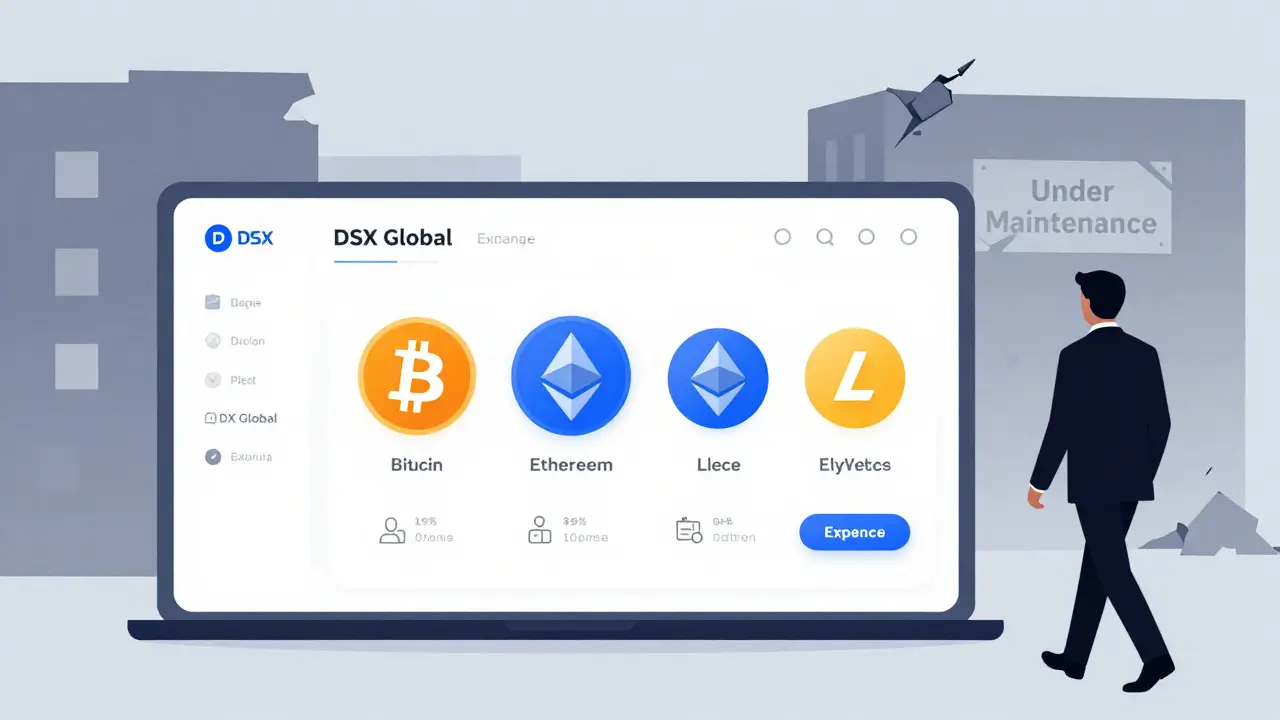
DSX was never a household name like Coinbase or Binance, but for a few years, it quietly served traders who wanted a clean, professional interface without the chaos of hundreds of altcoins. Founded in 2014 and based in London, DSX Global positioned itself as a no-nonsense exchange - focused on security, simplicity, and a few major cryptocurrencies. But by January 12, 2021, it was gone. No warning. No announcement. Just silence. Today, over four years later, DSX doesn’t just sit idle - it’s officially dead. And worse, it’s listed as a scam by Crypto Legal UK as recently as October 2025.
What Was DSX?
DSX is a now-defunct centralized cryptocurrency exchange that operated from 2014 to 2021, offering fiat-to-crypto trading, cold storage, and mobile apps for iOS and Android. Also known as DSX Global, it was headquartered at 24 Savile Row, London, and targeted both beginner and experienced traders with a minimalist design inspired by traditional financial markets.
Unlike exchanges that listed hundreds of tokens, DSX kept things tight - only 29 cryptocurrencies were available. This wasn’t a bug, it was a feature. The team believed that sticking to Bitcoin, Ethereum, Litecoin, and other well-established coins reduced risk and simplified compliance. For users who didn’t care about the latest meme coin, DSX felt like a breath of fresh air.
Fiat and Deposit Options
One of DSX’s strengths was its support for multiple fiat currencies. You could deposit and withdraw in EUR, GBP, USD, and even RUB - a rare move for a UK-based exchange at the time. This made it popular among Russian-speaking traders and those in Eastern Europe.
Initially, wire transfers were the only way to fund your account. But in February 2019, they added credit card deposits. That was a big deal. Suddenly, you could buy crypto in minutes without waiting for bank transfers. It showed DSX was trying to keep up with user expectations.
Mobile access came later that year. The iOS app launched on October 15, 2019, and Android was promised "in the near future." The app was clean, fast, and intuitive - a rarity among older exchanges. It felt like a product built by people who actually used crypto.
Security and Infrastructure
DSX took security seriously. All crypto holdings were stored in cold wallets. Two-factor authentication (2FA) was mandatory. Withdrawals required manual review - a slow process, but one that stopped hackers from draining accounts overnight.
Their website design was crisp, professional, and uncluttered. No flashy banners. No confusing charts. Just a clean trading interface with real-time price feeds and simple order books. It was built like a London trading floor - no nonsense, all function.
But here’s the problem: security doesn’t mean anything if the company goes bankrupt. DSX never secured FCA registration. They applied under the 5th Anti-Money Laundering Directive, but the process stalled. Without regulatory approval, they were operating in a legal gray zone. And when the market turned, they had no safety net.
Why DSX Failed
DSX didn’t die because of a hack. It died because it was outgunned.
While DSX was sticking to 29 coins, Binance was listing over 300. Coinbase was adding USDC, staking, and DeFi access. Kraken was rolling out margin trading and futures. DSX kept doing the same thing - no new features, no new coins, no innovation.
Trading fees were moderate, not bad, but not competitive. Customer support became slower as the company struggled. Users reported long delays in withdrawals, especially in the months before the shutdown.
Then came the 2021 bull market. Crypto prices soared. Exchanges with deep pockets and global reach exploded in volume. DSX had none of that. No venture funding. No marketing budget. No team expansion. Just a small group trying to run a professional exchange on a shoestring.
On January 12, 2021, they quietly filed for bankruptcy. No press release. No email to users. Just a blank website. And that’s when things got worse.
The Scam Listing and User Fallout
After DSX vanished, users tried to recover their funds. Some reached out to lawyers. Others posted on forums. But no one got their crypto back. No official recovery plan was ever published.
By 2025, Crypto Legal UK added DSX to its "List of Reported Scam Companies." The listing wasn’t based on rumors - it cited evidence of unresponsive customer service, frozen withdrawals, and lack of transparency during bankruptcy proceedings.
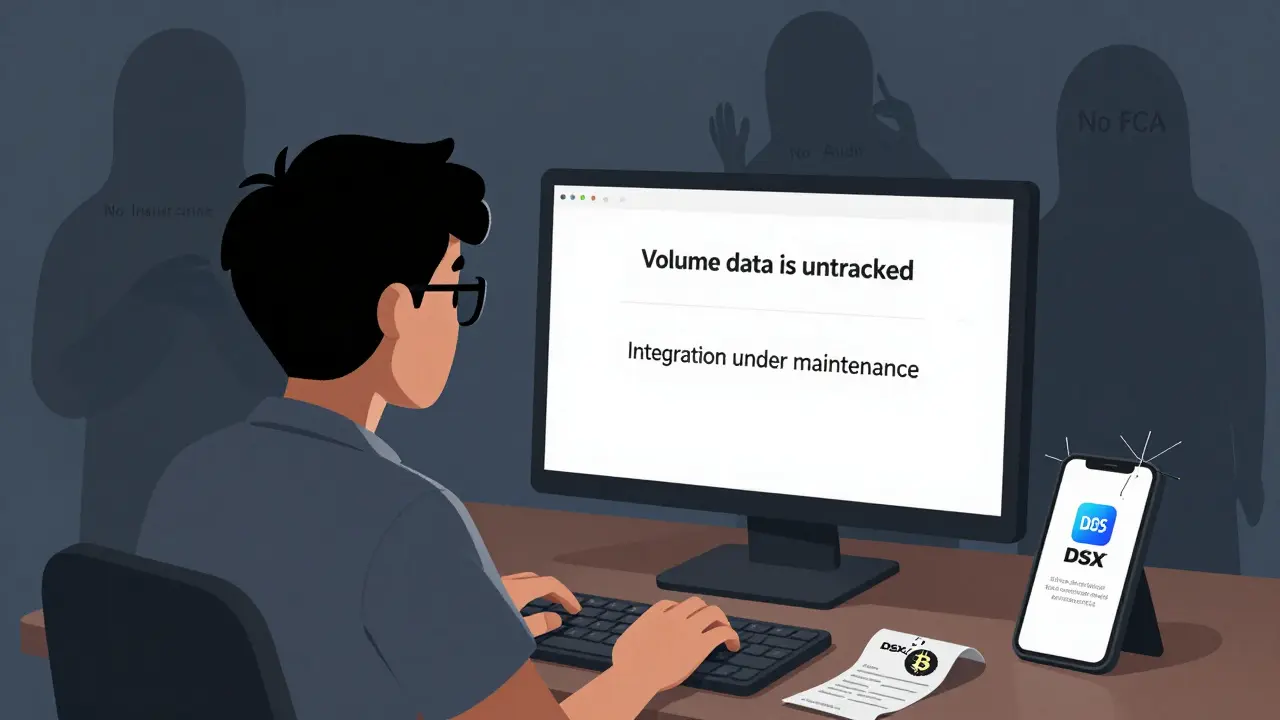
On Revain, one user wrote: "They closed the exchange. I had Bitcoin there. No one answers. I won’t write good things about this exchange because they closed it." Another said, "There are hopes the trade will resume," but that was wishful thinking. Four years later, the site still shows "Volume data is untracked" and "integration under maintenance."
There’s no evidence DSX ever had insurance for user funds. No proof of reserves. No audit reports. That’s not negligence - that’s a recipe for disaster.
Who Should Have Used DSX?
DSX wasn’t for everyone. If you wanted to trade Solana, Shiba Inu, or any new DeFi token - forget it. DSX didn’t list them.
But if you were a trader who:
- Only wanted Bitcoin, Ethereum, Litecoin, and a few others
- Preferred a clean, professional interface over flashy features
- Trusted a UK-based platform with wire transfers and 2FA
- Didn’t need mobile trading at first, but appreciated the iOS app when it came
Then DSX was a solid, quiet option - until it wasn’t.
What to Use Instead
After DSX died, most users moved to two exchanges: CEX.io and Coinbase.
CEX.io was praised by ExchangeRates.Pro as "a really trusted, surely a respectable, well established, interesting exchange platform." It supports over 50 cryptocurrencies, fiat deposits via card and bank transfer, and has a mobile app for both iOS and Android.
Coinbase? It scored 100/100 on the same platform. It’s regulated in multiple countries, offers insurance on stored assets, and has a track record of surviving market crashes. If you want safety, reliability, and ongoing updates - Coinbase is the default choice today.
Other solid alternatives include Kraken and Bitstamp - both older than DSX, both still operating, and both fully compliant with European regulations.
The Lesson
DSX’s story isn’t just about one failed exchange. It’s a warning.
Too many people think "it’s been around since 2014" means safe. But longevity doesn’t guarantee stability. DSX had experience, but no capital. It had a good design, but no strategy. It had security features, but no regulatory backing.
When you choose a crypto exchange, ask yourself: Do they publish audit reports? Are they licensed? Do they have insurance? Can you withdraw your funds if the market crashes? If the answers are "I don’t know," walk away.
DSX gave users a clean interface. But it didn’t give them security - not the kind that lasts.
Is DSX still operating?
No, DSX ceased operations on January 12, 2021, when it filed for bankruptcy. Its website is inactive, and all services have been permanently shut down. As of 2026, there are no plans to relaunch.
Can I recover my funds from DSX?
There is no official recovery process for DSX user funds. After bankruptcy, no assets were distributed to customers, and no insurance program existed to cover losses. Some users reported attempts to pursue legal action, but no public outcomes have been documented.
Why was DSX listed as a scam?
DSX was added to Crypto Legal UK’s scam database in October 2025 due to its unresponsive customer service, failure to return user funds after bankruptcy, and lack of transparency during its closure. The listing reflects documented user complaints and regulatory concerns.
Did DSX support Android?
Yes, DSX announced plans for an Android app in late 2019 alongside its iOS release. However, the Android app was never officially launched before the exchange shut down. Only the iOS version became available to users.
What cryptocurrencies did DSX support?
DSX supported 29 cryptocurrencies, including Bitcoin (BTC), Ethereum (ETH), Litecoin (LTC), Bitcoin Cash (BCH), Ripple (XRP), and Dash. It deliberately avoided newer or less-established tokens to reduce risk and focus on liquidity.
Was DSX regulated?
DSX applied for registration under the UK’s 5th Anti-Money Laundering Directive (5th AMLD) and was in the process of seeking FCA approval. However, it never received formal regulatory approval before its bankruptcy, meaning it operated without official oversight.
How does DSX compare to Coinbase?
Coinbase is fully regulated, insured, and supports over 200 cryptocurrencies. It has a global user base, 24/7 customer support, and a proven track record through multiple market cycles. DSX offered fewer coins, no insurance, and no regulatory approval. Coinbase is a far safer and more reliable option.
Final Thoughts
DSX looked professional. It felt trustworthy. But trust isn’t built on a clean UI - it’s built on transparency, regulation, and financial resilience. DSX had the first, but not the others.
If you’re looking for a crypto exchange today, don’t be fooled by age. Don’t be seduced by simplicity. Look for real proof: licenses, audits, insurance, and a clear path for customer support.
DSX is gone. And its legacy? A lesson in what happens when a company forgets that trust isn’t just design - it’s accountability.
Really appreciate this breakdown. DSX was one of the few exchanges that actually felt like it cared about user experience over hype.
sooo… they just vanished? like, no email? no ‘hey we’re shutting down’? lmao classic. i thought this was 2025 not 2018.
For anyone who used DSX and lost funds-your pain is real. I lost a chunk too. But the bigger lesson? Never trust an exchange that doesn’t publish audits or have clear regulatory backing. It’s not about how clean the UI looks. It’s about whether they’ve got a legal backbone.
Start asking these questions before you deposit: Who’s holding your keys? Are they licensed? Can you withdraw anytime? If you can’t answer those, you’re gambling.
USA all the way 🇺🇸! Why would anyone use some sketchy UK exchange when we got Coinbase with insurance and real customer service? 😤
While DSX had a clean interface and strong security protocols it lacked institutional transparency and regulatory compliance which are non negotiable in financial services. The absence of published audits and failure to obtain FCA registration rendered its operational model unsustainable regardless of user experience. This is not merely a failure of business strategy but a systemic governance failure.
You think DSX was the victim? Nah. It was the first domino. Every exchange that thinks ‘simplicity’ is a strategy is just delaying the inevitable. The market doesn’t reward quiet. It rewards noise. Scale. Hype. And DSX? It was too polite to survive.
Real crypto isn’t about clean UIs. It’s about who’s got the capital to outlast the next crash. DSX didn’t have a war chest. It had a desk and a dream.
They had iOS app but never launched Android? That’s wild. I used DSX because it was simple. But if you can’t even finish an Android app, how are you supposed to handle withdrawals during a crash?
Everyone’s acting like DSX was special. Newsflash: it wasn’t. It was just another small exchange that thought ‘no altcoins’ meant ‘safe.’ But safety isn’t about limiting options. It’s about having backups. Insurance. Legal structure. DSX had none of that. It was a pretty shell with no bones.
Another sad story of a company that failed to adapt. The real tragedy? Users lost money. The real crime? No one was held accountable. And now, four years later, we’re still talking about it. Because nothing changes.
DSX didn’t die because it was bad. It died because it was too good at what it did. Too clean. Too quiet. Too focused on the basics. The market wanted chaos. More coins. More leverage. More hype. DSX gave users peace. The market rewarded the noise.
DSX was a government sting operation. I knew it. The timing? Right after the 2020 election. The ‘bankruptcy’? Fake. The real crypto was moved to a hidden wallet tied to the Fed. They let it die to scare people into using Coinbase. Wake up.
Let me break this down. DSX was not a failure of design. It was a failure of ambition. While Binance was hiring engineers from Silicon Valley and funding marketing campaigns in 17 languages, DSX was still using the same 2015 dashboard. No new features. No expansion. No vision. Just a bunch of British guys in suits thinking they could outlast a bull market with a clean interface and cold storage. That’s not strategy. That’s nostalgia. And nostalgia doesn’t pay bills. It doesn’t pay users. It doesn’t even pay rent on Savile Row.
They thought their ‘minimalism’ was a competitive advantage. It was a death sentence. The crypto world doesn’t care how pretty your charts are. It cares if you can move fast. If you can scale. If you can survive when the lights go out. DSX? The lights went out. And they were still polishing their logo.
Now they’re on a scam list. Good. But don’t blame the users. Blame the founders who refused to evolve. They didn’t get outgunned. They just didn’t show up to the fight.
And if you think this is unique? Look at every other ‘quiet’ exchange from 2014–2018. Most are gone. The survivors? They raised millions. They hired PR teams. They got licenses. DSX? They got a website. And then silence.
The article is thorough. The structure is logical. The conclusion is accurate. However, it lacks any mention of the potential legal recourse available under UK insolvency law. Creditors may still file claims. The absence of public outcomes does not equate to absence of private actions.
dsx was legit. they had a real office on savile row. no one else had that. now its gone. and no one even says sorry. sad.
Everyone’s blaming DSX. But who really let this happen? The regulators. The FCA knew they were operating without a license. They sat on their hands. And now users are out millions. This isn’t a business failure. It’s institutional negligence.
They didn’t shut down DSX. They let it die. And now they’re calling it a scam to cover their own tracks.