
How Much Does It Actually Cost to Use Ethereum Today?
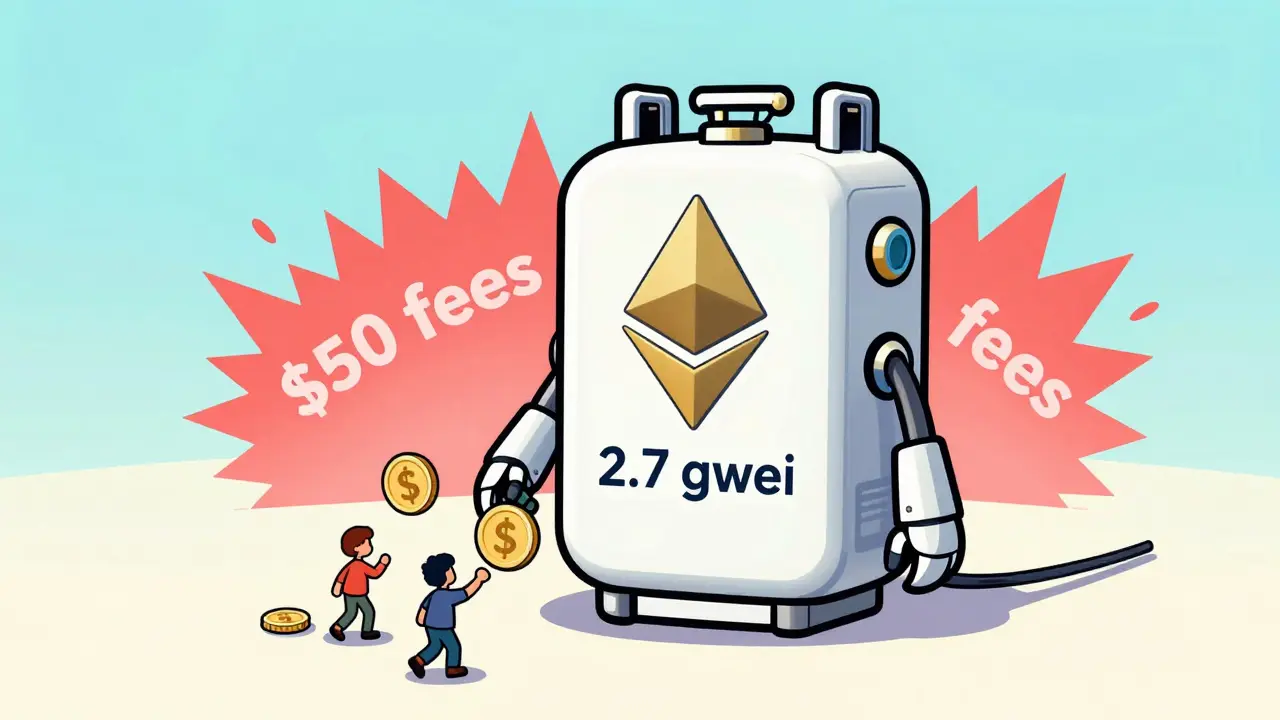
Just two years ago, sending a simple ETH transfer could cost you $10. Swapping tokens on Uniswap? That might’ve set you back $50. NFT minting? Forget it unless you had a spare $100 lying around. Now, in early 2026, the same ETH transfer costs less than 10 cents. A token swap? Around 40 cents. NFTs? Under a dollar. That’s not a slight improvement-it’s a revolution.
The Dencun upgrade in early 2025 didn’t just tweak Ethereum. It rewrote the rules. Gas fees, the hidden cost that once kept millions out of DeFi and NFTs, dropped by over 95%. The average gas price fell from 72 gwei in 2024 to just 2.7 gwei today. That’s not a bug fix. It’s a complete reset.
What Exactly Is a Gas Fee?
Think of gas as the fuel for Ethereum’s engine. Every action-sending ETH, swapping tokens, staking, minting an NFT-requires computational work. That work is paid for in gas. It’s not a fee you pay to a company. It’s a payment to validators who secure the network.
Since EIP-1559 launched in 2021, gas fees have two parts: the base fee and the priority fee. The base fee is burned-destroyed-so it doesn’t go to anyone. It automatically adjusts up or down based on how busy the network is. If blocks are full, the base fee rises. If they’re empty, it drops. The priority fee is optional. It’s a tip you can add to get your transaction processed faster. Most people leave it at zero unless they’re in a rush.
Each transaction uses a set number of gas units. A basic ETH transfer? 21,000 units. A simple token swap? Around 100,000. A complex DeFi interaction? Could be 500,000 or more. Multiply that by the current gas price (2.7 gwei), and you get your total cost. For example: 21,000 × 2.7 = 56,700 gwei = 0.0000567 ETH ≈ $0.09.
Ethereum vs. Solana: The Real Cost Comparison
Solana still boasts cheaper base fees. A transaction on Solana averages $0.00025. That’s nearly 400 times cheaper than Ethereum’s current average. So why isn’t everyone switching?
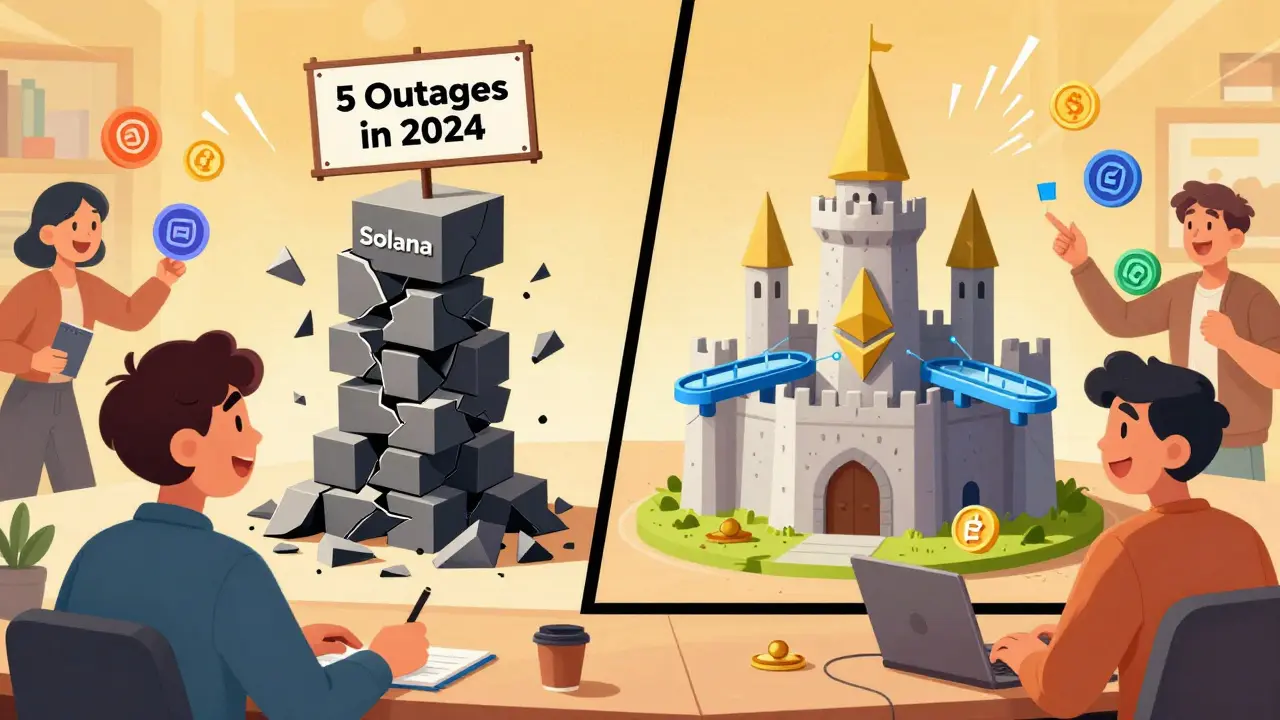
Because cost isn’t everything. Solana has had major outages-five in 2024 alone. When the network goes down, your transactions vanish. Ethereum, even at its most congested, never fully stops. It slows. It gets expensive. But it keeps running.
Also, Solana’s low fees come with trade-offs. It’s centralized in key ways. Validators are fewer. Infrastructure is concentrated. Ethereum’s strength isn’t just its cost now-it’s its security, its decentralization, and its massive ecosystem of apps, wallets, and users that all work together.
And here’s the kicker: most Ethereum users aren’t even paying Ethereum mainnet fees anymore. They’re using Layer 2s.
Layer 2s Are the Real Game-Changer
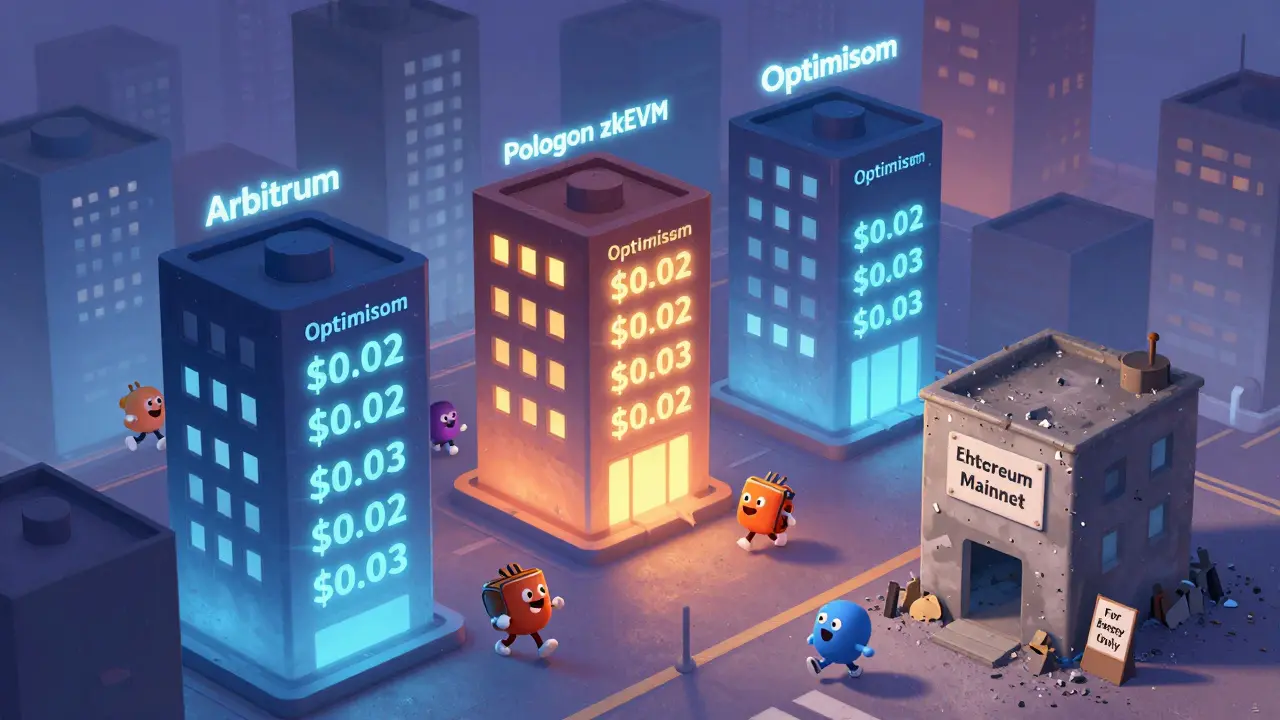
Arbitrum, Optimism, Polygon zkEVM-these aren’t competitors to Ethereum. They’re extensions of it. They handle transactions off the main chain, then bundle them up and post a single proof back to Ethereum. That means you get Ethereum’s security with near-zero fees.
On Arbitrum, a token swap costs about $0.02. On Optimism? $0.03. On Polygon? Sometimes less than a penny. These networks process over 80% of all Ethereum-linked transactions today. That’s why Ethereum’s mainnet fees are so low-they’re not doing the heavy lifting anymore.
Wallets like MetaMask now auto-detect which Layer 2 you’re on. You don’t need to switch networks manually. You just connect, and it picks the cheapest path. Most new users don’t even realize they’re not on Ethereum mainnet.
When Do Fees Spike? And How to Avoid Them
Even with all these improvements, Ethereum isn’t perfectly cheap. During major NFT drops, DeFi protocol launches, or when a popular meme coin explodes, network activity spikes. On February 19, 2025, a single token swap cost $50. That’s not normal. That’s chaos.
Here’s how to avoid getting burned:
- Check the gas tracker. Use sites like Etherscan or GasNow to see real-time prices. Look for green or yellow, not red.
- Wait for weekends. Weekdays, especially Tuesday and Wednesday, are busiest. Saturday and Sunday mornings are usually quietest.
- Set your own priority fee. In MetaMask, turn off ‘Fast’ and manually set it to 0.5-1 gwei. You’ll wait a few extra minutes, but save 90%.
- Use Layer 2 by default. If you’re not doing staking or complex smart contracts, stick to Arbitrum or Optimism. Your wallet will thank you.
Experienced users report saving 30-50% just by timing their transactions. That’s like getting free money every time you trade.
What About Other Blockchains?
Other chains are trying to compete. Avalanche has low fees but less liquidity. BNB Chain is fast but centralized. Sui and Aptos promise speed but lack the app ecosystem.
Here’s the reality: no other chain combines low cost, high security, and deep app support like Ethereum + Layer 2s. Even Solana, with its cheap fees, can’t match the number of DeFi protocols, wallets, or NFT collections built on Ethereum.
And Ethereum isn’t done. The next upgrades-like proto-danksharding-are already in testing. They’ll bring even lower costs and higher throughput. By late 2026, we could be looking at $0.01 swaps on Layer 2s.
Why This Matters for You
This isn’t just about saving a few dollars. It’s about access. Before 2025, small transactions on Ethereum were impractical. Now, you can send $5 worth of ETH to a friend, buy a digital art piece, or join a new DeFi pool without worrying about fees eating half your investment.
It’s why daily active wallets on Ethereum Layer 2s have doubled since January 2025. It’s why new users are joining Ethereum for the first time-not because it’s the “most decentralized,” but because it finally feels affordable.
The days of gas fees being a barrier are over. The new challenge? Learning how to use it wisely. Don’t just accept the default settings. Check the price. Wait for the quiet hours. Use Layer 2s. That’s how you make Ethereum work for you-not against you.
Final Thought: Ethereum Isn’t Dead. It’s Just Getting Started.
People said Ethereum was too expensive. Too slow. Too broken. They were right-until they weren’t. The Dencun upgrade didn’t fix Ethereum. It transformed it. And now, with fees at historic lows and Layer 2s handling the bulk of traffic, Ethereum is more usable than ever.
Other chains may be cheaper on paper. But only Ethereum offers a secure, decentralized, and now affordable foundation for the future of money.
Why did Ethereum gas fees drop so much in 2025?
The Dencun upgrade introduced proto-danksharding, which drastically reduced the cost of storing data on Ethereum. This allowed Layer 2 networks like Arbitrum and Optimism to bundle thousands of transactions into a single, cheap proof posted to Ethereum. As a result, mainnet congestion dropped, and base fees fell by over 90%. The shift wasn’t just technical-it was economic. By offloading most traffic to Layer 2s, Ethereum became a settlement layer, not a transaction processor.
Are Layer 2s safe to use?
Yes. Layer 2s like Arbitrum and Optimism inherit Ethereum’s security. They use fraud proofs or zero-knowledge proofs to verify transactions, then anchor those proofs to Ethereum’s main chain. If a Layer 2 tries to cheat, Ethereum can roll it back. This means your funds are as secure on Arbitrum as they are on Ethereum mainnet-just cheaper.
Can I still use Ethereum mainnet for transactions?
You can, but you shouldn’t unless you have to. Mainnet is now mostly used for moving funds between Layer 2s, staking ETH, or interacting with protocols that don’t yet support Layer 2s. For everyday swaps, NFTs, or DeFi, always choose a Layer 2. Your wallet will usually suggest it automatically. If you’re unsure, check the network name-it should say ‘Arbitrum One,’ ‘Optimism,’ or ‘Polygon zkEVM,’ not just ‘Ethereum’.
How do I know if my wallet is on a Layer 2?
Look at the network name in your wallet (MetaMask, Rainbow, etc.). If it says ‘Ethereum,’ you’re on mainnet. If it says ‘Arbitrum,’ ‘Optimism,’ ‘Base,’ or ‘Polygon zkEVM,’ you’re on a Layer 2. You can switch networks manually in your wallet settings. Most wallets now show the current gas fee in USD next to the network name, so you’ll instantly see if you’re on a cheap chain.
Is it worth switching from Solana to Ethereum now?
Only if you care about long-term reliability and ecosystem depth. Solana is cheaper and faster, but it’s still prone to outages and centralization issues. Ethereum’s ecosystem is far larger-thousands of DeFi apps, NFT marketplaces, and tools are built on it. If you’re just trading tokens once a month, Solana’s fine. If you’re using DeFi daily, holding NFTs, or planning to stay in crypto long-term, Ethereum + Layer 2s is the safer, more future-proof choice.
Bro. I just sent $5 to my buddy for pizza and it cost me 3 cents. THREE CENTS. I cried. Not from sadness, from pure, unfiltered joy. Ethereum went from ‘you’re gonna get robbed’ to ‘here, take my wallet’ in 18 months. I’m not even mad anymore. I’m just proud.
layer 2s are the real MVPs frfr. i didnt even know i wasnt on mainnet for like 6 months. my meta mask just auto picked arbitrum and now i swap tokens like its nothing. gas fees used to make me sweat like i was in a sauna. now? i just click and go. life is good.
It’s fascinating, really, how the economic architecture of Ethereum evolved from a congested, speculative toll road into a highly optimized, decentralized settlement layer - not because of any single miraculous upgrade, but because of the collective, iterative, community-driven refinement of protocol incentives, fee markets, and layering strategies. The Dencun upgrade didn’t just reduce data costs - it fundamentally redefined the role of the base chain, shifting it from transaction processor to trust anchor, which in turn enabled Layer 2s to scale without compromising security. And yet, most users don’t even notice - they just see cheaper fees and assume it’s magic. It’s not magic. It’s engineering. And it’s beautiful.
Solana users are still crying in their cornflakes. ‘Ohhh it’s cheaper!’ Yeah, and it crashed five times last year. Your ‘cheap’ transactions vanished into the void like your ex’s texts. Ethereum doesn’t vanish. It just makes you wait a few minutes and pay 40 cents. That’s not a bug - that’s reliability. You want speed? Go play on a toy chain. I want my money to survive the apocalypse.
The reduction in fees is indeed significant. I’ve observed the shift from mainnet congestion to Layer 2 adoption with interest. It’s a practical evolution, not a revolution. Many users now operate almost entirely on sidechains without realizing it. This is sensible. Efficiency should be the goal.
Americans think they invented blockchain. Solana’s down for 3 hours and suddenly you’re all ‘ETH IS THE ONLY ONE’. Bro, it’s just a blockchain. Stop acting like you saved the world because your gas fee dropped from $10 to $0.09. We’re still waiting for real utility, not just cheaper fees.
I’ve been using Arbitrum for months now. It’s seamless. I used to check Etherscan every time I swapped. Now I just hit send. The real win isn’t the cost - it’s the peace of mind. You don’t have to be a tech wizard to use this anymore. That’s huge.
You guys are acting like this is a gift. It’s not. It’s just the natural result of a system that finally stopped being greedy. You still think you’re special because you’re on Ethereum? Newsflash: 80% of your ‘Ethereum’ activity is happening on Layer 2s. You’re not using Ethereum. You’re using a glorified proxy. The real Ethereum is just sitting there collecting dust like a museum piece. Congrats.
I came from India where gas fees used to be insane. I used to wait weeks to do a simple swap. Now I do 5 swaps a day on Optimism for less than a dollar total. This isn’t just tech - it’s freedom. I can finally participate. Thank you to the devs who didn’t give up.
LMAO layer 2s. You think you're safe? What happens when one of them gets hacked? You think ETH will save you? Nah. Your funds are on some private chain with 3 validators. You're just trusting strangers again. Wake up.
If you’re still on mainnet for swaps, you’re doing it wrong. I’ve helped 12 friends switch to Arbitrum in the last month. All of them were scared. All of them now say ‘why didn’t I do this sooner?’ It’s not complicated. Open MetaMask. Click the network. Pick Arbitrum. Done. You just saved $50 this month. Go treat yourself to coffee. You earned it.
Gas fees at $0.03?? 😍🙌 I’m crying happy tears. This is the crypto future I believed in! 🚀💎
People act like this was inevitable. It wasn’t. It took years of grinding, arguing, building, and fighting against greedy miners and lazy devs. And now? Now we have a system that actually works for the people. Not for the whales. Not for the VCs. For the regulars. The ones who just want to send ETH to their mom or buy a NFT they love. This is the real win. This is why I’m still here. Not because it’s perfect. But because it’s ours.