
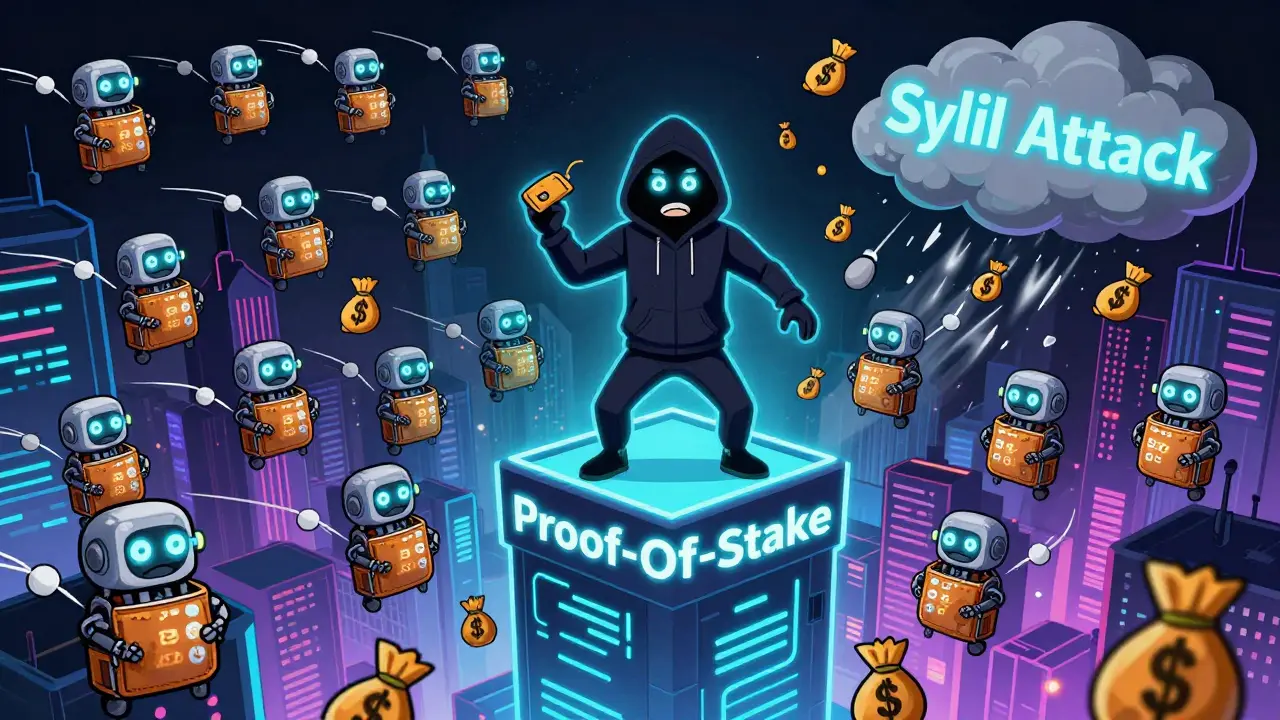
Imagine a network where one person controls 10,000 fake identities - each one voting, claiming rewards, or manipulating prices. That’s a Sybil attack. It’s not science fiction. In 2023 alone, over $287 million was stolen from DeFi protocols using fake accounts to game airdrops. And it’s getting smarter. The old tricks - like running dozens of bots on one server - are dead. Today’s attackers use AI to mimic real human behavior: timing transactions just right, varying IP addresses, even copying mouse movements. If you’re running a blockchain network, you can’t just rely on Proof-of-Stake or Proof-of-Work anymore. The future of security isn’t about harder math. It’s about knowing who’s really there.
Why Sybil Attacks Are Getting Harder to Stop
Sybil attacks work because blockchains are designed to be open. Anyone can join. That’s the point. But that openness is also the flaw. A single attacker can spin up thousands of fake wallets, each with a different IP, different device fingerprint, even different behavioral patterns. These aren’t simple bots anymore. They’re synthetic identities built to pass basic checks. In 2022, Optimism’s $OP airdrop lost $42 million to Sybil accounts. In 2023, zkSync and Arbitrum saw similar losses. Chainalysis found that 37% of all blockchain security incidents in 2024 were Sybil-based. That’s not a glitch. It’s a systemic vulnerability.Traditional consensus mechanisms like Proof-of-Stake don’t fix this. They just shift the cost. Instead of spending electricity (like PoW), attackers spend tokens. But if you’re distributing tokens through airdrops, and anyone can create a wallet, you’re handing out free votes. And that’s exactly what attackers are doing - farming votes, not coins.
Proof-of-Personhood: Proving You’re Human Without Giving Up Privacy
The most promising approach right now is Proof-of-Personhood (PoP). This isn’t about government IDs. It’s about proving you’re one unique human, not a bot farm. Idena does this with monthly validation ceremonies. Users solve visual puzzles in real-time, live on camera. The system checks for liveness, attention, and uniqueness. Their April 2024 report showed 99.2% Sybil resistance. But here’s the catch: it takes 30 minutes per person. That’s not scalable for millions of users.Worldcoin’s Orb takes a different path. It scans your iris using a 3D camera. As of June 2024, their v2.1 update achieved 99.98% liveness detection. That’s near-perfect. But 63% of users in a Consensys survey said they’re uncomfortable with facial or iris scanning. Privacy isn’t optional - it’s core to blockchain’s ethos. So the real innovation isn’t in the tech itself. It’s in how you use it.
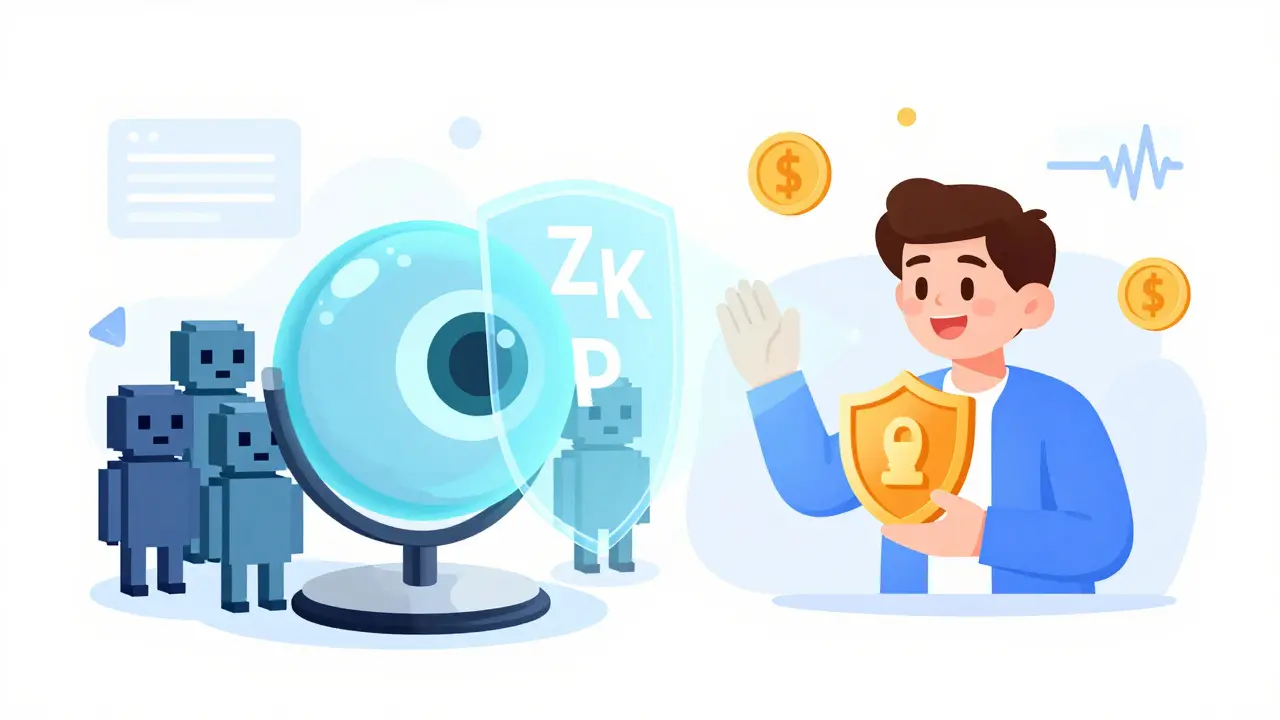
Zero-knowledge proofs (ZKPs) are the bridge. They let you prove you’re a real person without showing your iris, your face, or your ID. You run the scan locally. The system gets a cryptographic proof - not the data. Formo, a startup that launched in January 2024, uses this. They combine ZKPs with token ownership thresholds. To qualify for an airdrop, you need to hold at least 0.5 ETH and have made 10+ transactions in the last 90 days. During Optimism’s $OP airdrop phase 2, they blocked 4.2 million Sybil attempts. No biometrics. No ID. Just behavior and ownership.
AI and Behavioral Analysis: Spotting the Fake Before It Acts
The next layer is AI. Not just for detection - for prediction. Rejolut’s 2024 report found AI systems analyzing 15+ behavioral signals can spot Sybil clusters with 92.7% accuracy. These signals include:- Transaction timing - bots often send transactions at exact intervals
- Device fingerprinting - multiple wallets from the same browser or OS
- Network graph patterns - fake accounts cluster around each other, not real users
- Keystroke dynamics - how fast you type, how you move your mouse
Lightspark’s Q2 2024 system used these to cut fake account creation by 76%. But the real breakthrough is in prediction. Chainalysis’ Hexagate 2.0, launched in August 2024, doesn’t just block attacks - it predicts them. In test environments, it flagged Sybil clusters 47 minutes before they launched. That’s enough time to freeze airdrop eligibility, delay token distribution, or trigger a manual review.
AI doesn’t replace human verification. It enhances it. Think of it like a fraud detective. It flags the weird patterns. Humans then decide what’s suspicious. That balance is critical. Too much automation, and you get false positives - real users locked out. Too little, and bots slip through.
Trust Graphs and Social Proof: The Power of Your Network
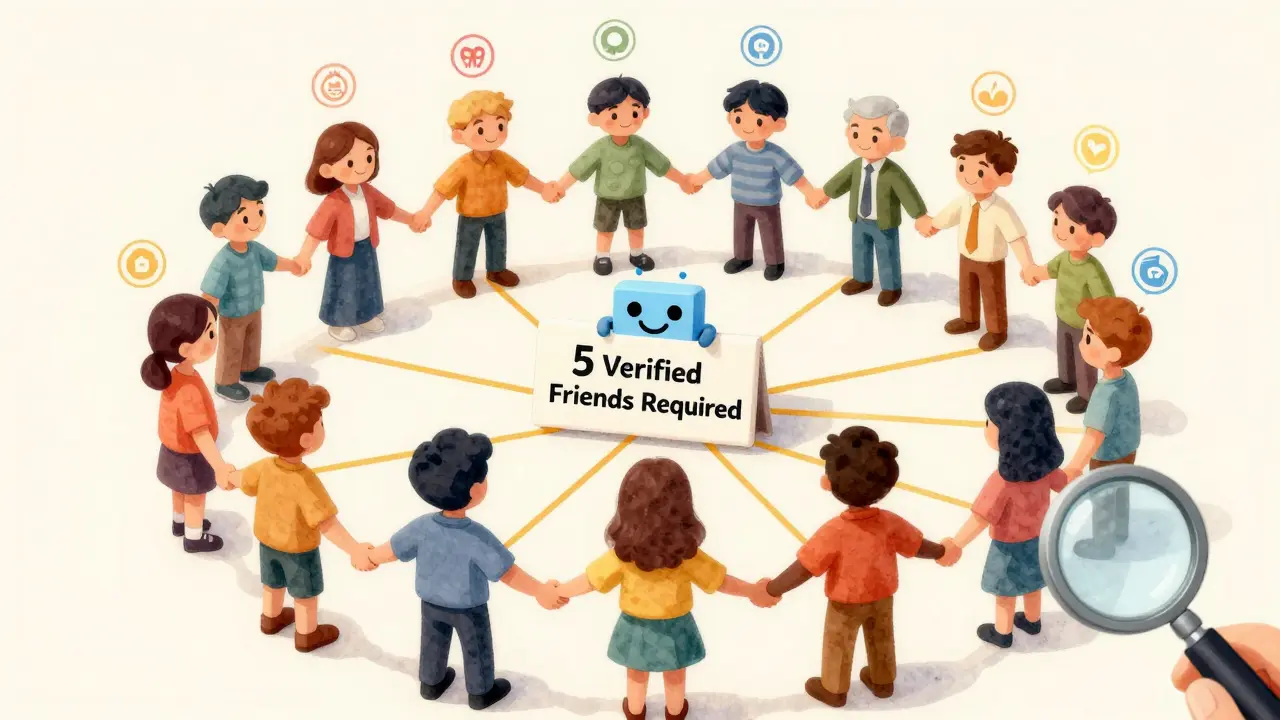
What if your identity wasn’t just about what you own, but who you know? BrightID uses trust graphs. Users vouch for each other. If five people you know have already been verified, you get a pass. It’s like a digital passport backed by your real-world connections. They’ve mapped 8.7 million connections across 1.2 million users. But MIT’s June 2024 evaluation found a problem: 18% false positives. People get locked out because their friends aren’t active enough.Gitcoin’s Passport system uses a similar model. Since February 2023, it’s processed 2.1 million verifications with 89% user satisfaction. Users earn “stamps” - like holding a token, joining a DAO, or completing a Gitcoin grant. These stamps build reputation. It’s not perfect. But it’s human-centered. And that’s the key. People trust systems they understand. If you can explain why your friend’s verification helps you, adoption grows.
Decentralized Identity: The Backbone of the Future
Microsoft’s ION network, built on Bitcoin, is quietly becoming a backbone for Sybil resistance. In Q2 2024, it processed 1.2 million Decentralized Identifiers (DIDs) with zero Sybil incidents. DIDs are like digital IDs you control. No central server. No company holding your data. You own the key. But here’s the bottleneck: only 15 of the top 100 crypto wallets support them. If your wallet doesn’t talk to ION or similar networks, you’re locked out.That’s why Ethereum’s upcoming Pectra upgrade in Q1 2025 matters. It introduces native account abstraction - a way to build verification modules directly into wallets. No more clunky third-party apps. You’ll be able to prove your uniqueness right inside MetaMask or Phantom. This could be the turning point. If wallets bake in Sybil resistance, adoption skyrockets.
The Trade-Offs No One Talks About
Every solution has a cost. Zero-knowledge proofs take 3.2 seconds per verification. That’s fine for a one-time airdrop. Not for a high-frequency DeFi trade. Biometrics raise privacy alarms. Trust graphs can be gamed by colluding friends. Economic disincentives - like requiring a $500 deposit to create a wallet - sound great until you lock out low-income users.Vitalik Buterin’s idea of “proof-of-uniqueness” combined with quadratic funding tries to solve this. It rewards genuine participation, not volume. But it needs widespread adoption. Emin Gün Sirer warns that too much identity verification turns blockchain into a gated community. And that defeats the purpose.
The Electronic Frontier Foundation put it bluntly: “Over-engineered Sybil prevention could undermine blockchain’s core value proposition of permissionless participation.”
What’s Next? Hybrid Systems Are the Answer
There’s no silver bullet. The future isn’t one method. It’s layers.- For low-risk networks: Use token-gated verification. Hold X tokens. Make Y transactions. Simple.
- For airdrops and governance: Combine ZKPs with behavioral AI. Prove you’re real without revealing your face.
- For enterprise use: Adopt decentralized identity (DID) standards. Use ION or Sovrin.
- For high-value protocols: Add economic disincentives. Make Sybil attacks expensive.
Forrester predicts 83% of networks will use hybrid models by 2028. That’s not speculation. It’s what’s already happening. Ethereum, Polygon, and Solana are all testing modular verification systems. You pick your level of security based on your risk. A meme coin? Maybe just token ownership. A stablecoin? Full DID + ZKP + AI checks.
The EU’s MiCA regulation, effective June 2025, will force stablecoin issuers to implement robust identity checks. The U.S. Executive Order 14067 requires the same for government blockchain projects. Compliance isn’t just legal - it’s survival.
What Developers Need to Know
If you’re building on blockchain, you need three skills:- Zero-knowledge cryptography - 75% of job postings now require it
- Decentralized identity standards - 68% of roles list DID as essential
- Behavioral analytics - 42% of teams are hiring for this
Integration takes 8-12 weeks. You’ll need to upgrade 3-5 smart contracts. Documentation is uneven. Chainlink’s tools score 4.7/5. Idena’s? 3.2/5. And community support? Fragmented. Ethereum has weekly working group meetings. Solana meets monthly. You can’t just copy-paste a solution. You have to build it for your use case.
Final Thought: Security Without Surrender
The goal isn’t to eliminate Sybil attacks. That’s impossible. The goal is to make them too expensive, too slow, or too risky to bother with. The future belongs to networks that balance security with freedom. Systems that protect users without asking for their private data. That verify identity without becoming gatekeepers. That use AI not to control, but to detect. That let users stay anonymous - but still prove they’re real.Blockchain’s power isn’t in its tech. It’s in its trust model. If we lose that - if we turn every wallet into a government-verified ID - we lose what made it special. The future of Sybil prevention isn’t about locking people out. It’s about letting the real ones in - quietly, securely, and without asking for their soul.
What is a Sybil attack in blockchain?
A Sybil attack happens when one person creates many fake identities to gain control over a decentralized network. These fake accounts can manipulate voting, claim airdrops, or distort token prices. The name comes from the 1973 book 'Sybil,' about a woman with multiple personalities. In blockchain, it’s one of the most common ways attackers exploit open networks.
How much money has been lost to Sybil attacks?
In 2023 alone, Sybil-based airdrop exploits stole $287 million from DeFi platforms like Optimism, Arbitrum, and zkSync. Chainalysis reported that Sybil attacks made up 37% of all blockchain security incidents in 2024. These numbers are rising as airdrops and governance voting become more valuable.
Can Proof-of-Stake prevent Sybil attacks?
Not really. Proof-of-Stake makes it expensive to create fake nodes because you need to stake real tokens. But if those tokens are distributed through airdrops - which they often are - attackers can create hundreds of wallets to collect them. PoS shifts the cost but doesn’t stop the attack. That’s why new methods like Proof-of-Personhood and AI detection are needed.
Is Worldcoin’s Orb a good solution for Sybil prevention?
Technically, yes - its 99.98% liveness detection is among the most accurate available. But it’s controversial. Over 60% of users are uncomfortable with iris scanning, and privacy advocates argue it creates permanent biometric records. For many, the trade-off isn’t worth it. Better alternatives like zero-knowledge proofs offer similar security without the privacy risks.
What’s the easiest way to prevent Sybil attacks in a small DAO?
Start with token-gated verification. Require members to hold at least 0.1 ETH or a specific governance token, and have made 5+ transactions in the last 60 days. This blocks most bots without requiring biometrics or complex systems. Combine it with Gitcoin Passport stamps for extra trust. It’s simple, effective, and respects privacy.
Will future blockchains require government IDs?
No - and they shouldn’t. The future is decentralized identity (DID), where you own your identity and prove it cryptographically without revealing personal data. Systems like Microsoft ION and Ethereum’s upcoming account abstraction allow verification without government documents. Requiring IDs would go against blockchain’s core principle of permissionless access.
How can I tell if a project is vulnerable to Sybil attacks?
Look at their airdrop distribution. If thousands of wallets got tokens with no history, no transactions, and no social proof - they’re likely vulnerable. Check if they use token-gating, behavioral AI, or zero-knowledge proofs. If they rely only on wallet creation date or IP address, they’re using outdated methods. Ask them: ‘How do you verify uniqueness?’ If they can’t answer, be cautious.
What’s the biggest risk in new Sybil prevention methods?
The biggest risk is centralization. If only a few companies control the identity verification tools - like Worldcoin, Civic, or Formo - you’re replacing one monopoly with another. The goal is to keep verification open, decentralized, and user-owned. Otherwise, you’re not building a blockchain. You’re building a bank.
So we’re just gonna turn blockchain into a DMV with crypto? Cool. I’ll wait for the 3-hour line to prove I’m not a bot.
Proof of personhood? More like proof you’re a US citizen with a camera.
Of course the solution is more surveillance. Because nothing says ‘decentralized’ like iris scans and keystroke logs. Next they’ll require your blood type and favorite color for ‘trust scoring.’
zksync lost 42mil? lol. i bet they just forgot to turn on the ‘dont let bots in’ switch
Dear friends, in India, we use mobile number verification for everything. Why not blockchain? Simple, cheap, effective. 😊
Let’s be real - if you’re not using ZKPs + behavioral AI + DID, you’re building a toy chain. This isn’t 2017 anymore. If your audit doesn’t mention Chainlink’s Verifiable Random Function and Graph Neural Networks, you’re not even in the game. Get with it.
Everyone’s talking about tech fixes. No one’s talking about the fact that airdrops are literally designed to be gamed. It’s not a bug - it’s a feature. The whole system is a Ponzi scheme with extra steps.
Wait - so if I hold 0.5 ETH and made 10 transactions… that’s proof I’m human? What if I’m a 12-year-old with a stolen credit card and a bot farm in Manila? What if I’m a DAO bot pretending to be a human pretending to be a bot? Are we just… stacking illusions now?
It’s funny how we want anonymity but also want to know who’s real. Like wanting to be invisible in a crowd but demanding everyone wear name tags. We’re trying to solve a social problem with cryptography. Maybe the real issue is that we’ve forgotten how to trust each other without a machine in the middle.
For anyone building on-chain: Start with Gitcoin Passport. It’s lightweight, community-driven, and integrates with MetaMask. Use stamps - token holdings, DAO participation, grant contributions. It’s not perfect, but it’s human. And humans build networks, not bots. Also, document everything. The docs for Idena are a nightmare. Chainlink’s are gold.
So we’re going to replace the tyranny of the state with the tyranny of the algorithm? Brilliant. Now my identity is owned by Formo, not the IRS. I feel so much freer.
Can we just pause and remember that blockchain was supposed to be about liberation? Not turning every wallet into a background check? I’m not against security - but I’m terrified of what we’re becoming in the name of it.
Y’all are overcomplicating this. If you want to stop Sybil attacks? Make airdrops rare. Make them meaningful. Stop giving away free money to anyone who can open a wallet. The problem isn’t the tech - it’s the greed. Fix the incentive, not the fingerprint.
ai detecting mouse movements… really? next theyll say you have to blink in a certain pattern to prove youre real
the fact that we even need this stuff is wild. but hey, if it keeps the bots out and lets me claim my airdrop, i’m down. just don’t make me scan my eyeball. i’m not a sci-fi movie.
Hey devs - if you’re building a new chain, start with Ethereum’s Pectra upgrade. Account abstraction means you can bake in Sybil resistance at the wallet level. No more third-party apps. No more clunky workflows. Just native verification. And yes, you’ll need ZKP skills. 75% of job posts say so - learn it now or get left behind.
You call this innovation? This is the death of privacy dressed up as security. Worldcoin’s orb? That’s not a device - it’s a biometric prison. And you’re all clapping like it’s a miracle. Wake up. The moment you hand over your iris to a startup, you’ve already lost. This isn’t progress. It’s surrender.