
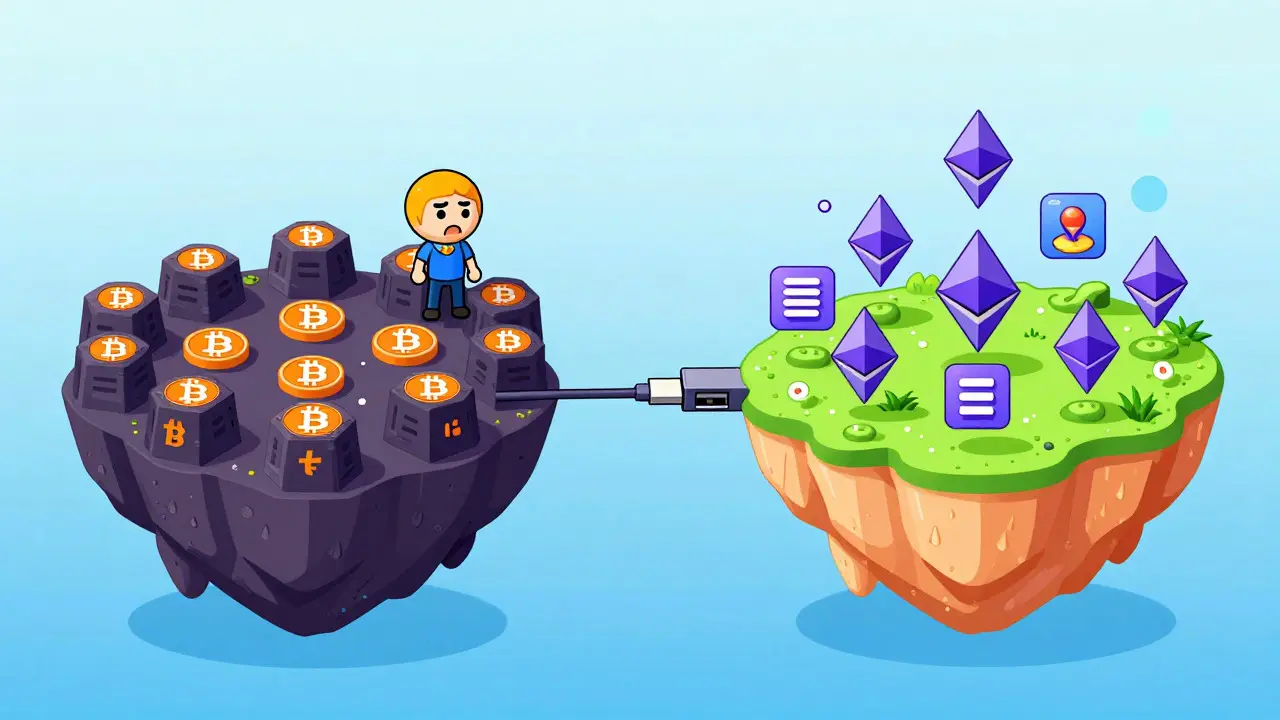
You have Bitcoin in your wallet. You want to use it in a lending protocol on Ethereum. But Bitcoin doesn't natively exist on the Ethereum network. It’s like trying to plug a USB-C cable into an older USB-A port-it just doesn’t fit without an adapter. In the world of crypto, that adapter is called a blockchain bridge. A blockchain bridge is a protocol that facilitates the transfer of assets and data between different blockchains, acting as a gateway between isolated networks. Without these bridges, every blockchain would be a lonely island, unable to communicate or trade with its neighbors.
This guide breaks down exactly how these bridges work, why they are essential for decentralized finance (DeFi), and what risks you need to watch out for when moving your money across chains.
The Core Problem: Blockchain Silos
To understand why we need bridges, you first have to look at how blockchains are built. Most major blockchains-like Bitcoin, The original cryptocurrency created by Satoshi Nakamoto in 2009, known for its security and store-of-value properties., Ethereum, A programmable blockchain platform that supports smart contracts and decentralized applications., and Solana, A high-performance blockchain known for its speed and low transaction costs.-operate independently. They have their own consensus mechanisms, their own rules, and their own native tokens.
Imagine if every country had its own currency but no way to exchange them. If you traveled from Australia to Japan, you couldn't buy sushi because your Australian dollars were useless there unless you converted them. In crypto, this fragmentation creates "silos." Your assets are stuck in one ecosystem. You can't easily move value from Bitcoin's secure network to Ethereum's vibrant DeFi apps. Bridges solve this by creating a communication layer that allows these disparate systems to talk to each other.
How Bridges Actually Work: The Lock-and-Mint Mechanism
A common misconception is that bridges physically move coins from one blockchain to another. They don't. Instead, they use a clever trick involving smart contracts. This process is often referred to as the "lock-and-mint" mechanism. Here is the step-by-step breakdown of what happens when you transfer an asset:
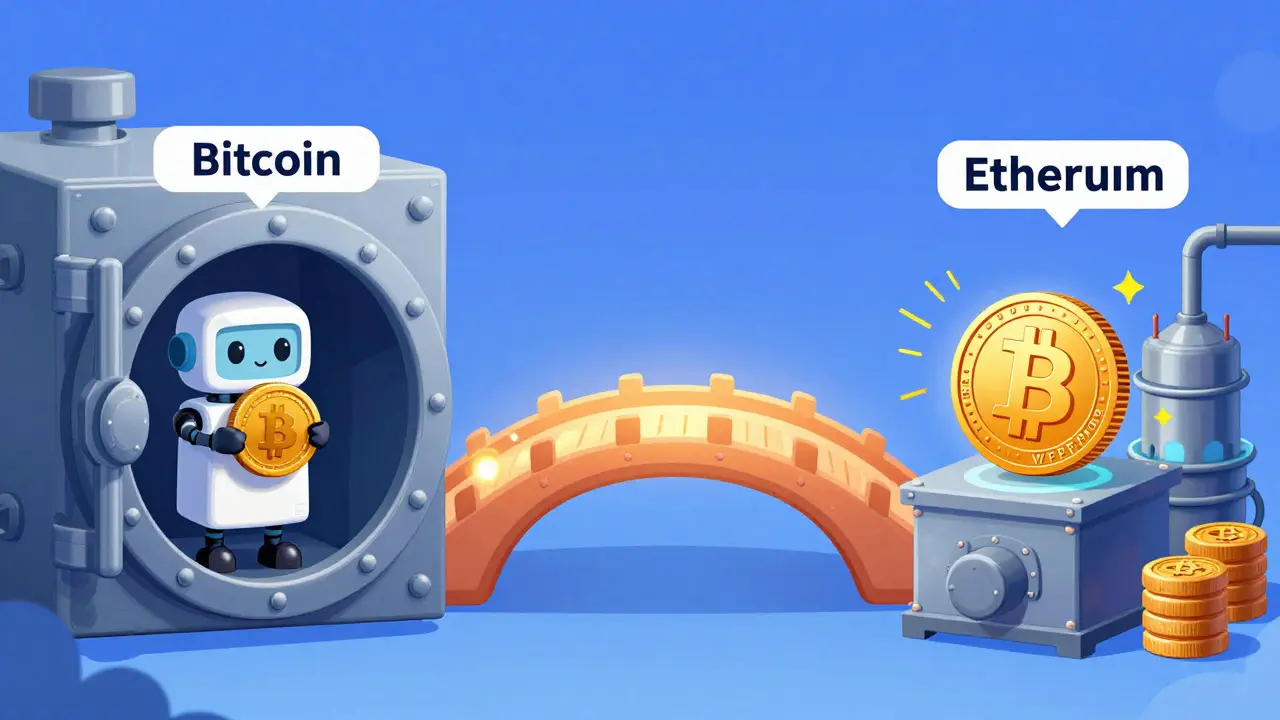
- Deposit and Lock: You send your original asset (let's say 1 BTC) to a special smart contract address controlled by the bridge on the source blockchain (Bitcoin). This contract acts like a secure vault. Once the funds are in, they are locked away and removed from circulation.
- Verification: The bridge monitors the blockchain. Validator nodes or oracles check the transaction details to confirm that the correct amount was sent to the correct address. This ensures the system knows exactly what you deposited.
- Minting Wrapped Tokens: Once verification is complete, the bridge mints a new token on the destination blockchain (Ethereum). This new token is called a "wrapped" version of your original asset. For example, you receive WBTC (Wrapped Bitcoin) on Ethereum. This token is pegged 1:1 to your original Bitcoin.
- Usage: You now hold WBTC in your Ethereum wallet. You can trade it, lend it, or stake it in any Ethereum-based DeFi protocol, just like you would with native ETH.
When you want to get your original Bitcoin back, the process reverses. You send the WBTC back to the bridge on Ethereum. The bridge burns (destroys) the WBTC and unlocks the original BTC from the vault on the Bitcoin network, sending it back to your wallet.
Types of Blockchain Bridges
Not all bridges are built the same way. While the lock-and-mint method is the most common, there are variations depending on how the bridge manages liquidity and security.
| Method | How It Works | Pros | Cons |
|---|---|---|---|
| Wrapped Asset Method | Locks original asset on source chain; mints equivalent on target chain. | Highly scalable; widely supported. | Relies on the security of the locking smart contract. |
| Liquidity Pool Method | Uses pre-existing pools of assets on both chains. Swaps occur within the pool rather than minting new tokens. | Faster transactions; less dependency on complex minting logic. | Requires significant capital to maintain liquidity on both sides. |
The Wrapped Asset Method, The most common bridge technique where original assets are locked and synthetic equivalents are minted on the destination chain. is the standard you'll encounter most often. It allows for seamless integration with existing protocols. For instance, platforms like Curve Finance and Aave rely heavily on wrapped assets to allow users to earn yield across multiple chains without leaving their preferred interface.
Why Interoperability Matters for DeFi
So, why go through all this trouble? The answer lies in efficiency and opportunity. By breaking down silos, bridges unlock several key benefits for users and developers alike.
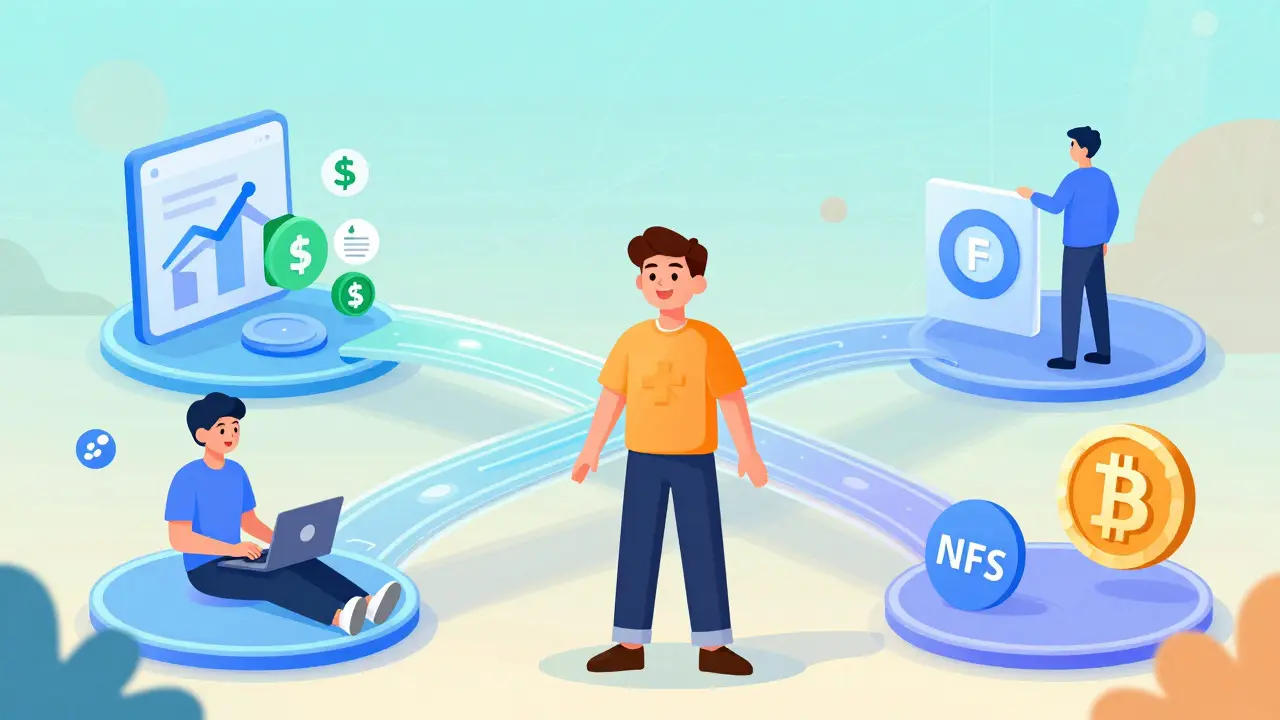
Expanded DeFi Opportunities: Different blockchains excel at different things. Ethereum has the deepest liquidity and most mature DeFi apps. Solana offers blazing-fast speeds and low fees. Bitcoin provides unmatched security. With bridges, you don't have to choose just one. You can keep your long-term holdings in Bitcoin while using wrapped versions to participate in lending markets on Ethereum or trading on Solana.
Scalability Solutions: During periods of high network congestion, transaction fees (gas) on Ethereum can skyrocket. Users can temporarily move their assets to a cheaper, faster Layer 2 solution or an alternative Layer 1 chain via a bridge. This alleviates pressure on the main network and saves users money. Once the dust settles, they can bridge back.
NFT Flexibility: Non-fungible tokens (NFTs) aren't limited to fungible currencies. Bridges also allow NFTs to move between chains. This opens up new marketplaces and use cases. An artist might mint an NFT on Polygon for low costs but later bridge it to Ethereum to access a larger buyer base.
Security Risks and Considerations
If bridges are so useful, why isn't everyone using them without worry? The short answer is trust. Because bridges involve locking significant amounts of value in smart contracts, they become prime targets for hackers.
In 2022 alone, billions of dollars were lost in bridge hacks. These breaches usually happen due to vulnerabilities in the smart contract code or flaws in the validator network. When you use a bridge, you are trusting that the code holding your funds is bug-free and that the validators managing the system are honest.
To mitigate these risks, always consider the following:
- Use Established Bridges: Stick to well-known, audited protocols. Avoid new, untested bridges promising high yields.
- Check Liquidity: Ensure the bridge has sufficient liquidity on both sides to handle your transaction size without slippage.
- Understand the Custody Model: Some bridges are centralized (controlled by a single entity), while others are decentralized (managed by a network of validators). Decentralized options generally offer better security against single points of failure.
Step-by-Step: How to Use a Blockchain Bridge
Ready to try it yourself? Here is a practical guide to transferring assets using a typical bridge service.
- Select Your Bridge: Identify a reputable bridge that supports your specific blockchain pair (e.g., Ethereum to Arbitrum).
- Connect Your Wallet: Open the bridge's website and connect your cryptocurrency wallet (like MetaMask or Phantom). Make sure you have enough native tokens on the source chain to pay for gas fees.
- Choose Assets and Amount: Select the asset you want to transfer and enter the amount. The interface will show you the estimated output on the destination chain.
- Confirm Transaction: Review the details carefully. Click "Bridge" or "Swap" to initiate the transaction. Confirm the action in your wallet.
- Wait for Verification: The time taken varies. Simple transfers might take minutes, while more complex cross-chain verifications could take longer. Monitor the status on the bridge dashboard.
- Receive Wrapped Assets: Once complete, check your wallet on the destination network. You should see the wrapped version of your asset ready to use.
The Future of Cross-Chain Technology
As the multi-chain landscape expands, bridges are evolving. We are seeing the rise of atomic swaps, which allow peer-to-peer exchanges without intermediaries, and intent-based architectures that simplify the user experience. The goal is to make the bridging process invisible-to the point where users don't even realize they are switching chains.
For now, however, understanding the mechanics behind the scenes is crucial. Blockchain bridges are not just technical tools; they are the infrastructure that holds the decentralized internet together. They enable the free flow of value, fostering innovation and accessibility across the entire crypto ecosystem.
What is a wrapped token?
A wrapped token is a synthetic asset that represents a cryptocurrency on a blockchain where it does not natively exist. For example, WBTC is Bitcoin wrapped to function on the Ethereum network. It is pegged 1:1 to the original asset and can be used in DeFi protocols on the host chain.
Are blockchain bridges safe?
While many bridges are secure, they carry inherent risks. Smart contract vulnerabilities and validator failures have led to significant losses in the past. To stay safe, use established, audited bridges and avoid locking large sums of money in lesser-known protocols.
How long does it take to bridge assets?
Transfer times vary widely depending on the bridge and the blockchains involved. Some transfers complete in under a minute, while others may take 10-30 minutes or more, especially if the bridge requires multiple confirmation blocks for security.
Do I lose my original asset when I bridge?
No, you do not lose your original asset. It is locked in a smart contract on the source blockchain. You receive a wrapped version on the destination chain. When you reverse the process, the wrapped token is burned, and your original asset is unlocked and returned to you.
What is the difference between a bridge and a swap?
A swap typically occurs within a single blockchain, exchanging one token for another. A bridge moves assets between different blockchains. However, some services combine both functions, allowing you to bridge and swap in a single transaction.