
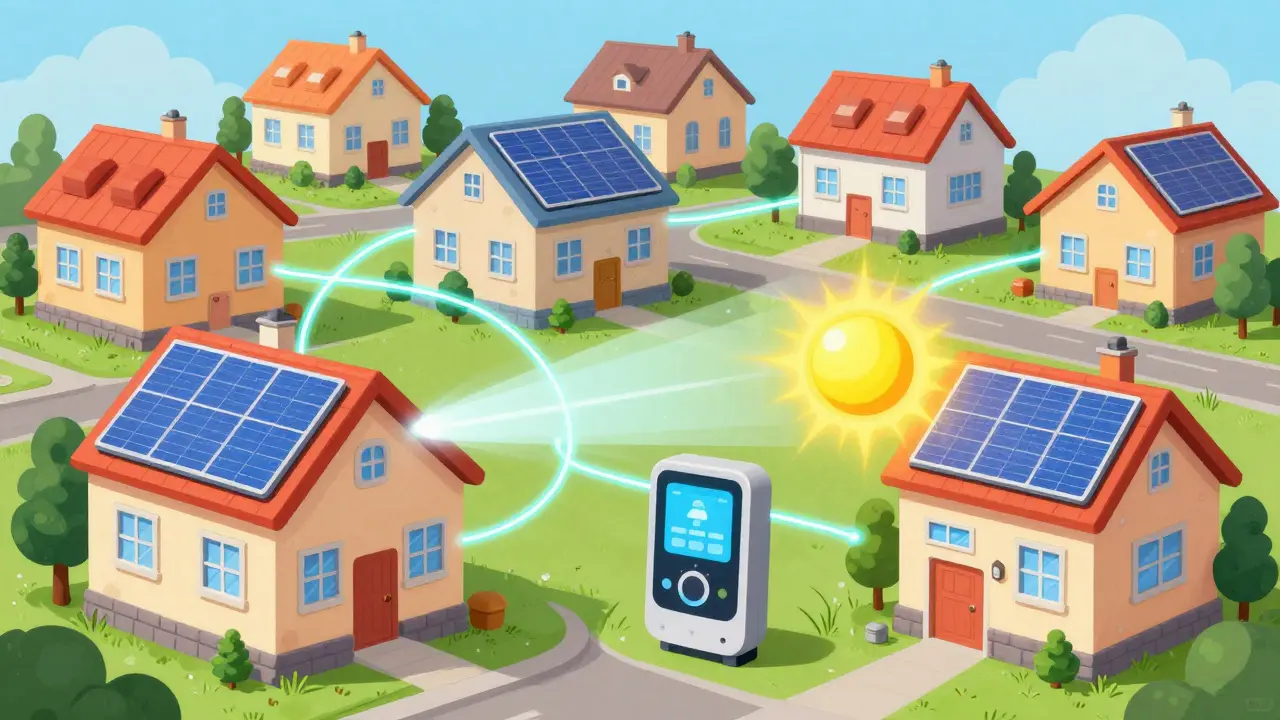
Imagine selling the extra sunlight your roof captures directly to your neighbor instead of feeding it back into a massive, distant grid. It sounds like science fiction, but it is happening right now in neighborhoods from Brooklyn to Fremantle. This is peer-to-peer energy trading, and it is reshaping how we think about power.
For decades, electricity has been a one-way street. You buy from the utility, you pay the bill, and that’s it. But with solar panels becoming cheaper and batteries getting smarter, homeowners are producing more power than they can use. The old system wasn’t built for this. That is where blockchain steps in. It acts as the digital ledger that makes direct, trustless trades possible without a middleman taking a cut.
What Is Peer-to-Peer Energy Trading?
At its core, P2P energy trading allows individuals who produce electricity (prosumers) to sell their surplus directly to other consumers. In a traditional setup, if you generate excess solar power, the utility buys it at a low feed-in tariff and sells it back to your neighbor at a higher retail rate. They keep the difference.
In a P2P model, you negotiate the price directly with your neighbor. If you agree on a fair rate, the transaction happens automatically. The key here is automation and trust. You don’t need to meet your neighbor to shake hands or send invoices. The technology handles the verification, payment, and record-keeping instantly.
This concept gained traction around 2016 with projects like the Brooklyn Microgrid. Since then, it has evolved from a niche experiment into a viable alternative for communities looking to lower costs and increase resilience. According to data from IRENA, these systems can reduce transaction costs by 30-45% compared to traditional utility-mediated arrangements.
The Tech Stack: How It Actually Works
You might wonder how a block of code can manage something as physical as electricity. It doesn’t control the electrons flowing through wires. Instead, it manages the *rights* to those electrons. Here is the breakdown of the components involved:
- Smart Meters: These are the eyes and ears of the system. Unlike old analog meters, IP-enabled smart meters (compliant with standards like IEEE 2030.5) record production and consumption in real-time, often every 15 to 60 minutes.
- Blockchain Ledger: Platforms like Ethereum or Hyperledger Fabric serve as the immutable database. Every kilowatt-hour traded is recorded here, creating a transparent history that no one can alter.
- Smart Contracts: These are self-executing codes. For example, a contract might say: "If House A produces surplus power and House B needs power, transfer $0.15 per kWh from B’s wallet to A’s wallet." No human intervention is needed.
- User Interface: Apps and web portals allow users to set preferences, such as "only buy from neighbors" or "sell at maximum price."
The process flows logically. Your smart meter detects surplus solar generation. It broadcasts this availability to the local blockchain network. A smart contract matches your supply with a nearby consumer’s demand. Once the trade is confirmed, the payment is released instantly. All of this happens in seconds, far faster than waiting for a monthly bill.
Why Choose P2P Over Traditional Utilities?
It isn’t just about ideology; there are tangible financial and technical benefits. Let’s look at the numbers.
| Feature | Traditional Utility Model | P2P Blockchain Model |
|---|---|---|
| Transaction Costs | High (utility margins + fees) | Low (30-45% reduction) |
| Transparency | Opaque pricing structures | Fully visible on public ledger |
| Settlement Time | Monthly billing cycles | Near-instant via smart contracts |
| Grid Losses | 5-8% due to long-distance transmission | ~6.2% reduction via local consumption |
| Resilience | Vulnerable to single-point failures | Decentralized; islands during outages |
One major advantage is reduced transmission loss. When electricity travels long distances, some of it dissipates as heat. By keeping energy local-buying from the house next door rather than a plant fifty miles away-you save that energy. Nature.com’s 2024 study highlights that local P2P systems minimize distribution losses significantly.
Financially, prosumers win too. Instead of accepting a fixed, often low feed-in tariff from the utility, you can sell at market rates. In Australia, Power Ledger trials showed solar owners earning an extra AUD$220-350 monthly from surplus sales. That is money back in your pocket, not the utility’s balance sheet.
Real-World Success Stories
Is this just theory? Not anymore. Several projects have proven the model works in practice.
The Brooklyn Microgrid remains the most famous example. Launched in 2016, it connected over 500 participants across three New York neighborhoods by late 2024. Users reported saving 12-18% on their energy bills. More importantly, when the main grid failed during storms, the microgrid kept powering homes because the local loop remained intact.
In Denmark, the town of Sonderborg implemented a blockchain-based system that reduced grid dependency by 37% during winter months. This was crucial for an island community where importing power can be expensive and unreliable.
These examples show that P2P trading excels in specific contexts: community solar projects, remote microgrids, and EV owner networks. However, it is not a magic bullet for every situation. Scalability remains a challenge. Most current implementations serve neighborhoods of 50-500 people. Scaling to city-wide levels requires significant infrastructure upgrades and regulatory changes.
Challenges and Limitations
Let’s be realistic. There are hurdles. First, blockchain throughput is still limited. Ethereum handles roughly 15-30 transactions per second. Visa handles 24,000. While energy trading doesn’t require millisecond speed, congestion can cause delays in smart contract execution. Reddit users in r/EnergyMarkets have complained about occasional lag during peak network times.
Second, regulation is a maze. Electricity markets were designed for centralized giants. Many jurisdictions do not legally recognize individuals as energy sellers. The WePower project in Lithuania faced 18 months of delays before shutting down due to unclear rules. Even in supportive regions, navigating compliance takes time and expertise.
Third, user experience matters. Setting up a P2P system isn’t plug-and-play. Onboarding can take 3-5 hours for first-time users. You need compatible smart meters, internet connectivity (minimum 1Mbps), and a device to run the app. For non-technical households, this learning curve can be steep.
The Future: V2G and Beyond
The next frontier is Vehicle-to-Grid (V2G) integration. Electric vehicles are essentially rolling batteries. Imagine parking your EV at home and having it automatically sell stored energy back to the neighborhood during peak evening hours. BMW and Siemens launched a trial in Munich in April 2024, connecting 200 EVs to a P2P market. This could turn every car into a revenue-generating asset.
Ethereum’s switch to proof-of-stake in 2022 also addressed environmental concerns, reducing energy consumption by 99.95%. This makes blockchain a greener choice for managing green energy, removing a major criticism of earlier systems.
By 2030, IRENA predicts P2P trading could account for 10-15% of distributed renewable transactions in regulated regions. As standards like IEEE 2030.5 Annex D finalize, interoperability will improve, making it easier for different devices and platforms to talk to each other.
Do I need special equipment to join a P2P energy market?
Yes. You typically need a smart meter that supports real-time data transmission (like IEEE 2030.5 compliant models) and an internet connection. Older analog meters cannot track the minute-by-minute production and consumption required for automated trading.
Is peer-to-peer energy trading legal everywhere?
No. Regulations vary widely. The EU has established frameworks for 'renewable energy communities,' and the US FERC Order 2222 opens doors for aggregated resources. However, many regions still prohibit direct sales between individuals. Always check local utility regulations before investing.
How much can I earn from selling excess solar power?
Earnings depend on your location, panel size, and local demand. In Australian trials, prosumers earned an additional AUD$220-350 per month. In the US, savings of 12-18% on total bills have been reported. It is rarely a get-rich-quick scheme, but it does offset costs effectively.
Does blockchain consume too much energy to be eco-friendly?
Not anymore. Early blockchains like Bitcoin used energy-intensive proof-of-work. However, major platforms like Ethereum switched to proof-of-stake in 2022, cutting energy use by 99.95%. Modern P2P energy systems are highly efficient and align well with sustainability goals.
What happens if my neighbor stops paying?
Smart contracts prevent this. Payments are usually held in escrow or transferred simultaneously with the energy delivery. If the funds aren’t available, the trade simply doesn’t execute. The blockchain ensures that only verified, paid-for energy is consumed.