
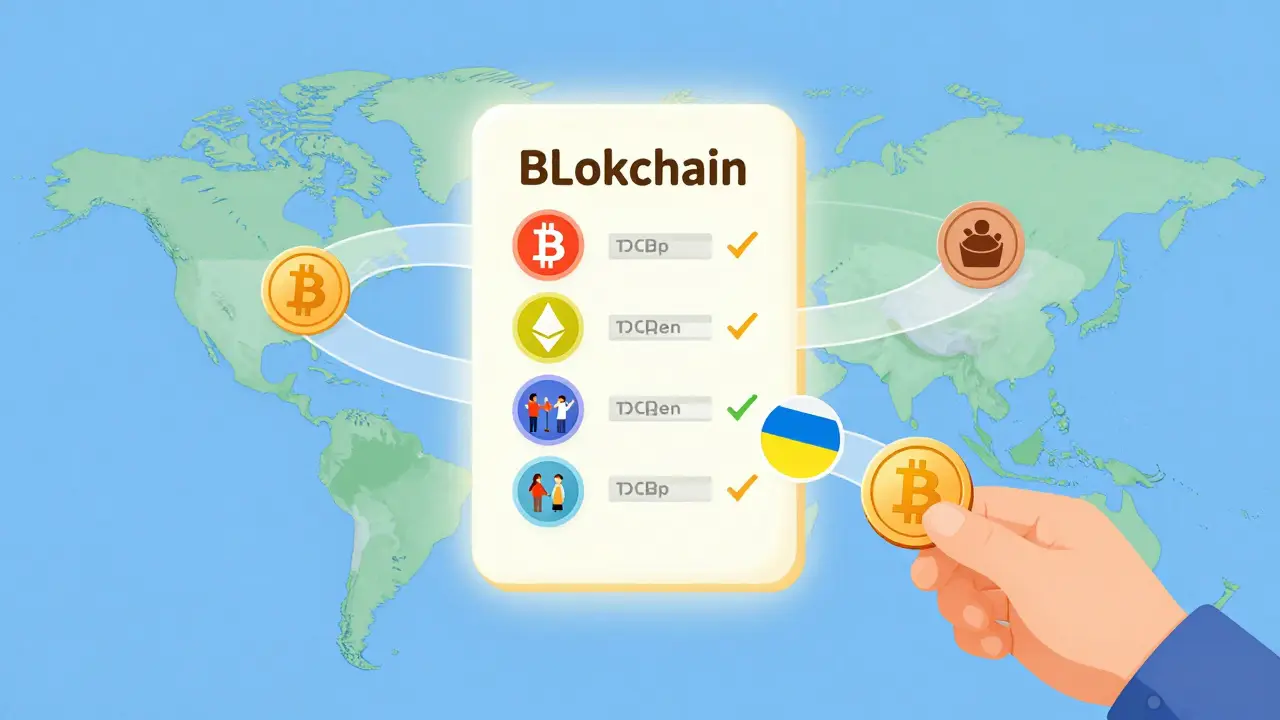
Imagine sending a donation and seeing every single step it takes-from your wallet to the hands of someone in need. No middlemen. No hidden fees. No guesswork. That’s not science fiction. It’s what blockchain is doing for charity today.
Traditional philanthropy has long struggled with trust. Donors ask: Where does my money go? How much actually reaches the cause? How long does it take? The answers are often vague, delayed, or buried in paperwork. Blockchain fixes this by making every transaction visible, permanent, and verifiable. It’s not about replacing charities. It’s about giving donors proof-and accountability-that they’ve never had before.
Proof of Impact: Seeing Your Donation Move
Before blockchain, a $100 donation to a disaster relief fund might disappear into a complex web of banks, intermediaries, and administrative layers. Only 75-85% of that money typically reached the intended program, according to Charity Navigator. The rest? Fees, overhead, delays.
With blockchain, that same $100 becomes a digital transaction recorded on a public ledger. You can track it in real time using a blockchain explorer. In 2022, when Ukraine needed urgent aid after Russia’s invasion, over $100 million in cryptocurrency arrived within 72 hours. Traditional aid channels took weeks to mobilize the same amount. Why? Because blockchain skips the banking system entirely. No wires. No checks. No delays.
Organizations like the Pineapple Fund distributed $55 million to more than 60 charities using multi-signature wallets-requiring at least two of three authorized people to approve each payout. That’s not just transparency. That’s security built into the system.
Lower Costs, Faster Results
PayPal and credit card processors charge around 2.9% plus 30 cents per transaction. For a nonprofit handling thousands of small donations, that adds up fast. On blockchain, sending cryptocurrency costs between $0.50 and $2.00, no matter the amount or distance. That’s a 97% reduction in fees, according to IMD Business School’s 2024 analysis.
Settlement times are just as dramatic. Bank transfers take 3-5 business days. Ethereum-based crypto donations settle in 15-30 seconds. That matters when you’re delivering food, medicine, or emergency cash to people in crisis.
Take the Identity Theft Resource Center. In 2024, they received $3.4 million in Bitcoin donations through The Giving Block. Without blockchain, processing that volume would have meant months of manual reconciliation, fees eating into their budget, and slower response times. With crypto? Instant deposits, automated receipts, and zero interference from third-party processors.
Who’s Giving-and Why
It’s not just tech-savvy millennials. The biggest crypto donors are often long-time cryptocurrency holders who’ve seen their holdings grow tenfold or more. They’re not just giving money-they’re giving appreciated assets. And here’s the smart part: when you donate Bitcoin or Ethereum directly to a nonprofit, you don’t pay capital gains tax. You also get a full fair-market-value tax deduction. That’s a double win.
According to Giving Compass’ 2025 donor survey, 72% of crypto donors are under 45. Their average donation? $12,500. Compare that to the $1,200 average for traditional donors. This isn’t a fringe movement. It’s a new class of high-impact givers entering the space.
Fortune 500 companies are catching on too. In 2022, only 12% had crypto donation options. By 2025, that number jumped to 47%, per Cone Communications’ CSR survey. They’re not doing it for PR. They’re doing it because their employees and customers expect it.

Real Stories: Transparency That Changes Trust
On Reddit, a user named ‘PhilanthropyFirst’ donated 0.5 BTC ($25,000) to Embrace Relief in March 2024. He didn’t just send the money. He tracked it through 17 steps-from his wallet, to the charity’s wallet, to a Ukrainian refugee center, to a family receiving meals. He posted screenshots. He shared timestamps. He didn’t need a newsletter or annual report. He saw it happen.
"I’ve never had this level of visibility with traditional charities," he wrote. That’s the power of blockchain. It turns trust from a promise into a public record.
But it’s not perfect. One nonprofit administrator on LinkedIn described a 3-week delay in January 2025 when they couldn’t convert donated ETH to USD fast enough. Market volatility tanked the value of their funds, and their food distribution program ran short. That’s a real problem. But it’s not a flaw in blockchain-it’s a flaw in how charities handle liquidity.
The solution? Most crypto donation platforms now offer instant conversion to fiat currency. 82% of them do it automatically, according to NPTrust’s 2025 report. The nonprofit doesn’t hold crypto. They get cash. The donor gets transparency. Everyone wins.
What’s Holding Back Wider Adoption?
Not everyone is ready. Only 22% of donors fully understand how crypto donations work, per Giving Compass. That’s a big barrier. People don’t trust what they don’t understand.
Regulation is another hurdle. 137 countries have different rules about crypto. Some ban it. Some tax it. Some ignore it. In the U.S., 28 states passed specific crypto charity laws in 2024-2025. The IRS clarified in Notice 2024-45 that donating crypto is treated like donating stock-no capital gains, full deduction. That’s a major step forward.
And then there’s the tech gap. Many nonprofits lack the staff or knowledge to set up a crypto wallet, manage private keys, or integrate with accounting software. But that’s changing fast. Platforms like The Giving Block, Coinbase Charitable, and NPTrust now offer turnkey solutions. Setup takes 2-4 weeks. Training is under 30 hours. Support teams handle the heavy lifting.
The Future Is Already Here
By 2026, 71% of major U.S. nonprofits plan to accept cryptocurrency, according to Instrumentl’s 2025 survey. That’s not speculation-it’s a roadmap.
What’s next? NFTs for impact verification. Imagine a donor receiving a digital badge tied to their contribution, showing exactly how their donation helped build a school or fund a vaccine. That’s launching in Q3 2025 through The Giving Block.
AI is getting involved too. In mid-2024, an experimental AI agent donated 0.3 ETH ($900) to an environmental nonprofit. It didn’t need a human to click ‘donate.’ It analyzed data, identified the most effective cause, and acted. This isn’t a gimmick. It’s the beginning of autonomous philanthropy.
And here’s the quiet revolution: blockchain isn’t replacing traditional giving. It’s enhancing it. Donor-Advised Funds (DAFs) now integrate with crypto. Foundations can pool donations, manage tax compliance, and distribute grants-all while keeping the blockchain ledger as a public audit trail.
The goal isn’t to make everyone a crypto expert. It’s to make giving simple, transparent, and trustworthy. When a donor knows their money reached the right place, on time, with no fees eaten away-they give more. And they give again.
Why This Matters for Every Donor
You don’t need to understand blockchain to benefit from it. Just like you don’t need to know how a credit card works to use one. You just need to know it’s safe, fast, and honest.
If you’ve ever doubted whether your donation made a difference, blockchain gives you the answer. If you’ve ever felt frustrated by slow aid or hidden fees, blockchain fixes that. If you’re a nonprofit leader, it’s not a luxury-it’s becoming a requirement. Donors are asking for it. And the data shows they’re giving more when they get it.
This isn’t a trend. It’s a shift in how humanity chooses to care for each other. The technology is here. The donors are ready. The question isn’t whether blockchain will change philanthropy. It’s how fast you’ll use it to do better.
Can I donate Bitcoin to any nonprofit?
Not yet, but it’s getting close. As of 2025, 78% of major U.S. nonprofits can accept cryptocurrency either directly or through Donor-Advised Funds. Platforms like The Giving Block and Coinbase Charitable make it easy for charities to add crypto options without technical expertise. If your favorite charity doesn’t accept crypto yet, you can ask them to sign up-many do so within weeks.
Is donating crypto safe?
Yes, if done through trusted platforms. Reputable crypto donation services use multi-signature wallets, encrypted storage, and automated compliance checks. Your private keys are never shared with the charity. The transaction is recorded on the blockchain, so it’s tamper-proof. The biggest risk isn’t hacking-it’s sending to the wrong address. Always double-check the wallet address before confirming.
Do I get a tax deduction for crypto donations?
Yes. In the U.S., the IRS treats crypto donations like stock donations. You don’t pay capital gains tax on the appreciated value, and you can deduct the full fair market value of the crypto at the time of donation. This applies only if you donate directly to a qualified nonprofit-not through a third-party exchange. Always get a receipt from the charity and keep your transaction hash for your records.
What happens if the price of Bitcoin drops after I donate?
It doesn’t affect you. Once you send the crypto, the value is locked in at the time of donation for tax purposes. The charity receives the full amount you sent. If they convert it to USD right away (which most do), they lock in the value too. You’re not responsible for price swings after your donation is complete. The charity bears the risk, not you.
Are crypto donations only for big donors?
No. You can donate as little as $5 in crypto. Many platforms allow fractional donations-even $1 worth of Ethereum or Dogecoin. While the average crypto donor gives $12,500, small donations are just as valid and tracked with the same transparency. Blockchain doesn’t care how much you give. It just makes sure it gets there.
Can I track my donation after I send it?
Yes. Every crypto donation has a unique transaction ID (hash) on the blockchain. You can paste this into a public explorer like Etherscan or Blockchain.com to see exactly where it went, how many confirmations it received, and when it was received by the charity. Some nonprofits even link these hashes to impact reports-showing how your $50 helped feed a child or plant a tree.
Is blockchain philanthropy just for tech people?
No. You don’t need to be a tech expert. Think of it like online banking. You don’t need to know how the internet works to send money. With crypto donations, you just need to click a button, enter the wallet address, and confirm. Most platforms guide you step-by-step. The technology does the heavy lifting. Your job? Give with confidence.
What if I want to donate in crypto but don’t own any?
You can buy crypto easily through apps like Coinbase, Kraken, or PayPal. Buy Bitcoin, Ethereum, or another supported coin, then send it directly to the charity’s wallet address. Many platforms also let you use a credit card to donate crypto instantly-no wallet needed. You pay with your card, the platform buys the crypto, and sends it on your behalf. Simple.
blockchain for charity? sure, until the price of eth drops 40% and the orphanage can't buy food because the charity didn't hedge. nice theory, terrible execution.
How quaint. A Western tech solution to a problem that doesn't exist in most of the world. In India, we have chai-wallahs who deliver aid with a smile and a receipt written on a napkin. No blockchain required. Just humanity.
Oh wow, so now we're outsourcing charity to crypto bros who think sending 0.5 BTC is 'philanthropy'? Let me guess - they also think their NFT monkey is a legacy. The real transparency is how little of this actually helps the people on the ground. Most of these 'transparent' donations vanish into tax havens disguised as 'nonprofits'.
And don't get me started on the 'double tax win' - that's just the rich playing accountant while kids go hungry.
The only thing blockchain proves is that the wealthy can now donate with more flair - and fewer consequences.
Actually, the real win here isn't the tech - it's the trust. I've donated to three charities via crypto now. Each one sent me a link to the transaction hash, then a photo of the school built with that money. No email blasts. No fundraising letters. Just proof. That’s revolutionary. And yes, even $10 donations are tracked - I did one last week to a water project in Kenya. Saw the well being dug. Real stuff.
And yes, volatility is a risk - but 82% of platforms auto-convert to fiat. The charity gets cash. You get transparency. Win-win. Stop acting like it's a scam because you don't understand it.
Oh please. You think blockchain is the answer? What about the 12 million people in the Global South who don’t have smartphones, let alone wallets? You’re not helping them - you’re building a luxury dashboard for Silicon Valley elites who want to feel virtuous while their crypto portfolio doubles. This isn’t charity. It’s performance art with a ledger.
And don’t give me that 'they can buy crypto easily' nonsense. Try buying ETH in rural Bihar. The internet cuts out every 20 minutes. The power goes out. Your 'transparent' donation? Gone. Vanished. Like magic.
Look, I get it - blockchain is cool. I’ve been in crypto since 2017. But let’s be real: most nonprofits don’t have the bandwidth to manage private keys, let alone reconcile on-chain transactions with their accounting software. I work with a small org in Ohio - they got a $50k BTC donation last year. Took them six weeks to convert it because their CFO panicked every time a transaction hash popped up. They almost refused the gift. The tech is there, sure - but the human infrastructure? Barely exists. And that’s the real bottleneck.
Also, the tax deduction thing? Totally valid. But let’s not pretend this is about helping the poor. It’s about capital gains avoidance disguised as altruism. The average crypto donor gives $12,500 - that’s not the guy selling his last pair of shoes to feed a family. That’s the guy who bought Bitcoin for $300 and now wants to write it off.
And yes, I know about The Giving Block. I’ve used it. It’s great. But it’s not scalable to the 99% of charities that don’t have a tech team. Until we solve that, this is just a fancy niche.
Also, AI donating ETH? That’s not philanthropy. That’s algorithmic gambling with moral veneer. If a bot decides who deserves aid based on data points, we’re not building trust - we’re outsourcing empathy to a neural net.
Don’t get me wrong - I love the transparency. But let’s not confuse novelty with impact.
So we’re now celebrating a system that requires users to understand private keys, transaction hashes, and blockchain explorers - all to give $5 to a child? Meanwhile, the average donor in the UK still gives through direct debit, gets a receipt, and knows their money went to the soup kitchen. No one needs a crypto wallet to be kind.
This isn’t progress. It’s complexity masquerading as innovation.
OMG YES!! 🙌 I donated $20 in DOGE to a cat rescue last month and tracked it all the way to the vet bill!! 🐱💖 Blockchain is the future and I’m so here for it!!
if you dont know how to use a wallet dont donate
I love that this is making giving more human - not less. When you can see your $50 feed a family for a week, it changes everything. I’ve started asking my friends to donate crypto instead of birthday gifts. Last month, my sister sent $75 in ETH to a refugee center. We got a video of kids eating their first warm meal in months. That’s the kind of connection money can’t buy - but blockchain made possible.
It’s not about being techy. It’s about being real.
Blockchain philanthropy feels like digital alchemy - turning skepticism into trust, silence into transparency, and doubt into direct impact. It’s not just about ledger entries; it’s about rewriting the emotional contract between giver and receiver. No longer are donors ghosts in the machine. We become witnesses. We become co-authors of change. And that? That’s the quiet revolution no headline can capture.
I once donated $100 in LINK to a solar project in rural Nepal. Three weeks later, I got a photo: a child reading under a lamp powered by the very energy my donation funded. No charity newsletter. No donor report. Just a grainy phone pic and a timestamp on Etherscan. That’s the poetry of it.
We don’t need to understand every line of code. We just need to believe that truth can be immutable. And for the first time in philanthropy - it is.
It’s not about the technology - it’s about the intention. When you can see your donation move, it doesn’t just change how you give - it changes how you care. I used to feel guilty donating because I never knew if it mattered. Now? I know. And that’s the real gift.
Let’s not mistake efficiency for equity. Blockchain may make transactions transparent, but it does nothing to address the systemic inequalities that create the need for charity in the first place. A ledger can track a $100 donation - but it cannot fix a broken healthcare system, a collapsed education infrastructure, or centuries of colonial extraction. The real philanthropy lies not in the blockchain, but in the policy, the advocacy, the structural change that makes these donations unnecessary. Let’s not let shiny tech distract us from the deeper work.
Transparency without justice is just a very well-organized illusion.
Good point. I’ve seen charities use blockchain to prove impact, but I’ve also seen them ignore the root causes - like underfunded local governments or exploitative supply chains. The tech helps us see the symptom. But we still need to treat the disease.
Maybe the real innovation isn’t the ledger - it’s when nonprofits start using blockchain data to lobby for policy change. Imagine a public dashboard showing where donations go… and then using that data to demand government accountability. That’s the next level.