

Many people assume that if a country has restrictions on cryptocurrency, its citizens must use shady workarounds to get access. That’s not true in Colombia. In fact, Colombians don’t need to bypass restrictions because there aren’t any - not the kind you’d think, anyway.
Colombia has over 5 million people actively using crypto. In 2024 alone, $6.7 billion in cryptocurrency was traded within the country. That’s not a niche hobby. That’s a full-blown financial movement. And it’s happening openly, legally, and with institutional backing.
There’s no ban - just rules
The idea that Colombians struggle to access crypto exchanges comes from outdated stories. There’s no law saying you can’t buy Bitcoin, Ethereum, or any other coin. You can walk into a local exchange, link your bank account, and start trading - no VPNs, no peer-to-peer dodging, no underground apps.
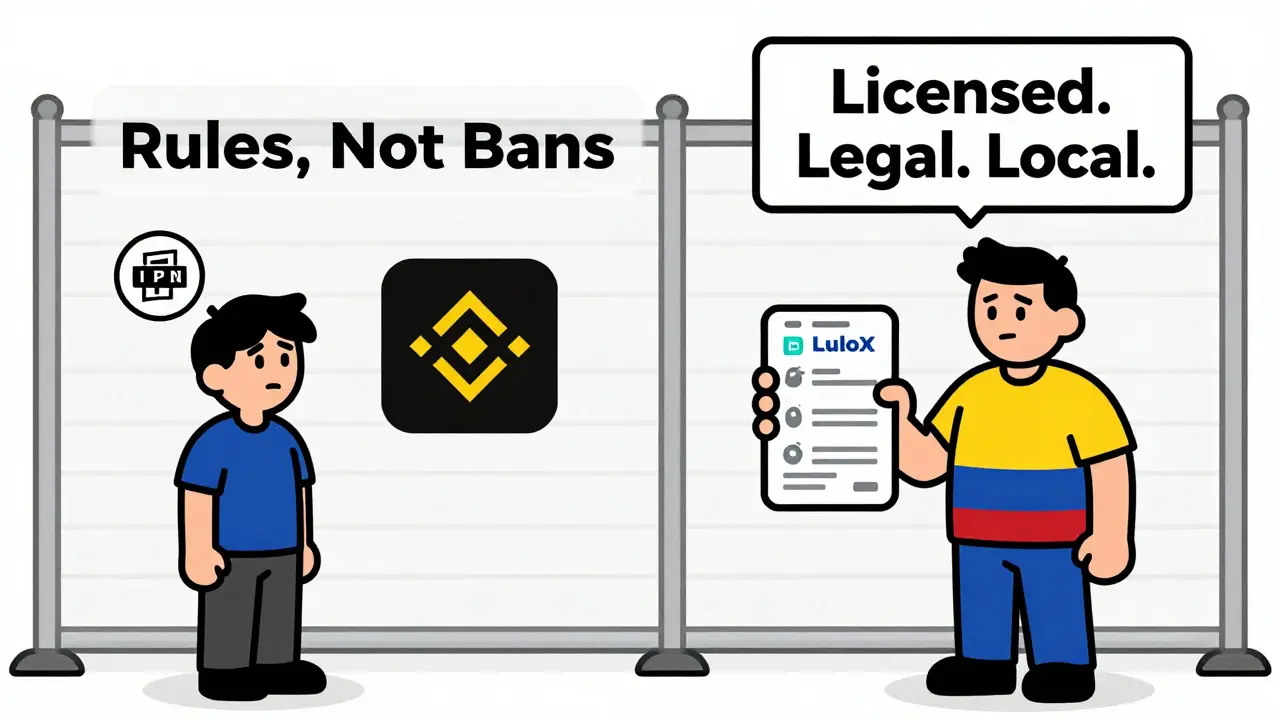
What exists isn’t a wall. It’s a fence. The government doesn’t stop you. It just wants to know who you are and where your money comes from. That’s it.
The Financial Superintendency of Colombia (SFC) requires all crypto platforms operating in the country to follow strict KYC (Know Your Customer) rules. If you’re buying crypto, you’ll need to show your ID, proof of address, and sometimes even proof of income. But that’s the same process you go through to open a bank account or buy a car. It’s not a barrier - it’s standard procedure.
Local exchanges are thriving
Colombians aren’t just using Binance or Coinbase. They’re using local platforms built for them.
LuloX is one of the biggest homegrown crypto exchanges. It supports Colombian pesos (COP), has a simple mobile app, and integrates directly with local banks. You can deposit COP via PSE (Colombia’s real-time payment system) and buy Bitcoin in under five minutes.
Then there’s Wenia, launched by Bancolombia - Colombia’s largest bank. Yes, the same bank that handles your salary and mortgage now runs a crypto exchange. Wenia offers a stablecoin called COPW, pegged 1:1 to the Colombian peso. It’s not a workaround. It’s a product designed by one of the country’s most trusted financial institutions.
These aren’t fringe players. They’re regulated, audited, and supervised by the SFC. And they’re growing fast.
Crypto mining? It’s legal - and booming
One of the biggest myths is that mining crypto is banned or hidden. It’s not. Colombia has become one of the top mining spots in Latin America.
Why? Low electricity costs, stable internet, and clear rules. In 2023, the government released official guidelines for mining operations: register your equipment, report energy use, pay taxes like any other business. That’s it.
A startup in Bogotá now runs a 2-megawatt mining farm powered by renewable energy. They hired 30 local technicians. They pay taxes. They report everything. And they’re not hiding.
Other mining hubs have popped up in Medellín, Cali, and even smaller towns. The government doesn’t shut them down. It encourages them.

How taxes work - no surprises
Some people think crypto is tax-free. It’s not. But that doesn’t mean it’s restricted - it means it’s treated like any other financial asset.
If you trade crypto and make a profit, you pay income tax. If you run a crypto business, you pay corporate tax. The rules are simple:
- Capital gains from personal trading are taxed under personal income tax brackets (10%-39%).
- Businesses must report crypto income as part of their annual tax return.
- There’s no special crypto tax - just existing tax laws applied to digital assets.
The UIAF (Financial Intelligence Unit) monitors transactions over $150. If someone moves $10,000 in crypto without reporting, they get flagged. But that’s not a restriction - it’s anti-money laundering. The same rules apply to cash transfers, wire transfers, and real estate sales.
Why people think there are restrictions
So where did the idea come from that Colombians need to bypass rules?
It’s partly confusion. In 2021, the SFC told traditional banks they couldn’t hold crypto or facilitate crypto transactions. That meant some banks blocked deposits to crypto exchanges. But that rule only applied to banks - not to you.
It didn’t stop you from buying crypto. It just meant you had to use a crypto exchange directly, not go through your bank. And that’s exactly what people did. They switched to platforms like LuloX or Wenia. They didn’t hide. They adapted.
Also, some international platforms (like Binance) got blocked in Colombia because they refused to comply with local regulations. But that didn’t stop Colombians - it just pushed them toward local, compliant services.
The future is regulated - not restricted
Colombia isn’t waiting for global rules. It’s making its own.
Bill 510 of 2025, introduced by Senator Gustavo Moreno and Representative Julián López, is now moving through Congress. This bill will formally recognize Virtual Asset Service Providers (VASPs) as legal entities. It will set licensing requirements, reporting standards, and consumer protections.
This isn’t about shutting crypto down. It’s about bringing it into the light.
By 2026, every crypto platform in Colombia will need to be licensed. That means more security, fewer scams, and more trust. And it means Colombians will have even better access - not less.
Colombia’s crypto scene in numbers
Here’s what’s real:
- 5 million+ active crypto users
- $6.7 billion in crypto traded in 2024
- 36th globally in crypto adoption (Chainalysis 2025)
- 5th in Latin America
- Over 20 licensed local crypto platforms
- 3 major banks offering crypto services (Bancolombia, Davivienda, BBVA)
These aren’t underground numbers. They’re public data. Collected by regulators. Reported to the IMF. Verified by international analysts.
You don’t need to bypass anything
Colombians don’t need to use a VPN to access crypto. They don’t need to trade in cash. They don’t need to hide their transactions.
They just need to use a licensed exchange, show their ID, pay their taxes, and follow the rules - the same rules that apply to stocks, real estate, or foreign currency.
The real story isn’t about restrictions. It’s about evolution. Colombia didn’t shut crypto out. It invited it in. And now, millions of people are using it - legally, safely, and without apology.
Is it legal to buy Bitcoin in Colombia?
Yes, it’s completely legal to buy, sell, and hold Bitcoin and other cryptocurrencies in Colombia. There is no law banning crypto ownership. The government regulates platforms that offer crypto services, not individual users.
Can I use Binance in Colombia?
Binance is not licensed in Colombia, so it doesn’t offer services directly to Colombian users. However, many Colombians still access it through international accounts. But for full legal protection and local support, using a licensed Colombian exchange like LuloX or Wenia is recommended.
Do I have to pay taxes on crypto profits in Colombia?
Yes. Crypto gains are taxed under Colombia’s existing income tax laws. Personal traders pay capital gains tax (10%-39%), while businesses must report crypto income as part of corporate taxes. The UIAF tracks large transactions to prevent money laundering, not to punish users.
Are Colombian banks allowed to offer crypto services?
Traditional banks like Bancolombia and BBVA cannot hold or trade crypto directly. But they can partner with licensed crypto platforms. Bancolombia launched Wenia, a fully regulated crypto exchange, so users can now buy crypto through their bank’s ecosystem - legally and safely.
Is crypto mining legal in Colombia?
Yes. Crypto mining is legal and regulated. Operators must register their equipment, report energy usage, and pay taxes. Several mining farms now operate openly in Bogotá, Medellín, and other cities, contributing to local job growth and infrastructure.
Wow, this is such a refreshing take! I always thought countries like Colombia had to sneak around crypto laws, but it’s actually just… regulated? Like, normal? That’s kind of beautiful.
It’s not about restriction - it’s about integration. And honestly, that’s how innovation should work. No shadow games, just clear rules and real access. Kudos to Colombia for doing it right.
so like… no vpn? no p2p? just… use lulox? 😱 i’m shook. i thought every country had to be sneaky. this is wild. also, 5 million users?? legit?? 🤯
Colombia didn’t just welcome crypto - they threw it a parade with a band, empanadas, and a tax form. It’s not just legal - it’s woven into the fabric of daily finance. That’s not policy. That’s culture.
Imagine if every country treated digital assets like they were just… money? No fear. No panic. Just clarity. Colombia’s doing the heavy lifting for the whole world here.
This is what happens when you let bureaucrats write financial policy. No wonder the US is falling behind. Colombia’s got more sense than half our Congress. We still treat Bitcoin like it’s contraband. Meanwhile, they’re mining with solar panels and filing taxes like pros. Pathetic.
It’s interesting how the narrative shifts when you stop framing regulation as oppression. Colombia’s approach shows that compliance and innovation aren’t opposites - they’re partners. The fact that banks like Bancolombia are leading this? That’s a quiet revolution.
I love this. Not because it’s perfect, but because it’s real. People think crypto has to be chaotic or underground to be authentic. But here’s proof: it can be orderly, safe, and still transformative. That’s the future. And it’s already here.
so… they just… let people buy btc? like… with id? and stuff? i thought you had to be a spy or something. also, is 6.7 billion a lot? idk. i’m not a math person. 🤷♀️
YESSSSSS this is what I’ve been saying for YEARS! 🙌 Colombia didn’t "bypass" anything - they built a better system. Why do we keep acting like regulation = oppression? It’s not a wall. It’s a doorway. And guess what? LuloX is open. Wenia is open. The future is here. Let’s stop acting like crypto is some rebellion. It’s banking. With better UX.
This is the kind of story I need to see more of. Not "crypto is illegal" drama. Not "Binance banned" panic. Just… clean, smart, real-world adoption.
Colombians aren’t hackers. They’re just people who want to use money better. And the system let them. That’s the win.
They say "no ban," but what about surveillance? The UIAF tracks everything. That’s not regulation - it’s control. And if they can track your crypto, they can track your life. This isn’t freedom. It’s a velvet cage.
Colombia’s crypto scene reminds me of how Japan handles anime - not as a fringe thing, but as part of mainstream culture. Same energy. Same respect. Same infrastructure. We need more countries to stop panicking and start building.
While the narrative of Colombia’s regulatory clarity is compelling, it’s important to contextualize the data. The $6.7 billion in traded volume represents approximately 0.8% of GDP - significant, but not transformative at a macro level.
Additionally, while licensed exchanges are growing, penetration among rural populations remains low due to digital literacy gaps and infrastructure limitations. The success is real, but it’s not universal. Nuance matters.
Oh great, another "Colombia’s so cool" article. Newsflash: they’re not special. They just have less regulation than we pretend to. Meanwhile, the US is trying to actually protect people. You think it’s "open"? It’s just sloppy. And now everyone’s using it to launder money. Thanks, Colombia.
Colombia’s crypto scene? Cute. But let’s be real - it’s just another way for rich people to avoid taxes while pretending it’s "progressive." And don’t get me started on "mining farms" - that’s just energy theft with a blockchain label. Real innovation doesn’t need a 2-megawatt rig. It needs soul.
Wait, wait, wait… you’re telling me… they don’t even… require… a… notarized… affidavit… for… Bitcoin… purchases?!?!?!?!?!?!?!?!
It’s not about legality - it’s about ethics. If you’re trading crypto, you’re participating in a system designed to undermine sovereign currency. Colombia isn’t enlightened - they’re naive. And now they’re teaching the world that financial responsibility is optional. What a tragic legacy.
Didn’t know Bancolombia did crypto. That’s actually kinda cool. I thought only the big US apps could do that. Guess I was wrong. Thanks for the update.