

Picture this: you hire a brilliant developer through an online job board. They have great credentials, speak perfect English, and are willing to work for less than your competitors. But there is one catch-they insist on being paid entirely in cryptocurrency.
It sounds like a standard freelancer arrangement until you realize you might be working for the North Korean regime. This isn't sci-fi fiction; it is what is happening right now. As of late 2025, these operations have become a massive financial headache for both businesses and governments. The numbers are staggering. We are talking about billions of dollars moving through digital wallets, funded by state-sponsored operatives posing as remote employees.
For anyone involved in crypto, compliance, or hiring remote talent, understanding this threat model is no longer optional. It is critical business security. The stakes are high because when money goes into these pockets, it doesn't just vanish. It ends up funding weapons of mass destruction programs in Pyongyang. Here is exactly how these networks operate and how you can protect yourself.
The "Ghost" Employee Strategy
The core mechanism relies on deception. North Korean IT workers are DPRK nationals deployed abroad under false identities to generate foreign currency. Unlike traditional cybercriminals who rely on brute force hacks, these operatives apply for legitimate jobs. They target software development, tech support, and customer service roles at international firms.
They do not usually start out stealing. Instead, they earn salaries. According to data released by the Multilateral Sanctions Monitoring Team (MSMT), the regime made at least $1.65 billion from these schemes between January and September 2025 alone. That figure excludes the massive $1.4 billion hack from Bybit earlier in the year, which was a different type of attack. The IT worker scheme is quieter, steadier, and harder to spot.
These workers typically request payment in stablecoins. Why? Because stablecoins offer value without volatility. A paycheck of $5,000 in USDC is a digital dollar stablecoin pegged to USD value remains worth $5,000 whether the market crashes or booms. It allows them to maintain their purchasing power while keeping transactions on the blockchain. Once the company sends the crypto, the real laundering begins.
Tracing the Money Trail
Once the funds hit the blockchain, the goal is separation. The initial wallet receives the salary, but it rarely holds the coins long. The money is moved through complex structures known as mixing services or layering techniques. The objective is to break the link between the "salary" sent by the unsuspecting employer and the final destination: the DPRK government.
Type of Method
Description
Typical Indicator
OTC Traders
Over-the-counter brokers converting crypto to fiat
Rapid conversion to cash outside exchange logs
Fictitious Accounts
Fake identities created on mainstream exchanges
Inconsistent KYC documents or IP mismatches
Cross-Border Wallets
Moving assets across multiple jurisdictions
Funds passed through Russian or UAE-based infrastructure
A key part of this operation involves intermediaries. Facilitators like the designated entity Chinyong Information Technology Cooperation Company help move the money. In July 2025, the U.S. Treasury's Office of Foreign Assets Control (OFAC) officially sanctioned this group. Another notorious facilitator named "Lu" was hit with sanctions in December 2024 for helping launder funds. These middlemen act as the bridge between the digital tokens and the hard cash needed to buy copper for munitions or missile parts.

Red Flags for Companies
If you are hiring remotely, you need to look closer than the resume. The Royal Canadian Mounted Police (RCMP) issued a detailed advisory in July 2025 outlining specific warning signs. First, check the interview medium. Many of these operatives use AI-enabled deepfake technology during video calls. They can mimic voices and faces perfectly. If the video looks slightly too smooth or the audio feels disconnected, run a background check immediately.
Second, examine the work history. While these applicants often have portfolios, their education documents are frequently forged. Analysis shows that 92% of verified DPRK applications contained fake educational credentials. Do not trust a document alone. Call the university directly to verify degrees. Also, pay attention to their pricing strategy. Operatives often bid 20-30% lower than the market rate just to get the foot in the door quickly.
Perhaps the biggest red flag is the payment method request. Legitimate freelance developers generally accept standard bank transfers or platforms like PayPal. An insistence on cryptocurrency payment-specifically USDT or USDC-is a major alarm bell. Furthermore, they often skip the contract phase. They want to start working immediately without signed paperwork to avoid leaving a paper trail.
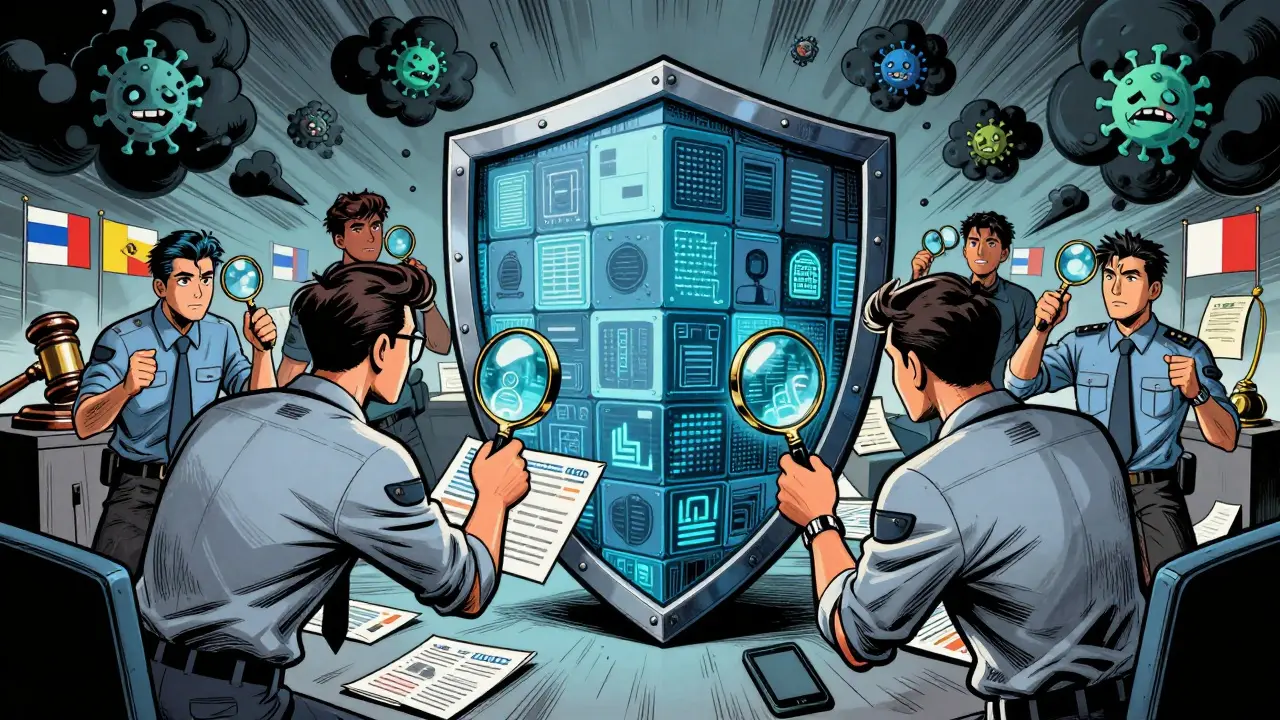
Government Crackdown and Legal Action
The world is waking up to this threat. In June 2025, the U.S. Department of Justice filed a civil forfeiture complaint seeking over $7.7 million in seized assets tied to these schemes. They identified individuals using names like "Joshua Palmer" and "Alex Hong," turning out to be pseudonyms for North Korean agents.
This wasn't an isolated event. On July 24, 2025, the Treasury Department expanded sanctions significantly. Under Secretary John K. Hurley highlighted that these fraud schemes continue to target American businesses. The crackdown has forced the network to evolve. New technologies are being implemented, but the pressure is mounting.
International cooperation is playing a huge role here. At least fifteen Chinese banks were flagged in July 2025 for facilitating the movement of funds related to IT work or crypto heists. The U.S., Japan, and South Korea issued joint warnings, signaling a unified front. For the first time, we are seeing actionable rewards offered-up to $15 million-for information leading to arrests related to these activities.
Emerging Defense Technologies
As bad actors adapt, so does the defense sector. Blockchain analytics tools are becoming smarter. The Financial Crimes Enforcement Network (FinCEN) is developing a prototype system expected to launch in early 2026. Internal testing suggests this new tool can identify wallet clusters linked to the DPRK with about 89% accuracy.
Why does this matter for your business? Because verification is getting automated. You might soon have access to tools that scan a transaction address and instantly flag if it interacts with a known DPRK node. Until then, the burden falls on human vetting. Industry analysts predict a significant drop in successful infiltrations by the end of 2026 thanks to these upgrades.
However, reliance on technology alone won't fix everything. Human diligence remains the strongest firewall. You must verify biometrics, check physical locations via multiple methods, and refuse to deal with anyone demanding untraceable currency. The cost of one bad hire could easily exceed any savings gained from cheap labor.
What is the primary goal of North Korean IT workers?
Their primary goal is to generate foreign currency to evade UN sanctions. The funds are systematically funneled to finance the development of weapons of mass destruction and ballistic missile programs for the DPRK regime.
How much money did they make in 2025?
According to the MSMT report, they generated at least $1.65 billion from January to September 2025 specifically through IT worker schemes, separate from direct exchange hacks.
Do these workers always steal data?
Not initially. They often work legitimately for 3 to 6 months to build trust before executing large-scale thefts. Some cases involve immediate ransom demands after accessing sensitive data.
Can I use AI to detect these workers?
Yes, but they also use AI. You should test their biometric responses across different platforms. Their performance often degrades when asked to perform random physical actions simultaneously in a call.
Is paying in crypto illegal?
Paying employees in crypto isn't inherently illegal, but refusing to verify the recipient increases risk. It becomes suspicious when combined with identity inconsistencies and refusal to sign contracts.
The fundamental nature of trust in the digital era has shifted dramatically due to these state sponsored operations. We used to believe that verification protocols were sufficient safeguards against malicious actors in remote work environments. Now we see that identity fabrication has become an industrial scale process funded by authoritarian regimes. The implications extend far beyond simple financial loss for individual businesses or unsuspecting employers. It represents a systemic vulnerability within the global decentralized finance infrastructure itself. When labor becomes weaponized currency the concept of meritocracy dissolves completely into something resembling digital feudalism. We must ask ourselves what value remains when credentials can be purchased or forged by state intelligence agencies. The technology was meant to liberate economic activity from geographic boundaries and political constraints. Instead it has created new corridors for illicit capital flight that bypass traditional banking oversight mechanisms. We are watching the slow erosion of confidence in digital labor markets globally. Companies hesitating to hire remotely might miss out on genuine talent while risking security breaches. Regulators scrambling to catch up with blockchain analytics tools lag behind by years in sophistication. The cost of compliance is rising exponentially as detection methods evolve faster than enforcement capabilities. It feels like a dystopian scenario where the most skilled workers are hidden behind layers of cryptographic anonymity. Yet those skills fund programs that threaten global security stability and democratic institutions worldwide. Perhaps the ultimate solution lies in rethinking how we validate human existence online without compromising privacy rights.
Thats really bad news for us all fix please they did it again
we cant ignore the signs anymore folks
please pay attention to the warnings listed in the guide
I saw a job offer last week asking for usdt payment only
Red flag for me so i declined immediately
Too risky
You have to look at the layering techniques used by these OTC brokers who facilitate the transfer. The liquidity extraction happens off exchange which makes standard KYC checks ineffective in many jurisdictions. Regulatory arbitrage allows them to exploit gaps between financial intelligence units and local enforcement bodies globally. Most firms lack the forensic accounting resources required to trace these specific wallet clusters effectively.
This scares me because I am planning to hire someone soon
I will double check everything before we talk money
The separation of identity and asset custody creates significant moral hazard issues for third parties involved in the transaction chain. While individuals seek efficient payment rails state actors coopt those same rails for malign purposes. Vigilance remains the primary defense tool available to non-governmental entities operating in this sector today.
Stay safe everyone and keep your guard up
We can protect our companies from these threats together
Just need to be patient with the process
Honestly the deepfake tech mentioned is super advanced now
Video calls aren enough proof anymore imo
Need better biometrics or its game over
OMG my heart is racing thinking about hiring scammers
Why does nothing stay safe anymore ever
I feel so vulnerable right now honestly
The legal precedents set by recent DOJ actions indicate a strengthening position for civil forfeiture claims. Asset seizure provides leverage against intermediaries moving funds through sanctioned banking channels. Enforcement priorities remain high given the strategic threat posed by DPRK WMD financing networks.
Sure our tax dollars could fund this spy agency instead
Typical foreign entanglement nonsense waste of time
Lets just block them at the border next time
Analyzing the behavioral patterns of these agents reveals consistent discrepancies in educational validation processes. Verification services often fail to cross reference international student databases effectively. Automated risk scoring might help identify outliers before interview stages commence officially.
Efficiency metrics show zero ROI for businesses ignoring these warning indicators
Data suggests high probability of theft in unverified crypto payments
Risk exposure is unacceptable for enterprise grade security policies
Total scam.
im worried about teh fake schools they go to
i hope i dont meet anyone bad
its so scary to think about
It is important we do not panic but stay aware of the details shared here.
Many honest devs still want to work remotely safely
We just need better vetting tools soon though
My cousin works in tech and he said this is happening everywhere now
Everyone is scared to sign contracts without cash upfront
It is such a mess for regular people
Use multi-factor authentication on wallet addresses
Verify IP consistency during hiring
Check university records manually
good points there thanks
hope everyone stays safe out there
we got this
The blockchain forensics field is evolving rapidly to counter these specific laundering chains. New heuristic models can detect clustering behavior typical of centralized state actors moving funds. However manual review remains essential until AI integration reaches full maturity levels globally. The financial industry cannot afford complacency regarding potential infiltration vectors. Security teams must update protocols regularly to address emerging tactics seen in 2025 reports. We need stronger collaboration between private firms and public safety agencies to close these loopholes eventually. Education plays a massive role in preventing future incidents involving compromised personnel. Awareness campaigns targeting HR departments would yield better results than software patches alone. The cost of doing business changes significantly when geopolitical threats enter the employee pool. Technology helps but human judgment saves the day most of the time here. We must remain skeptical of convenience when it comes to payroll methods. Untraceable assets attract bad actors regardless of legitimate intentions initially. Trust is built slowly but destroyed instantly by a single bad hire. Organizations need dedicated compliance officers trained specifically on crypto risk mitigation strategies. This isn't going away anytime soon despite current regulatory efforts underway.
Feeling drained reading all these stats about the billions lost
Wish there was a magic button to fix everything