
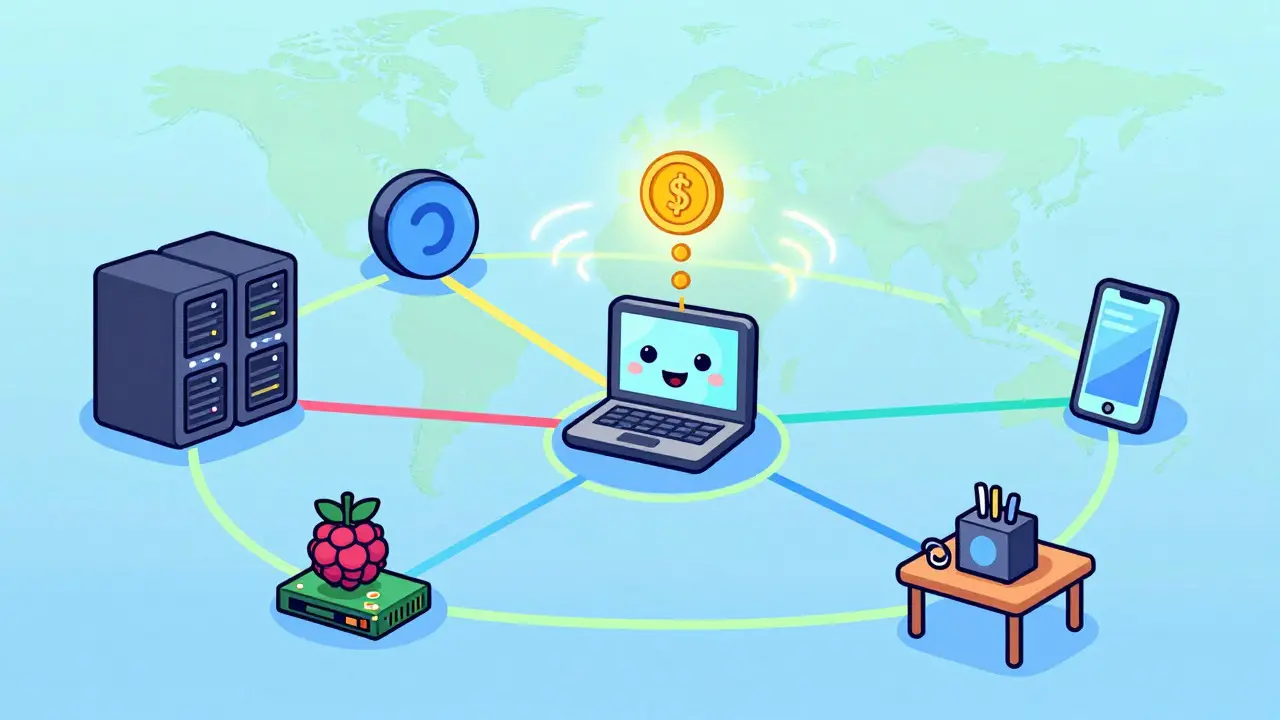
Imagine sending money to a friend without calling a bank, checking with a credit card company, or waiting for a clearinghouse to approve the transfer. You just hit send, and the transaction happens. That magic isn’t sorcery; it’s P2P networks. These peer-to-peer systems are the invisible skeleton holding up every major cryptocurrency, from Bitcoin to Ethereum. Without them, crypto would just be another centralized database run by some corporation.
We often talk about blockchain as if it’s the whole story. But the blockchain is just the ledger. The P2P network is the nervous system that keeps that ledger alive, secure, and honest. It’s how thousands of strangers agree on what happened when, without trusting each other. If you want to understand why crypto matters-or why it sometimes feels slow-you have to look under the hood at these networks.
The Core Mechanism: How Nodes Talk to Each Other
In a traditional client-server model (like browsing the web), your computer asks a central server for data. In a P2P network, there is no boss. Every participant, called a node, connects directly to others in a flat mesh. There is no hierarchy. Your laptop can talk to a server farm in Japan or a Raspberry Pi in Brazil with equal status.
When you send Bitcoin, your wallet doesn’t broadcast to a central authority. It shouts into the digital void. Nearby nodes hear you, check if the transaction follows the rules (do you have enough funds? Is the signature valid?), and then pass it along to their neighbors. This process, known as transaction propagation, ripples across the globe until every full node has seen it.
| Feature | Client-Server (Traditional) | P2P (Cryptocurrency) |
|---|---|---|
| Control | Centralized authority | Distributed among all nodes |
| Failure Point | Single point of failure | No single point of failure |
| Trust Model | Trust the provider | Verify via code/consensus |
| Scalability | High throughput (e.g., Visa) | Limited by network bandwidth |
This structure creates a trustless environment. You don’t need to know who runs the node receiving your transaction. You only need to trust the math. As Andreas Antonopoulos, author of *Mastering Bitcoin*, puts it, "The P2P network is the immune system of Bitcoin." It constantly scans for anomalies and rejects anything that breaks the consensus rules.
Why Decentralization Matters More Than Speed
If speed were the only metric, P2P networks would fail. Visa processes roughly 65,000 transactions per second on its centralized infrastructure. Bitcoin manages about 4 to 7 transactions per second. Ethereum handles around 15 to 30. On paper, crypto looks sluggish.
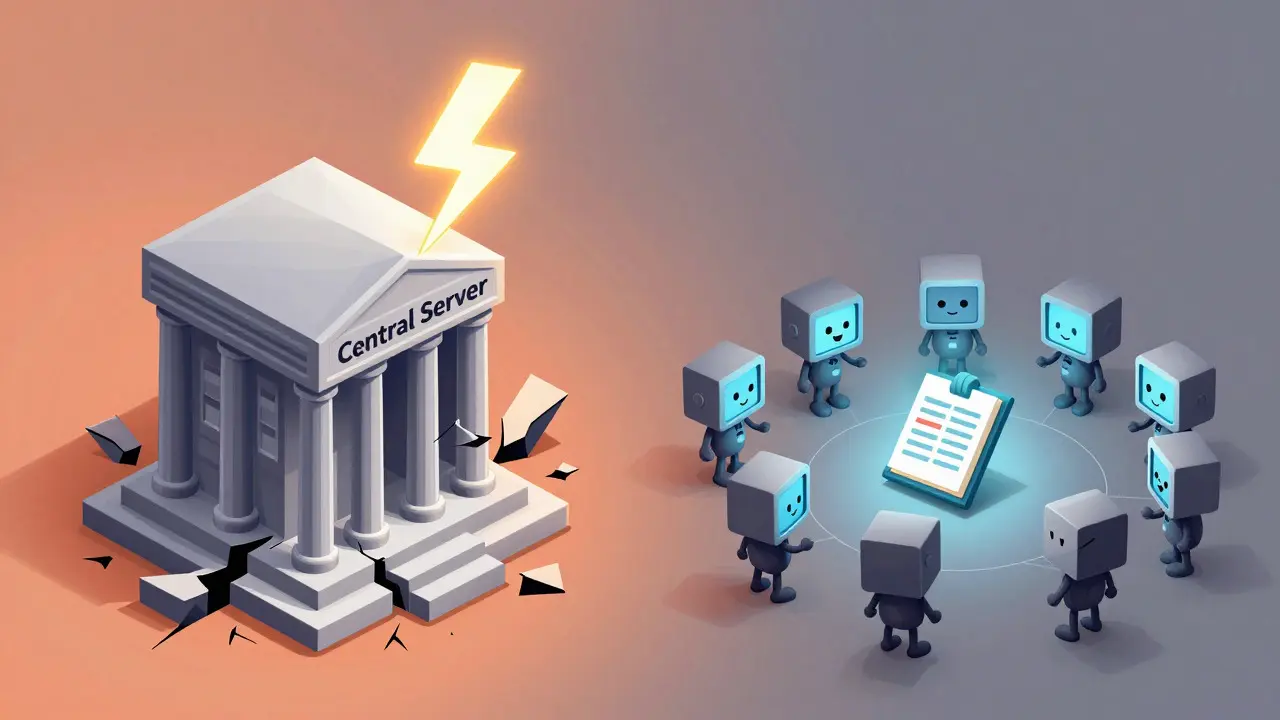
But here is the trade-off: resilience. When Twitter’s API went down in 2020, disrupting many centralized services, the Bitcoin network didn’t blink. Why? Because there was no central server to crash. Even if half the nodes went offline, the remaining ones could still validate transactions and keep the ledger moving. This censorship resistance is the killer feature. No government or corporation can easily shut down a network where the data lives on thousands of devices worldwide.
Consider cross-border remittances. The World Bank reported $640 billion in global remittances in 2022, with average fees of 6.15%. Traditional banks rely on correspondent banking networks that are slow and expensive. P2P networks allow value to move directly between wallets, bypassing those intermediaries entirely. For someone sending money home from abroad, that direct line is worth more than raw speed.
The Hidden Costs: Running a Node Isn't Free
Decentralization sounds great until you realize someone has to pay for it. In a P2P network, every full node stores a complete copy of the blockchain. For Bitcoin, that means downloading terabytes of data. As of late 2023, the Bitcoin blockchain grows by approximately 144MB daily. A new node needs at least 50GB of storage, 2GB of RAM, and a stable broadband connection.
This creates a "tragedy of the commons" problem. Nodes bear the cost of bandwidth and electricity without direct compensation. Historically, this led to a drop in publicly reachable nodes-from 12,000 in 2017 to about 5,000 in 2020. Fortunately, interest revived, and numbers climbed back to roughly 14,000 by October 2023. Still, the barrier to entry remains high for average users.
User experiences reflect this tension. On Reddit’s r/Bitcoin, user u/NodeRunner89 shared that syncing took 72 hours on a 1Gbps connection with a 2TB SSD, but noted, "Now I feel part of the network's security backbone." Conversely, others complain about complexity. Trustpilot reviews for blockchain explorers show 29% of users citing technical difficulty as a pain point. Running a node requires understanding TCP/IP, firewall configuration, and port forwarding-skills not everyone possesses.
Vulnerabilities and Attacks: Keeping the Network Honest
A P2P network is only as strong as its weakest link. While resilient to outages, it faces unique attack vectors. One major threat is the eclipse attack. In this scenario, malicious actors isolate a specific node, feeding it false information while blocking legitimate updates. Vitalik Buterin’s research showed that on Ethereum’s network of ~8,000 nodes, an attacker could isolate a target with as few as 11 strategically placed malicious nodes.
Another issue is bandwidth congestion. During peak times, transaction propagation slows dramatically. A 2022 Cornell University study found that while transactions reach 95% of nodes in 8.6 seconds under optimal conditions, delays can stretch to over 40 seconds during congestion. Users have reported transaction confirmations taking 72+ hours during fee market spikes. This isn’t a bug; it’s the network protecting itself from spam by prioritizing higher fees.
Quantum computing looms as a future threat. Current cryptographic standards could be compromised by quantum computers as early as 2035, according to NIST timelines. If private keys become crackable, the entire trust model of P2P networks collapses. The industry is already working on post-quantum cryptography, but it’s a race against time.
Evolution: Scaling the P2P Dream
The crypto world isn’t standing still. Developers are finding ways to make P2P networks faster and cheaper without sacrificing decentralization. Ethereum’s transition to proof-of-stake in September 2022 reduced energy consumption by 99.95%, making running nodes far more accessible. Bitcoin’s Taproot upgrade improved transaction relay efficiency by 25%.
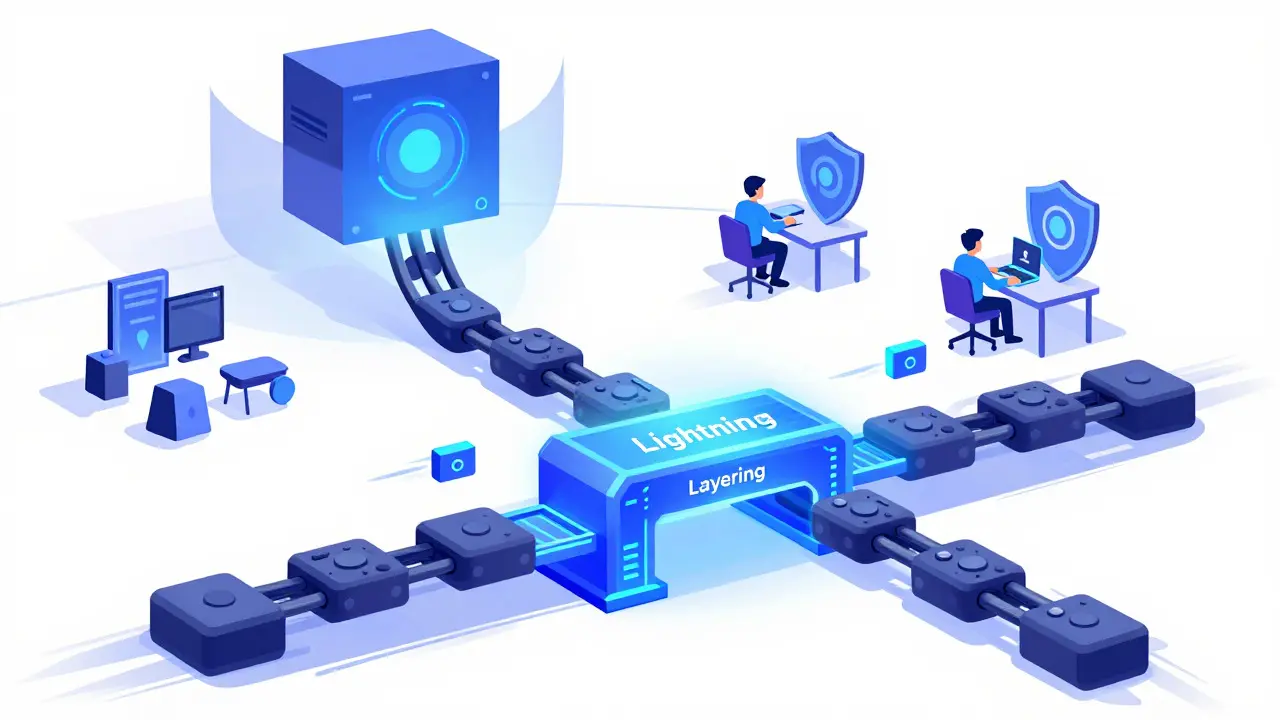
Layer-2 solutions like the Lightning Network take transactions off the main chain. By handling small payments between peers directly, they reduce load on the base P2P network. The Lightning Network now processes $1.2 billion monthly across 18,000 nodes. Future protocols like Erlay aim to cut bandwidth requirements by 80%, allowing more people to run lightweight nodes.
Regulatory frameworks are also adapting. The EU’s MiCA regulation, effective December 2024, recognizes P2P participants as "distributed ledger technology service providers," requiring registration. This brings clarity but also adds compliance burdens. In the U.S., the SEC maintains that decentralized networks may still fall under securities laws if sufficient centralization exists, creating uncertainty for developers.
FAQ
What is a P2P network in cryptocurrency?
A P2P (peer-to-peer) network is a decentralized system where computers (nodes) connect directly to each other without a central server. In crypto, nodes share transaction data and validate blocks, ensuring the ledger remains accurate and secure through consensus rather than trust in a single entity.
Why are P2P networks slower than banks?
P2P networks prioritize decentralization and security over speed. Banks use centralized servers optimized for high throughput (e.g., Visa’s 65,000 TPS). Crypto networks like Bitcoin handle 4-7 TPS because every node must verify transactions independently, which takes time and bandwidth.
Can a P2P network be shut down?
It is extremely difficult. Since data is distributed across thousands of nodes globally, shutting down one or even hundreds of nodes does not stop the network. However, governments can restrict access to exchanges or ISPs, indirectly hindering participation.
What is an eclipse attack?
An eclipse attack occurs when malicious nodes isolate a specific victim node, controlling all its connections. This allows attackers to feed false data or delay transaction visibility. Research shows Ethereum nodes can be eclipsed with as few as 11 malicious peers.
Do I need to run a node to use crypto?
No. Most users rely on lightweight wallets or exchanges that connect to full nodes on their behalf. Running a full node is optional but enhances personal privacy and contributes to network security by validating transactions independently.
How do Layer-2 solutions help P2P networks?
Layer-2 solutions like the Lightning Network handle transactions off the main blockchain, reducing congestion. They settle final balances on-chain periodically, allowing instant, low-cost payments while preserving the base layer’s security and decentralization.
Is P2P architecture secure against quantum computers?
Currently, no. Standard cryptographic algorithms used in P2P networks could be broken by advanced quantum computers. Experts estimate this risk may materialize by 2035, prompting ongoing development of post-quantum cryptography standards.