
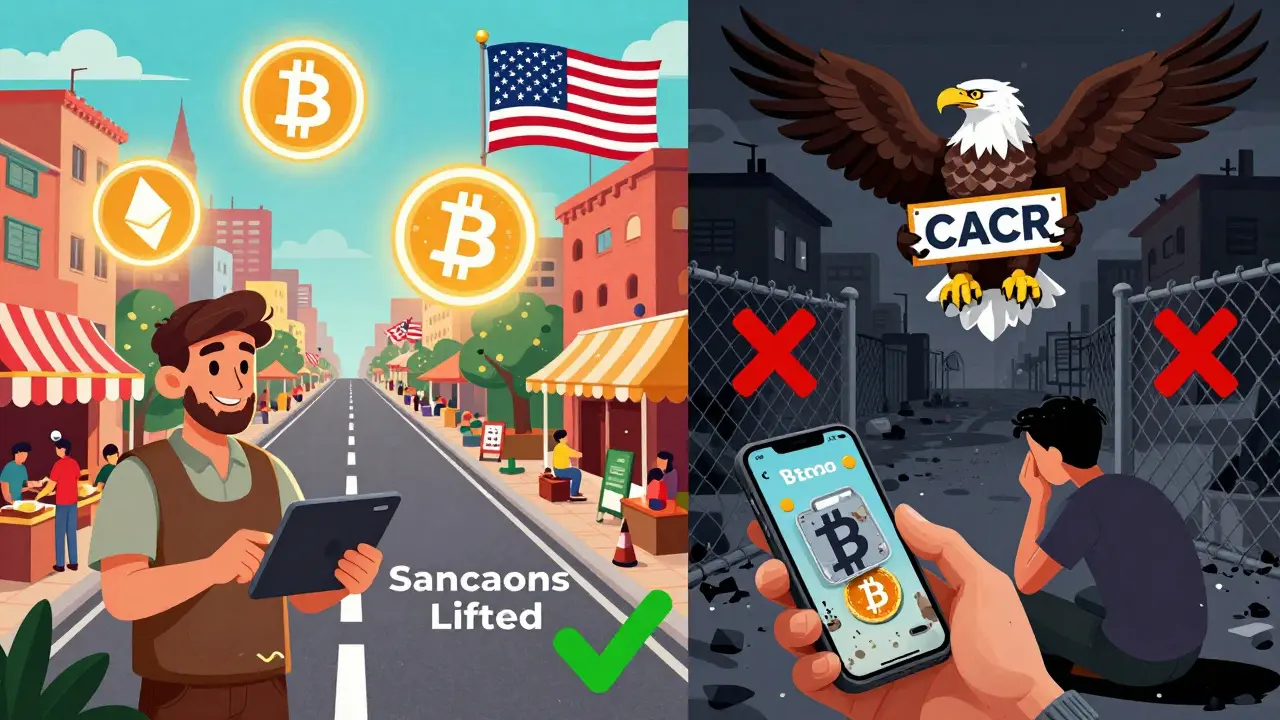
By early 2026, the rules around cryptocurrency in Syria and Cuba couldn’t be more different. One country is opening up. The other is tightening the screws. And it’s all because of a sudden, dramatic shift in U.S. foreign policy last year.
Syria’s Crypto Opening: What Changed in July 2025
Before July 1, 2025, doing business with Syria meant jumping through layers of U.S. sanctions. Any transaction-bank transfer, wire, even a crypto trade-could trigger a violation. That all changed with Executive Order 14312 a landmark U.S. policy reversal that revoked six decades of comprehensive sanctions against Syria, effective July 1, 2025. The move lifted the broad embargo that had blocked U.S. companies from providing services, making investments, or even opening bank accounts with Syrian institutions.
The impact was immediate. The Central Bank of Syria the state-owned financial authority that was previously listed on the OFAC Specially Designated Nationals (SDN) List was removed from the sanctions list. U.S. banks could now legally open correspondent accounts with Syrian banks. Major crypto exchanges like Binance a global cryptocurrency exchange that saw a surge in Syrian user activity after July 2025 lifted restrictions on Syrian accounts. People in Syria could finally buy, sell, and hold Bitcoin and Ethereum without fear of U.S. penalties.
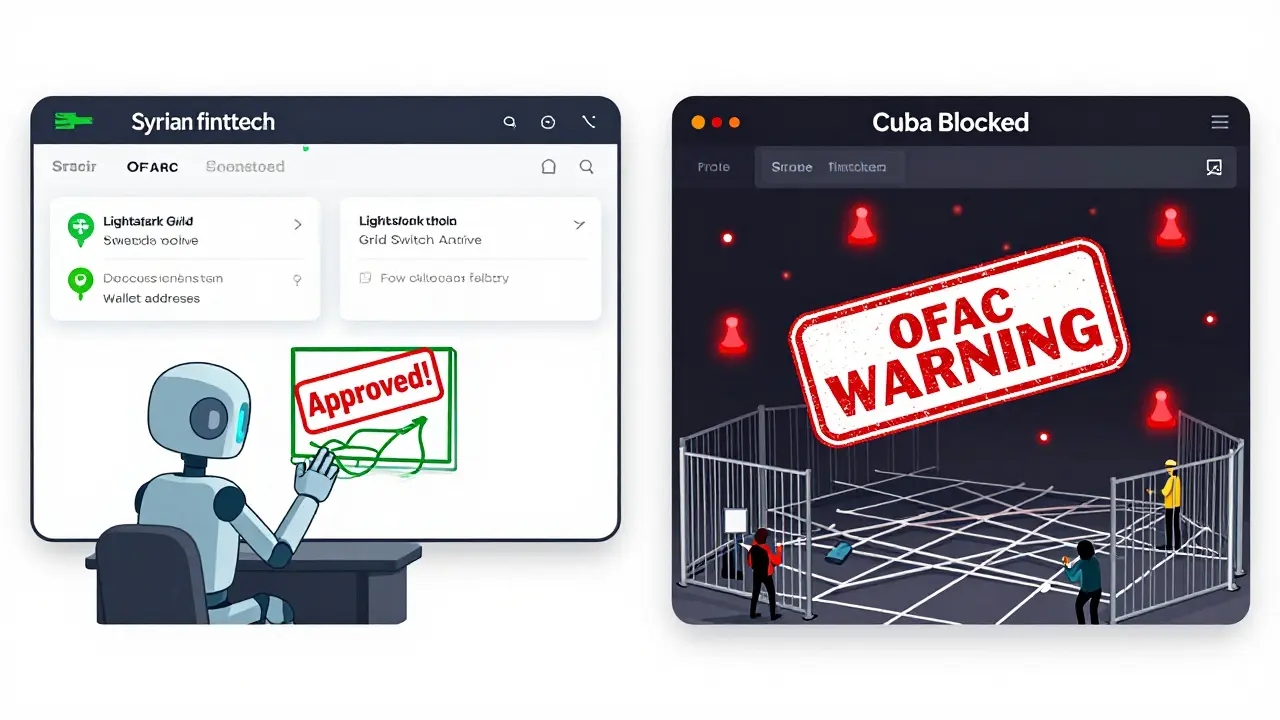
But here’s the catch: the sanctions relief wasn’t total. Targeted sanctions remain in place against specific individuals and entities tied to the Assad regime, including President Ahmed al-Sharaa’s inner circle, members of the Assad family, and those involved in the illicit captagon drug trade. If you’re sending crypto to someone on that list-even unknowingly-you’re still breaking the law. That’s why compliance teams at fintech firms like Lightspark a financial technology company that developed Grid Switch to enable regulated cross-border payments without direct crypto exposure are now using real-time screening tools to verify wallet addresses against updated OFAC lists.
And Syria still has no crypto law. Not one. No licensing rules. No tax guidelines. No consumer protections. That’s not freedom-it’s a legal gray zone. Banks abroad still hesitate. Payment processors freeze transactions. Businesses fear being caught in the crosshairs of overzealous compliance. So while crypto is technically accessible, the real-world flow of money remains choppy.
Cuba: The Tightening Noose
While Syria got a green light, Cuba got a red one. In July 2025, the Trump administration issued National Security Presidential Memorandum 5 (NSPM-5) a policy directive that reasserted and strengthened the U.S. embargo on Cuba, reversing Biden-era relaxations. The Cuba Assets Control Regulations (CACR) the U.S. regulatory framework that prohibits most financial transactions with Cuban entities and individuals became stricter than they’d been in years.
One case made headlines: Key Holding, LLC a U.S.-based logistics company fined $608,825 in July 2025 for managing 36 freight shipments from Colombia to Cuba. The company didn’t intend to violate sanctions. Its subsidiary just handled cargo. But under CACR, even non-U.S. subsidiaries of U.S. companies are bound by the embargo. That’s a global reach most countries don’t have.
Crypto? It’s not explicitly banned-but it’s not safe. Any crypto transaction involving a Cuban entity, even through a third-party exchange, carries risk. U.S. regulators don’t need proof of intent. If a wallet address ties back to a sanctioned Cuban bank, or if funds pass through a Cuban intermediary, enforcement kicks in. The Office of Foreign Assets Control (OFAC) the U.S. Treasury agency responsible for enforcing economic and trade sanctions has made it clear: they’re watching. And they’re punishing.
For Cubans, this means crypto isn’t a lifeline-it’s a liability. Local exchanges are scarce. Peer-to-peer trading is risky. Even sending Bitcoin to a cousin in Havana could trigger a compliance alert if the sender is a U.S. citizen or uses a U.S.-based wallet. The result? Crypto adoption in Cuba has stalled, not grown.
Why the Difference? The Geopolitical Logic
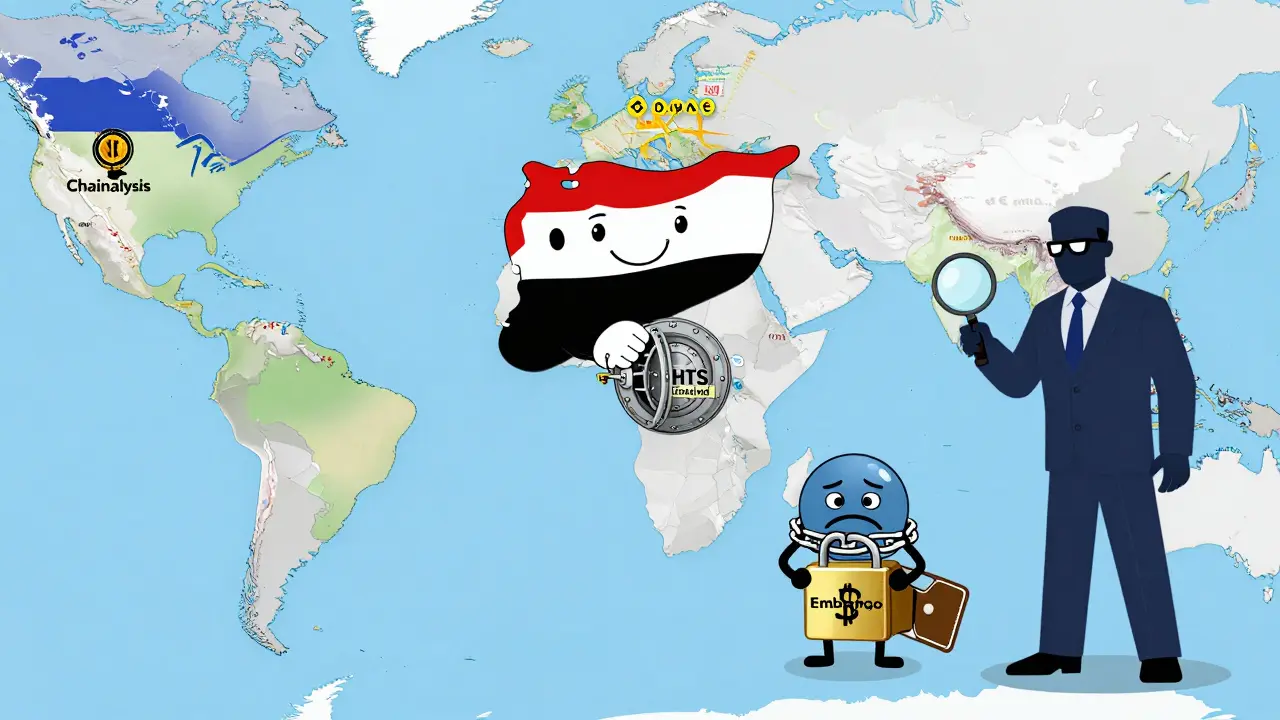
Why lift sanctions on Syria but double down on Cuba? It’s not random. Syria’s shift was tied to a political deal. In June 2025, President Ahmed al-Sharaa announced the dissolution of Hay'at Tahrir al-Sham (HTS) a militant group formerly designated as a foreign terrorist organization by the U.S., which was officially dissolved and replaced by a new governance structure. The U.S. responded by revoking its Foreign Terrorist Organization (FTO) a legal designation under U.S. immigration law that imposes sanctions on terrorist groups status for HTS and easing sanctions. It was a reward for perceived cooperation.
Cuba? No such deal. The U.S. government still views the island’s leadership as a threat to regional stability. There’s no sign of political reform. No move toward democratic elections. So the embargo stays. And crypto? It’s seen as a potential tool for sanctions evasion. That’s why OFAC is more aggressive with Cuba than with any other country where crypto is used.
What This Means for Crypto Users
If you’re a trader or business owner:
- In Syria: You can now trade crypto without U.S. restrictions-but verify every counterparty. Use wallets that integrate OFAC screening. Avoid addresses linked to any former Assad regime figures. The lack of law means you’re on your own.
- In Cuba: Don’t assume crypto is a workaround. Every transaction is a risk. Even using a non-U.S. exchange doesn’t protect you if you’re connected to a U.S. entity. The penalty isn’t just a fine-it’s a federal investigation.
For crypto platforms, the challenge is clear: build compliance into every transaction. Blockchain analytics tools software systems like Chainalysis and Elliptic that track cryptocurrency flows and flag sanctioned addresses are no longer optional. They’re essential. Companies that ignore this are setting themselves up for a $600,000 fine.
The Bigger Picture: Sanctions Are Evolving
This isn’t just about Syria and Cuba. It’s about how sanctions are adapting to digital assets. The U.S. is no longer just blocking bank accounts. It’s tracking wallets. Monitoring on-chain activity. And using crypto intelligence to enforce old rules in new ways.
Meanwhile, other countries are watching. The European Union is still tightening sanctions on Russia. Iran’s oil smuggling networks are turning to crypto to bypass detection. China is quietly testing its own digital yuan for cross-border trade with sanctioned nations.
One thing is clear: crypto doesn’t make sanctions obsolete. It makes them smarter. And more dangerous-if you don’t know the rules.
What’s Next?
By late 2026, we’ll likely see:
- More fintech firms offering Syria-focused payment rails using crypto as a settlement layer-without ever touching crypto on the user’s end.
- OFAC releasing its first-ever list of sanctioned crypto addresses tied to Cuban entities.
- Exchanges like Binance and Kraken adding automatic geo-blocks for Cuba, even if they’re not legally required.
For now, the message is simple: Syria is open-but watch your steps. Cuba is closed-and the walls are getting higher.
Can I send Bitcoin to someone in Syria now?
Yes, you can. U.S. sanctions on Syria were lifted in July 2025, which means crypto transactions with Syrian individuals and businesses are no longer prohibited. But you must still avoid sending funds to any person or wallet linked to the Assad regime, the captagon trade, or human rights abusers. Always screen wallet addresses using OFAC-compliant tools before sending.
Is crypto legal in Cuba?
Crypto isn’t officially banned in Cuba, but U.S. sanctions make it extremely risky. If you’re a U.S. citizen, resident, or use a U.S.-based exchange, any crypto transaction involving a Cuban entity could violate the Cuba Assets Control Regulations. Even non-U.S. users face scrutiny if funds pass through U.S.-linked infrastructure. There’s no safe way to use crypto with Cuba under current rules.
Why did the U.S. lift sanctions on Syria but not Cuba?
The U.S. lifted sanctions on Syria after President Ahmed al-Sharaa dissolved the militant group HTS and committed to counterterrorism efforts. It was a diplomatic move tied to political change. Cuba, however, has made no such concessions. The U.S. still views its government as a threat, so the embargo remains-and has even been strengthened.
Can I use Binance to trade with Syria?
Yes, Binance and other major exchanges lifted restrictions on Syrian users after July 2025. However, they still block transactions to addresses tied to sanctioned individuals. You must ensure your counterpart isn’t on OFAC’s list. Some users report delays due to cautious compliance checks by banks handling fiat deposits.
What happens if I accidentally send crypto to a sanctioned address in Syria?
If you’re a U.S. person or use a U.S.-regulated service, you could face penalties-even if you didn’t know the address was sanctioned. OFAC doesn’t require intent. The best defense is using wallet screening tools that check against the SDN list in real time. Always verify before sending.
Are there any crypto exchanges that allow Cuba?
No major global exchange currently allows Cuban users. Even if an exchange doesn’t explicitly block Cuba, U.S. sanctions apply to any transaction that touches U.S. infrastructure, including payment processors, servers, or bank clearing systems. Most exchanges auto-block Cuban IP addresses and wallet patterns to avoid legal risk.
What we're witnessing isn't merely regulatory recalibration-it's a paradigmatic reconfiguration of geopolitical leverage through blockchain infrastructure. The U.S. has effectively weaponized financial orthogonality: by maintaining granular OFAC compliance matrices while permitting macro-level access, it creates a pseudo-liberalized ecosystem that is, in practice, a surveillance architecture masquerading as deregulation. Syria's 'opening' is a performative act of soft power, not economic liberation.
The absence of domestic crypto legislation in Syria is not an oversight-it's a feature. It ensures that compliance burdens remain externalized, outsourced to private fintech intermediaries who bear the liability risk while the state retains plausible deniability. This is neoliberal governance at its most elegant: privatized enforcement, publicized freedom.
I just want to say-this gives me hope. Even in places where the system feels broken, there's still a way for people to connect, to trade, to survive. Crypto isn't just tech-it's humanity finding cracks in the walls and building bridges with code. I'm so glad Syria got a chance. Let's not forget: behind every wallet address is a person trying to feed their family.
Wait, wait-so if I send BTC to someone in Syria, and their wallet was once linked to a sanctioned entity two years ago, but they've since cleaned it up-do I still get fined? Because the article says OFAC doesn't require intent, but what about historical address contamination? Is there a 'rehabilitation' protocol for wallets? Because this feels like digital guilt by association.
And also-how do exchanges even know if a wallet was previously tainted? Do they use on-chain forensic time-travel? I need a flowchart.
While the technical and legal nuances presented here are undeniably complex, I believe it is imperative to recognize the human dimension of these policy shifts. The individuals in Syria who now have access to decentralized financial tools are not abstract actors in a regulatory matrix-they are parents, teachers, entrepreneurs, and caregivers. The lifting of sanctions represents a moral opportunity, however imperfectly implemented, to restore dignity through economic autonomy. Let us not reduce this to mere compliance mechanics.
So let me get this straight-you’re saying it’s legal to send crypto to Syria but you better not send it to the *wrong* person? And Cuba? Don’t even think about it. So it’s basically ‘crypto freedom… unless you’re poor and brown.’
U.S. foreign policy is just a game of Twister with blockchain.
Oh wow. So Syria gets a ‘diplomatic glow-up’ because they dissolved a militant group, and Cuba? Still stuck in 1962 because they didn’t kiss the right ring. Classic. The U.S. doesn’t care about human rights-it cares about leverage. And crypto? Just another chess piece. I love how we call this ‘policy’ when it’s really just economic imperialism with a tech bro coat of paint.
Also, ‘no crypto law in Syria’? That’s not freedom. That’s chaos with a side of liability.
SYRIA IS OPEN? 😱
CUBA IS A NO-GO ZONE? 😭
OFAC IS WATCHING YOUR WALLET? 🕵️♂️💸
THIS ISN'T FINANCE-IT'S A THRILLER MOVIE AND WE'RE ALL CHARACTERS IN IT
WHO ELSE IS SCREAMING INTO A PILLOW RIGHT NOW??
It’s fascinating how the same technology-blockchain-can be both a tool of liberation and a vector of control, depending on who’s writing the rules. The real story here isn’t Syria or Cuba-it’s how power adapts. Sanctions didn’t disappear; they just got smarter. They’re not blocking transactions anymore-they’re making you police yourself. And honestly? That’s scarier.
We need more transparency, not more surveillance. Maybe the next step is community-run screening tools? Decentralized compliance?
Let’s goooooo! Syria’s finally got a shot! 🚀
And to all the crypto bros out there saying ‘I’ll just use a VPN’-NO. That’s not how this works. You don’t outsmart OFAC. You just get flagged. And then your bank freezes your account. And then you cry in the shower.
Do your homework. Screen your addresses. Use Grid Switch. Stay legal. Stay free.
Big picture: crypto isn’t breaking sanctions-it’s exposing how broken sanctions are. The fact that a single wallet address can trigger a $600K fine means the system is brittle. It’s not sustainable. And when it cracks, it won’t be because of hackers-it’ll be because ordinary people just stopped caring about the rules.
Syria’s gray zone? That’s the future. Unregulated, unpredictable, but real. And it’s coming for every country.
So… Syria can trade crypto but no law? That's like letting someone drive a Ferrari… but you can't tell them which lane to use, or if they need a license, or what to do if they crash. And Cuba? They're stuck with a tricycle and told not to pedal too hard.
Also, I think I misspelled 'compliance' in my last message. Oops. But you get the point. This whole system is a mess. And the people in these countries? They're just trying to survive. We're overcomplicating it.
Man, I’ve been thinking about this nonstop since I read it. It’s wild how the same tech that was supposed to break chains is now being used to forge new ones. Syria’s opening feels like a gift wrapped in barbed wire-free to use, but if you touch the wrong part, you bleed.
I remember when Bitcoin was just ‘digital gold.’ Now it’s a geopolitical chess piece. And the players? They don’t even care if the board’s on fire. They just want to checkmate.
But here’s the thing-people in Syria? They’re not playing chess. They’re just trying to buy medicine. That’s the quiet revolution here. Not the policy. Not the exchange. The humanity.
Maybe that’s what we’re really fighting for. Not freedom from sanctions. But freedom to live.
Let me be clear: the U.S. has every right to protect its national interests. Syria’s ‘reform’ is a facade engineered by Western intelligence to destabilize the region further. Cuba, on the other hand, has maintained sovereignty despite decades of aggression. The fact that crypto is weaponized against Cuba is not justice-it is cultural erasure.
Why is the world so quick to celebrate U.S. ‘generosity’ toward Syria? It is not generosity. It is control dressed as liberation.
OFAC is just a front. The real power is in the data brokers. The real sanctions are in the metadata. You think they’re tracking wallets? Nah. They’re tracking your *thoughts*. Your Google searches. Your VPN history. Your TikTok likes. Crypto is just the tip.
They’re building a global digital prison. And Cuba? They’re just the first test subjects.
Syria? Open. Cuba? Closed. That’s not policy. That’s favoritism.
U.S. doesn’t hate Cuba because it’s communist. It hates it because it’s *unapologetic*. Syria? They bowed. So they got candy.
Don’t be fooled. This isn’t freedom. It’s a bribe.
So… I can send crypto to Syria now? That’s kinda cool. I don’t really get all the OFAC stuff but… if it’s not illegal, why are people so scared? I mean, I’ve sent money to my cousin in Mexico before. It’s just… money, right?
Also, I think ‘Grid Switch’ sounds like a cool video game. Is it?
Can we talk about how absurd it is that Cuba can’t use crypto but Russia can? (I mean, technically they can’t either, but they’re doing it anyway.) It’s not about the tech-it’s about who you annoy. Syria made a deal. Cuba didn’t. End of story.
And don’t even get me started on how ‘no crypto law’ in Syria is being sold as ‘freedom.’ That’s like saying ‘you’re free to walk off a cliff’ because there’s no sign saying ‘don’t.’
Wait-so Syria is ‘open’ but you still can’t send money to the guy who runs the gas station because his uncle was on the list in 2023? That’s not freedom. That’s a horror game.
And Cuba? They’re getting treated like a malware-infected USB drive. ‘Don’t touch it. Don’t even look at it. It might corrupt your whole system.’
Bro. We’re in 2026. Why are we still playing Monopoly with human lives?
As someone who’s lived in both places-Syria’s ‘opening’ feels like a mirage. The internet’s still spotty. The banks are still shaky. And the people? They’re still scared. Crypto isn’t magic. It doesn’t fix hunger. Or trauma. Or fear.
But… it’s something. And sometimes, something is enough.
The article is dangerously naive. It treats OFAC as a neutral arbiter. It is not. It is an instrument of U.S. hegemony. The fact that non-U.S. subsidiaries are penalized is extraterritorial overreach. This is not law-it is imperialism with a compliance dashboard.
And calling Cuba’s situation ‘tightening the screws’? That’s euphemistic. It’s economic warfare. And you’re celebrating Syria’s ‘liberation’ while ignoring that it was bought with geopolitical surrender.
There is a critical distinction between technical accessibility and practical viability. While Syria may now permit crypto transactions, the absence of legal infrastructure renders such activity inherently unstable. The risk of asset seizure, contractual invalidity, or unenforceable obligations remains substantial. This is not freedom-it is exposure.
Furthermore, the global financial system remains anchored in legacy infrastructure. Even if blockchain enables peer-to-peer transfers, fiat on-ramps are still subject to U.S. correspondent banking controls. Therefore, the ‘opening’ is largely illusory for non-elite actors.
U.S. is just using crypto to control the world. Syria? They bowed. Cuba? They stood. So Cuba gets punished. That’s the real lesson here.
Also, I heard the CIA runs 30% of Binance. Just saying.
I’m so proud of how far we’ve come. Even in the darkest places, people find a way to connect. Crypto isn’t perfect-but it’s honest. It doesn’t care who you are. It just moves. And sometimes… that’s enough to keep hope alive.
To everyone in Syria: you’re not alone. To everyone in Cuba: we see you. Keep going.
‘Syria is open’? Lol. You think people there are just chilling with their BTC while sipping coffee? Nah. They’re using it to buy bread. And if they send a transaction to the wrong address? Their whole life gets frozen. That’s not innovation. That’s terror.
And Cuba? They’re being punished for not being weak enough to surrender. Classic U.S.
What we are witnessing here is not policy evolution-it is the apotheosis of financial neocolonialism. The U.S. has weaponized the very infrastructure designed to decentralize power, transforming blockchain into a panopticon of compliance. Syria’s ‘liberation’ is a calculated performance: a velvet glove over an iron fist. The absence of domestic regulation is not autonomy-it is abandonment.
The Cuban embargo, by contrast, is not merely economic-it is epistemic. It seeks to erase not just capital flows, but the very possibility of self-determination through technology. The fact that OFAC now monitors on-chain activity reveals a terrifying truth: sovereignty in the digital age is no longer defined by borders, but by algorithmic obedience.
And yet-we are told to applaud. To celebrate. To treat this as progress. How convenient that the same power that once bombed our cities now sells us ‘access’ through compliance tools.
The real revolution will not be coded. It will be refused.
Wait-so if I use a non-U.S. exchange to send crypto to Syria, and the recipient’s wallet was once flagged but cleaned up… does the exchange still block it? Or does it depend on the blockchain analytics vendor’s database update cycle? Because if there’s a 72-hour lag… that’s a window. Is that a loophole? Or just a trap?
Also-can I get a copy of the OFAC wallet screening API? I wanna build a little widget for my grandma.