

Form 8949 Crypto Tax Calculator
Calculate Your Crypto Tax Liability
Enter your transactions to see your capital gains and tax impact under 2025 IRS rules
Transaction Log
Calculation Results
Every time you sell, trade, or spend Bitcoin, Ethereum, or any other cryptocurrency, the IRS treats it like selling a stock - not spending cash. That means you owe taxes on the profit, even if you didn’t convert it to dollars. And if you didn’t report it on Form 8949, you’re at risk. Starting in 2025, the rules got tighter, the paperwork got more complex, and the IRS is watching closer than ever.
Why Form 8949 Matters for Crypto
Form 8949 isn’t optional. It’s the IRS’s official form for tracking every time you dispose of a capital asset - and that includes crypto. Whether you traded Bitcoin for Ethereum, sold Solana for USD, or used Dogecoin to buy a laptop, it’s a taxable event. The IRS doesn’t care if you made $5 or $50,000. If you moved crypto out of your wallet, you need to report it.Before 2025, many people skipped this form because exchanges didn’t send clear tax documents. Now, with the new Form 1099-DA rolling out, the IRS expects every transaction to be accounted for. Form 8949 is where you list each one - in detail. It’s not just a summary. It’s a transaction log. And if your numbers don’t match what the exchange reports to the IRS, you’ll get flagged.
What Information Goes on Form 8949
You can’t just write “I sold 2 BTC.” That’s not enough. For every crypto sale or trade, you need to fill in seven key details:- Description of property: “Bitcoin,” “Ethereum,” “UNI,” etc.
- Date acquired: When you bought or received it (not just the year - the exact date)
- Date sold or disposed: When you traded, sold, or spent it
- Gross proceeds: The USD value at the time of the sale or trade
- Cost basis: What you originally paid for it, including fees
- Adjustments: Any reductions (like fees paid in crypto) or increases to basis
- Gain or loss: Gross proceeds minus cost basis
Each transaction gets its own line. If you made 50 trades this year, you need 50 lines. No shortcuts. No averages. No guessing.
Short-Term vs. Long-Term: The Big Tax Difference
Form 8949 splits your crypto sales into two categories - and that makes a huge difference in your tax bill.- Short-term: Assets held for one year or less. These are taxed at your regular income tax rate - up to 37% in 2025.
- Long-term: Assets held longer than one year. These get a lower capital gains rate - 0%, 15%, or 20%, depending on your income.
Example: You bought 1 ETH for $3,000 in March 2024 and sold it for $4,500 in February 2025. That’s a $1,500 profit. Since you held it less than a year, it’s short-term. If you’re in the 24% tax bracket, you owe $360 in taxes on that trade.
But if you’d held it until April 2025, it would’ve been long-term. You might’ve paid only $225 - or even $0 - depending on your income. Timing matters.
Form 1099-DA Is Coming - But It’s Not Enough
Starting in 2025, crypto exchanges like Coinbase, Kraken, and Binance US must issue Form 1099-DA. This form reports your gross proceeds - the total USD value of your sales and trades. Sounds helpful, right?It’s not.
Here’s why: Form 1099-DA does NOT report your cost basis. That’s still your job. The IRS knows this. That’s why they still require Form 8949. You have to calculate what you paid for each coin yourself - even if the exchange gives you a 1099-DA.
And here’s the kicker: exchanges only report transactions that happened on their platform. If you sent ETH from Coinbase to MetaMask and then traded it on Uniswap, the exchange doesn’t see that. So your 1099-DA will miss half your activity. You’re still responsible for reporting it all.

Wallet-by-Wallet Accounting Is Now Required
Before 2025, some people used “universal accounting.” That meant they averaged the cost basis of all their Bitcoin across every wallet and exchange. It was messy - but it was allowed.Now, it’s illegal.
The IRS requires wallet-by-wallet accounting. That means if you bought 1 BTC for $40,000 in Wallet A in 2022 and another 1 BTC for $60,000 in Wallet B in 2024, you can’t average them to $50,000. When you sell from Wallet B, your cost basis is $60,000. When you sell from Wallet A, it’s $40,000. Mixing them up can inflate your gains - and trigger an audit.
This change hits traders the hardest. If you move crypto between wallets, exchanges, or DeFi protocols, you need to track every transfer and its original cost basis. One missed transfer can throw off your entire tax return.
What About Airdrops, Staking, and Forks?
Getting free crypto? That’s income. The IRS treats airdrops, staking rewards, and hard forks as taxable income at the time you receive them.Example: You get 500 UNI tokens in an airdrop. At that moment, UNI is worth $1 each. You owe income tax on $500. Later, you sell those tokens for $2 each. Now you have a $500 capital gain - and you need to report it on Form 8949.
Staking rewards? Same thing. If you earned 0.5 ETH in staking rewards in June 2025, and ETH was $3,200, you report $1,600 as income. When you sell that ETH later, you calculate gain/loss based on that $1,600 cost basis.
And yes - you still need to track every single one of these events on Form 8949.
How to Avoid Mistakes
Most people mess up Form 8949 because they wait until December to start collecting data. Don’t do that.- Track every transaction weekly. Use a spreadsheet or crypto tax software. Record the date, asset, amount, USD value, and wallet address.
- Save your transaction IDs. If the IRS asks for proof, you need the blockchain hash or exchange receipt.
- Don’t rely on exchanges alone. They don’t track your off-platform trades or wallet transfers.
- Use crypto tax tools. Koinly, CoinTracker, and TaxBit can auto-import transactions from exchanges and wallets. But double-check their cost basis calculations - they’re not perfect.
- Keep records for 7 years. The IRS can audit crypto returns for up to 7 years if they suspect fraud.
What Happens If You Don’t Report
The IRS isn’t just sending letters anymore. They’re matching data.Exchanges are now required to report your gross proceeds to the IRS. If you report $10,000 in sales on your return but the exchange says you sold $50,000 - that’s a red flag. You’ll get a CP2000 notice. Then a letter. Then an audit.
Fines start at $100 per unreported transaction. But if the IRS thinks you’re hiding income, penalties can hit 75% of the underpaid tax - plus interest. And if they suspect fraud, you could face criminal charges.
According to Treasury Department estimates, crypto tax evasion cost the U.S. government $6.2 billion in 2024. That’s why enforcement is ramping up.
Tools That Actually Help
You don’t have to do this alone. Here are the tools that work:- Koinly: Best for DeFi users. Connects to 500+ wallets and protocols.
- CoinTracker: Good for beginners. Simple interface, strong exchange support.
- TaxBit: Used by accountants. Handles complex staking and NFT trades.
- Excel/Google Sheets: Free, but only if you’re disciplined. Use templates from the IRS or crypto tax sites.
None of these tools are 100% accurate. Always review the final Form 8949 before filing. Look for duplicate entries, missing airdrops, or misclassified long-term/short-term trades.
What’s Next for Crypto Taxes
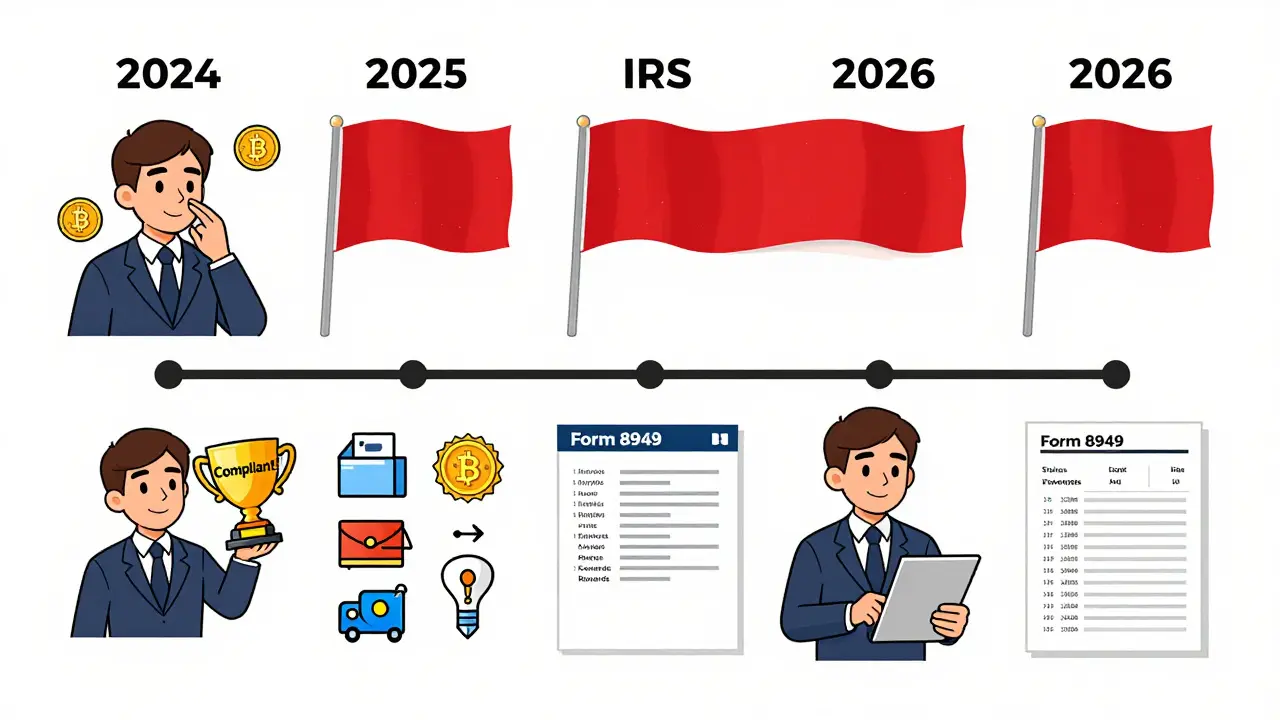
By 2026, Form 1099-DA will start including cost basis - finally. That’ll make things easier. But until then, you’re still the accountant.There’s talk of new rules for DeFi, NFTs, and DAOs. The IRS is also testing AI tools to detect crypto tax evasion by analyzing blockchain patterns. If you’re doing 10+ trades a month, you’re already on their radar.
The message is clear: If you own crypto, you’re part of the tax system. Form 8949 isn’t going away. It’s getting harder. But if you stay organized, you won’t just avoid penalties - you’ll save money.
Do I need to file Form 8949 if I only bought crypto and never sold?
No. Buying crypto with USD is not a taxable event. You only report when you sell, trade, spend, or gift it. But keep records of your purchase dates and prices - you’ll need them when you do dispose of it.
What if I lost crypto in a hack or scam?
You can claim a capital loss if you can prove you owned the crypto and lost access permanently. You’ll need transaction records, wallet addresses, and documentation of the hack or scam. The loss goes on Form 8949 as a negative gain. But the IRS is strict - don’t assume it’s automatic.
Can I use FIFO, LIFO, or specific identification for crypto cost basis?
Yes. The IRS allows specific identification - meaning you can choose which coins you sold based on their purchase price. FIFO (first-in, first-out) is the default if you don’t specify. LIFO is not allowed for crypto. To use specific identification, you must document which exact coins you sold, including their acquisition date and cost basis.
Do I need to report crypto received as a gift?
You don’t report receiving crypto as a gift. But when you later sell it, your cost basis is the same as the giver’s original cost - not the value when you received it. If the giver’s basis is unknown, your basis is zero, meaning the full sale amount is taxable. Keep records of the gift and the original purchase details.
What if I traded crypto on a non-U.S. exchange?
You still owe U.S. taxes. The IRS taxes U.S. citizens and residents on worldwide income. Even if the exchange doesn’t report to the IRS, you must report all transactions on Form 8949. Non-U.S. exchanges rarely provide tax documents, so you must track everything yourself.
Just bought BTC last year and never touched it. No form needed. Easy.
The IRS is turning crypto into a full-time job. I spent 3 weeks last year just tracking my trades, and now they want wallet-by-wallet accounting? This isn't taxation, it's psychological warfare. I swear, if I have to fill out another 8949, I'm moving to Portugal and letting them chase me across the Atlantic with their spreadsheets and subpoenas.
You people act like Form 8949 is some kind of monster. It's a spreadsheet. You list the date, the asset, the price, the gain or loss. Seven columns. That's it. If you're overwhelmed, you're not doing it right. You're using the wrong tools or you're too lazy to organize. Stop making excuses and start tracking. Your future self will thank you when the CP2000 doesn't land in your inbox.
I used Koinly last year and it saved me so much stress. I had like 47 trades across 3 wallets and 2 DeFi platforms. The tool auto-imported everything, flagged the ones it wasn't sure about, and I just double-checked. Took me 2 hours total. Don't let the fear of complexity stop you. Start small. Track one wallet this week. Build the habit. You got this.
The IRS doesn't own your blockchain transactions. You're not a taxpayer, you're a node in a decentralized network. They want control. They want to track your every move. But crypto was built to escape this. Why are you helping them by filling out their forms? Just don't report. Let them chase shadows. The system is rigged. You're not breaking the law. You're resisting it.
As someone who lives in Canada but trades on US exchanges, I can confirm: the IRS still wants your data even if you're not a citizen. I filed Form 8949 last year because I had US-based trades. The tax software I used (Koinly) handled cross-border complexity well, but I had to manually input every airdrop from a non-US DeFi protocol. It was tedious, but necessary. Don't assume geography protects you. The blockchain doesn't care about borders.
I just use FIFO. Everyone else does. Why make it harder? The IRS doesn't care if you're using specific ID. They just want the total. If you're not getting audited, why stress over which coin you sold? It's not like they're going to check your wallet history. They're not even tracking it right. Just report the total gain and move on.
I used to think crypto taxes were scary... until I realized it's just math with extra steps. 🌈✨ Every time I get a staking reward now, I immediately log it in a Google Sheet. Date, amount, USD value. Done. No panic. No chaos. Just consistency. You don't need to be a CPA. You just need to be consistent. Small habits > last-minute panic. You're not behind. You're just getting started.
This is all a setup. The IRS is working with exchanges to track us. They're going to freeze wallets next. They already know who you are. They're just waiting for you to file so they can audit you. I stopped trading. I moved all my crypto to a hardware wallet and never touch it. They can't tax what they can't access. This is digital tyranny. They want to turn freedom into a tax form.
You all are so naive. The IRS doesn't care if you're compliant. They care if you're profitable. If you made money, they want a cut. If you didn't, they'll still audit you to find something. The system is designed to intimidate, not inform. Why do you think they made the form so complicated? To scare people into paying more. Just pay the minimum and move on. Don't overthink it.
I don't know why you're all so worried... The IRS? Ha! They can't even track their own budget! They're sending out letters to people who didn't even trade! I got one last year for $0.00 profit! And I didn't even use a US exchange! This is a scam. A money grab. They're printing money by scaring people into paying fake taxes. I'm not filing. Let them come to my house in Lagos. They'll need a visa.
I spent 40 hours last year doing 8949. 40 HOURS. And then I got audited anyway. They said my cost basis was 'inconsistent'. I had the receipts. I had the screenshots. I had the blockchain hashes. They still said no. Now I'm paying a CPA $800 a year just to look at my spreadsheets. This isn't tax. It's extortion. And the worst part? They know it. They're laughing at us.
America thinks it owns the world's crypto. We in Nigeria don't care about your 8949. We use crypto to survive. We send money home. We pay for food. We don't have banks. You want to tax us? Go tax the banks that stole our money for decades. This form is colonialism with a spreadsheet.
I want to emphasize the importance of record-keeping not just for compliance, but for peace of mind. When you track every transaction-every airdrop, every staking reward, every wallet transfer-you're not just fulfilling a legal obligation. You're creating a financial narrative of your journey. This isn't about fear. It's about clarity. It's about knowing exactly where your assets came from and where they went. That kind of awareness is invaluable, whether you're filing taxes or simply reflecting on your financial growth. The process may feel burdensome, but the self-knowledge it cultivates is transformative.
I started using CoinTracker this year. It imported my trades from Coinbase and my MetaMask wallet. It flagged a few airdrops I forgot about. I reviewed each one. Took 20 minutes. Filed my 8949 in under an hour. No stress. No drama. Just got it done. Sometimes the simplest tools work best.
Oh wow, you actually filed Form 8949? Did you also send them your birth certificate and your pet’s social security number? How very patriotic of you. I’m sure the IRS will be thrilled you gave them your entire crypto life story. Next time, maybe just mail them your diary too. They love a good bedtime story.
I think people are missing the bigger picture here. The IRS isn't just after crypto. They're trying to normalize surveillance. Every time you fill out a form like 8949, you're agreeing that your financial movements are something that needs to be logged and approved. And once they have your crypto data, what's next? Your DeFi interactions? Your NFT purchases? Your wallet addresses? It's not about taxes anymore. It's about control. And the more we comply, the easier it becomes for them to expand. I'm not saying don't report. I'm saying question why we're being asked to report at all. What are we really giving up when we hand over these details? And who benefits from the data?