
Crypto Tax Calculator
Calculate Your Crypto Tax Liability
Is crypto legal in India? The short answer is yes - you can buy, sell, and hold Bitcoin, Ethereum, and other digital assets. But crypto regulation in India isn’t about legality anymore. It’s about taxes, tracking, and strict government control.
India Doesn’t Ban Crypto - But It Doesn’t Welcome It Either
You won’t find a law that says "cryptocurrencies are illegal" in India. But you also won’t find one that says they’re money. As of 2025, the government treats crypto as Virtual Digital Assets (VDAs) - a new legal category created under the Income Tax (No. 2) Bill, 2025. This bill, passed in August 2025, replaced the old Section 2(47A) and made it official: crypto isn’t legal tender. It’s not rupees. It’s not gold. It’s not stocks. It’s something else entirely - and the government wants to tax it heavily.This isn’t a neutral stance. It’s a warning wrapped in a tax form. The message from the Ministry of Finance is clear: we won’t stop you from trading, but we’re watching every move.
The 30% Tax That’s Changing Everything
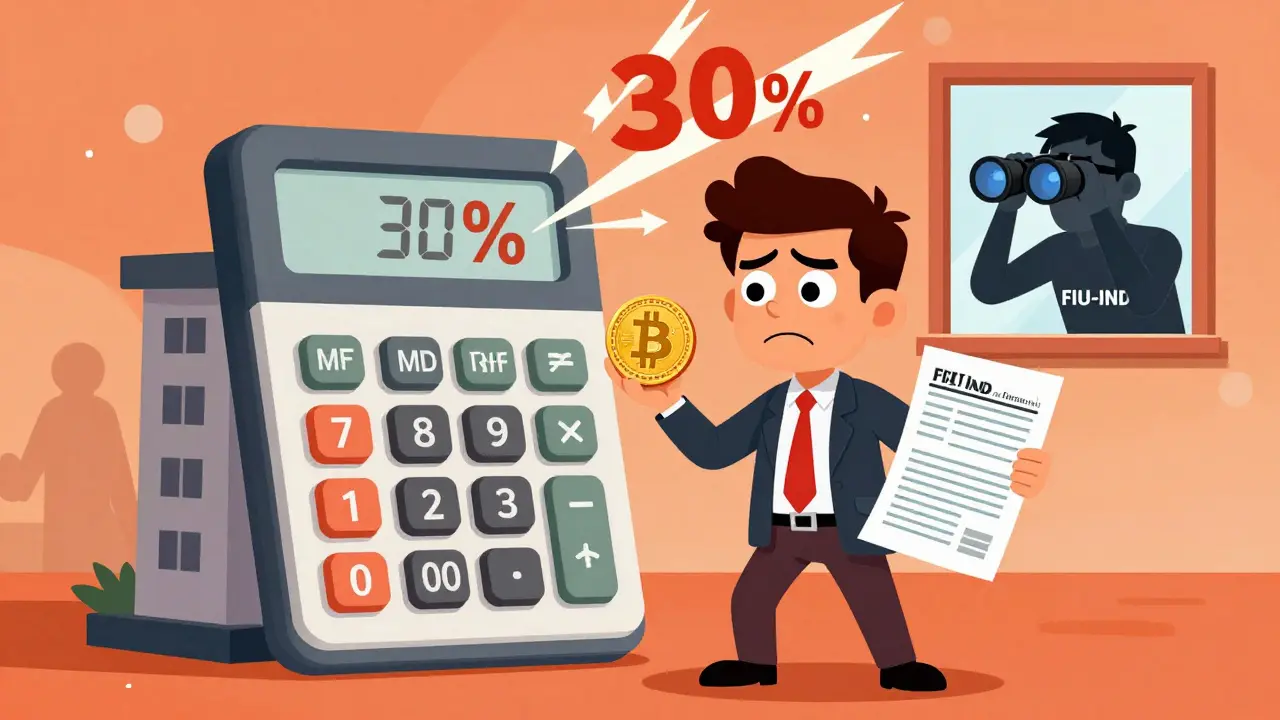
If you make money from crypto in India, you pay 30% in taxes - no exceptions. That’s not capital gains. That’s not income tax. It’s a flat rate on every profit, with zero deductions. Lose ₹50,000 on one trade? Too bad. You can’t use that loss to reduce your tax on a ₹1,00,000 profit from another. The government doesn’t care about your overall portfolio. They only care about the gain.On top of that, every single transaction - whether you’re buying Bitcoin with INR, swapping Ethereum for Solana, or cashing out to your bank - triggers a 1% Tax Deducted at Source (TDS). That means if you buy ₹1,00,000 worth of crypto, ₹1,000 is automatically taken out before you even get it. And yes, that TDS is non-refundable even if you end up losing money overall.
This is one of the highest crypto tax rates in the world. Compare it to the U.S., where long-term capital gains can be as low as 0%, or the EU, where many countries cap crypto taxes at 30% only after losses are offset. India’s system is designed to discourage speculation - not support it.
Who’s Watching Your Trades?
The Income Tax Department doesn’t just rely on your self-reported returns. They’re actively tracking crypto transactions through multiple channels:- FIU-IND (Financial Intelligence Unit India) collects transaction data from all registered crypto exchanges. If you traded on CoinSwitch, ZebPay, or WazirX in the last year, your data is already in their system.
- Exchange reporting is mandatory. All platforms must report user transactions to the tax authorities quarterly, including wallet addresses, transaction amounts, and timestamps.
- Bank monitoring - banks flag large deposits from crypto exchanges. If you suddenly get ₹8 lakh into your account from a crypto platform and didn’t report it, expect a notice.
In 2019, the tax department sent out hundreds of notices to crypto traders asking for proof of income. Today, that’s routine. If you’re trading and not reporting, you’re already on their radar.
The History: From Ban to Tax
Back in 2018, the Reserve Bank of India (RBI) banned banks from serving crypto businesses. That shut down most exchanges. Traders couldn’t deposit or withdraw INR. The market collapsed.Then, in March 2020, the Supreme Court overturned the ban. Banks had to reopen accounts. Crypto trading exploded. But the government didn’t celebrate. They started drafting tax laws.
By 2022, a 30% tax was introduced. In 2024, TDS kicked in. In 2025, the new bill made it all official. The RBI still calls crypto a "macroeconomic threat." SEBI wants to regulate it like securities. The Finance Ministry just wants the money.
There’s still no comprehensive law. No license system. No consumer protection rules. No clear rules on inheritance, gifting, or mining. That’s the grey area: legal to trade, but legally unprotected.
What About NFTs and Other Tokens?
NFTs, DeFi tokens, and even gaming assets are included in the VDA definition. If you sell an NFT for ₹2 lakh, you pay ₹60,000 in tax. If you swap tokens on a decentralized exchange like Uniswap, the TDS still applies - if the platform is registered in India or if you’re a resident. The government doesn’t care if it’s decentralized. If you’re in India and you trade, you’re subject to the rules.Even airdrops count as income. If you get free tokens, you pay tax on their value the moment you receive them - not when you sell.

What’s Next? Global Pressure and the Digital Rupee
India is part of the G20’s global crypto reporting framework. By 2026, tax data from Indian exchanges will be automatically shared with other countries - meaning if you’re hiding crypto income from foreign tax authorities, you’re at risk.Meanwhile, the RBI is preparing its own digital currency: the Digital Rupee. It’s not crypto. It’s not decentralized. It’s a government-controlled digital version of the rupee. When it launches fully, expect tighter controls on private crypto - not a ban, but a push toward official digital money.
Experts believe India’s next step will be licensing crypto exchanges - not to legalize them, but to control them. Think of it like a liquor license: you can sell, but only if you follow every rule, pay every fee, and report every sale.
What Should You Do?
If you’re trading crypto in India:- Track every transaction - buys, sells, swaps, airdrops, staking rewards.
- Use tax software - tools like Koinly or CoinTracker can auto-import exchange data and calculate your tax liability.
- Report everything - even if you think you lost money. The tax department already has your data.
- Don’t use P2P platforms to avoid TDS - the government is already tracking wallet addresses linked to Indian residents.
- Keep records for 7 years - tax audits can go back that far.
There’s no way to legally avoid the 30% tax. But you can avoid penalties. The government isn’t trying to shut down crypto. They’re trying to tax it - and they’re very good at collecting.
Is crypto legal in India in 2025?
Yes, it’s legal to buy, sell, and hold cryptocurrencies in India. But they are not legal tender. The government treats them as Virtual Digital Assets (VDAs) and taxes them heavily under the Income Tax (No. 2) Bill, 2025.
What is the crypto tax rate in India?
All profits from crypto transactions are taxed at a flat 30%. There are no deductions for losses, no exemptions, and no lower rates for long-term holdings. Additionally, a 1% TDS applies to every transaction, whether you’re buying, selling, or swapping assets.
Do I have to report crypto even if I lost money?
Yes. India does not allow you to offset crypto losses against gains. Even if your net result is a loss, you must report every transaction. The tax department already has your data from exchanges, so hiding losses won’t help - and could trigger an audit.
Are NFTs taxed the same as Bitcoin in India?
Yes. NFTs, DeFi tokens, and other digital assets are classified as Virtual Digital Assets (VDAs) under Indian law. Any income from selling, trading, or receiving them is subject to the same 30% tax and 1% TDS as Bitcoin or Ethereum.
Can I use a foreign exchange to avoid Indian crypto taxes?
No. If you’re an Indian resident, you’re taxed on your global crypto income. The Indian tax department can access transaction data through international reporting standards like CARF and CRS. Using foreign exchanges doesn’t exempt you - it just makes it harder to prove you paid your taxes.
Will India ban crypto like China did?
Unlikely. India’s approach is the opposite of China’s. Instead of banning crypto, India is taxing it aggressively and tracking every transaction. The goal isn’t to eliminate crypto - it’s to control it, monitor it, and collect revenue from it.
What happens if I don’t report my crypto income?
You risk penalties, interest, and a tax audit. The government already has your transaction data from exchanges. If your bank statements show large deposits from crypto platforms and you didn’t declare them, you could face fines up to 200% of the tax evaded - plus criminal charges for willful evasion.
Is the Digital Rupee the same as cryptocurrency?
No. The Digital Rupee is a central bank digital currency (CBDC) issued by the Reserve Bank of India. It’s not decentralized. It’s not anonymous. It’s a digital version of the Indian rupee, controlled entirely by the government. It’s meant to compete with private crypto, not replace it.
Crypto's legal but taxed like a luxury good. 30% flat? No loss offsets? That's not regulation, that's a revenue grab.
Oh wow, so India’s just turned every crypto trader into an accidental tax felon. Brilliant. 🙃
You Americans don’t get it. This is the only sane way to handle crypto. No loopholes, no excuses. If you make money, you pay. End of story. The government isn’t your accountant.
30% tax? TDS on EVERY swap? I just spent 4 hours debugging my tax software and I swear I saw a demon in the CSV. This is worse than my ex’s emotional blackmail.
It's important to recognize that while the regulatory framework may appear punitive, it also provides a clear legal structure where none existed before. Many individuals were operating in a gray zone with no clarity on reporting obligations. This system, however harsh, at least offers certainty. For those who wish to comply, tools exist. For those who refuse, consequences follow - and that is the essence of governance.
Look, I get it - taxes suck. But if you’re trading crypto in India, you signed up for this. The government didn’t ask you to gamble. You did. Now pay up. And stop crying about TDS - it’s like paying sales tax on a new phone. You don’t get a refund if the phone breaks.
Use Koinly. Track everything. Keep receipts. Seven years. Seriously. I’ve seen people get audited over $200 in unreported gains. It’s not worth it. Be smart. Be prepared. Don’t be the guy who thinks he’s too cool for tax software.
They’re not banning crypto. They’re outbidding it. The Digital Rupee is the real play. This tax regime? Just the bait.
Let me guess - next they’ll tax your dreams and charge TDS on hope. 30% on air-dropped tokens? Who wrote this? A tax auditor with a grudge and a PowerPoint?
I traded on Binance for 2 years and never reported. Now I’m sweating bullets. My bank flagged a ₹7L deposit last month. They sent me a letter. Not a notice. A LETTER. Like I’m being summoned to court. I’m not even rich - I just bought Dogecoin in 2021. Now I owe ₹1.2L in back taxes and penalties. I’m crying into my chai.
wait so if i swap usdt for btc on a dex and then sell it for inr… i pay tds twice? once on the swap and once on the sale? and no loss carryforwards? i think my brain just quit
It’s funny how we treat money like it’s sacred - until it’s digital. Then suddenly it’s a threat. We regulate gold, stocks, real estate… but crypto? Oh no, it’s too wild, too dangerous, too… *free*. So we tax it into submission. Is this control? Or fear? I wonder if we’re punishing innovation because we don’t understand it… or because we can’t control it yet.
Maybe the Digital Rupee isn’t the future - maybe it’s the last gasp of a system trying to hold onto power before it’s replaced.
India’s crypto policy is the only mature framework in the world. The US is a regulatory wasteland. Europe is drowning in bureaucracy. China banned it and lost its edge. India? Taxed it, tracked it, and moved on. This isn’t repression - it’s responsibility. If you can’t handle taxes, don’t trade.
So… the government knows everything. Every swap. Every wallet. Every bank deposit. And they’re not even trying to hide it. Like… what if I just… stop using crypto? Is that illegal now? Do I have to report my regret?
Man, I just want to buy some ETH and chill. But now I gotta file a 20-page tax report just to own a digital token? And if I mess up, I get fined 200%? I’m not a CPA. I’m just a guy who likes blockchain tech. Why does everything have to be so… complicated?
Can we just make a simple app that does it all? Like, ‘Click here to trade. Click here to pay taxes. Done.’
30% tax on crypto? That’s not a tax - that’s a funeral. I just buried my portfolio and the government charged me for the shovel. And now they’re billing me for the soil. 🕯️💸
Wow. So you’re telling me I can’t even trade on Uniswap without the Indian government taking 1% before I even touch my coins? And I thought my ex was controlling. This is worse. I’m not trading crypto anymore. I’m just sending money to the state and hoping they don’t audit my Netflix account next.
Just because you’re taxed doesn’t mean you’re regulated. There’s still no legal recourse if an exchange gets hacked. No insurance. No consumer protection. You’re not a trader - you’re a volunteer taxpayer.
Does anyone else think the 1% TDS is just a way to make small traders feel like they’re paying something - even if they lose money? It’s psychological. Like a toll booth you can’t avoid.
I’ve been holding crypto since 2017. I lost money in 2022. I made money in 2023. But under Indian law, I still pay 30% on the gains - even though I’m down overall. That’s not fair. That’s not economics. That’s just… cruelty disguised as policy. I don’t hate crypto. I hate being treated like a criminal for trying to build wealth.
And the worst part? I’m not even rich. I’m just a teacher who believed in the tech. Now I’m scared to open my bank statements.
They dont ban it they tax it so hard it dies on its own genius
Just use Koinly. Seriously. I used to hate it. Now I love it. It connects to every exchange, auto-fills your TDS, and even flags airdrops. I saved myself 12 hours of work last tax season. Worth every rupee.
There is no such thing as a "non-refundable" TDS on crypto losses. That is a violation of basic tax equity principles. The government should allow for net loss offsets. The current system is economically irrational and legally indefensible.
They’re watching. They’re always watching. I got a notice last week. Said my wallet address matched a transaction from WazirX in 2023. I didn’t even remember that trade. I thought I deleted the app. Nope. They have it. I’m not even mad. I’m impressed. 😅
It is not merely taxation - it is the institutionalization of surveillance capitalism under the veneer of fiscal responsibility. The state has weaponized compliance. The citizen is now a data point. The blockchain, once a symbol of decentralization, has been subsumed into the apparatus of state control. One must ask: Is this governance… or colonization?