

Have you ever stumbled upon a crypto project that sounds too good to be true? Low fees, NFT marketplaces, and promises of 'winning tokens' while you trade. That is the pitch for Leonicorn Swap, a decentralized exchange (DEX) built on the Binance Smart Chain (BSC). But in 2026, after years of hype, rug pulls, and silent abandonments in the DeFi space, does this platform still deserve your attention? Or is it just another ghost town with a fancy name?
I’ve spent weeks digging into the code, community forums, and transaction data to give you the straight facts. If you are thinking about connecting your wallet to Leonicorn Swap, you need to know what is really going on behind the screen. The short answer? It is risky. Very risky. Let’s break down why.
The Basics: What Exactly Is Leonicorn Swap?
Leonicorn Swap is a decentralized exchange that allows users to swap BEP-20 tokens directly from their wallets without an intermediary. Unlike centralized exchanges like Coinbase or Binance, you never hand over custody of your funds. Instead, you interact with smart contracts on the blockchain.
The platform was founded by Mofassair Hossain, a figure known more for marketing than coding. According to his profile, he raised $600 million for various blockchain projects between 2018 and 2023. While that sounds impressive, it raises a red flag: who actually wrote the code? In the world of DeFi, technical expertise matters more than marketing budgets. A pretty website doesn’t stop hackers.
The native token of the ecosystem adds another layer of confusion. Some platforms list it as LEOS, while others call it LEONS. This inconsistency isn’t just a typo; it suggests poor governance and a lack of professional oversight. When you can’t even agree on the ticker symbol, how can you trust the security of your assets?
| Feature | Leonicorn Swap | PancakeSwap (Leader) | Ethereum DEXs (Uniswap) |
|---|---|---|---|
| Blockchain | Binance Smart Chain (BSC) | Binance Smart Chain (BSC) | Ethereum |
| Avg. Transaction Fee | $0.01 - $0.05 | $0.01 - $0.05 | $1.50 - $5.00+ |
| Security Audits | None Publicly Listed | Multiple (CertiK, PeckShield) | Extensive (Trail of Bits, OpenZeppelin) |
| Native Token | LEOS / LEONS (Confusing) | CAKE | ETH / UNI |
| Market Share (BSC) | Negligible (<1%) | ~60% | N/A |
Why Fees Are Not Enough to Save You
One of the main selling points of Leonicorn Swap is its low cost. Transactions reportedly cost as little as $0.01. This is because it runs on the Binance Smart Chain, which is designed for speed and cheapness compared to Ethereum. For someone trading small amounts, saving a few dollars on gas fees seems attractive.
But here is the catch: low fees do not equal safety. In fact, they often attract bad actors. Because entry barriers are low, scammers can launch fake tokens or malicious pools quickly. Without robust security measures, those cheap transactions become a playground for exploits.
Consider this: if a platform charges you pennies but offers no insurance, no audits, and no customer support, who pays when things go wrong? You do. Always remember that in DeFi, you are your own bank. If the vault gets robbed, there is no FDIC insurance coming to save you.
The Missing Piece: Security and Audits
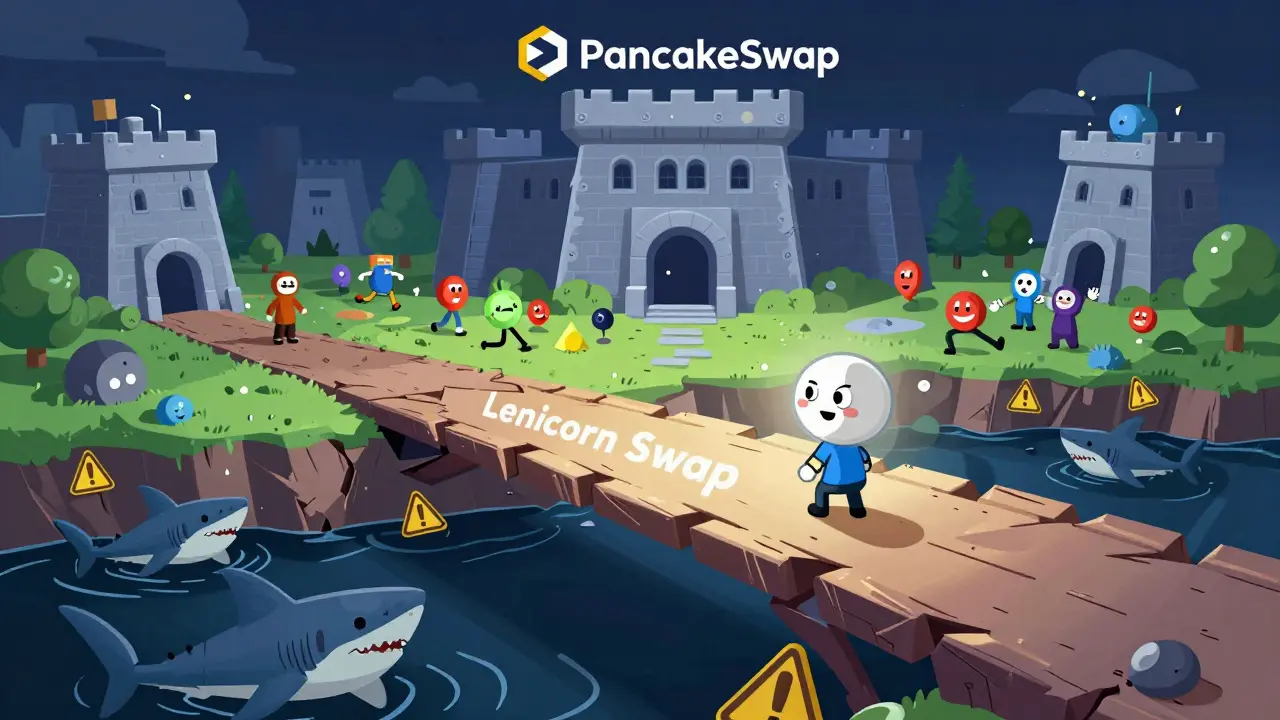
This is where Leonicorn Swap fails hard. As of mid-2026, there is no public record of a formal security audit from reputable firms like CertiK, Hacken, or PeckShield. According to Immunefi’s 2022 report, 78% of DeFi hacks involved unaudited or poorly audited code. That statistic hasn’t improved much since then.
Why does this matter? Smart contracts are immutable once deployed. If there is a bug-a simple line of code that allows anyone to drain the liquidity pool-it stays there forever unless the developers have a backdoor (which introduces its own risks). Leonicorn Swap has neither proven security nor transparency about its development team.
I looked through GitHub repositories, Twitter threads, and Discord channels. There is almost nothing. No active developer updates, no bug bounty programs, no community-driven security discussions. Silence in the crypto world usually means one of two things: either the project is dead, or the founders are hiding something. Neither scenario inspires confidence.
Liquidity and Market Depth: Can You Actually Trade?
Liquidity is the lifeblood of any DEX. It determines how easily you can buy or sell a token without causing massive price swings. Leonicorn Swap suffers from critically low liquidity. Data from Kriptomat shows significant volatility, with 24-hour price changes exceeding 4% in some instances, despite low volume.
Compare this to PancakeSwap, which handles billions in daily volume across thousands of pairs. On Leonicorn Swap, trying to move even a modest amount of capital could result in huge slippage. Slippage is the difference between the expected price of a trade and the executed price. High slippage means you lose money instantly just by clicking 'swap.'
Furthermore, the limited number of trading pairs restricts your options. If you want to trade niche altcoins, you might find them listed here, but at what cost? The risk of getting stuck with untradeable assets is high. Most major traders avoid these thin markets entirely.
Community and Trust: Who Is Using This?
In crypto, community equals credibility. Projects like Uniswap and PancakeSwap have hundreds of thousands of active users on Telegram, Discord, and Reddit. They share tips, report bugs, and hold developers accountable.
Leonicorn Swap? Crickets. I searched for user reviews on Trustpilot, Reddit threads discussing the platform, and YouTube tutorials. Almost nothing exists. The absence of organic community growth is a massive warning sign. Real projects build tribes. Fake or abandoned projects rely on paid ads and silence.
The founder’s background in marketing rather than technology further undermines trust. While Mofassair Hossain claims to have advised top startups, building a secure financial protocol requires deep engineering knowledge. Marketing skills cannot patch a vulnerable smart contract.

Is Leonicorn Swap Still Operational in 2026?
Here is the confusing part. Some aggregators like CryptoRank list the token price as 'N/A,' suggesting the project may be delisted or inactive. Yet, other platforms like KuCoin still host guides on how to buy LEOS. This contradiction leaves users in limbo.
If the site loads and transactions process, it is technically 'alive.' But being alive is not the same as being healthy. With no recent roadmap updates, no new features launched in the last 18 months, and declining interest, Leonicorn Swap appears to be in maintenance mode-or worse, slowly fading away.
Messari’s 2023 DeFi report noted that 68% of minor DEXs fail within 18 months of launch due to unsustainable tokenomics. Leonicorn Swap fits this profile perfectly. Without a clear utility beyond basic swapping, why would anyone stick around?
Better Alternatives for BSC Traders
If you love the idea of low fees and fast transactions on Binance Smart Chain, you don’t need to risk your capital on obscure platforms. Stick to the leaders:
- PancakeSwap: The undisputed king of BSC. Huge liquidity, regular audits, and a vibrant community. Yes, it’s crowded, but that’s also why it’s safe.
- BiSwap: Offers lower fees than PancakeSwap in some cases and has gained traction with yield farming enthusiasts.
- Uniswap (on Arbitrum/Optimism): If you want deeper liquidity and aren’t tied strictly to BSC, Layer 2 solutions offer Ethereum-level security with near-BSC costs.
These platforms have survived multiple bear markets, survived hacks (and patched them), and continue to innovate. Leonicorn Swap has none of that track record.
Final Verdict: Stay Away
Leonicorn Swap checks all the boxes of a high-risk, low-reward DeFi experiment. It lacks security audits, has inconsistent branding, suffers from low liquidity, and has virtually no community presence. The promise of earning tokens while trading is a common tactic used to lure inexperienced investors into volatile environments.
In 2026, we have better tools. We have clearer standards. And we have enough cautionary tales to know that 'too good to be true' usually means 'it is.' Save your crypto for platforms that prioritize security over hype. Your future self will thank you.
Is Leonicorn Swap a scam?
While there is no definitive proof that Leonicorn Swap is a fraudulent scheme designed to steal funds outright, it exhibits many characteristics of high-risk or abandoned projects. The lack of security audits, inconsistent token naming (LEOS vs LEONS), and absence of a transparent development team make it extremely dangerous. In crypto, 'not a confirmed scam' often overlaps with 'likely a waste of time or potential loss.'
What is the difference between LEOS and LEONS?
This discrepancy is a major red flag. Different data providers list the native token under different tickers. CoinMarketCap and CryptoRank use LEOS, while Kriptomat uses LEONS. This inconsistency suggests poor project management and potential confusion among investors. Always verify the contract address before buying any token, as tickers can be duplicated by scammers.
Can I withdraw my funds from Leonicorn Swap?
Technically, yes, if the smart contracts are functioning correctly. Since it is a decentralized exchange, your funds are held in your wallet, not on a central server. However, if the liquidity pool is drained or the contract is compromised, you may find yourself unable to swap out your assets without losing significant value due to slippage or frozen functions. Never invest more than you can afford to lose.
Why are there no security audits for Leonicorn Swap?
Security audits cost money and require cooperation from developers. Many small or hastily created DEXs skip this step to save costs or hide vulnerabilities. The absence of an audit from firms like CertiK or PeckShield means your code has not been independently verified for safety. This significantly increases the risk of exploits such as reentrancy attacks or flash loan manipulations.
Is it safer to use PancakeSwap instead?
Yes, absolutely. PancakeSwap is the largest DEX on Binance Smart Chain, with billions in total value locked (TVL). It undergoes regular security audits, has a large community monitoring for issues, and offers deep liquidity. While no platform is 100% hack-proof, established leaders like PancakeSwap provide a much higher level of security and reliability compared to niche, unaudited alternatives like Leonicorn Swap.
Another BSC scam wrapped in a pretty UI. The fact that they can't even agree on their own ticker symbol is the biggest red flag I've seen all year. Just stick to PancakeSwap or Uniswap and save yourself the headache.
I honestly feel for anyone who got burned by these kinds of projects. It's so disheartening when you put your trust in something promising only to find out it's hollow inside. We need more transparency in this space, seriously! 😔
The inconsistency in the token ticker is not an oversight; it is a deliberate obfuscation tactic designed to confuse retail investors while insiders liquidate positions. This is classic pump-and-dump methodology executed by entities operating outside regulatory oversight. Do not engage.
i mean its kinda sus but maybe they just have bad marketing? idk i just want low fees lol
Look at the code structure if you actually care about security. Most of these 'DEXs' are just copy-pasted templates with backdoors hidden in the router contracts. You are walking into a trap. 🚩📉
Only amateur degens fall for this garbage. Real investors look at TVL and audit reports from reputable firms like CertiK. Leonicorn has neither. It is pathetic how people ignore basic due diligence.
What is the nature of value in a decentralized exchange without trustless verification? If the foundation is built on sand, the castle will inevitably crumble under the weight of greed. One must question the motives behind such flashy promises.
Thanks for sharing this info. Its really helpful to know what to avoid. Stay safe everyone!
You are clearly not paying attention to the fundamentals. A DEX without public audits is not a DEX; it is a charity for hackers. Stop wasting time on obscure tokens and learn how blockchain actually works.
I appreciate the detailed breakdown here. It is important we look out for each other in this community. Let us keep supporting projects that prioritize user safety and transparency above all else. 💪
omg i almost signed up last week thank god i read this first. scary stuff.
The liquidity depth is practically non-existent compared to established protocols. Slippage will eat your profits alive before you even execute the trade. Smart contract vulnerabilities are rampant in unaudited BSC forks. Wake up! 📉💀
Boring article. Everyone knows these are scams. Why do we need a review for obvious trash?
Let me be clear: if there are no public audits, there is no reason to interact with the platform. Period. Your funds are at immediate risk of being drained by exploiters. Use reputable exchanges.
It is interesting to observe how marketing often overshadows technical substance in the crypto space. True decentralization requires robust security measures, not just catchy names. We should advocate for higher standards across the industry.
This is absolutely terrifying when you think about how many people are using these platforms blindly. The lack of accountability is staggering. We need stricter regulations or better education for users. It feels like the Wild West out there! 😱
Oh, look at me, I discovered another rug pull. Groundbreaking journalism. Next, you will tell me water is wet. Get a real job.
The governance model is nonexistent. Without proper checks and balances, the founders have absolute control over the treasury. This is not DeFi; it is CeFi disguised as decentralization. Avoid at all costs.
From a technical standpoint, the absence of verified source code on Etherscan or BscScan is a critical failure. The smart contracts are likely proxy-enabled, allowing owners to upgrade logic maliciously. Never approve unlimited allowances on unknown interfaces. 🔒🚫