
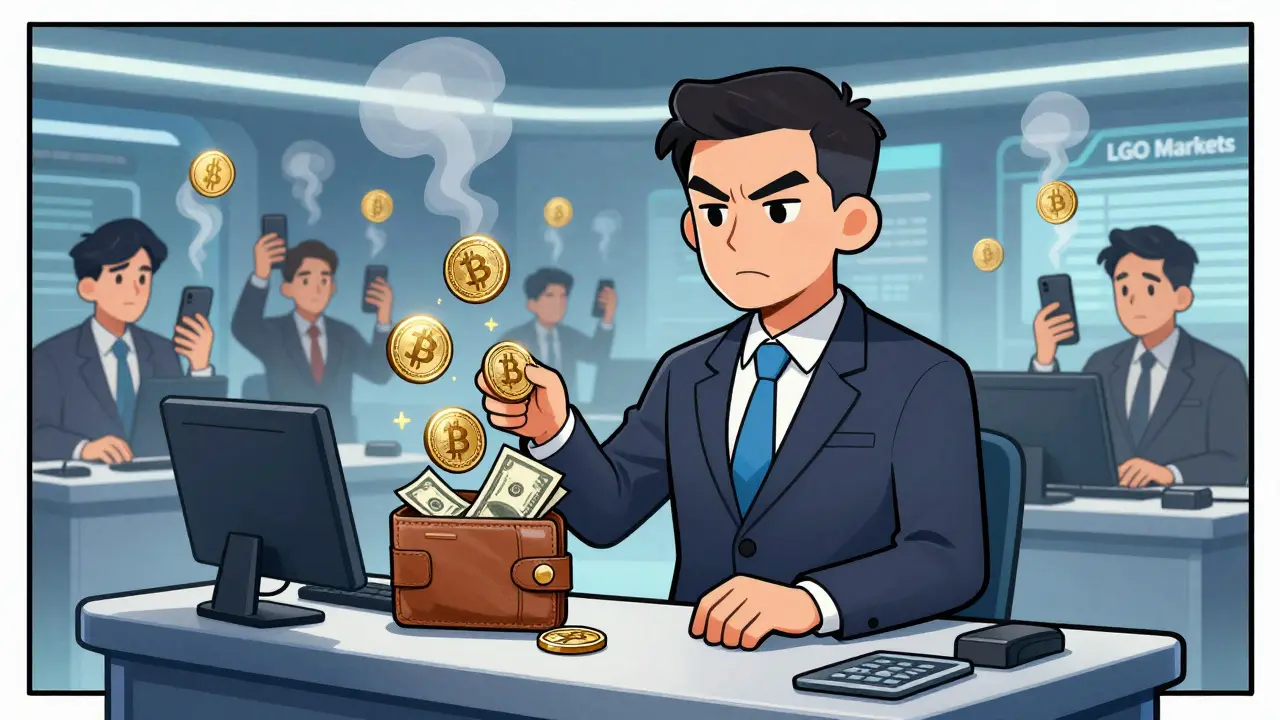
Back in 2018, LGO Markets entered the crypto space with a bold promise: a trading platform built for institutions, not retail traders. It wasn’t just another exchange. It claimed to solve the biggest problem in crypto trading - settlement risk - by doing something no other platform dared to: physically settling trades in real dollars and real Bitcoin, just like Wall Street. By 2020, it was acquired by Voyager Digital. Today, it doesn’t exist as a standalone platform. But understanding what LGO was - and why it failed - tells you a lot about how institutional crypto really works.
What Was LGO Markets?
LGO Markets, originally called Legolas Exchange, launched in 2017 with a team of ex-banking and fintech professionals. Its founders - Frédéric Montagnon, Julien Romanetto, and Ouziel Slama - didn’t want to compete with Binance or Coinbase on volume. They wanted to compete on trust. Their idea was simple: if you’re managing millions in digital assets, you shouldn’t have to worry about whether your trade actually settled. Most exchanges kept funds in hot wallets. LGO didn’t. They used a hybrid model - centralized for user experience, decentralized for transparency - but with a twist. Every trade on LGO ended with real Bitcoin in your wallet and real USD in your bank account. No IOUs. No synthetic derivatives. No counterparty risk from the exchange holding your assets. That was their USP. It mirrored how traditional financial markets work: execution, clearing, and settlement handled by separate entities. Banks held the fiat. Custodians held the crypto. LGO’s matching engine just made sure the trade happened fairly. They partnered with Ledger for security and built their own blockchain protocol to prevent front-running. That meant no trader could sneak ahead of your order by seeing it on the order book. That’s a big deal for hedge funds and asset managers who trade large blocks. If your order leaks, you get ripped off. LGO said they fixed that.Who Was LGO For?
LGO wasn’t for you if you wanted to buy $100 of Ethereum on your phone. It was for European hedge funds, family offices, and institutional traders who needed compliance, custody, and clean settlement. Minimum deposit? $100,000. Onboarding? Took weeks. KYC/AML checks? Rigorous. API integration? 2-3 weeks to go live. This wasn’t a platform for beginners. It was built for professionals who treated crypto like bonds or equities. That’s why it gained traction in Europe. Operating under French financial regulations, LGO had passporting rights across the EEA. That gave it an edge over U.S.-based competitors trying to serve European clients. Finance Magnates reported in 2019 that European hedge funds liked LGO’s regulatory clarity. But they also complained - the trading pairs were limited. Mostly BTC/USD. No altcoins. No margin trading. No options. If you wanted to trade Solana or Polkadot, you went elsewhere. Trustpilot showed a 4.1/5 rating from 37 institutional users. Common praise: "responsive support team," "reliable settlement." Common complaint: "onboarding was a nightmare." That’s the trade-off. Security and compliance come with friction.Why Did LGO Struggle to Grow?
Here’s the problem: being the most secure exchange doesn’t mean you’ll win. In crypto, volume drives liquidity. Liquidity drives traders. And LGO had neither. While Coinbase reported $1.2 trillion in quarterly volume in 2021, LGO’s entire platform likely handled less than $1 billion annually. According to Delphi Digital’s 2020 report, institutional crypto volume hit $1.8 trillion that year. Coinbase Institutional owned 32%. Kraken Pro had 18%. LGO? Less than 2%. And that was before the acquisition. Its physical settlement model was brilliant - but complicated. Banks had to be involved. Custodians had to be coordinated. Settlements took time. Retail exchanges like Binance could settle trades in seconds using internal ledgers. LGO couldn’t. That meant slower execution, higher operational costs, and fewer traders willing to use it. Also, the crypto market didn’t mature fast enough. In 2019, most institutions still used OTC desks or legacy platforms like Cumberland. LGO was ahead of its time. By the time institutions were ready for a clean, regulated platform, Coinbase and Kraken had already built institutional-grade products with better liquidity and more trading pairs.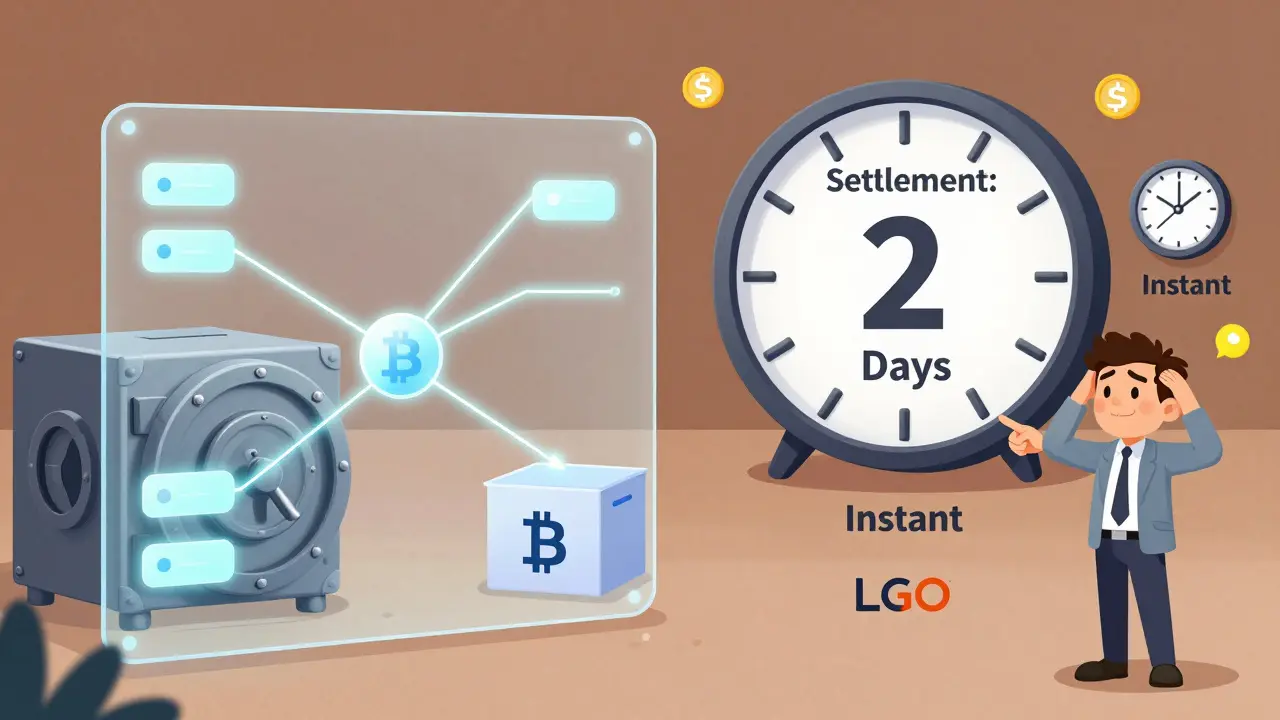
The Acquisition: What Happened in 2020?
On October 24, 2020, Voyager Digital announced it had bought LGO Markets. The price was undisclosed. But the reason wasn’t. Voyager wanted European institutional clients. LGO had them. Voyager had a retail app. LGO had the regulatory setup. The plan? Merge the two. LGO’s compliance infrastructure would power Voyager’s European expansion. LGO’s team, including CEO Hugo Renaudin, would join Voyager. The LGO token? It would be merged into a new, more useful token. For a while, it looked like a smart move. Voyager gained instant access to European institutions. LGO’s founders got a lifeline. But the merger didn’t fix the core issue: LGO’s model was too slow, too narrow, and too expensive to scale. By 2021, LGO’s platform was being phased out. The LGO token was delisted from major exchanges. Trading volume dropped to $548 per day - down from $21.6 million raised in its ICO. The exchange no longer existed as a standalone product. Its technology was absorbed. Its clients were migrated. Its team was reassigned.What Happened to LGO After Voyager’s Bankruptcy?
Voyager filed for Chapter 11 bankruptcy in July 2022 after losing $1.2 billion to the collapse of Three Arrows Capital. That was the death knell for anything LGO-related. The regulatory licenses, the institutional client base, the tech stack - all became part of Voyager’s bankruptcy estate. No buyer stepped in to revive LGO as a separate entity. Today, the LGO token still exists on a few obscure exchanges, but it’s essentially dead. The website redirects to Voyager’s old domain, which now shows a bankruptcy notice. The people who built it? They’ve moved on. The idea? Still valid - but too late.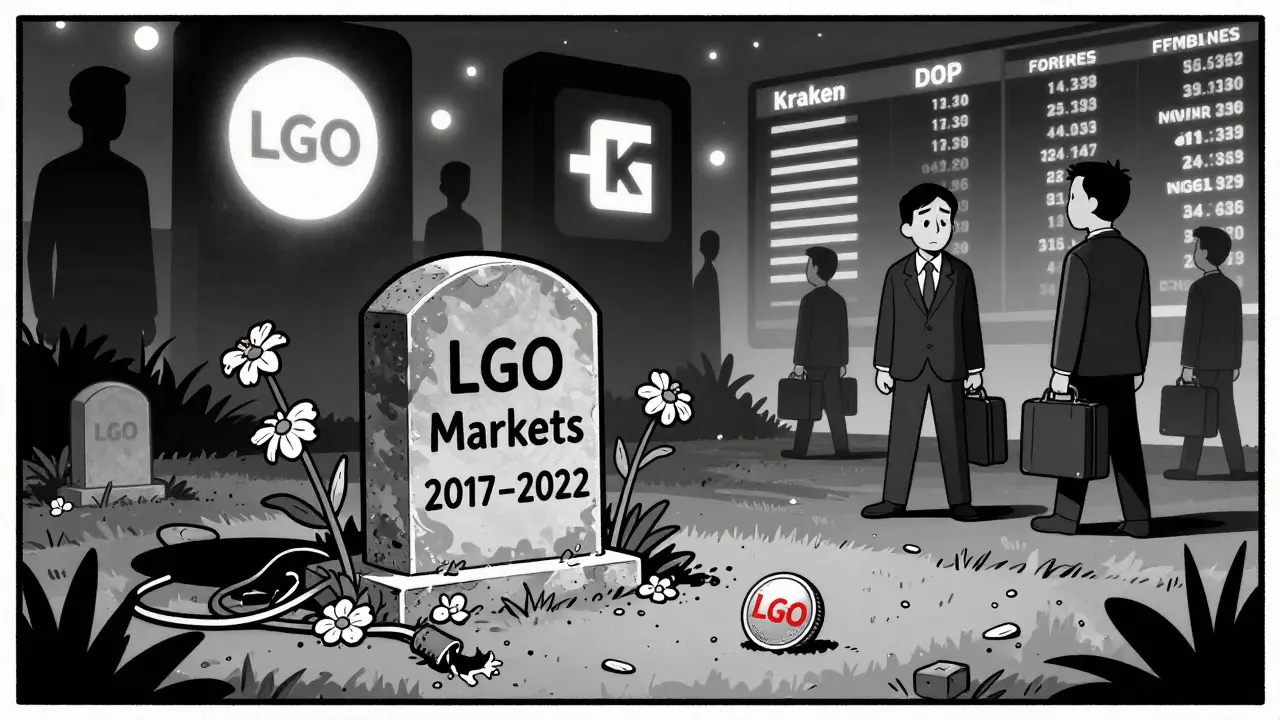
Was LGO a Good Idea?
Yes. But not for the retail crowd. For institutions that needed clean, transparent, physically settled trades? LGO was one of the few platforms that actually delivered. It solved real problems: front-running, counterparty risk, lack of regulatory clarity. But crypto moved too fast. Retail exploded. Liquidity became king. And institutions, even the most sophisticated ones, chose volume over perfection. LGO’s failure wasn’t about bad tech. It was about timing. It was built for a world where institutions treated crypto like gold - slow, safe, regulated. But the market became a casino. And casinos don’t care how clean your settlement is. They care how fast you can place your bet.What Can You Learn from LGO?
If you’re an institutional trader looking for a secure crypto exchange today, LGO is gone. But its lessons live on:- Physical settlement matters - if you’re managing large sums, avoid exchanges that don’t let you withdraw your assets directly.
- Regulation is your friend - platforms under EU or U.S. regulatory oversight (like Kraken, Bitstamp) are safer for institutional use.
- Don’t chase novelty - LGO’s hybrid model sounded smart, but it didn’t scale. Simplicity wins in crypto.
- Liquidity beats security - if you can’t trade your asset quickly, security doesn’t matter.
Is LGO crypto exchange still operating?
No, LGO Markets ceased independent operations after being acquired by Voyager Digital in October 2020. Following Voyager’s bankruptcy in July 2022, the platform was fully shut down. The LGO token is no longer listed on major exchanges and has minimal trading volume.
What made LGO different from other crypto exchanges?
LGO’s key difference was its physically settled model. Unlike most exchanges that keep assets in pooled wallets, LGO ensured every trade ended with real Bitcoin in your wallet and real USD in your bank account. This eliminated counterparty risk and mirrored traditional financial market structures, making it attractive to institutional clients who needed transparency and regulatory compliance.
Why did LGO fail despite its innovative model?
LGO failed because its model was too complex and slow to scale. While it solved real problems like front-running and settlement risk, the crypto market moved faster than institutions could adapt. Competitors like Coinbase and Kraken offered similar security with far greater liquidity and more trading pairs. LGO’s minimum $100,000 deposit and weeks-long onboarding also limited its user base to a tiny fraction of the market.
Can I still trade LGO tokens today?
Technically yes, but it’s not practical. The LGO token still trades on a few obscure exchanges with daily volume under $600 as of 2025. It has no utility, no exchange support, and no development team. It exists only as a historical artifact. Most holders have written it off.
Who bought LGO Markets and what happened after?
Voyager Digital acquired LGO Markets in October 2020 to gain access to its European institutional clients and regulatory framework. LGO’s team joined Voyager, and the LGO token was planned to be merged into a new token. However, after Voyager’s bankruptcy in 2022, all LGO-related operations were terminated. The platform was shut down, and its assets became part of Voyager’s bankruptcy estate.
LGO was a noble idea, but crypto isn't about trust-it's about speed and volume. Institutions didn't fail LGO; the market did. Nobody wants to wait days for settlement when Binance executes in seconds.
They built a Swiss bank for a rave party.
Honestly? LGO was the only one trying to do right by institutions. The fact that it got swallowed by Voyager and then vanished tells you everything about how broken this space is.
Security shouldn't be a luxury. It should be the baseline.
I think LGO’s story is heartbreaking, but also deeply instructive. It wasn’t that their model was flawed-it was that the market wasn’t ready. We keep chasing the shiny new thing, the 10x returns, the memecoins… but the real innovation? The quiet, careful, compliance-first infrastructure? That’s what we need to preserve.
It’s like building a cathedral while everyone else is building cardboard castles. One will outlast the other-but not everyone gets to see it.
Maybe in 10 years, when the hype dies down, people will look back and say, ‘Oh, right-LGO was the one that tried to make crypto real.’
Kinda sad, honestly. LGO had the right idea, but crypto doesn’t reward patience. It rewards hype.
Still, I respect anyone who tried to build something honest in this jungle.
It’s fascinating how LGO mirrored traditional finance so precisely-clearinghouses, custodians, physical settlement. That’s not just ‘niche,’ that’s *principled.*
Meanwhile, the rest of the industry is running on vapor and hot wallets. I hope someone picks up the torch. The world needs more LGOs, not fewer.
LGO? Cute. Like a Tesla Model S in 2008. Beautiful engineering. Zero market fit.
Real institutions don’t care about ‘physical settlement.’ They care about liquidity, APIs, and not getting liquidated at 3 AM because some guy in a Discord got frontrun.
Also, minimum $100K? Who even has that lying around anymore?
I’ve been in crypto since 2016, and LGO was the only platform I ever felt safe using. Not because it was flashy, but because I knew my Bitcoin was mine. No IOUs. No ‘we’ll settle tomorrow.’
It’s heartbreaking that the people who needed it most-the ones with real money, real responsibility-got pushed out by the noise.
Maybe we lost more than an exchange. Maybe we lost our moral compass.
India’s institutional crypto scene is still in its infancy, but I’ve seen similar models fail here too. People want returns, not responsibility.
LGO’s failure isn’t unique-it’s just the first high-profile one. The lesson? Build for the future, not the hype.
It is worth noting that LGO’s regulatory framework under French law granted EEA passporting rights, a significant advantage over U.S.-based competitors attempting to serve European institutional clients.
Furthermore, its partnership with Ledger for hardware security and proprietary blockchain protocol to mitigate front-running represented a technically sophisticated approach that remains unmatched by most current platforms.
Its operational model, while complex, was not inherently flawed-it was simply incompatible with the prevailing market velocity and retail-driven liquidity paradigm.
They didn’t fail because of timing. They failed because they were a front for the Fed. Look at who funded them. Look at who bought them. Look at what happened after. Crypto was never meant to be real. It was always a money laundering pipeline with a blockchain sticker on it.
Why do smart people always lose? Because the system rewards the loudest, not the best.
LGO was the quiet guy who showed up on time with a suit. Binance? The guy who brought the keg and set the whole place on fire.
Guess who won?
And now we’re all just ash.
What LGO demonstrated was that institutional-grade infrastructure can be built without sacrificing transparency or integrity. The fact that it was absorbed and then abandoned speaks to a systemic rot in crypto’s soul.
When the most principled players are erased by the most opportunistic, we are not witnessing market evolution-we are witnessing moral capitulation.
Perhaps the true failure was not LGO’s, but ours-for turning away from the architecture of trust in favor of the theater of velocity.
You know, I remember when I first heard about LGO-I was working at a family office in Chicago, and our CIO was actually excited. He said, ‘Finally, someone who gets it.’ We spent months onboarding, did all the KYC, even flew a guy over to Paris to sign papers. It was a pain, sure, but when we finally made that first trade and saw the Bitcoin land in our cold wallet and the USD hit our account? It felt like the first real moment in crypto. Like we weren’t gambling-we were investing. And then Voyager came in, and everything just… disappeared. No announcement. No fanfare. Just silence. And now? No one even remembers. It’s like it never happened. But it did. And it mattered. To us. To the few who cared. And maybe that’s all that ever really counts.
Interesting case study. In India, we see the same tension-between compliance and speed. But here, regulators are still figuring out crypto. LGO’s model could’ve worked if regulators had moved faster. Maybe the lesson is: don’t wait for the market to catch up. Build the market too.
LGO’s physical settlement model was technically sound and aligned with fiduciary standards. Its downfall was not architectural but behavioral: the market prioritized speculative liquidity over asset sovereignty.
Furthermore, its API integration timelines, while rigorous, were appropriate for institutional clients. The criticism of onboarding friction ignores the non-negotiable nature of AML/KYC in regulated finance.
The failure was cultural, not technical.
I’ve worked with institutional clients who’ve tried every exchange out there. LGO was the only one that didn’t make me feel like I was handing over my life savings to a stranger on the internet.
They didn’t just talk about custody-they proved it. Every trade, every settlement, every audit trail. It was painstaking, yes. But that’s what trust looks like.
Now we’ve got exchanges that can’t even tell you if your Bitcoin is real or just a number on a screen.
That’s not progress. That’s regression.
Let’s be real-LGO was a Trojan horse for the ECB. Look at the founders. French fintech. EU passporting. Then Voyager, a US retail play. And now? All gone. Coincidence? Or did someone quietly kill a competitor that threatened the fiat system?
Ask yourself: why does no one talk about this anymore? Because they don’t want you to remember what real crypto could’ve been.
Anyone who used LGO was a sucker. You think you’re safe because you waited weeks for KYC? You’re just the guy who got scammed slower.
Real institutions don’t use exchanges. They use OTC desks. LGO was a marketing gimmick for people who didn’t understand the game.
And now you’re crying because the con artist got bought by another con artist? Pathetic.
Why do Americans keep pretending crypto needs rules? We don’t need LGO. We need freedom. We need speed. We need to trade without some bureaucrat in Paris looking over our shoulder.
LGO was a leash. And we’re better off without it.