

Imagine locking your savings in a high-yield account, but you can’t touch the money for six months. That’s traditional staking in blockchain networks like Ethereum. You earn rewards, sure, but your capital is dead weight until the unbonding period ends. Now imagine getting a receipt for that locked money-a digital token you can trade, lend, or use as collateral while your original asset keeps earning interest. This is liquid staking, and it is the engine driving modern DeFi composability.
We are past the early days of crypto where you had to choose between securing a network (staking) or using your assets in decentralized finance (DeFi). Liquid staking tokens (LSTs) have bridged this gap, turning static staked assets into dynamic financial instruments. But how does it actually work under the hood, and why should you care about the technical models behind them?
How Liquid Staking Works: The Mechanics
At its core, liquid staking is a three-step process that separates the act of staking from the ownership of the asset.
- Deposit: You send your cryptocurrency, such as ETH, to a liquid staking protocol.
- Minting: The protocol stakes your ETH with validators to secure the network. In return, it mints a derivative token called an LST (like stETH or rETH) and sends it to your wallet.
- Usage: You hold the LST. It represents your claim on the underlying ETH plus any staking rewards earned. Crucially, this LST is transferable and usable in other DeFi apps.
The magic happens in step two. When you stake directly, your ETH sits idle in a validator queue. With liquid staking, the protocol pools funds from many users to run efficient validators. You get liquidity back immediately via the LST. If the network pays out 4% annualized staking rewards, your LST value increases relative to the underlying asset, or the protocol issues more LSTs to your balance, depending on the model used.
cToken vs. aToken Models: Which One Matters?
Not all LSTs behave the same way. There are two primary technical architectures for handling rewards, and understanding the difference is vital for managing your portfolio.
| Feature | cToken Model (e.g., stETH) | aToken Model (e.g., rETH) |
|---|---|---|
| Reward Mechanism | Exchange rate adjusts. 1 stETH buys more ETH over time. | Token supply adjusts. You receive more rETH tokens. |
| User Experience | Balance stays constant; value per token rises. | Balance increases; value per token stays pegged. |
| Integration Complexity | Higher. Protocols must calculate real-time exchange rates. | Lower. Easier for lending protocols to track collateral value. |
| Example Protocol | Lido Finance | Rocket Pool |
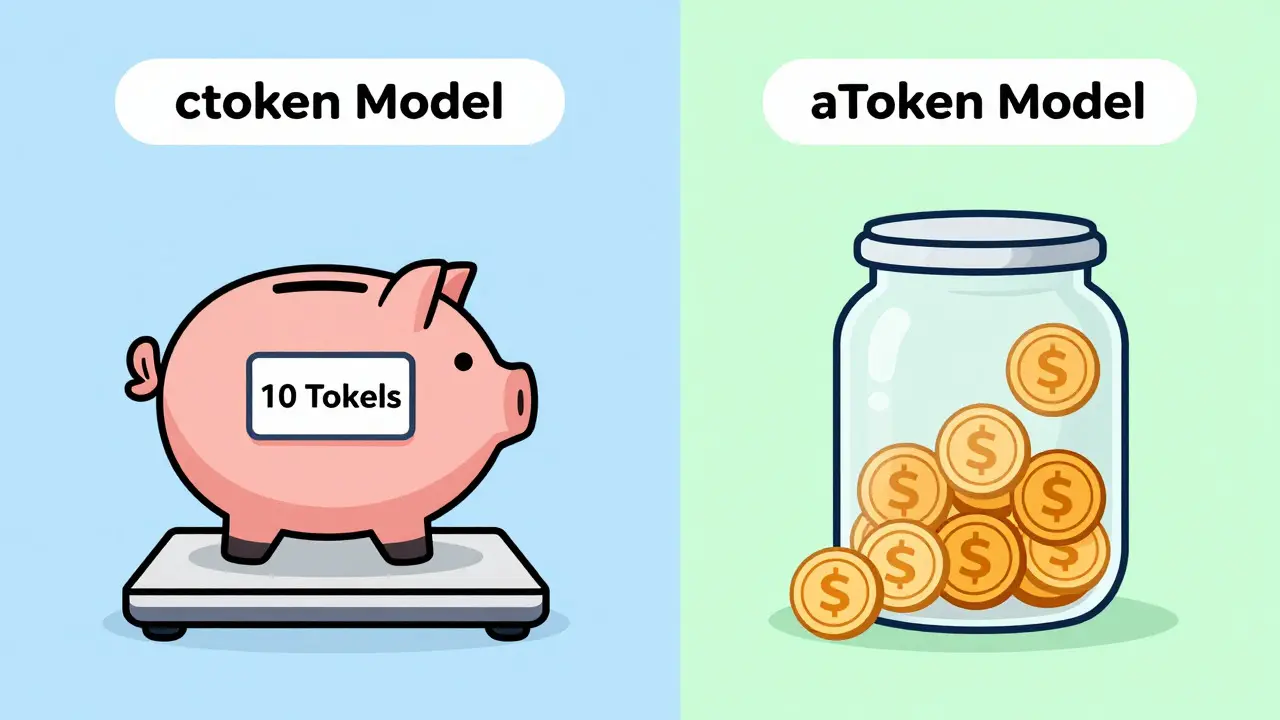
In the cToken model, popularized by Lido Finance, the number of tokens in your wallet doesn’t change. Instead, the ratio of stETH to ETH slowly drifts upward. If you start with 10 stETH, you still have 10 stETH next year, but those 10 tokens might be redeemable for 10.4 ETH. This requires DeFi interfaces to constantly fetch oracle prices to display accurate balances.
In contrast, the aToken model, used by Rocket Pool, keeps the exchange rate stable at 1:1. As rewards accrue, the protocol mints new rETH tokens and distributes them to holders. Your wallet balance grows numerically. This is often cleaner for lending markets because the collateral value is easier to predict without complex rate calculations.
DeFi Composability: Putting LSTs to Work
Why bother with LSTs if you just want yield? Because of composability. In DeFi, applications are built like Lego blocks. An LST is a versatile block that fits into many structures.
When you deposit LSTs into a lending protocol like Aave or Compound, you unlock leverage. Here’s a typical scenario:
- You stake 10 ETH and receive 10 stETH.
- You deposit 10 stETH into Aave as collateral.
- You borrow USDC against that collateral.
- You provide that USDC to a yield farming pool on Uniswap.
Now, your original ETH is earning ~3-4% in staking rewards. Your stETH is earning interest from the lending market. Your borrowed USDC is generating trading fees from the DEX. You’ve tripled the utility of your initial capital. This is composability in action: one asset participating in multiple revenue streams simultaneously.
Risks and Security Considerations
Liquidity isn’t free, and neither is safety. Introducing smart contracts and derivatives adds layers of risk that don’t exist when you self-stake.
Smart Contract Risk: If the liquid staking protocol’s code has a bug, hackers could drain the vault. While major protocols undergo rigorous audits by firms like Trail of Bits or OpenZeppelin, no code is immune. Always check the latest audit reports before depositing significant capital.
Validator Slashing: Validators can lose a portion of their stake if they misbehave (double-signing or downtime). Most liquid staking protocols have insurance funds or slashing protection mechanisms, but severe events could impact the value of your LST. Diversifying across different protocols mitigates this.
Centralization Concerns: Some critics argue that dominant liquid staking providers control too much voting power in proof-of-stake networks. For example, if one protocol controls 30% of all staked ETH, it effectively holds disproportionate influence over network upgrades. This is a governance risk rather than a direct financial loss, but it matters for the long-term health of the ecosystem.

Enterprise Standards and Institutional Adoption
As institutions enter the space, retail-friendly protocols aren’t enough. Enter Liquid Collective, a standard backed by industry giants like Coinbase and Figment. They introduced the LsToken standard, which aims to unify liquid staking across chains with enterprise-grade compliance.
LsTokens focus on multi-chain interoperability and KYC/AML readiness. For a hedge fund or bank, this means they can stake assets securely while maintaining regulatory reporting trails. For retail users, this signals maturation. When institutions adopt these standards, liquidity deepens, spreads tighten, and price stability improves for everyone.
Future Outlook: Cross-Chain and Beyond
The next frontier is cross-chain liquid staking. Currently, most LSTs are native to Ethereum. However, new bridges and wrapped versions allow stETH to be used on Arbitrum, Optimism, and Polygon. Future developments aim to make this seamless-staking on Ethereum but using the liquidity on Solana or Cosmos without manual bridging.
We’re also seeing the rise of Restaking, pioneered by EigenLayer, where staked assets are reused to secure other services. This layers composability on top of composability, potentially increasing yields further but also compounding risk. As we move through 2026, expect clearer regulations around LST classification, which will either legitimize these assets for broader adoption or impose constraints that reduce flexibility.
What is the main difference between staking and liquid staking?
In traditional staking, your assets are locked and inaccessible until you unstake, which can take days or weeks. In liquid staking, you receive a tradable token (LST) representing your stake, allowing you to use the value in other DeFi applications immediately while still earning staking rewards.
Are LSTs safe to hold?
LSTs carry smart contract risk and validator slashing risk, unlike direct staking. However, major protocols like Lido and Rocket Pool have strong security records, extensive audits, and insurance mechanisms. Diversification across multiple protocols is recommended to mitigate single-point failures.
Which LST model is better: cToken or aToken?
It depends on your preference. cToken models (like stETH) keep your token count constant while the value per token rises, which is intuitive for long-term holders. aToken models (like rETH) increase your token balance, which can be easier for tracking growth in lending protocols. Both achieve similar economic outcomes.
Can I lose money with liquid staking?
Yes. Risks include smart contract hacks, validator slashing, and depegging events where the LST trades below the value of the underlying asset due to market panic. Additionally, if the underlying asset (e.g., ETH) drops in price, your LST value drops proportionally.
What is DeFi composability?
DeFi composability refers to the ability to combine different decentralized finance protocols to create new financial products. For example, using an LST as collateral to borrow stablecoins, then lending those stablecoins elsewhere. It allows assets to serve multiple functions simultaneously, maximizing capital efficiency.