
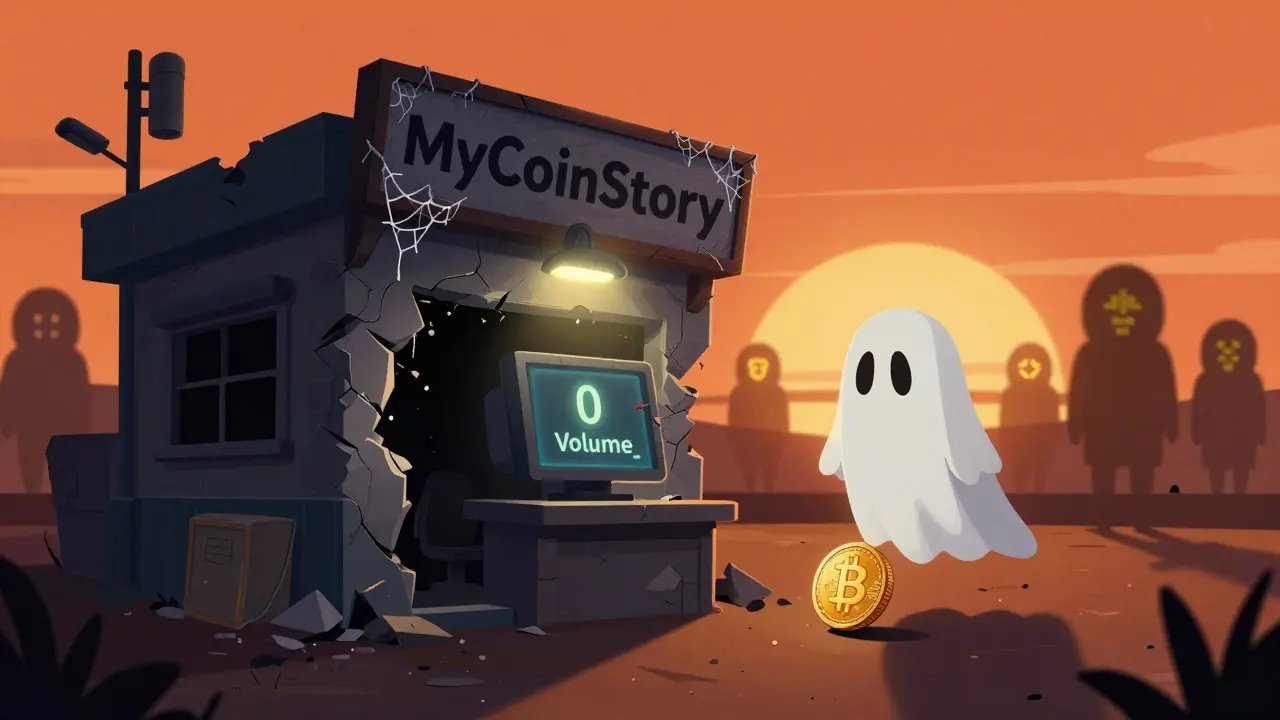
When you hear the name MyCoinStory, you might think of a rising star in crypto derivatives - a platform built by financial experts, offering low fees, and listing rare futures like TRON’s SUN and Klaytn’s KLAY before anyone else. But here’s the truth: MyCoinStory isn’t just struggling. It’s likely gone.
Launched in 2020, MyCoinStory (MCS) promised to be the next big thing in perpetual contract trading. It claimed to be the first exchange to list SUN and KLAY futures. Its fees were competitive: 0.04% for takers, 0.02% for makers. That’s lower than the industry average at the time. It even had a market maker program touted as "the best in the industry." But none of that mattered if no one was trading.
What Did MyCoinStory Actually Offer?
MyCoinStory was built for derivatives traders - people who want to bet on price movements without owning the underlying asset. It focused almost entirely on perpetual futures contracts. That meant users could trade with leverage, go long or short, and hold positions indefinitely. Sounds familiar? It should. That’s exactly what Binance Futures, Bybit, and OKX do - and they do it with way more liquidity.
MCS didn’t offer fiat on-ramps. You couldn’t deposit USD, AUD, or EUR. You had to already own crypto. No bank transfers. No credit cards. That alone limited its user base to experienced traders who already had wallets filled with Bitcoin, Ethereum, or altcoins. And even then, the platform didn’t support margin trading beyond perpetual contracts. No spot trading. No staking. No savings accounts. Just derivatives.
The withdrawal fee for Bitcoin was 0.0005 BTC. That’s slightly below the industry average of 0.00053 BTC. But here’s the catch: if you can’t trade, you don’t need to withdraw. And if no one’s trading, the fee doesn’t matter.
The Mobile App That Wasn’t There
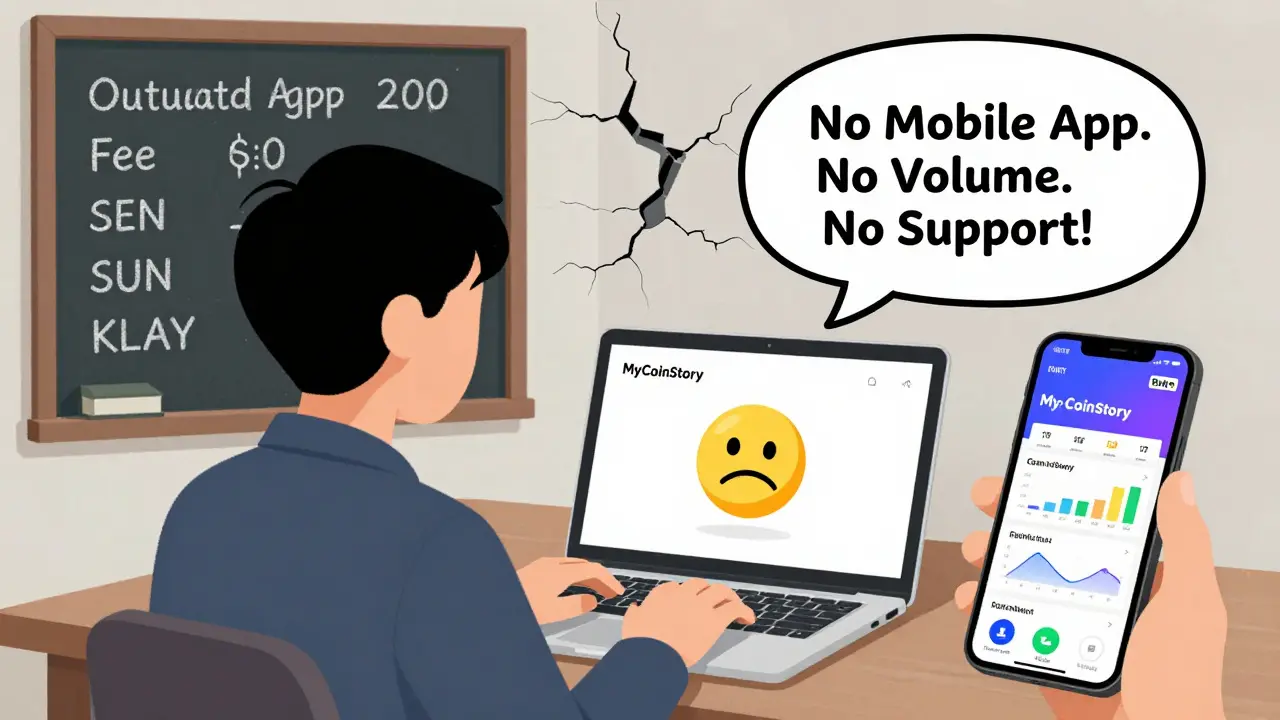
In 2026, if a crypto exchange doesn’t have a mobile app, it’s already dead. MyCoinStory never built one. Not for iOS. Not for Android. At a time when 78% of traders use mobile devices to monitor markets, MCS forced users to stick to desktop browsers. That’s a massive barrier. Most people don’t sit at a laptop all day. They check prices on their phones while commuting, waiting in line, or scrolling through Twitter.
Compare that to Bybit or KuCoin - both have polished, reliable mobile apps with push alerts, one-tap trading, and real-time charts. MCS? Nothing. Not even a basic web wrapper. The lack of a mobile presence wasn’t an oversight. It was a fatal flaw.
Trading Volume: 0
Here’s the most damning evidence: as of 2023, MyCoinStory showed 0 trading volume and 0 trading pairs on Cryptogeek.info. That’s not a glitch. That’s not a temporary dip. That’s a tombstone.
Back in November 2020, Bitcoin.com reported MCS had a daily volume of $100 million. CoinGecko backed that up. But that was four years ago. Since then? Silence. No press releases. No social media updates. The last tweet from its official Twitter account was in December 2020. The GitHub repo - the only sign of developer activity - hasn’t been touched since 2021.
Compare that to real exchanges. Binance processes over $20 billion in daily volume. Even smaller players like Bitget or MEXC hit $100 million daily. MCS? Zero. That means no liquidity. No order depth. No price stability. If you tried to open a position today, you’d likely get slippage so bad it’d feel like gambling.
Why Did It Fail?
MyCoinStory didn’t fail because of bad technology. Its fee structure was smart. Its early listings were bold. It didn’t fail because it was unprofessional. It failed because it vanished.
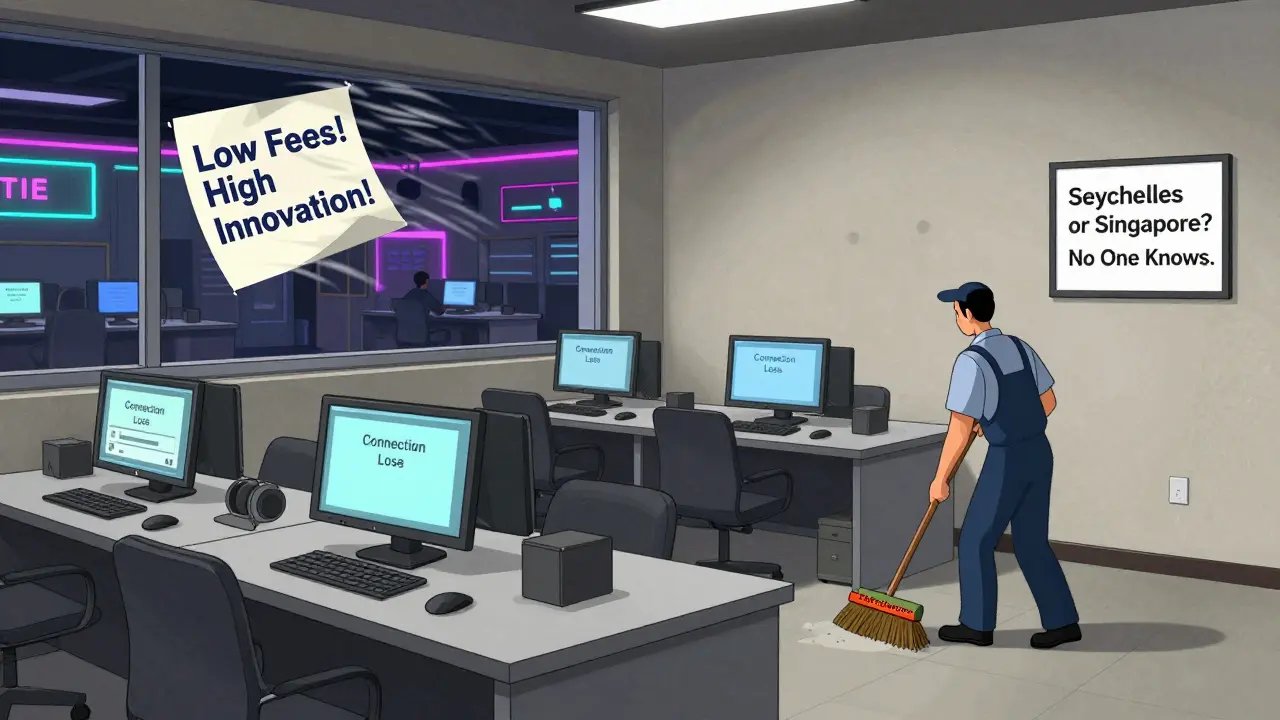
It operated out of the Seychelles - a jurisdiction with no real crypto regulation. That’s not a strength. It’s a red flag. Regulated exchanges like Coinbase Derivatives or LedgerX have legal oversight. If something goes wrong, you can file a complaint. With MCS? No recourse. No customer support logs. No audit trail.
And then there’s the market. The derivatives space exploded between 2020 and 2023. Volume jumped from $0.5 trillion quarterly to over $2 trillion. But consolidation followed. The top five exchanges now control 83% of the market. New entrants need massive capital, marketing, and liquidity incentives to survive. MCS had none of that.
It didn’t have a community. Reddit threads? Three mentions in three years. Trustpilot reviews? One. No user testimonials. No YouTube tutorials. No Discord server. Just a website that stopped updating.
Is MyCoinStory Still Operational?
Try to visit mycoinstory.com today. The site might load. Or it might not. The domain could be parked. The API could be offline. Even if the homepage shows up, the trading engine is almost certainly dead. No volume means no matching engine. No matching engine means no trades.
The platform’s own claims - 24/7 support, inclusive trading environment - now sound like relics. There’s no way to contact support. No email bounces back. No live chat. No ticket system. The entire infrastructure appears abandoned.
Some sources still list it as "Singapore-based." Others say Seychelles. That confusion alone tells you something’s wrong. Legitimate exchanges don’t flip their jurisdictional story. They’re transparent. MyCoinStory wasn’t.
What Should You Do Instead?
If you’re looking for a derivatives exchange today, don’t waste time on MyCoinStory. It’s not a risky platform. It’s a ghost.
Here are three real alternatives:
- Bybit: Low fees, high liquidity, excellent mobile app, and strong security. Popular for perpetual contracts.
- Binance Futures: The largest by volume. Deep order books, hundreds of trading pairs, and advanced tools.
- KuCoin: Offers both spot and derivatives, supports altcoins, and has a solid user base.
All three have mobile apps, active customer support, and real-time trading volume. They’re not perfect - no exchange is - but they’re alive.
Final Verdict
MyCoinStory had potential. It had smart pricing. It had early innovation. But potential doesn’t pay bills. Liquidity does. Community does. Consistency does.
Today, MyCoinStory is a cautionary tale. It’s what happens when a crypto project launches with hype, ignores user needs, and vanishes without a word. The trading pairs disappeared. The volume dropped to zero. The team went silent.
If you see a platform with zero volume and no mobile app, walk away. Even if the fees look good. Even if the branding is slick. If no one’s trading, you’re not a user. You’re a ghost.
Is MyCoinStory still active in 2026?
No, MyCoinStory is not active. As of 2023, all major exchange tracking sites show 0 trading volume and 0 available trading pairs. Its website may still load, but the trading engine is offline. No updates have been posted since late 2020, and its GitHub repository hasn’t been updated since 2021. It’s effectively abandoned.
Can I still deposit or withdraw funds from MyCoinStory?
It’s highly unlikely. Even if the website appears online, there’s no evidence that deposits or withdrawals are being processed. The platform has no customer support, no help center, and no user reports of successful transactions in over two years. If you have funds on the platform, you should assume they are inaccessible.
Why did MyCoinStory fail when it had low fees?
Low fees don’t matter without liquidity. Traders need deep order books to enter and exit positions without slippage. MyCoinStory had no users, so no volume. No volume means no traders. No traders means no reason for market makers to stay. It became a dead platform with a price list - like a store with open shelves but no customers.
Was MyCoinStory regulated?
No, MyCoinStory was not regulated. Sources conflict on its location - some say Singapore, others say Seychelles. Neither jurisdiction offers strong investor protection for crypto derivatives. Unlike exchanges regulated in the UK, US, or EU, MyCoinStory provided no legal recourse for users. That’s a major risk.
Are there any user reviews or testimonials for MyCoinStory?
There is only one known user review across all major platforms, and it contains no details. Reddit, Trustpilot, and other forums show virtually no discussion about MyCoinStory after 2021. This lack of community engagement is a strong indicator that the platform had almost no active users.
I remember when MCS was the talk of the crypto subreddit back in 2020. Everyone was hyped about SUN and KLAY futures. I even opened an account. But then... nothing. No updates, no app, no volume. It’s wild how fast a platform can go from "next big thing" to digital ghost town. You can have the best fees in the world, but if no one’s trading, you’re just running a fancy static webpage.
Don’t even get me started on the lack of a mobile app. In 2026? That’s not a mistake. That’s a death sentence.
This is why I never trust any exchange that doesn’t have a clear regulatory footprint. MCS hiding behind Seychelles? Red flag #1. No legal recourse? Red flag #2. No mobile app? Red flag #3. You don’t need to be a genius to see this was doomed from day one. It’s not even a failure-it’s an embarrassment to the whole industry.
Low fees mean nothing without liquidity. It’s like opening a grocery store with the best prices in town but no shelves. No one’s going to show up. And when they do, they’ll leave because they can’t buy anything. MCS didn’t fail because of tech. It failed because it didn’t understand the most basic rule of markets: supply needs demand.
Honestly? I feel bad for the devs who worked on this. They built something that looked solid. But crypto is brutal. You need community, marketing, and consistency. Not just a whitepaper and a fee schedule. If you’re building something, don’t just launch it-keep showing up. MCS disappeared. And that’s why it’s dead.
I tried MCS once... just to see. The site loaded, but the trading interface was glitchy. Tried to place a small order. Got an error that said "no liquidity available." Then I checked the volume on CoinGecko... zero. I closed the tab and never looked back. Sometimes the silence speaks louder than any tweet.
I’m from India, and I remember hearing about MCS from a few traders here. We were excited because it listed altcoins we couldn’t find anywhere else. But then... radio silence. No updates. No community. Just a website that looked like it was built in 2018. It’s sad. We need more platforms that support niche assets-but they can’t vanish without a word.
The structural flaw here was the lack of a multi-chain on-ramp strategy. MCS was hyper-focused on derivatives, but didn’t integrate with DeFi bridges or liquidity pools. Without cross-chain interoperability, even the most technically sound platform becomes an isolated silo. In a Web3 ecosystem, isolation equals extinction. They didn’t just fail-they were architecturally obsolete from inception.
Oh my god, I can’t believe people still talk about this. It’s like digging up a fossil and asking if it’s still alive. The domain probably got auctioned off last year. I checked the WHOIS-registered to some shell company in the Seychelles. The guy who ran it? Vanished. No LinkedIn. No Twitter. No trace. This isn’t a crypto story. It’s a noir novel.
I think MCS was never real. I think it was a honeypot. A trap for retail traders to deposit their coins so someone could siphon them off quietly. No volume? No support? No updates? That’s not incompetence. That’s a heist. And the regulators? They’re all looking the other way because it’s offshore. We’re being played.
I still have a small balance on MCS. I tried withdrawing last year. The transaction just... disappeared. No confirmation. No error. Just gone. I’ve emailed them. No reply. I’ve checked Reddit. No one else has had luck. I think I lost 0.02 BTC. Not much. But it’s the principle. They took the money. And they didn’t even have the decency to say goodbye.
You know what’s funny? MCS had the perfect name. MyCoinStory. Like, it’s not a platform. It’s a narrative. And the narrative was: "We’re the underdog who’s going to disrupt the giants." But narratives don’t pay server bills. Liquidity does. Community does. Execution does. They wrote a great story. But forgot to write the ending.
I’ve seen this movie before. Platform launches with big claims. Gets early traction. Then stops updating. The devs move on to the next hype cycle. The website stays up because domain renewal is cheap. The trading engine? Dead. The API? Unreachable. The team? Ghosted. This isn’t unique. It’s the standard model for 90% of crypto startups. They don’t fail. They just... evaporate.
I am writing this with the utmost formality. The operational discontinuity of MyCoinStory represents a systemic failure in the governance of decentralized financial infrastructure. The absence of a formal dissolution notice, coupled with the non-response to user inquiries, constitutes a breach of fiduciary duty under emerging crypto standards. I have filed a formal complaint with the International Crypto Oversight Board. They are reviewing.
The real tragedy isn’t that MCS failed. It’s that it had potential. The fee structure was better than Binance’s in 2020. The early listings were bold. They had a chance. But they didn’t build a community. Didn’t engage. Didn’t listen. That’s not a tech problem. That’s a leadership problem. And leadership failures are the deadliest kind.
I used to check MCS every day. Just to see if it was alive. It wasn’t. I’d refresh. Wait. Refresh again. Nothing. Then I stopped. Now I only look at Bybit and KuCoin. And honestly? I’m happier. The market’s big enough for everyone. But you have to show up to play.
If you’re building something in crypto, don’t just launch it. Keep showing up. Post updates. Answer questions. Even if you’re scaling back. Even if you’re pivoting. Silence kills trust. MCS didn’t have to be huge. But they had to be real. And they weren’t. That’s the lesson here.
I just want to say-I had my entire savings on MCS. 0.5 BTC. I thought I was being smart. Low fees. Unique pairs. Now? Nothing. I can’t even log in. I’ve cried. I’ve screamed. I’ve Googled "is mycoinstory a scam" 200 times. I know I’m not alone. But no one cares. It’s just another ghost in the blockchain graveyard.
You know what’s ironic? The platform’s name was "MyCoinStory." But no one’s story ended up being theirs. The devs’ story? Gone. The traders’ story? Lost. The users’ story? Erased. The only story left is the one we tell each other: "Don’t trust the shiny thing that disappears." And honestly? I’m glad I didn’t put more in.
I’ve been saying this for years: the crypto industry doesn’t kill projects. It ignores them. MCS didn’t get shut down. It got ignored. And that’s worse. You can fight a regulator. You can’t fight silence. The market doesn’t care if you’re a genius. It only cares if you’re visible. MCS? Invisible. So it’s dead.
I think the whole thing was a front. A way to collect wallet addresses. Then sell them to data brokers. Or worse-use them to front-run trades on other platforms. The 0 volume? A smokescreen. The lack of mobile app? To prevent users from monitoring their balances. The silence? Because they knew what they did. And they’re still watching.
I’m not even mad. Just tired. Another one bites the dust. I used to get excited about new platforms. Now? I just check CoinGecko for volume. If it’s not over $10M daily, I skip it. MCS? 0. That’s not a startup. That’s a tombstone.
I have been in this industry since 2013. I have seen countless projects come and go. MyCoinStory is not a failure. It is a symptom. The symptom of a system that rewards hype over execution, branding over substance, and silence over accountability. It is not an anomaly. It is the norm. And until we change the culture, more will follow.
I remember the day I signed up for MCS. I was so excited. I’d never seen KLAY futures anywhere else. I thought I’d found the next big thing. I even told my friends. We all deposited. We all waited. And then... nothing. Not a peep. No tweet. No email. No update. Just a website that looked like it was built by a college kid in 2015. I don’t blame the tech. I blame the people who walked away. You don’t just disappear on people. Not in crypto. Not ever. That’s not business. That’s betrayal.