

Imagine waking up to find that owning a digital wallet or trading a single coin could land you in a jail cell for three years. For residents of Nepal, this isn't a dystopian movie plot; it's the legal reality. The government has slapped an absolute ban on all things crypto, yet thousands of people are doing it anyway. Why risk everything for a digital asset? The answer usually boils down to one word: survival.
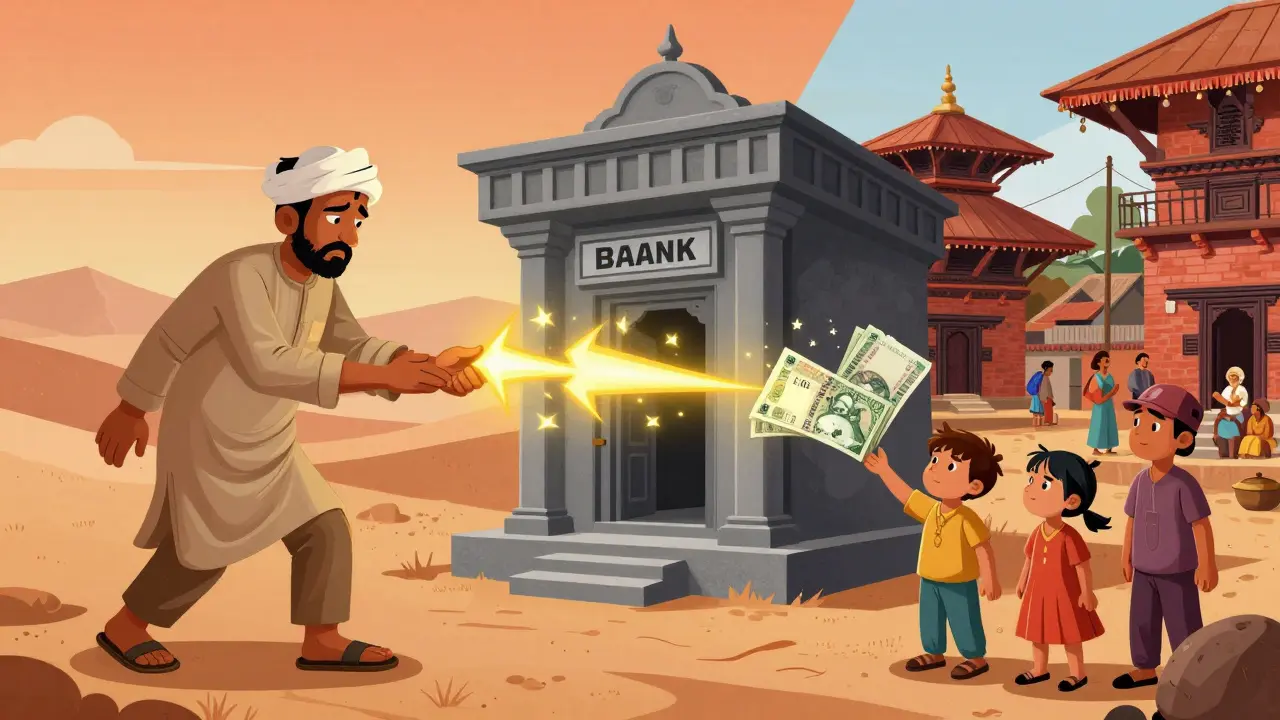
In Nepal, the legal landscape is brutal. The Nepal Rastra Bank is the central bank of Nepal responsible for monetary policy and financial regulation has made it clear: trading, mining, and payments are completely illegal. If you're caught, you're not just looking at a slap on the wrist. We're talking about fines that can reach three times the transaction amount and the very real possibility of asset confiscation. But despite these threats, a shadow economy is thriving, driven largely by a desperate need for faster, cheaper ways to move money across borders.
The Remittance Engine Driving Underground Adoption
To understand why Nepalis risk prison, you have to look at the economy. Nepal relies heavily on remittances-money sent home by citizens working abroad. Traditional banking channels are often slow, plagued by high fees, and burdened by mountains of paperwork. For a worker in Qatar or Malaysia, sending money home through a standard bank can feel like a marathon of bureaucracy.
This is where Cryptocurrency enters the picture. By using digital assets, users can bypass the traditional banking system entirely. They aren't looking to "get rich quick" with volatile coins; they are using crypto as a utility. A worker abroad buys a stablecoin or Bitcoin, sends it to a contact in Kathmandu, and that contact sells it for Nepali Rupees via a peer-to-peer (P2P) arrangement. The money arrives almost instantly, and the fees are a fraction of what a bank would charge.
This creates a high-risk loop. Since the Foreign Exchange Regulation Act prohibits these transfers, every single one of these transactions is technically a crime. The users aren't using official exchanges-which would require KYC (Know Your Customer) documents that flag their residency-but are instead relying on encrypted messaging apps and trusted social circles to swap assets.
The Digital Divide: Tech-Savvy Youth vs. The State
There is a glaring generational gap in how this ban is perceived. On one side, you have the government, which views digital assets as a gateway to money laundering, Ponzi schemes, and financial instability. On the other, you have a generation of tech-savvy youth who see Blockchain as the future of global finance. For these young developers and entrepreneurs, the ban isn't just a legal hurdle; it's a ceiling on their professional growth.
Many talented Nepali programmers are forced into a strange double life. By day, they might work on government-approved software projects; by night, they contribute to open-source blockchain projects or manage portfolios on international platforms using VPNs to hide their location. This "brain drain" of innovation is significant. Instead of building the next big FinTech unicorn in Kathmandu, Nepal's brightest minds are operating in the shadows or moving abroad to countries with clearer regulations.
| Feature | Traditional Banking | Underground Crypto |
|---|---|---|
| Legal Status | Fully Legal | Strictly Illegal |
| Transfer Speed | Days / Weeks | Minutes |
| Cost/Fees | High | Very Low |
| Risk Level | Low (Safe) | Extreme (Legal/Financial) |
| Recourse | Bank Dispute/Law | None (No Legal Protection) |
The Legal Minefield and Enforcement
The government isn't just issuing warnings; they are making arrests. The Electronic Transaction Act provides the legal teeth for the police to pursue cybercrime charges. In recent years, high-profile raids in Kathmandu have targeted individuals operating large-scale P2P trading rings. When the police seize a phone or a laptop, any evidence of a crypto wallet can be enough to trigger an investigation.
The danger here isn't just the law, though. Because the entire ecosystem is underground, there is zero consumer protection. If a Nepali user is scammed by a "crypto agent" or loses their keys in a hack, they can't go to the police for help. Reporting a theft would essentially mean confessing to a crime. This creates a predatory environment where scammers know their victims are silenced by the fear of imprisonment.
The State's Alternative: CBDCs
The Nepal Rastra Bank isn't against digital money-they're just against money they can't control. To counter the appeal of decentralized assets, the government is planning its own Central Bank Digital Currency (or CBDC). A CBDC is essentially a digital version of the national currency, issued and regulated by the central bank.
By introducing a state-controlled digital rupee, the government hopes to provide the efficiency of digital payments without the "anarchy" of decentralized finance. However, a CBDC doesn't solve the problem of cross-border remittances if the state still maintains strict capital controls. If the digital rupee is just as restricted as the physical one, the incentive to use underground crypto will remain.

Common Workarounds and Their Risks
While most people keep their methods secret, a few common patterns emerge in how the ban is circumvented. Many use foreign-based accounts or trust "middlemen" in countries like India or the UAE to hold their assets. They trade via P2P platforms, where the crypto is swapped for cash through direct bank transfers or mobile wallets that don't explicitly mention cryptocurrency in the transaction notes.
The risk of this approach is that it relies entirely on trust. In a system where the law doesn't protect you, a single dishonest partner can wipe out your entire life savings. Furthermore, as banks implement better AI-driven monitoring for suspicious transaction patterns, the "safe" ways to move money are disappearing, forcing users into even riskier a-la-carte cash trades.
Is it illegal to simply own Bitcoin in Nepal?
Yes. The Nepal Rastra Bank and the government maintain an absolute ban. Owning, trading, or mining cryptocurrency is illegal under the Foreign Exchange Regulation Act, and violators can face imprisonment and heavy fines.
What are the penalties for crypto trading in Nepal?
Penalties can include up to 3 years in prison, fines up to three times the amount involved in the transaction, and the confiscation of all related digital and physical assets.
Why do Nepalis use crypto if it's so dangerous?
The primary driver is cross-border remittances. Crypto allows workers abroad to send money home faster and with significantly lower fees than traditional banks, which are often slow and expensive.
Will a CBDC replace cryptocurrency in Nepal?
The government hopes so. A Central Bank Digital Currency provides the speed of digital assets while keeping the government in total control. However, it may not satisfy users who want a decentralized asset to hedge against inflation.
Can you use a VPN to trade crypto in Nepal?
While some use VPNs to access international exchanges, this does not make the activity legal. If the financial trail is discovered by authorities, the user is still subject to the laws of Nepal.
What Happens Next?
The tension in Nepal is reaching a breaking point. You can't tell a population that the world is moving toward digital finance and then forbid them from touching the technology. As long as the traditional remittance system remains inefficient, the underground crypto market will grow. The government has two choices: continue a costly and largely ineffective game of cat-and-mouse, or create a regulated framework that allows for innovation while preventing fraud.
For now, the brave-or the desperate-will keep trading in the shadows, hoping that the digital revolution arrives in Kathmandu before the police do.
it's crazy how people just keep doing it anyway haha
central banks always try to kill what they cant control it's basic economics
honestly the goverment is just scared of loseing there power over the money
The situation in Nepal is truly a reflection of the global struggle between decentralization and state control, and while the risks are immense, the drive for financial autonomy is a powerful motivator that often outweighs the fear of legal repercussions in the eyes of those who feel trapped by an inefficient system. It is my hope that they find a middle ground where innovation is encouraged without jeopardizing the financial stability of the average citizen.
too scary man!! imagine getting arrested for a wallet omg
The asymmetry of information here is staggering. The state's insistence on a CBDC is merely a facade for enhanced surveillance capitalism, utilizing a programmable ledger to ensure total fiscal hegemony. It is utterly pedestrian to assume a digital rupee solves the remittance friction when the underlying bottleneck is regulatory capture and capital controls, not the medium of exchange itself. The cognitive dissonance required to believe a government-led digital asset will provide the same utility as a decentralized protocol is profound.
Using stablecoins for liquidity management in high-inflation or restrictive environments is a classic hedging strategy. I believe we should focus on the interoperability of these shadow systems to optimize the throughput for the migrant workers who are the backbone of the economy.
Imagine thinking a CBDC is a good idea 😂 just more control for the big guys 🤡
The legal frameowrk in Nepal is clearly outdated and doesnt reflect the actual digital transition happening globally. It is simply a matter of time before the underground market becomes too big to ignore or suppress through mere arrests.
Omg I cant believe they'd risk prison for this!! But like totaly get the part about the bank fees being a nightmare... the system is so broken its actually insane lol
It is heartening to see the ingenuity of the youth in Nepal. Despite the stringent regulations, their ability to adapt and utilize virtual private networks to continue their professional development in blockchain technology is truly commendable. One can only hope that the authorities will eventually recognize the economic potential of these skilled developers and provide a legal path for their innovation to flourish within the country.
Absolutely pathetic that people are risking their lives for some fake internet money. This is why we need strong national borders and actual currencies, not this digital anarchy taking over every corner of the globe.
This is exactly how it starts. First, they ban the coins, then they tell you it's for your own safety, and then they drop the CBDC so they can track every single cent you spend. It's a globalist trap and Nepal is just the latest testing ground for total financial surveillance.
my heart literally hurts for these people... imagine being scammed and not even being able to tell the police because you'd go to jail too 😭😭
just use a vpn and keep it low key
It's a really tough spot to be in. Sending money to family is a basic need, and it's sad that the only efficient way to do it is through illegal channels. Hope things get better for them. :)
The reliance on peer-to-peer networks in the absence of legal protections introduces a significant layer of counterparty risk. From a technical standpoint, the use of encrypted messaging apps provides a veneer of security, but the actual settlement of funds remains vulnerable to fraud and exploitation.
Stop playing with magic internet money and get a real job 🙄 🤡
It's a wild ride when you think about it. These folks are basically digital pioneers in a land where the laws are still stuck in the twentieth century. It takes a lot of guts to operate in those shadows just to keep the family fed, and I really feel for the devs who have to hide their brilliance like they're some kind of secret agents.
Interesting how the generational gap plays into this. The youth are basically forced to be criminals just to stay competitive in the global tech market.
P2P is the only way in these regions.
Get it together Nepal! You can't just ban the future and expect people to just stop wanting it. This is embarrassing for a modern state!
It is a complex situation. Respect to those trying to support their families despite the risks.
It's heartbreaking to realize that the very tools meant to liberate us from inefficient systems are the ones that could put someone behind bars. I hope the government listens to the needs of the people instead of just focusing on control.
Stay strong everyone!