
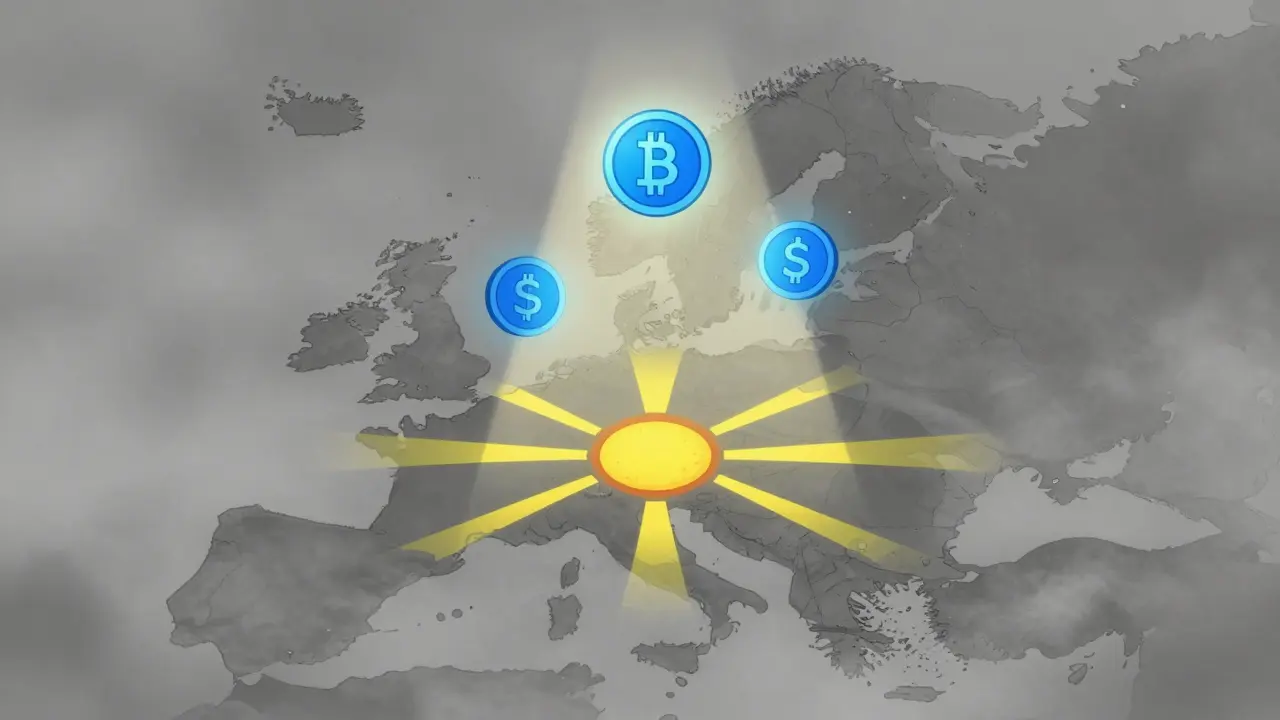
The Reality Behind the North Macedonia Crypto Ban Rumors
If you've heard that North Macedonia has banned cryptocurrency, you aren't alone in being confused. There is a lot of conflicting noise out there. Some sources say it's completely prohibited, while others claim it's wide open. As we move through early 2026, the truth sits somewhere in the middle. It is not a total prohibition, but it isn't a free-for-all either. You are dealing with what experts call a "legal gray zone."
This nuance matters immensely if you plan to hold, trade, or develop businesses involving blockchain technology in the region. A vague regulatory environment creates risk. You could lose money not because Bitcoin dropped, but because you violated an unspoken rule. Let's break down exactly what is allowed, what is restricted, and where the country stands as we navigate the second quarter of 2026.
North Macedonia is a country in Southeastern Europe currently navigating complex financial regulations regarding digital currencies. The nation operates under evolving policies that balance EU accession requirements with domestic economic stability, resulting in a partial restriction framework rather than an outright ban.What Actually Counts as a Ban?
To understand the situation, you have to define what "banned" means in this context. In most people's minds, a ban means you cannot own, trade, or talk about digital assets. That is not the case here. Northern Balkan Region does not criminalize holding a wallet or sending crypto to a friend.
The restrictions focus specifically on official financial operations. Cryptocurrencies do not have legal tender status. This is the core constraint. You cannot walk into a store in Skopje and pay solely with Ethereum or Bitcoin. Shops cannot require it, nor can they legally accept it as payment for goods and services in the same way they accept Denars.
Furthermore, traditional banks are barred from offering direct crypto trading services. You won't find a button on your online banking portal to buy Bitcoin directly from your Macedonian bank account. This forces everyone to look elsewhere for liquidity. The distinction between owning an asset and using it for payment is critical. One is tolerated; the other is restricted.
The Stance of the National Bank
The primary regulator shaping this landscape is the National Bank of the Republic of North Macedonia, often abbreviated as NBRM. Since 2018, the bank has issued public warnings. These weren't bans, but they were strong cautionary notes.
- They cited extreme price volatility as a major risk to personal savings.
- They highlighted the lack of consumer protection in offshore markets.
- They warned about potential fraud schemes disguised as investment opportunities.
These warnings created a chill effect. Even though there was no law explicitly forbidding possession, banks stopped facilitating transactions out of fear of violating anti-money laundering protocols. By 2024, however, things began to shift. A new government took office with a different mindset. They saw digital assets as a tool for foreign capital investment rather than just a threat.
This shift accelerated discussions around compliance. The NBRM is no longer just shouting warnings; they are participating in drafting legislation. Their goal is to bring transparency to the market without stifling innovation. For an investor, this means the regulatory fog is lifting, but you still need to tread carefully until the final laws are signed.

Alignment with the European Union and MiCA
You cannot separate North Macedonia's crypto policy from its ambition to join the European Union. This geopolitical goal drives almost every piece of financial legislation in the country right now. The EU introduced a massive set of rules called the Markets in Crypto-Assets (MiCA) regulation.
| Feature | North Macedonia (2026 Projection) | European Union (MiCA Standard) | Estonia / Malta |
|---|---|---|---|
| Crypto Legal Status | No Legal Tender (Asset Class) | Regulated Asset Class | Regulated Innovation Hub |
| Exchange Licensing | In Progress (Late 2026 Target) | Mandatory Passporting System | Established License Regimes |
| Consumer Protection | Emerging Standards | Strict Whitepaper Requirements | High Investor Safeguards |
As we head through 2026, draft legislation in North Macedonia is heavily modeled after MiCA. Why? Because full adoption is a prerequisite for eventual EU membership. If the country wants to become part of the union, its financial laws must eventually mirror Brussels' standards.
This influences your business strategy. If you are launching a crypto exchange or a stablecoin project targeting Macedonian users, planning ahead is wise. The government expects to license exchanges between late 2025 and mid-2026. Once licensed, these platforms will offer legal protections similar to what you'd see in neighboring Slovenia or Croatia.
Taxation and Reporting Responsibilities
One of the most confusing areas remains taxation. Currently, there is no dedicated law defining exactly how profits from digital assets are taxed. This silence creates a dangerous assumption trap. Many believe crypto income is tax-free simply because there is no specific rule.
That logic is risky. General tax laws still apply. Capital gains on assets usually incur tax obligations. If you make a significant profit selling Bitcoin, the tax authority may categorize it under general income or capital gains once the audit trail is established. Without clear legislation, enforcement is inconsistent, but the liability exists.
In early 2026, we expect a formal clarification. Financial analysts predict the upcoming framework will introduce a structured reporting requirement. You will likely need to declare holdings above a certain threshold. Waiting for this clarity before making large moves is the smartest play.
Anti-Money Laundering Compliance
Money laundering concerns are the primary driver behind the strict oversight of banks and transfers. North Macedonia follows global standards set by the Financial Action Task Force (FATF). This means exchanges and service providers must verify your identity (KYC).
If you use a local fintech startup to convert crypto to fiat currency, they are bound by Anti-Money Laundering (AML) and Combating the Financing of Terrorism (CFT) rules. These rules prevent anonymous transactions. While this protects the economy, it adds friction to your user experience.
You will notice that legitimate platforms require more documentation than unregulated ones. Do not try to bypass this. Using shell companies or offshore proxies to hide ownership exposes you to significant penalties. Compliance costs more upfront but saves you from legal trouble later.
Practical Steps for Traders and Investors
If you reside in North Macedonia or plan to do business there, here is your actionable guide for 2026:
- Choose Reputable Platforms: Until local exchanges get licensed, stick to global, regulated exchanges that accept international users. Avoid unregistered local intermediaries.
- Keep Records: Save transaction hashes and conversion dates. Prepare for future tax audits even if you haven't been asked yet.
- Avoid Payment Methods: Do not attempt to use crypto for paying utility bills or shop rent officially. It lacks legal tender status.
- Monitor Draft Laws: Follow the government gazette for updates on the 2025-2026 legislative roadmap.
Regional Comparison and Market Opportunities
While North Macedonia is playing catch-up, neighboring Estonia and Malta are decades ahead. They have built entire economies around friendly crypto regulation. North Macedonia offers a lower-cost alternative for some tech startups, especially those looking for blockchain infrastructure outside of expensive hubs like London or Berlin.
We see local startups already experimenting with non-currency applications. Supply chain verification for agriculture and digital identity systems for expatriates are hot topics. These projects use blockchain without necessarily creating a currency. This sector faces fewer hurdles than pure trading platforms.
For the average investor, this means limited local liquidity. Most trading still happens on offshore platforms. However, once the local licensing system goes live, you might see a boom in locally compliant services. Early adopters who position themselves correctly during this transition phase stand to gain the most.
Is it illegal to own Bitcoin in North Macedonia?
No, owning cryptocurrency is not illegal. Individuals can hold and trade digital assets, primarily through offshore exchanges, as there is no explicit criminal prohibition on possession.
Can I use crypto to pay for groceries?
No. Cryptocurrencies do not have legal tender status. Businesses cannot legally mandate their acceptance, and shops generally avoid accepting them to stay compliant with financial regulations.
How will the 2026 laws change my trading?
New laws aim to license local exchanges and implement MiCA-aligned rules. This will mean stricter KYC procedures but better consumer protection and clearer tax obligations compared to the previous gray zone.
Does the National Bank regulate crypto?
The National Bank of the Republic of North Macedonia issues warnings and contributes to policy, but comprehensive regulation is moving toward a specialized agency framework aligned with EU standards.
Are there capital gains taxes on crypto?
Specific crypto tax laws are pending, but general capital gains principles likely apply. Profits from trading may be taxable under current broad financial income laws until clarified.
Another gray zone pops up and suddenly everyone wants to be a lawyer explaining things nobody understands.
The real joke is that we all pretend we know how it works when we don't.
regulatory frameworks are shifting constantly so liquidity provision becomes tricky for institutional players who need compliance assurance before deploying capital
we see similar patterns in emerging markets trying to align with eu standards without stifling local innovation potential
It is really encouraging to see more clarity coming out of the region regarding blockchain adoption.
Hopefully the new licensing laws help protect smaller investors from getting scammed while they wait for proper infrastructure to develop locally.
Protect your own assets lol because they certainly wont do it for you
I agree that alignment with MiCA creates better pathways for cross border transactions eventually.
The integration of FATF guidelines also helps stabilize trust in the digital asset ecosystem for international partners.
For anyone navigating these changes keeping detailed records of transaction hashes is essential for future audits.
You should prepare documentation now rather than waiting until the tax authorities request proof later.
This development represents a significant milestone for regional financial modernization initiatives!!!
The strategic alignment with European Union protocols demonstrates a mature approach to digital asset governance!!!
We anticipate further improvements in consumer protection mechanisms shortly!!!
Investors should remain vigilant regarding legislative updates scheduled for late 2026!!!
Compliance will become the cornerstone of sustainable blockchain operations in the area!!!
Financial institutions are adapting their internal policies to match new requirements effectively!!!
Global market confidence grows when clear regulatory frameworks are established publicly!!!
Education programs for traders will likely emerge alongside these new laws soon!!!
Transparency in reporting ensures that illicit activities remain outside legitimate channels!!!
Local startups benefit from the stability offered by structured regulatory environments!!!
Cryptocurrency utility expands beyond trading once legal tender limitations are addressed properly!!!
Innovation hubs will attract foreign capital seeking compliant jurisdictions!!!
Historical volatility warnings from national banks served as necessary preparatory steps!!!
The timeline suggests a balanced evolution rather than abrupt policy shifts!!!
Collaboration between government and tech sectors yields positive outcomes for economic growth!!!
We look forward to seeing how these policies impact daily commerce in Skopje next year!!!
They only care about tracking your money movement through centralized ledgers.
The talk of consumer protection is just cover for increased surveillance capabilities.
True freedom requires anonymity which these regulations explicitly kill off.
I understand the frustration with centralized oversight but consider the historical context of financial crime.
When regulations disappear entirely we often see the rise of fraud rings that hurt ordinary people most severely.
The introduction of KYC processes might feel intrusive yet it builds necessary trust with traditional banking partners.
Without this framework banks would refuse to interact with crypto businesses entirely which isolates the economy.
North Macedonia has a unique position trying to bridge EU standards with Balkan economic realities.
Ignoring the anti-money laundering directives could result in sanctions that hurt far more than strict local compliance ever could.
Many developing nations attempted full deregulation and ended up blacklisted by global payment processors.
The current path offers a middle ground that preserves individual rights while preventing systemic abuse.
Patience during the legislative drafting phase allows for community input to shape final rules.
We see neighbors like Slovenia managing this transition successfully through similar phased approaches.
Tax clarity eventually removes the risk of arbitrary enforcement actions against citizens holding assets.
Legal status distinctions mean you own property safely without needing to convert it illegally.
The National Bank participation signals a shift from hostility to constructive supervision models.
Long term viability depends on balancing innovation with safeguards against predatory schemes.
Those who adapt to compliance early secure their position in the next era of finance.
Too much focus on profit generation ignores the ethical implications of speculative bubbles.
People need to remember that stability matters more than rapid gains.
The distinction between asset ownership and payment usage clarifies many previous misconceptions about legality.
Observing the legislative roadmap shows a clear intention to integrate digital assets into the broader economy.
Only the elite undrstand the real implications of these fiscal policies
most peoplle dont realize how banking data gets shared accross borders silently
its all about contol not security frankly spoked
Formalizing these rules provides a stable foundation for business planning within the region.
The expectation of MiCA alignment ensures compatibility with larger European markets later on.
From a technical compliance perspective the proposed licensing framework mirrors established standards used elsewhere.
Adopting these practices early reduces friction when scaling operations internationally.