
Energy Opportunity Cost Calculator
How Much Energy Does Crypto Mining Use?
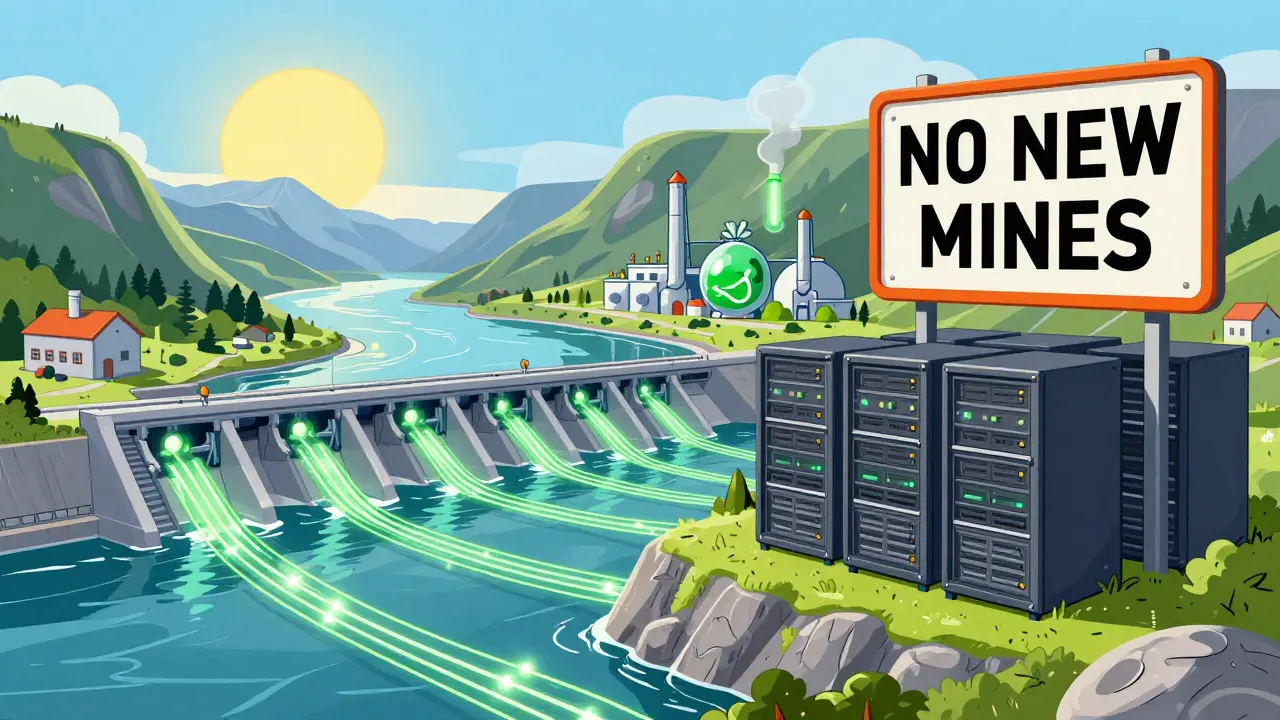
Norway's energy is renewable, but it's finite. This calculator shows how energy used by crypto mining could power local industries instead.
Norway doesn’t have a shortage of electricity. It has more than enough - thanks to hydroelectric dams that run on clean, renewable power. But now, the government says crypto mining is using too much of it - and not giving enough back. In June 2025, Norway’s Labour Party government announced plans to block new cryptocurrency mining data centers from opening, with the ban expected to take effect in autumn 2025. This isn’t about banning Bitcoin or digital assets. It’s about who gets to use the country’s power - and why.
Why Norway Is Taking Action
Norway’s energy grid is one of the greenest in the world. Over 95% of its electricity comes from hydropower. That made it a magnet for crypto miners looking for cheap, clean energy. Companies from the U.S., Russia, and China set up massive data centers in places like Tromsø and Sør-Trøndelag, drawn by low electricity prices and cool northern climates that help with cooling.
But here’s the problem: those data centers eat electricity like a furnace in winter. One large mining operation can use as much power as a small town. And while miners pay for their electricity, they don’t create many local jobs. No factories. No engineers. No teachers. Just servers humming 24/7, sending profits overseas.
The Norwegian government looked at the numbers and asked: Why use our renewable energy to support a global industry that gives almost nothing back to our communities? Instead, they want that power going to industries that build real value - like aluminum smelting, green hydrogen production, or data centers for healthcare and education.
What the Ban Actually Does
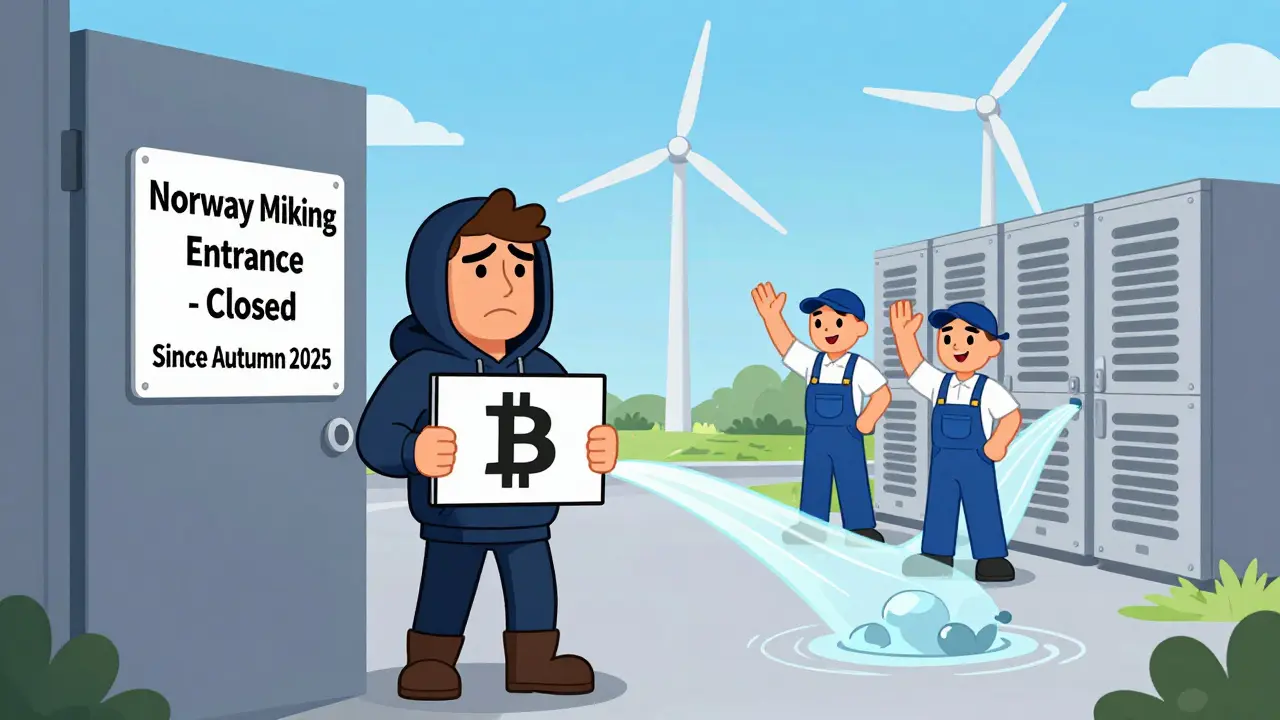
This isn’t a full shutdown. Existing crypto mining operations can keep running. The ban only stops new ones from being built. That’s a key difference. The government isn’t trying to kick out miners already there. It’s just saying: no more.
Why? Because they want time to figure out how big the problem really is. In early 2025, Norway introduced a new rule: all data centers, including crypto mines, must register with authorities. That gave officials a clearer picture of how much power was being used, where, and by whom. Now, with that data in hand, they’re acting.
The ban is temporary - at least for now. Officials say it could be reviewed in a year or two. If mining tech gets much more efficient, or if the economy changes, the rules could change too. But for the moment, the message is clear: Norway’s energy is too valuable to waste on something that doesn’t help Norwegians directly.
How This Compares to Other Countries
Norway isn’t the first country to crack down on crypto mining. China banned it outright in 2021, forcing thousands of miners to flee. Russia banned mining in 10 regions in January 2025 after blackouts hit. Kosovo shut it down in 2022 when the national grid collapsed under demand. New York State imposed a two-year moratorium on mining powered by fossil fuels.
But Norway’s approach is different. It’s not about climate guilt or carbon emissions. It’s about opportunity cost. Even though Norway’s energy is clean, it’s still finite. Every kilowatt used for mining is one less kilowatt for a hospital, a school, or a factory that employs people.
Other countries with lots of renewable power - like Iceland and Canada - are watching closely. If Norway’s ban works, they might follow. That’s why industry analysts say this could be a turning point. For the first time, a country with perfect conditions for mining is choosing not to play the game.
What This Means for Miners
If you’re a crypto miner operating in Norway right now, you’re not in danger. Your lights stay on. But if you were planning to expand, build a new facility, or move your operation here - you’re out of luck. The door is closed.
Some miners argue that their presence helps fund renewable energy projects. They say they buy up surplus power that would otherwise go to waste. But Norway’s government says that’s not enough. The country doesn’t need more energy infrastructure. It needs better use of what it already has.
Miners who want to keep going will have to look elsewhere. Kazakhstan, the U.S. (especially Texas), and Georgia are still open. But even those places are starting to tighten rules. The era of free-for-all crypto mining in cheap energy havens may be ending.
What This Means for Bitcoin and Crypto
Bitcoin mining is global. It’s not tied to one country. When one place shuts down, miners just move. So Norway’s ban won’t crash the Bitcoin network. The hash rate will adjust. Mining will continue - just not here.
But this ban does send a signal. It shows that governments are no longer willing to accept crypto mining as a neutral, harmless activity. Even when it’s green, it’s still being judged by its economic return - not just its energy source.
This could lead to more pressure on miners to prove they’re adding value. Maybe future regulations will require miners to partner with local businesses, hire local workers, or reinvest profits into community projects. That’s the direction things are heading.

What’s Next for Norway
The government isn’t done. After the ban takes effect, they’ll keep monitoring energy use. They’ll track how much power is saved. They’ll see if local industries benefit. And they’ll decide whether to make the ban permanent.
One thing is certain: Norway’s decision breaks the myth that renewable energy = free pass for crypto mining. Clean power doesn’t mean unlimited power. And when a country has limited resources - even if they’re clean - it has to choose who benefits most.
For now, Norway is saying: Let’s use our energy to build a future that lasts - not just to mine digital coins that vanish into global markets.
What This Means for You
If you’re a crypto investor, this won’t change your portfolio. Bitcoin still works. Ethereum still runs. But if you’re thinking about mining yourself, think again. The low-hanging fruit is gone. The days of setting up a rig in a cheap energy country and walking away rich are fading fast.
Governments are catching up. Regulations are tightening. The real winners won’t be the biggest miners - they’ll be the ones who adapt, who build real businesses, and who prove their value beyond just electricity bills.
Norway didn’t ban crypto. It just said: don’t use our power for something that doesn’t help us.
Is cryptocurrency mining illegal in Norway?
No, cryptocurrency mining is not illegal in Norway. The government is only banning new mining data centers from being built. Existing operations are still allowed to run. You can still own, trade, and mine Bitcoin legally - you just can’t open a new large-scale mining facility after the ban takes effect.
Why is Norway banning crypto mining if it uses renewable energy?
Even though Norway’s electricity is mostly renewable, the government says mining uses too much power for too little local benefit. A mining center doesn’t create jobs, pay local taxes, or support community services. That same electricity could power aluminum plants, green hydrogen projects, or hospitals - all of which create real economic value for Norwegians.
Does the ban apply to small-scale miners or home setups?
The ban targets large-scale data centers, not individual miners. If you’re running a few rigs in your garage, you’re not affected. The government’s focus is on industrial-level operations that consume megawatts of power - the kind that can rival small towns in energy use.
When will the ban start?
The ban was announced for autumn 2025. As of December 2025, it has likely been enacted. The exact date hasn’t been publicly confirmed, but government officials have stated the rules are in place or will be enforced immediately following the autumn deadline.
Can existing mining operations be shut down later?
Yes. While the current ban only stops new mines, the government has not ruled out future restrictions on existing ones. If energy demand rises, or if mining operations are found to be using more power than reported, authorities can use the Planning and Building Act to limit or shut them down. Registration requirements make it easier to track and enforce these rules.
What happens to miners who were planning to move to Norway?
They’ll need to find another location. Countries like the U.S. (especially Texas and Washington), Georgia, Kazakhstan, and Canada are still welcoming large mining operations. But even there, regulations are getting stricter. Norway’s move signals a global shift: clean energy doesn’t mean open season for crypto mining anymore.
Is Norway’s decision part of a larger trend in Europe?
Yes. The European Union is tightening rules on energy use across all sectors. While no other EU country has banned mining yet, countries like Sweden and Finland are closely watching Norway. The EU’s broader goal is to prioritize energy for critical infrastructure, manufacturing, and climate goals - not speculative digital industries with little local impact.
Does Norway still allow cryptocurrency trading?
Absolutely. Norway allows people to buy, sell, and hold Bitcoin and other cryptocurrencies. Exchanges must follow anti-money laundering rules, and capital gains are taxed. The ban only affects mining - not ownership, trading, or using crypto as an asset.
So they’re not banning crypto, just the power-hungry factories that don’t hire anyone. Makes sense. Why waste clean energy on digital ghosts when you could power real industry?
I love how Norway’s thinking here. It’s not anti-crypto, it’s pro-people. You’ve got all this renewable power, sure, but it’s not infinite. If a data center is just sucking up electricity and shipping profits abroad while giving zero jobs or tax revenue back, then yeah, prioritize hospitals, green hydrogen, smelting plants-things that actually build a future. This isn’t Luddism, it’s pragmatism. Other countries are gonna have to face this soon too. Renewable doesn’t mean free. It means valuable. And value should go where it matters most.
THIS IS THE BEGINNING OF THE GREAT ENERGY TAKEOVER!! THEY’RE USING CRYPTO AS AN EXCUSE TO CONTROL THE FLOW OF DIGITAL WEALTH!! YOU THINK THEY WANT TO POWER HOSPITALS? NO!! THEY WANT TO STEER EVERYTHING INTO STATE-CONTROLLED GREEN ENERGY MONOPOLIES AND THEN TAX YOU FOR IT!! THE MINERS ARE THE ONLY ONES STANDING BETWEEN YOU AND A DIGITAL FEUDAL SYSTEM!! THEY’RE COMING FOR YOUR RIGS NEXT!!
Good for Norway. Honestly, this is the kind of leadership we need. Not every tech trend deserves a free pass just because it’s ‘innovative.’ If your business model doesn’t lift up your community, you shouldn’t get to suck up the public’s resources. Keep the lights on for real people, not just offshore wallets. This is how you build resilience.
Small-scale miners are fine-this is only about industrial-scale operations. If you’re running a couple of rigs in your garage, you’re not the problem. The issue is when one facility uses as much power as a town. Norway’s just asking: who benefits? And the answer’s not ‘a bunch of anonymous crypto investors.’
I’ve lived in Iceland. We had the same thing happen. Miners came in, prices went up, locals got priced out. They didn’t even pay extra taxes. Just took the power, left. Norway’s being smarter than most. This isn’t anti-tech-it’s anti-exploitation. Clean energy isn’t a free buffet.
There’s a deeper question here: what does it mean to ‘use’ energy? Is energy just a commodity to be bought and sold, or is it a public good tied to collective well-being? Norway’s saying: if you’re not contributing to the social fabric, you don’t get priority access. That’s a philosophical shift. We’ve treated energy like water from a tap-always there, always cheap. But when you realize it’s finite, even if renewable, you start asking: who gets to drink first?
They’re just jealous because they can’t mine crypto themselves. It’s all about control. The elites don’t want regular people getting rich off tech. This is the new socialism-stealing your digital dreams under the guise of ‘saving energy.’
Existing mines stay open. New ones blocked. Registration required. No ban on trading or holding. Simple. Clear. Effective. Norway’s not panicking. They’re adjusting.
This is the future. Not every innovation deserves space. If your thing doesn’t create jobs, pay taxes, or improve lives-it’s a parasite. Norway’s choosing to be a host, not a buffet.
Let me tell you something-this is the kind of bold move that changes the game. Most countries are too scared to say no to tech money. But Norway? They looked at the numbers, saw the imbalance, and said ‘nope.’ You don’t need to be anti-crypto to be pro-community. This isn’t about stopping progress-it’s about making sure progress serves people, not just algorithms and offshore accounts. Imagine if every country with clean energy did this. The whole mining industry would have to evolve. Maybe we’d see miners partnering with schools, funding local grids, hiring engineers. That’s the future I want. Not just more servers, more profits, more nothing.
Western nations always act like they own the world’s resources. Norway has power? Good. But why should they decide who gets to use it? Africa has the minerals, Asia has the labor, and now Europe decides who can mine? This is neocolonialism dressed up as environmentalism. Let the market decide-not a government that thinks it knows better.
They’re lying!! They’re not banning mining-they’re hiding the truth!! The real reason? The banks and central banks are terrified that crypto is exposing their fraud!! Norway’s government is a puppet of the IMF!! They’re shutting down mining to force everyone back into fiat slavery!! And they’ll use ‘energy conservation’ as the excuse!! YOU THINK THIS IS ABOUT HOSPITALS?? NO!! IT’S ABOUT CONTROL!! THE SERVERS ARE WATCHING YOU!!
I get why Norway’s doing this. But I also feel bad for the miners who invested based on existing rules. They should’ve been grandfathered in longer, or given a transition plan. It’s not wrong to protect national interests-but fairness matters too.
So the takeaway is: clean energy doesn't mean free energy. Norway's saying: we've got the juice, but we're not gonna let it be used for something that doesn't help us. Makes sense. If you're mining just to flip coins, go somewhere else. But if you're using that power to make real stuff-like green hydrogen or aluminum-that's the kind of tech we should be backing. This isn't anti-crypto. It's pro-value.